
- Read the advert for the competencies
- Not the duties — the competencies. VA: “make note of the competencies listed — they’ll likely guide the interview questions.”
- Find an example for each
- From “past jobs, volunteer work, military service, or other experiences”. Include ones “where you learned something valuable from a challenge”, not only wins.
- Write them out and say them aloud
- “Write out a few examples in the STAR format and rehearse your delivery. Practicing out loud helps you feel confident and articulate in the moment.”
- Then the logistics
- Video: test connection, audio and video; quiet, well-lit space. In person: plan the route and arrive early. Either way, dress professionally.
Work · guide
How to prepare for an interview that is being scored
By Alberto Gulotta · Updated · 8 min read
Advice on how to prepare for an interview arrives in numbered lists — eleven steps, fifteen things, thirty tips — and nearly all of it assumes the interview is a conversation you need to go well. For a great many jobs, and for essentially every large employer and public body, that is not what it is.
What you are actually walking into
US Office of Personnel Management, the federal government’s own definition — read 22 August 2026- “An assessment method designed to measure job-related competencies… by systematically inquiring about their behavior in past experiences and/or their proposed behavior in hypothetical situations.”
- “All candidates are asked the same predetermined questions in the same order.”
- “All responses are evaluated using the same rating scale and standards for acceptable answers.”
Read those two bullets again, because between them they replace most of the advice on this subject. The questions are written before you arrive. Your answers are scored against a standard. Preparing for a conversation and preparing to be scored are different activities, and the second one is far more tractable.
That changes what preparation means. If the questions are drawn from a list of competencies, then the list is the syllabus — and in most cases it has been published, in the advertisement, before anybody applied. The single highest-value hour you can spend is not rehearsing charm. It is going through that list and finding one specific example for each item on it.
A US federal employer sets out the same method from the candidate’s side, and it is short enough to do properly.
- You are allowed to pause
- “Take a moment to think before responding. Ask for clarification if necessary.” That is the employer saying it, not a coach.
- Say “I”, not “we”
- “Use first-person (‘I’) statements to clarify your role in the situation.” A story told in “we” tells them nothing about you.
- Failures are allowed
- “Be truthful, even when discussing failures — what matters is what you learned or how you improved.”
- Go past the technical
- Reflect on “how your actions impacted others, how you managed emotions, resolved conflict, or showed empathy”.
Three of those deserve pulling out, because they contradict the obvious approach to interviews.
The first is the pause. Candidates rush because silence feels like failure, and rushing is how a good example comes out backwards. An employer telling you in writing to take a moment, and to ask for clarification, is permission worth carrying into the room.
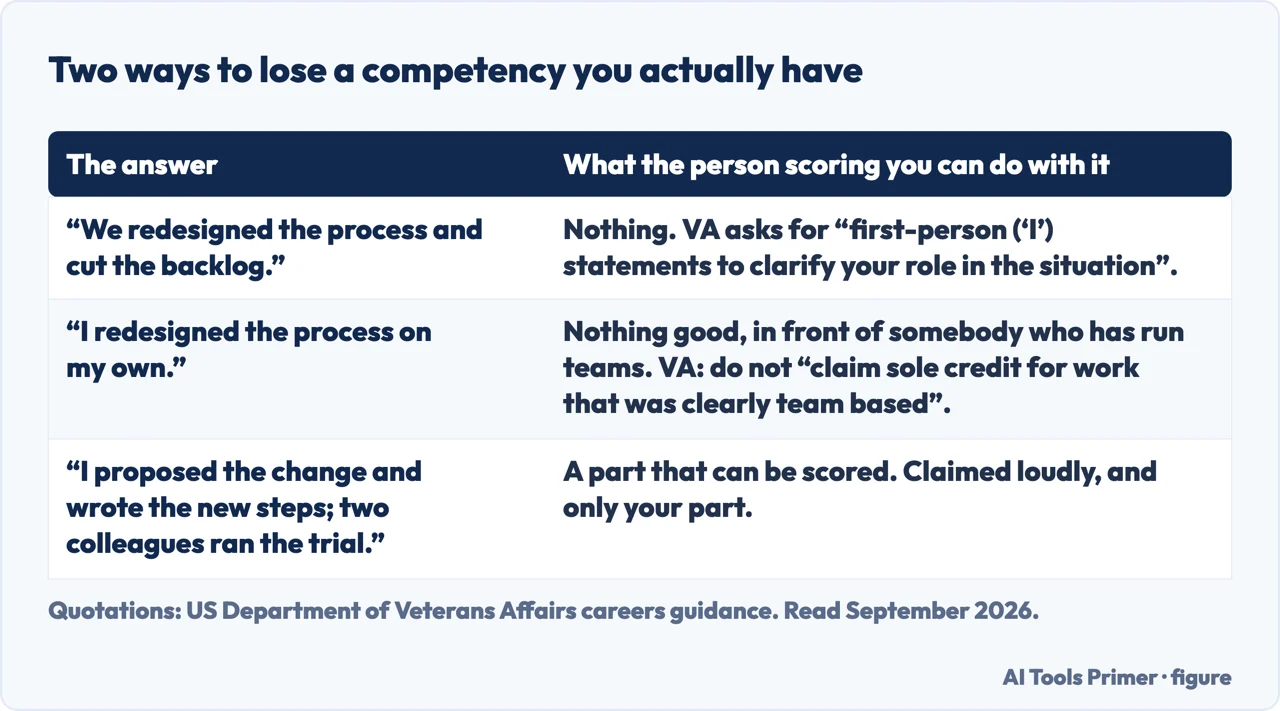
The second is “I” rather than “we”. It feels graceless and it is the entire point — the interviewer is scoring you, and a story told in the first person plural gives them nothing to score. This is also the commonest reason a strong candidate rates poorly on a competency they genuinely have.
The third is that failures are permitted, and specifically that “what matters is what you learned or how you improved.” The prepared answer to “tell me about something that went wrong” is not a disguised success. It is a real difficulty with a real ending.
Which leads to the pair of sentences that is the best advice on that entire page, and possibly on this entire subject.
“Be honest but not modest; this is your chance to brag about your skills and accomplishments…”
“Teamwork is very commonplace, and most successes are not achieved alone in the modern workplace. Do not flagrantly exaggerate your contributions or claim sole credit for work that was clearly team based.”
Both sentences are from the same page, one after the other, and together they are the most useful thing on it. Claim your part loudly and claim only your part. The failure mode on each side is real: the modest candidate who says “we” all the way through and is scored on nothing, and the one who takes sole credit for a team project in front of somebody who has run teams and knows better.
One practical note about the examples themselves. VA is explicit that they need not come from paid work — “past jobs, volunteer work, military service, or other experiences” — which matters enormously to anyone returning to work, changing field, or starting out. A competency demonstrated while running a committee or a unit is a competency demonstrated.
And prepare questions of your own. Coming with none is itself an answer, and it is not the one you want on the sheet.
The guides below take it four ways: the preparation itself, the answers and how they are shaped, the specific questions that come up most, and what happens once it is over.
Where to start
Four ways in.
- “It is tomorrow morning.”
- Start at the preparation
- “How should an answer be shaped?”
- Go to shaping the answers
- “What will they actually ask?”
- That is the questions
- “It is over.”
- That is afterwards
The preparation
The hour before the hour. Most of it is reading the advertisement properly and finding one example per competency, which is more useful than any amount of rehearsing.
Shaping the answers
A scored answer has a shape. These guides cover the framework, its length discipline, and the two words that decide whether you are credited with anything.
The questions
The handful that come up almost everywhere, each with a guide of its own explaining what it is really testing.
Common interview questionsThe ones that recur, and what each is written to measure.Open this guide →
Tell me about yourselfNot a STAR question, and treating it as one is the usual mistake.Open this guide →
What are your weaknessesThe question most often fumbled, and the shape of an answer that works.Open this guide →
Why should we hire youPrepared least, asked most.Open this guide →
Afterwards
It ends and there is still something to do — including, on one of these guides, the only sanctioned chance to improve an answer that came out wrong.
The thank-you emailTwo careers offices on what it is for, and the twenty-four hours it lives in.Open this guide →
Negotiating the offerThe conversation all of this was leading to.Open this guide →
Handing in your noticeThree lines and a date, and whether the notice is required at all.Open this guide →
Not covered here. It will not give you eleven steps. The government that publishes its own interview method describes three things to do beforehand, and the first is reading the advertisement properly.
It will not tell you to perform. Structured interviews are scored against written standards precisely so that performance matters less than substance.
And it will not script your answers. Every example has to be yours, which is the one part of this that nobody can do for you. What holds instead is simple: the definition of a structured interview is quoted from the US Office of Personnel Management and the preparation guidance from a US federal employer.
Step 10 of 24 in the job search
The order this is meant to be read in, from writing the CV to handing in notice.
- Before this
- What shows up on a background check, and what you are owed
- After this
- Star interview method: what employers say it is for
Sources
- US Office of Personnel Management — Structured Interviews (the definition, that all candidates are asked the same predetermined questions in the same order, and that all responses are evaluated using the same rating scale and standards) — www.opm.gov, read 22 August 2026.
- VA Careers (US Department of Veterans Affairs) — The interview process (the before-and-during guidance, the instruction to note the competencies in the announcement, the permission to pause and ask for clarification, the first-person rule, and the balance between claiming your part and claiming only your part) — vacareers.va.gov, read 22 August 2026.
Written by Alberto Gulotta
Founder and editor of AI Tools Primer, writing from Palermo, Italy. Thirty-five years of taking computers apart, starting with a Commodore 64 — the long version is on the about page.
Something wrong on this page? Write to aitoolsprimer@gmail.com and it gets fixed.
Written on 22 August 2026 · last checked 23 September 2026.
Independence and limits
No affiliate links and no paid placements anywhere on this site. Nobody pays to appear here, and no company has seen this page before you did.
This is general information, not professional advice. Where a page touches money, health, safety or the law, it names its source and the date it was read — and your situation may still differ. See the privacy page and the cookie policy.