
Work · guide
What shows up on a background check, and what you are owed
By Alberto Gulotta · Updated · 8 min read
The interesting half of what shows up on a background check is not the list. The list is five items long and published by the Federal Trade Commission. The half worth reading is what the employer has to do around it — before they order the report, and again before they use it against you.
What employers might check, in the FTC’s own list
Five headings. Four are the ones you would list yourself; the fifth is the reason to read the list.
- Employment history
- Education
- Criminal or other public records
- Financial or credit history
- Public social media activities
Four of those are the expected ones. The fifth is public social media activities, named by a federal agency in the same breath as employment history and criminal records. The word doing the work is public: this is not a claim about private accounts or messages, it is the observation that what is open to everybody is open to an employer too — which is the argument for setting a Facebook profile to private, or for locking it in one move where that option is offered.
“Employers must get your written permission before running a background check with a background reporting company. You have the right to say no, but if you do, you may not get the job.”
That is the Federal Trade Commission, and the second sentence is why the first one matters less than it sounds. The permission is real and so is the refusal, but so is the consequence, and the FTC declines to pretend otherwise. What the rule buys you is not a veto — it is knowledge that it is happening, in a form you can keep.
There is one detail in the permission rule that is more useful than the permission itself. The employer must tell you they could use the information to make decisions about hiring, promoting or firing you — and the FTC specifies the form: “They must give you this information in writing in a standalone document.” Not a clause inside the application form: a document of its own, which is a much harder thing to sign without reading.
Then the part that matters when something goes wrong, and the FTC sets it out step by step. Before an employer decides against you because of the report, they “must give you a copy of the report and a ‘summary of rights’ that tells you about your rights under the Fair Credit Reporting Act”. Not afterwards, and not on request. Before.
If you are turned down because of the report, four things you must be told
- The name, address and phone number of the background reporting company.
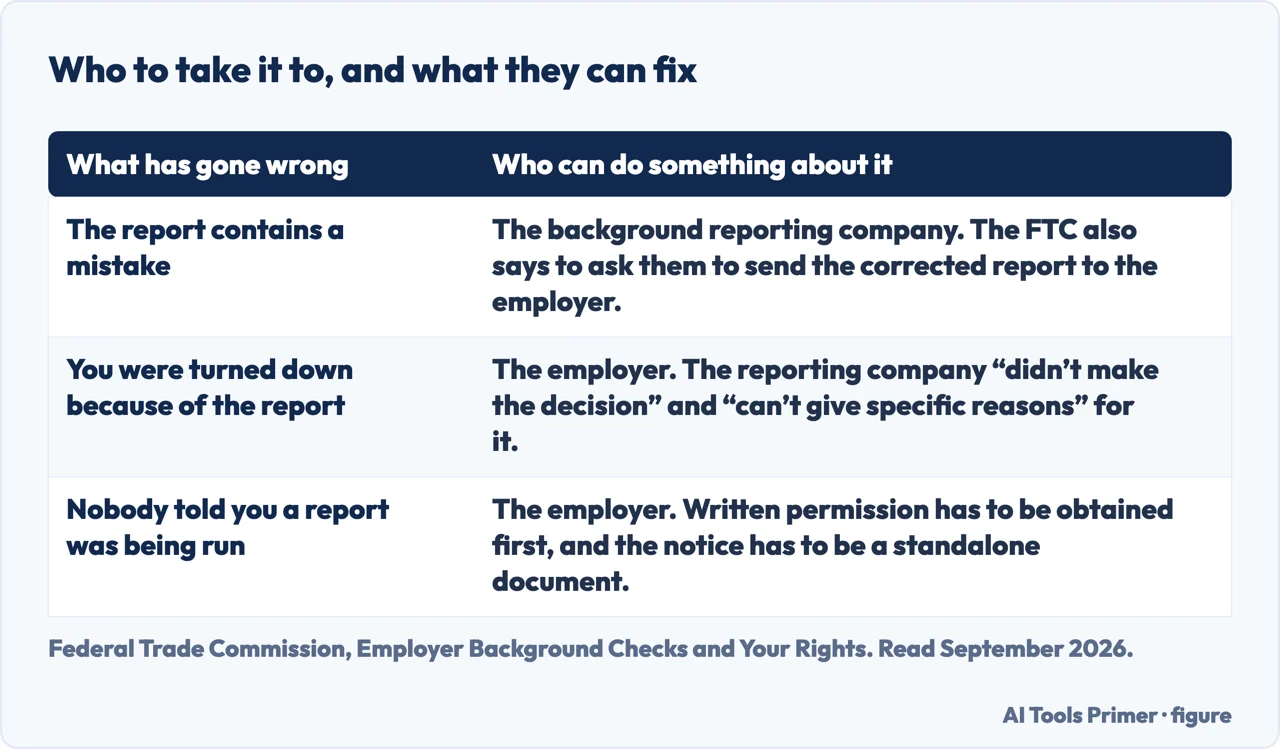
- That the reporting company “didn’t make the decision” about not hiring you, “and can’t give specific reasons for it.” Which tells you where to take a complaint and where not to.
- That you have the right to dispute anything inaccurate or incomplete, with the company rather than with the employer.
- That you have the right to an additional free report — and the deadline that comes with it: “You must ask for it within 60 days of the employer’s decision.”
The second of those four is the one to hold on to when you are angry, because it tells you the shape of the problem. The reporting company assembled the information and did not make the decision; the employer made the decision and did not assemble the information. Complaining to either about the other half is a conversation that cannot go anywhere. Errors go to the company; the hiring decision belongs to the employer, and the FTC’s wording separates them deliberately.
The fourth is the one with a clock on it, and the clock is short. Sixty days from the employer’s decision, and the extra report is free. Note where that sits in the list: being told about the deadline is itself one of the four things you are owed. If nobody mentioned it, that is not a detail you missed — it is a step that was required.
The move that belongs before any application, not after a rejection. The FTC: “Check your credit report. That way, you’ll be able to dispute any mistakes before an employer sees them.” The free route it names is AnnualCreditReport.com, or 1-877-322-8228 by telephone. Reading the report is also where somebody discovers an account they never opened, and the free defence against that is a credit freeze rather than a subscription: the published figures on identity theft protection.
And alongside it, a second check that has nothing to do with your own records: “Some cities and states have specific requirements covering what employers can ask about your credit history or possible criminal records, and when in the hiring process they can ask those questions.” The timing is part of the law, not only the content.
The FTC also gives an instruction that is easy to skip once a correction is made. If the reporting company revises your report, “review the report to make sure the mistakes are gone”, then “ask the background reporting company to send a copy of the corrected report to the employer and tell the employer about the mistake.” A corrected file helps nobody if the person who read the wrong version never learns it was wrong.
A second agency has a paragraph in this, and it is the one that matters if you decide to question a decision months after it was taken. In the guidance the FTC publishes jointly with the Equal Employment Opportunity Commission, the employer is given a retention duty: “Any personnel or employment records you make or keep (including all application forms, regardless of whether the applicant was hired, and other records related to hiring) must be preserved for one year after the records were made, or after a personnel action was taken, whichever comes later.” The rule is addressed to employers, but read from your side it is a window: for a year after a decision, the paperwork behind it is supposed to still exist.
Where these rules apply. Everything quoted on this guide is United States law — the Fair Credit Reporting Act — as set out by the Federal Trade Commission for consumers. Other countries protect this differently, sometimes more strictly, and a page written about one jurisdiction is not evidence about another.
The guides below take it four ways: the five categories, the permission and the standalone document, what happens if the report costs you the job, and the checking worth doing before you apply to anybody.
Where to start
Four ways in.
- “I have not applied yet.”
- That is before you apply
Before you apply
Everything above is easier if the mistakes were found first. Two checks, both free, both better done while nothing is at stake.
Not covered here. It will not tell you how to keep something off a report. The guides here are about what is checked, what you must be told, and how to correct what is wrong.
It will not treat the permission form as a formality. The FTC requires it to be a standalone document, and that requirement exists so it is read.
And it will not present United States law as universal. What is quoted here is the Fair Credit Reporting Act, and the guide says so rather than leaving you to assume. What holds instead is simple: the four disclosures after an adverse decision and the sixty-day window are the Federal Trade Commission’s, with the retention rule from the joint FTC and EEOC guidance.
Step 9 of 24 in the job search
The order this is meant to be read in, from writing the CV to handing in notice.
- Before this
- How to write a cover letter for an internship with nothing on your CV
- After this
- How to prepare for an interview that is being scored
Sources
- Federal Trade Commission, Consumer Advice — Employer Background Checks and Your Rights (the five categories employers might check including public social media activities, the written-permission requirement and the right to refuse, the standalone-document rule, the obligation to provide a copy of the report and a Summary of Rights before an adverse decision, the four disclosures owed if you are turned down, the sixty-day window for an additional free report, the advice to check your credit report at AnnualCreditReport.com beforehand, the note that local law affects if and when employers may ask, and the instruction to have a corrected report sent to the employer) — consumer.ftc.gov, read 22 August 2026.
- U.S. Equal Employment Opportunity Commission — Background Checks: What Employers Need to Know, published jointly with the Federal Trade Commission (the one-year retention rule for personnel and employment records, including all application forms regardless of whether the applicant was hired) — www.eeoc.gov, read 5 September 2026.
Written by Alberto Gulotta
Founder and editor of AI Tools Primer, writing from Palermo, Italy. Thirty-five years of taking computers apart, starting with a Commodore 64 — the long version is on the about page.
Something wrong on this page? Write to aitoolsprimer@gmail.com and it gets fixed.
Written on 22 August 2026 · last checked 23 September 2026.
Independence and limits
No affiliate links and no paid placements anywhere on this site. Nobody pays to appear here, and no company has seen this page before you did.
This is general information, not professional advice. Where a page touches money, health, safety or the law, it names its source and the date it was read — and your situation may still differ. See the privacy page and the cookie policy.