
Work · guide
How to write a cover letter for an internship with nothing on your CV
By Alberto Gulotta · Updated · 9 min read
The difficulty with how to write a cover letter for an internship is not the format. The format is published, freely, by several excellent university career services, and they broadly agree with each other. The difficulty is that every one of those structures asks you to do something an intern applicant cannot obviously do.
“The overall goal of a cover letter is simple: get you selected for the next round of the hiring process. Therefore, you need to make it very clear that you understand what the reviewer is looking for, and that you are a qualified match.”
MIT’s Nuclear Science and Engineering Communication Lab, read 21 August 2026. It is the cleanest statement of the job a letter does. It also contains the exact word that makes an internship application hard: qualified. You are applying precisely because you are not yet.
That word is the whole problem. The standard middle paragraph maps your experience onto the posting — but you are applying for an internship because you have not done this work before. So the honest question is not how to write the letter. It is what goes in the middle, and almost nothing published about this subject answers it directly.
What goes in the middle when you have no relevant jobs
Every structure published by a university career service asks the middle paragraphs to match your experience to the posting. For an internship that instruction has no obvious object. Here is what genuinely fills it, in rough order of how convincing each one is.
- Coursework with a resultNot the course title — what you built or found “I built X and it did Y” is evidence. “I took Advanced Y” is a transcript entry, and they already have your transcript.
- A project nobody assignedThe strongest thing an applicant without a job has Something you made because you wanted to, however small, answers the question the employer actually has: will this person do things without being told.
- Unrelated work, read for the transferable partA till, a kitchen, a call centre These demonstrate turning up, working under pressure and handling people. Say what it demonstrates rather than describing the job.
- A specific reason for this employerSomething you could not write to anybody else Name a project, a paper, a product decision. This is the paragraph that separates a real application from a template, and it costs twenty minutes of reading.
- What you want to learnLegitimate here in a way it is not in a job application An internship is a training arrangement. Saying precisely what you want to get better at is appropriate, and vagueness about it is what makes most intern letters interchangeable.
Notice what is absent: any attempt to sound experienced. The reviewer knows what an internship is. Claiming otherwise is the single most common mistake in these letters, and it is transparent from the first sentence.
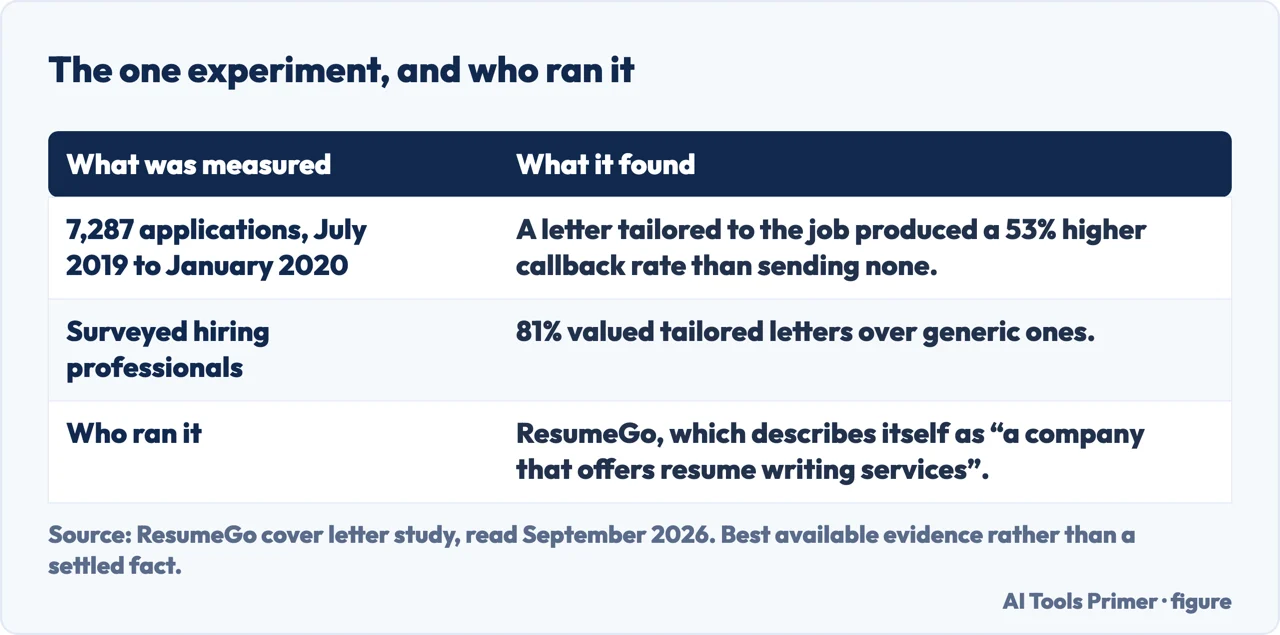
Before the mechanics, one thing that changes how much of this is worth doing. The largest field experiment anybody has published on cover letters — 7,287 applications, run between July 2019 and January 2020 — found that letters tailored to the specific job produced a 53% higher callback rate than sending none, while eighty-one per cent of the surveyed hiring professionals valued tailored letters over generic ones. The study was run by ResumeGo, which describes itself as “a company that offers resume writing services”, so read it as the best available evidence rather than a settled fact. The practical implication survives the caveat: a generic internship letter is close to worthless, and the fifth item in the list above is where the value actually sits.
The mechanics, where the career services agree
From the University of Michigan Career Center, read 21 August 2026 — the most specific published guidance of the four university pages read for this guide.
- Structure
- “3-4 paragraphs”: who you are and why you are writing, then the match, then follow-up.
- Type size
- “10 to 12 point, using the same font as your resume.”
- Margins
- “.5 to 1 inches.”
- Layout
- “Left justified, beginning no more than 2 inches from the top.”
- Voice
- “Positive language, confident but not imposing, concise with supporting detail, written in active verb voice.”
- By email
- “If applying via email, use the body of the email as your cover letter, starting with a professional salutation.” Not an attachment nobody opens.
- A referral
- If somebody referred you, Michigan puts their name “in the first sentence”, not buried at the end.
Where the career services quietly disagree, and it matters. Michigan asks for three to four paragraphs and gives a paragraph-by-paragraph brief. MIT organises the same material as four functions — state the position, explain your interest, show the qualified match, make follow-up easy — without prescribing a paragraph count. The functions are the real structure; the paragraph count is a convenience. If you have one strong project and one strong reason, three paragraphs will beat four padded ones.
MIT also says something the more encouraging pages leave out, and it is worth carrying: “For some positions, a cover letter may be a formality; for others, it will be used to gauge how you’ll fit in.” You usually cannot tell which you are facing. That argues for writing one good letter rather than four quick ones, and for accepting that some of the effort lands on a document treated as a formality.
The length question, since the search results raise it. One page, and for an internship usually less. A letter longer than the CV it introduces has misunderstood its own job — and an intern CV is short by definition, which is the constraint rather than a problem.
What not to do, specifically. Do not open by naming the position and the source in a sentence that could be pasted into any application; the reviewer has read a hundred of those this week. Do not describe enthusiasm — demonstrate it by knowing something about the organisation. Do not apologise for inexperience, which draws attention to the thing the reader had already accepted. And do not send a letter generated from the job title alone: the evidence above says the generic letter is the one that does not work, and a model given nothing specific will produce exactly that.
One practical note that costs nothing and is missed constantly. If you are applying by email, the letter is the email. Michigan states it plainly — use the body, with a proper salutation — because a letter attached to an empty message is a letter nobody has a reason to open.
Everything quoted on this page comes from a university career service or from a named study with its date and its commercial interest stated. That is a lower bar than it sounds: most of the pages answering this question are attached to a product that writes the letter for you.
Where to start
Four ways in.
- “I do not know if I need one at all.”
- Start at whether to write one
- “Can AI write it for me?”
- Read using ai on it
- “What about the CV underneath it?”
- Go to the document itself
Whether to write one
Most of this question is settled by the posting rather than by any advice. Three cases, and only one of them is a decision.
Using AI on it
The fastest route to the generic letter the evidence says does not work — and the narrower use where the tools genuinely help.
The document itself
A letter introduces a CV. If the CV underneath it cannot be read by the software that sees it first, the letter never gets a reader.
Not covered here. It will not give you a letter to copy. The one finding everybody agrees on is that the generic letter is the one that does not work, so a template here would be actively counterproductive.
It will not tell you to sound experienced. The reviewer knows what an internship is, and the attempt is visible from the first line.
And it will not sell you a cover letter builder, which is what several guides on this question are ultimately for. What holds instead is simple: the structure and mechanics are quoted from two university career services, with the experiment carrying its dates and the disclosed interest of the company behind it.
Step 8 of 24 in the job search
The order this is meant to be read in, from writing the CV to handing in notice.
- Before this
- How to write a cover letter, which is not a CV in prose
- After this
- What shows up on a background check, and what you are owed
Sources
- MIT Nuclear Science and Engineering Communication Lab — Cover letter for a job or internship position, on the goal of a letter, its key elements, and when it is a formality — mitcommlab.mit.edu, read 21 August 2026.
- University of Michigan Career Center — Cover Letter Resources, on paragraph structure, type size, margins, layout, voice and applying by email — careercenter.umich.edu, read 21 August 2026.
- ResumeGo — Cover Letters: Just How Important Are They?, a field experiment of 7,287 applications with a survey of 236 hiring professionals, published by a company that states it offers resume writing services — www.resumego.net, read 21 August 2026.
Written by Alberto Gulotta
Founder and editor of AI Tools Primer, writing from Palermo, Italy. Thirty-five years of taking computers apart, starting with a Commodore 64 — the long version is on the about page.
Something wrong on this page? Write to aitoolsprimer@gmail.com and it gets fixed.
Written on 21 August 2026 · last checked 23 September 2026.
Independence and limits
No affiliate links and no paid placements anywhere on this site. Nobody pays to appear here, and no company has seen this page before you did.
This is general information, not professional advice. Where a page touches money, health, safety or the law, it names its source and the date it was read — and your situation may still differ. See the privacy page and the cookie policy.