
Work · guide
What to put on a resume, and what to leave off it
By Alberto Gulotta · Updated · 9 min read
Most answers to what to put on a resume are somebody’s preference presented as a standard. There is a better source, and it is a strange one to find on this subject: an employer publishing instructions to its own applicants, in public, with a list of what not to send.
What to put in
USAJOBS, read 21 August 2026
- Contact details at the top: full name, email address, phone number
- For each relevant role: employer name, job title, start and end dates including the month and year
- The number of hours you worked per week — unusual on private-sector résumés and genuinely useful
- Descriptions showing you can do the tasks in the advert, “at the required level”
- Education where the posting requires it: institution, completion date, degree type, and grade point average
What to leave out
The same page, quoted directly
- Your Social Security Number
- Photos of yourself
- “Personal information, such as age, sex, religious affiliation”
- Classified or government sensitive information
- Encrypted and digitally signed documents
Two of those entries are worth pausing on. The hours per week is unusual outside government applications and it is quietly useful anywhere: it distinguishes two years full time from two years of Saturdays, and a reader who cannot tell will assume the less impressive one. And the instruction about dates is specific — “include the month and year” — because a year alone reads as a gap being smoothed over, which is the opposite of what you intended.
The harder question is not which sections exist but what goes inside them, and the same source gives a formula for that too.
“Accomplished [X] as measured by [Y], by doing [Z].”
The sentence pattern the United States federal government gives its own applicants for describing work. It is worth more than most of the advice written about résumés because it forces the two things people leave out: a result, and how it was measured. Responsible for social media has neither. Grew the newsletter from four hundred to nine hundred subscribers by publishing weekly instead of monthly has both.
Two or three bullets in that shape under each recent role does more than any amount of adjective. The federal guidance adds the discipline that makes them land: “Use concise, results-focused language. Use numbers, percentages, dollars or descriptions to highlight your accomplishments” — and crucially, “focus on the work experience that is most relevant to the job you’re applying for”, with the instruction to “remove or deprioritize outdated or unrelated work experience”.
Why that leave-out list exists, in the country that publishes it. Age, sex and religion are on it because a hiring decision influenced by them is unlawful — and because it happens anyway. The US Equal Employment Opportunity Commission, which enforces that law, reports in its own study that “6 out of 10 older workers have seen or experienced age discrimination in the workplace and 90 percent of those say it is common”.
So the instruction is not etiquette. Every one of those items gives a reader something they are not supposed to weigh, and once it is on the page nobody can prove it was not weighed. That is also why a photograph is on the list — and why copying a European CV template, where photographs are still normal in several countries, is a genuine mistake on an American application rather than a stylistic one.
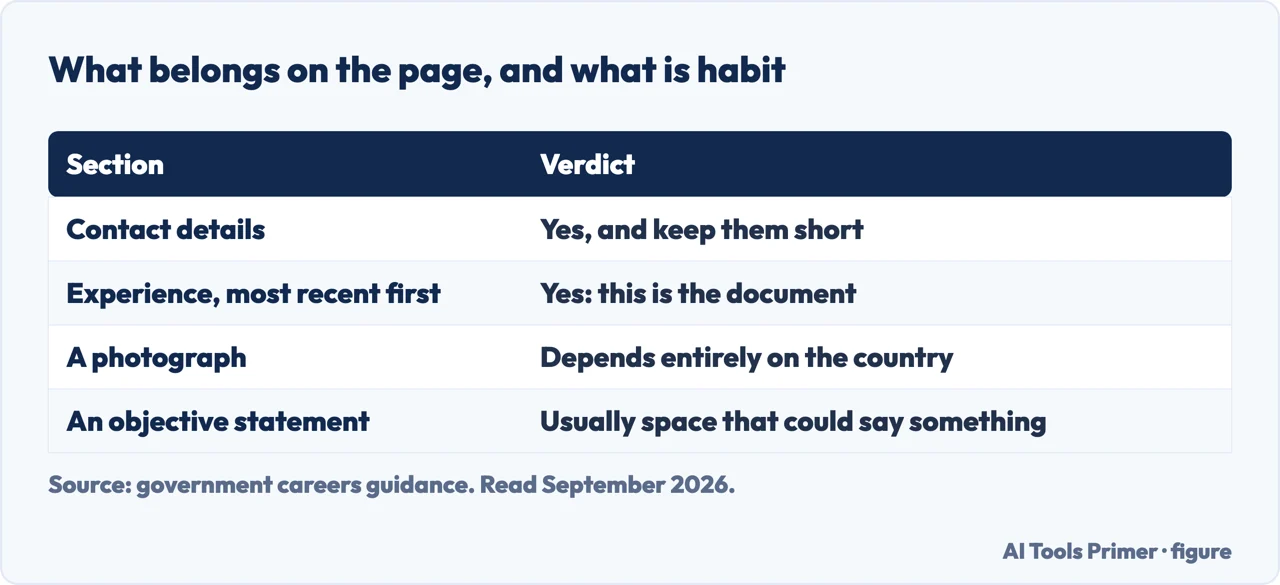
The sections that survive out of habit rather than use. An objective statement describing what you want, which uses the most valuable space on the page to talk about yourself rather than about the job. “References available on request”, which has been assumed for decades. A full postal address, where a city is sufficient and the rest is data you have handed over for no return. And a skills list of qualities nobody can check — that one has its own guide in this section, because a list of qualities is the easiest thing on a résumé to write and the hardest to check.
A summary at the top, on the other hand, usually earns its place — provided it is about the match rather than about your ambitions. Three lines saying what you do, the strongest evidence you have that you do it, and what you are moving towards. That is the part a reader uses to decide whether to read the rest, and it is the one place on the document where writing well pays immediately.
Order. Contact details, then a short summary if you use one, then work experience in reverse chronological order, then education, then anything checkable — certifications, languages, tools named in the advert. Education moves above experience only while it is the strongest thing you have, which is true while it is true, and stops being true once there is work to put above it.
One caveat about the source, stated plainly because the page is built on it. USAJOBS is a US federal application system, and some of its rules are specific to that context — the two-page limit, the series and grade for federal roles, the grade point average requirement. The parts quoted above are the ones that transfer: what belongs in a work entry, the sentence pattern for describing it, and the list of what not to include. Where a rule is federal rather than general, this guide says so, and the guide on résumé length covers the limits that are not.
The rest of this page — the sections to drop, the case for a summary, the ordering — is our judgement rather than anybody’s published rule, and it is marked here rather than presented as received wisdom. The two things that are quoted are quoted with the date they were read.
Where to start
Four ways in.
- “I do not know what to write under each job.”
- The formula above, then writing the entries
- “How much of this fits on the page?”
- That is length and history
- “Will software read my sections?”
- Go to how it is read first
- “What about the letter that goes with it?”
- See the letter
Writing the entries
Sections are the easy part. What goes inside them is where a document stops being a list of jobs and starts being an argument.
Length and history
How much fits and how far back it reaches. One of these has an enforced answer for one kind of employer, and the other has a documented reason behind the convention.
How it is read first
Software reads the sections before a person does, and it reads text rather than layout. What survives that pass decides what gets a reader at all.
The letter
What the résumé cannot carry is what the letter is for — which is also the test for whether you need one.
Not covered here. It will not give you a template. The include list above is short enough to work from directly, and a template is where the sections nobody needs come back in.
It will not tell you a photograph is a style choice. An employer publishes it as something not to send, and the commission that enforces the law publishes why.
And it will not sell you a résumé builder, which is what two widely read guides on this question are for. What holds instead is simple: the include and leave-out lists are quoted from a United States government application system, and the parts that are our judgement are marked in the text.
Step 2 of 24 in the job search
The order this is meant to be read in, from writing the CV to handing in notice.
- Before this
- ATS friendly resume template: what that actually means
- After this
- What are good skills to put on a resume, and which ones count
Sources
- USAJOBS Help Center — How do I write a resume for a federal job?, including what to include, what to leave out, and the accomplishment sentence pattern — help.usajobs.gov, read 21 August 2026.
- US Equal Employment Opportunity Commission — The State of Age Discrimination and Older Workers in the U.S. 50 Years After the Age Discrimination in Employment Act — www.eeoc.gov, read 21 August 2026.
Written by Alberto Gulotta
Founder and editor of AI Tools Primer, writing from Palermo, Italy. Thirty-five years of taking computers apart, starting with a Commodore 64 — the long version is on the about page.
Something wrong on this page? Write to aitoolsprimer@gmail.com and it gets fixed.
Written on 21 August 2026 · last checked 23 September 2026.
Independence and limits
No affiliate links and no paid placements anywhere on this site. Nobody pays to appear here, and no company has seen this page before you did.
This is general information, not professional advice. Where a page touches money, health, safety or the law, it names its source and the date it was read — and your situation may still differ. See the privacy page and the cookie policy.