
Work · guide
Why do you want to work here, and what they are checking
By Alberto Gulotta · Updated · 9 min read
The trap in why do you want to work here is that it sounds like a question about your feelings, so people answer it with feelings. Enthusiasm, admiration, a sentence about culture. All of it sincere, none of it usable — because the interviewer cannot tell the difference between a candidate who feels those things and one who has learned to say them.
“Employers want to see that you have a genuine interest in working for them… To prepare for questions about the employer, you need to research the company. You should look at their website and ‘about us’ pages to find out more about their products, services and values.”
The United Kingdom’s National Careers Service, read 21 August 2026, filing this question under about the employer. The word doing the work is genuine. The question is not testing whether you can praise them — it is testing whether you looked.
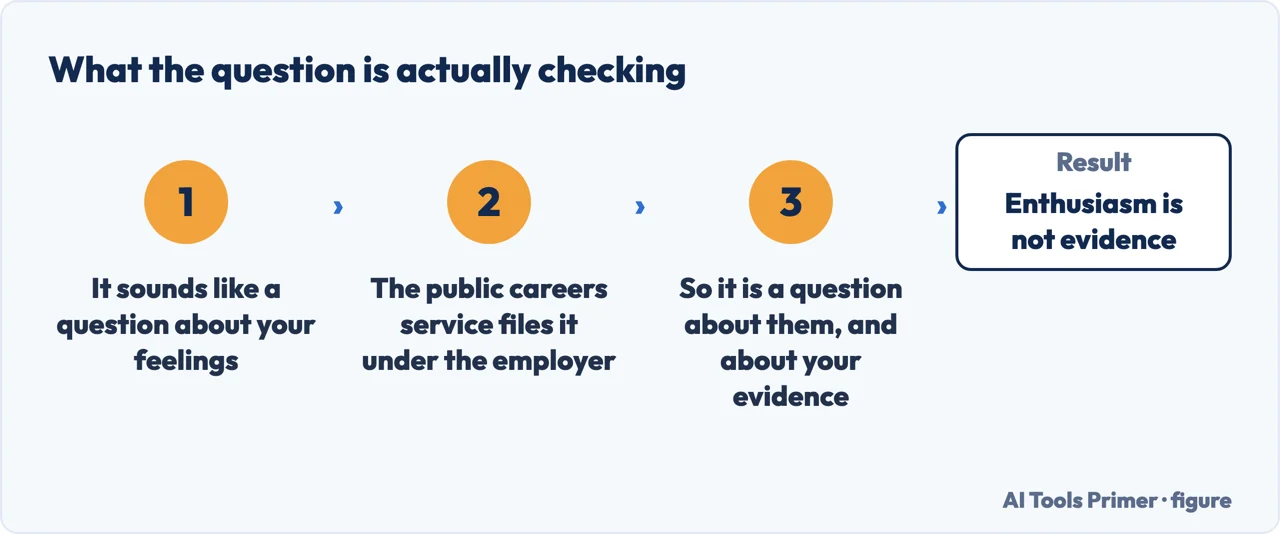
That single word reframes the task. You are being asked to produce evidence of attention, and attention leaves traces that enthusiasm does not. Which is why the same answer can be excellent or worthless depending on one property: whether anybody else could have given it.
Three depths of answer, and only one of them lands
The difference between them is not enthusiasm. It is how much of the answer could be given by somebody who had never heard of the company until this morning.
- Anybody could say it You’re a leader in the industry and I’d learn a lot here. True of thousands of employers, therefore evidence of nothing. This is where most answers stop, and interviewers hear it several times a day.
- You read the website I saw you’ve moved into the European market this year. Better, and it proves you looked — but it is on the front page, so it proves only that. It also invites the follow-up question you may not be ready for.
- You connect their thing to your thing Your move into Europe means the support side has to work in four languages at once. I spent two years doing exactly that at a smaller scale, and it’s the part of the job I want more of. This one cannot be given by anybody else in the queue, because half of it is yours.
The careers service adds the instruction that makes the third level possible rather than lucky: “Show what you’ve learned about the company throughout the interview.” Not in one rehearsed paragraph — spread across the hour, wherever it fits naturally.
Where to find the material. The careers service names the obvious places — the website, the about pages, the products and the values — and they are the right starting point. Beyond them, four sources are usually more productive and almost nobody uses them: the job advert itself, which tells you what problem this hire exists to solve; recent news or announcements, which tell you what changed; the public profiles of people already doing the job, which tell you what it actually involves; and, if the organisation makes something you can use, the thing itself. Having used the product is the single most convincing fact available to a candidate, and it is free.
What not to say, and why. Not the salary, the benefits or the commute — all legitimate reasons to want a job, none of them answers to this question, which is about the employer rather than the terms. Not a compliment you could pay to a competitor. Not a fact recited from the homepage with nothing attached to it. And not a claim about their culture unless you have a specific reason to believe it, because the person opposite works there and knows.
What if the honest answer is that you need a job? That is a real answer, and it does not disqualify you. The question does not ask why you are job-hunting; it asks why this one, out of the ones you could apply to. There is nearly always a real answer to that narrower question — the work is closer to what you are good at, the place is smaller, the industry is one you understand — and a modest true reason outperforms an inflated one every time.
Who actually wrote the university pages on these questions
Checked on 21 August 2026, by opening each page and reading its byline.
| Ranking page | Written by |
|---|---|
| MIT Sloan, Career Development Office | Byline: “Maja Stojanovic | Big Interview” — an interview-coaching company, which also ranks separately on the same page of results |
| Pomona College, Career Development Office | States: “was originally published on WikiJob” |
| Harvard FAS, Mignone Center for Career Success (on the neighbouring “tell me about yourself” question) | Byline: “By Guest or External Blog”, with “Read the full article on The Muse” |
None of this is hidden — every one of them attributes the source. But three of the most authoritative-looking results on these questions are commercial careers content published under a university’s domain, and the domain is doing most of the persuading. It is a good argument for checking the byline rather than the address bar.
We are not saying those pages are wrong. Two of them are perfectly reasonable advice. The point is narrower and worth carrying beyond this question: on careers topics, a university domain frequently is not a university source, and the difference matters when you are deciding whose reasoning to trust.
Everything quoted on this guide from the National Careers Service is a public document with no product attached. The three-level structure is ours, built to make the difference between the levels testable rather than a matter of taste — the test being whether the person after you in the queue could give the same answer.
Where to start
Four ways in.
- “I have an interview and I have not researched them.”
- Start at preparing
- “They also asked why they should hire me.”
- That is the other questions
- “I am applying to a lot of places.”
- Go to applying at volume
- “What do I ask them back?”
- See your turn
Preparing
The research that turns a generic answer into a specific one. It takes about half an hour.
The other questions
The rest of the hour, grouped the way a public careers service groups them: by what the employer is trying to find out.
Applying at volume
This question is the one that punishes volume hardest, because it is the one that cannot be answered generically.
Your turn
The end of the interview is assessed too, and it is where the research you did pays a second time.
Not covered here. It will not give you a sample answer to adapt. An answer anybody could adapt is by definition an answer anybody could give, which is the exact failure this question is designed to catch.
It will not tell you to flatter them. The question asks what you noticed, and admiration without specifics reads as the absence of noticing.
And it will not sell you interview coaching — including through the side door, which on this particular question turns out to be how a good deal of the advice reaches you. What holds instead is simple: the framing of this question is quoted from a public careers service, and the bylines on those university pages were checked by opening each one on the date given.
Step 16 of 24 in the job search
The order this is meant to be read in, from writing the CV to handing in notice.
- Before this
- What are your weaknesses, and why the safe answers fail
- After this
- Why should we hire you, and where the answer is written down
The reason this employer rather than another one
The one thing a generated answer has to leave blank, asked in four places.
- The same job, in the other places it comes up
- How to write a cover letter, which is not a CV in prose
- Are cover letters necessary, and who actually reads them?
- Questions to ask at the end of an interview, and what they are for
Sources
- National Careers Service (United Kingdom) — How to answer common interview questions, on questions about the employer and how to research a company before an interview — nationalcareers.service.gov.uk, read 21 August 2026.
- MIT Sloan Career Development Office — 3 Tips for Answering “Why Do You Want to Work Here”, bylined Maja Stojanovic, Big Interview — cdo.mit.edu, read 21 August 2026.
- Pomona College Career Development Office — 10 Best Sample Answers to “Why Do You Want to Work in Our Company?”, stated as originally published on WikiJob — cdo.pomona.edu, read 21 August 2026.
Written by Alberto Gulotta
Founder and editor of AI Tools Primer, writing from Palermo, Italy. Thirty-five years of taking computers apart, starting with a Commodore 64 — the long version is on the about page.
Something wrong on this page? Write to aitoolsprimer@gmail.com and it gets fixed.
Written on 21 August 2026 · last checked 5 September 2026.
Independence and limits
No affiliate links and no paid placements anywhere on this site. Nobody pays to appear here, and no company has seen this page before you did.
This is general information, not professional advice. Where a page touches money, health, safety or the law, it names its source and the date it was read — and your situation may still differ. See the privacy page and the cookie policy.