
Work · guide
How to follow up after an interview without guessing the date
By Alberto Gulotta · Updated · 8 min read
How to follow up after an interview is usually asked as a timing question — how long to wait, when it becomes too soon or too late. The public careers services answer it from an earlier point in the story: the timing was supposed to be settled before you left.
Among the things a thank-you note should contain: “Date and time you will follow up as previously agreed.”
That line is from CareerOneStop, the careers service of the United States Department of Labor, and the two words carrying it are previously agreed. The follow-up is not something you invent a week later. It is something you settle before you leave the room, and then restate in writing while it is still fresh. Asked at the end of an interview — when will you be making a decision, and may I check in after that — it costs nothing and turns the whole of the next fortnight from guesswork into a diary entry.
That single habit changes what the following week consists of. With a date in hand there is nothing to decide. Without one, everything you do afterwards is a judgement call made without information, and no article can supply what the employer knows.
Before any of that, though, there is a step the same service puts first, and it has nothing to do with contacting anybody.
The step before any message
CareerOneStop asks three questions immediately after the interview, and they are about you rather than about them.
- “Did you answer the questions appropriately?” Written down within the hour, while you can still remember what you actually said.
- “Did you get stumped?” The question that caught you is the one to prepare properly, because it will be asked again.
- “Did the interviewer seem especially focused on a certain aspect of your experience or career?” What they kept returning to is what the job is really about.
The service’s own word is immediately, and it is worth taking literally rather than as emphasis. And there is a specific reason to bother, which CareerOneStop states plainly — “many interviews are multi-stage, so it is possible that you’ll be going back to this employer to interview again.” The notes are not a diary. They are preparation for a second conversation with the same people, who will remember what they asked.
Then the message itself. It is a thank-you note first and a follow-up second, and the service is specific about both what goes in it and when it goes.
What goes in the note, in CareerOneStop’s list
- Statement of appreciation for the opportunity.
- Expression of continued interest in the job.
- Brief restatement of qualifications and skills.
- Additional background you may have failed to mention — the answer you thought of on the way home has a place to go.
- Follow up on any websites, books, articles or contacts mentioned. If they recommended something, having read it by the time you write is the cheapest way to be memorable.
- The date and time you will follow up, as agreed.
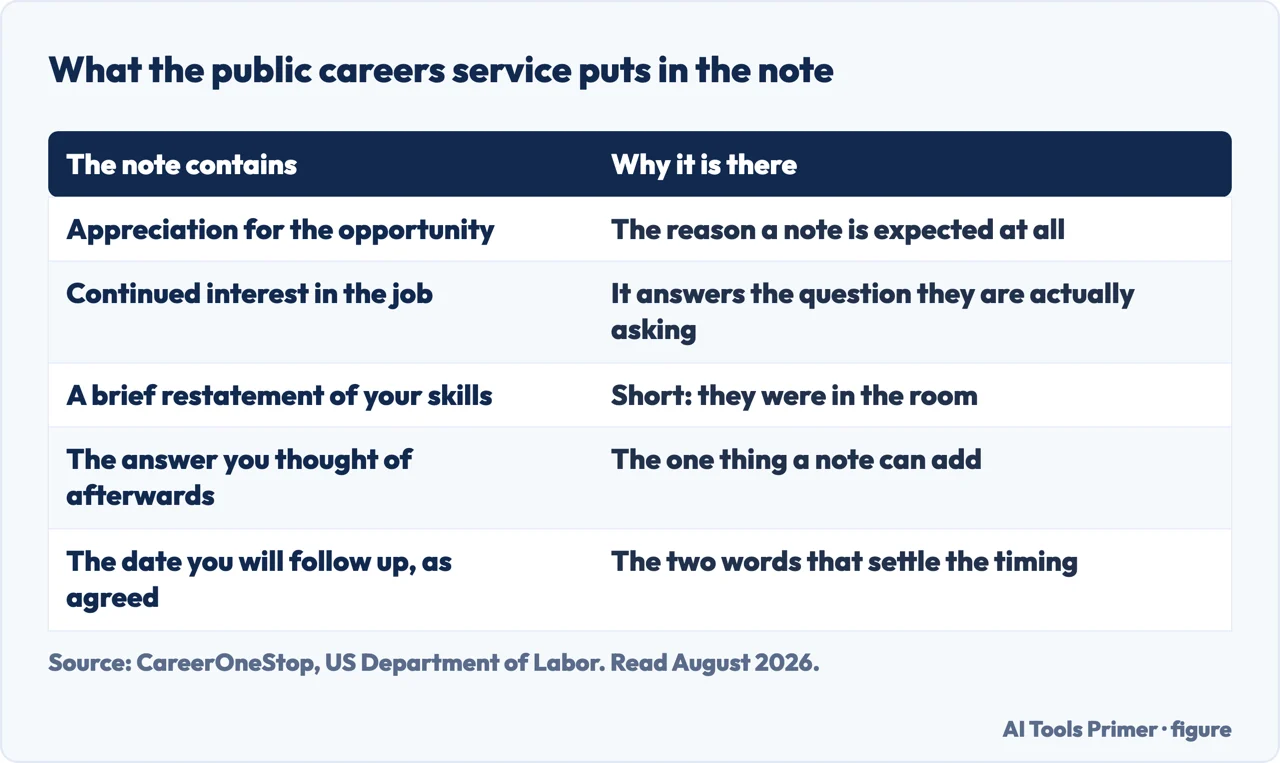
Two of those six are the ones that turn a courtesy into a contribution. The fourth gives a home to the thing you failed to say, and a note is the one route back to the table that nobody has to apologise for using. The fifth is quieter and stronger: if the interviewer mentioned a book, a report or a person, following it up before you write is a small piece of evidence that you listen and act — demonstrated rather than asserted, which is a different kind of claim to make about yourself.
Two administrative points from the same page, both easy to get wrong. Address the note to the interviewer by name and title. And where several people were in the room: “send a separate thank-you note to each person you interviewed with, or send a single thank-you to a key person for distribution” — either is offered, but sending nothing because you cannot decide is not.
And the number these sources do not give you. Neither page says “wait five working days” or “chase after a week”. What they give instead is timing for the first message — “no later than 24 hours after the interview, even if the interview didn’t go well” — and the instruction to carry an agreed date inside it.
That absence is worth respecting rather than filling in. A decision date agreed with the employer beats any general rule, because it is theirs. If no date was agreed and none was offered, the honest position is that you are guessing — and the useful move is to ask for one rather than to pick one.
One last thing about who gets thanked, because it widens the job considerably and costs nothing. CareerOneStop: “Employers, employment contacts, and references should receive a thank-you note whenever they have helped you” — after an informational interview, when somebody gives you a referral or information, or “whenever someone takes time out of his or her schedule for you.” The service puts employers, contacts and references in the same sentence, and the second and third of those are easy to leave out of a list that begins with an interview.
The guides below take it four ways: the debrief, the note, the agreed date, and everybody else who should hear from you.
Where to start
Four ways in.
- “It finished ten minutes ago.”
- Start at the debrief
- “What do I actually write?”
- Go to the note
- “It has been a week and nothing.”
- That is the agreed date
The debrief
Three questions from a public careers service, asked immediately, about your own performance rather than their reaction. The material only exists for about an hour.
The note
Six things a public service says to include, and a deadline that applies even when the interview went badly.
The agreed date
The part that belongs in the interview rather than after it. Ask when the decision is expected, and the following fortnight stops being a guess.
Not covered here. It will not give you a number of days to wait. The public services do not publish one, and the date the employer gives you is better than any rule this page could invent.
It will not treat the note as the whole of following up. The service puts a debrief before it and a second interview after it.
And it will not suggest chasing harder as a strategy. What it suggests instead is asking one question before you leave the room. What holds instead is simple: the debrief questions and the twenty-four hour timing are quoted from a public careers service with no product to sell, on the date it was read.
Step 20 of 24 in the job search
The order this is meant to be read in, from writing the CV to handing in notice.
- Before this
- Thank you email after interview: what the templates leave out
- After this
- How to negotiate a salary, and why the number compounds
Sources
- CareerOneStop (United States Department of Labor) — Follow-up after interview, Veterans (the instruction to evaluate your own responses immediately with three specific questions, the note that many interviews are multi-stage, and the guidance to write the thank-you note the same day) — www.careeronestop.org, read 22 August 2026.
- CareerOneStop (United States Department of Labor) — Thank-you notes (who should receive one, the six items to include, the instruction to write within 24 hours even if the interview did not go well, addressing the note by name and title, and the choice between separate notes and one for distribution) — www.careeronestop.org, read 22 August 2026.
- National Careers Service (United Kingdom) — Interview tips (that an interview is a conversation between you and the employer to see whether you are the right fit for the role; the advice to check after the invitation whether the interview is in person, by phone or by video, and to make sure the date leaves enough time to prepare; that a potential employer may not expect you to have done the job before but will look for relevant experience or strengths; the four preparation steps of reading the job description, researching the company website, rereading your CV and preparing examples from past experience; the pointer to the STAR method for answering fully; and that at the end of an interview employers usually ask whether you have questions for them) — nationalcareers.service.gov.uk, read 5 September 2026.
Written by Alberto Gulotta
Founder and editor of AI Tools Primer, writing from Palermo, Italy. Thirty-five years of taking computers apart, starting with a Commodore 64 — the long version is on the about page.
Something wrong on this page? Write to aitoolsprimer@gmail.com and it gets fixed.
Written on 22 August 2026 · last checked 23 September 2026.
Independence and limits
No affiliate links and no paid placements anywhere on this site. Nobody pays to appear here, and no company has seen this page before you did.
This is general information, not professional advice. Where a page touches money, health, safety or the law, it names its source and the date it was read — and your situation may still differ. See the privacy page and the cookie policy.