
Chat · guide
Open source AI models: weights, code, data and licences
By Alberto Gulotta · Updated · 17 min read
Open source AI models are not all one thing. The Open Source Initiative asks for weights, complete code and detailed data information on approved terms, while an open-weight model such as OpenAI’s gpt-oss shares the weights under Apache 2.0. Licences add conditions: Meta’s Llama 3 licence has a threshold of 700 million monthly active users.
| Question | Answer | Where it comes from |
|---|---|---|
| What does the OSI ask of an open source AI system? | Four freedoms, with data information, complete code and parameters on approved terms | OSI definition 1.0 |
| Is open-weight the same thing? | No: both say it shares the weights and reveals less than an open source model | OSI blog, Stanford HAI |
| Is gpt-oss open source? | OpenAI calls it open-weight, under Apache 2.0 and a usage policy | OpenAI help page |
| What does the Llama 3 licence add? | A naming rule, a use policy and a 700 million monthly active user threshold | Meta licence text |
| Which model here publishes its data? | Ai2 calls Olmo fully open and links its training data | Ai2 |
What “open” means for a model
The pages we read agree on the parts and differ on how many of them must be shared. In a blog post of 16 September 2026, the Open Source Initiative (OSI) says an AI model has three main components: training data, weights or parameters, and code for data preparation and training. Which of them you can reach, it says, decides whether the model is closed, open-weight or Open Source. The OSI’s definition adds that a model is the architecture, the parameters, weights included, and the code that runs it, and that weights are the learned parameters laid over the architecture to produce an output from an input.
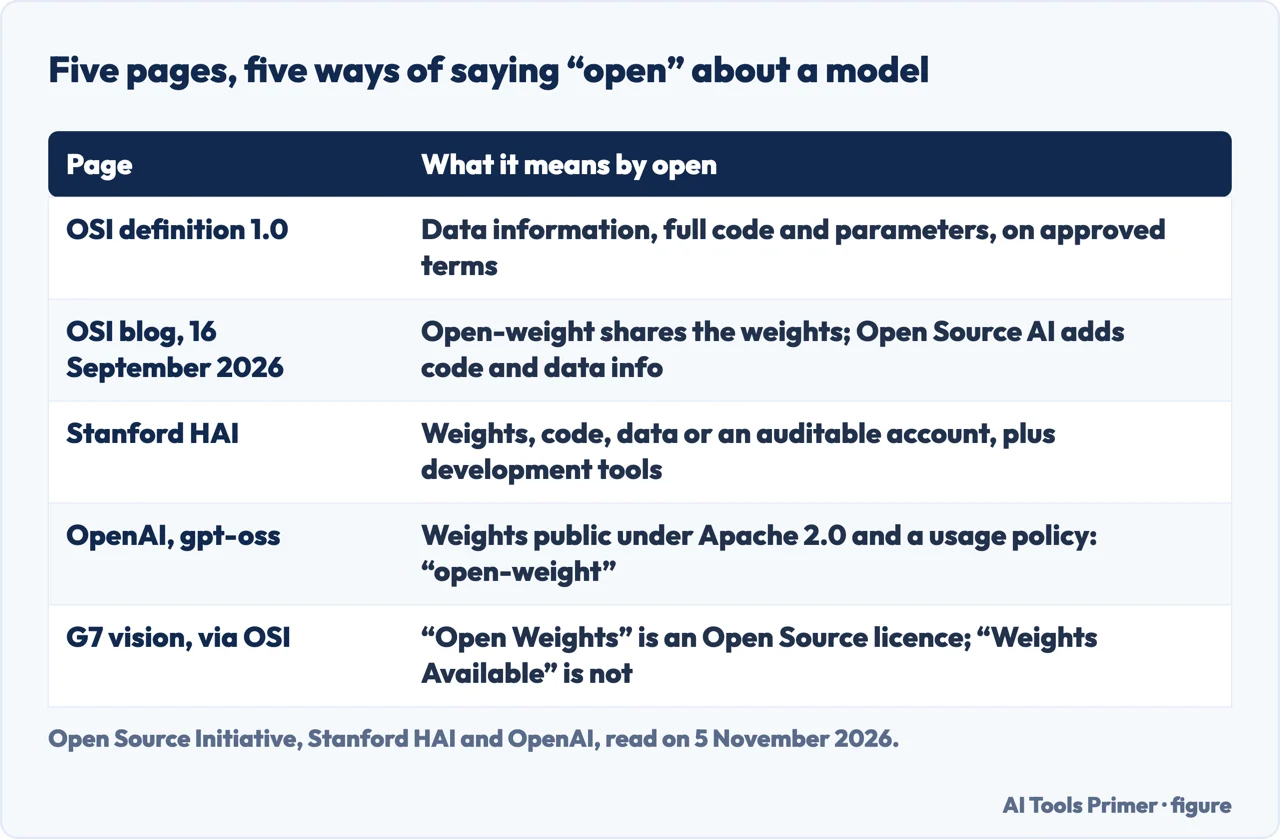
So the short answer is that “open source” and “open weights” are not the same thing: the OSI blog and Stanford HAI both treat releasing only the weights as less than open source. The OSI blog says open-weight models release their weights and do not share the other components. Stanford HAI defines an open-source model as one whose weights, source code, training data or a detailed, auditable account of that data, and development tools are available to download, run, inspect, reproduce, modify and improve, and adds that, unlike an open-weight model, it reveals more than the learned parameters. OpenAI, for its gpt-oss models, uses the terms “open models” and “open-weight” and says the weights are public under Apache 2.0 and its usage policy. The table below puts the five uses side by side. One more twist, from the G7 criteria as the OSI describes them, is covered further down: there, “Open Weights” is a narrower label than in everyday speech.
The OSI’s definition, element by element
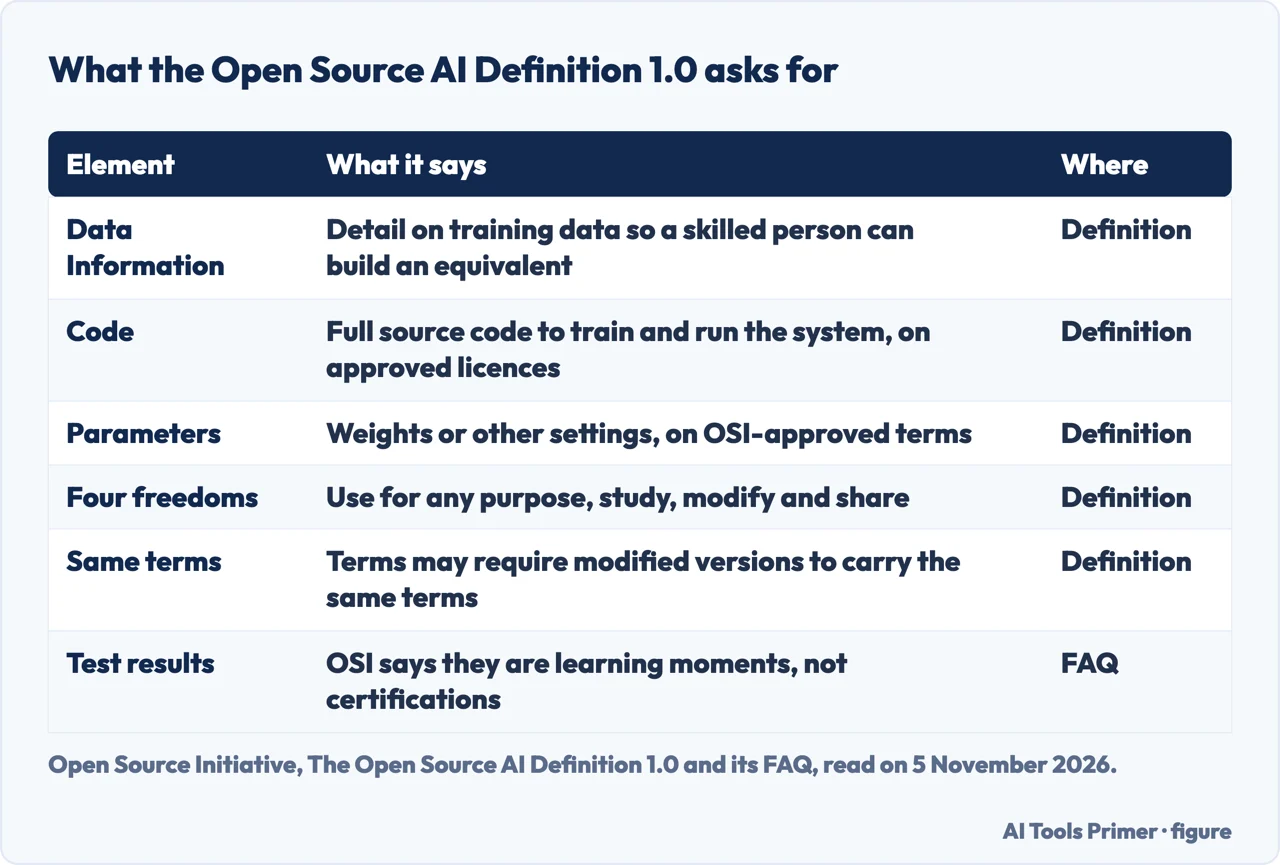
Version 1.0 of the Open Source AI Definition says an Open Source AI is a system made available under terms that grant four freedoms: to use it for any purpose without asking permission, to study how it works and inspect its components, to modify it for any purpose, including to change its output, and to share it with or without modifications. The precondition is access to the “preferred form to make modifications”. The definition page does not carry a date; the OSI’s end-of-year review says the first stable version was released at the All Things Open conference in Raleigh, in 2024.
For a machine-learning system the definition lists three elements that must all be there. Data Information is detailed enough that a skilled person can build a substantially equivalent system: a full description of the training data, with its provenance, scope, how it was obtained and selected, labelling and filtering, plus a list of the publicly available data and where to get it, and a list of data obtainable from third parties, including for a fee. Code is the complete source code used to train and run the system, and the definition’s examples include data processing and filtering code, training code with its arguments and settings, validation and testing, tokenizers and inference code. Parameters are the weights or other configuration settings, and the examples include checkpoints from key intermediate stages. Each element has to come under OSI-approved terms, and the terms may require modified versions to be released under the same terms.
The definition then applies the same test to parts. “Open Source models” and “Open Source weights” must include the data information and the code used to derive those parameters, and the OSI’s FAQ says there is no distinction between system, model and weights: the requirements are the same. The definition does not require a specific legal mechanism for the parameters, which may be free by nature or may need a licence.
Why the OSI asks for data information, not the data
The FAQ answers the objection that training data is the source code of an AI system. It says AI systems are not programmed in the conventional way, that training data is important for studying a system but is not necessarily what practitioners use as the preferred form for modifying it, and that the data information and code requirements let third parties fork a system using the same information as the original developers. It sorts data into four classes. Open training data can be copied, preserved, modified and reshared, and the OSI says it must be shared. Public data can be inspected while it stays available, and obtainable data can be had, including for a fee; both must be disclosed with details on where to obtain them. Unshareable nonpublic data, such as personal information, must be described in detail, so that, in the FAQ’s example, a hospital could create a dataset with the same structure from its own patient data. The FAQ gives medical AI as a field where data cannot always be legally shared.
The FAQ also reports a validation exercise. It lists Pythia (EleutherAI), OLMo (Ai2), Amber and CrystalCoder (LLM360) and T5 (Google) as having passed, and Llama 2 (Meta), Grok, Phi-2 (Microsoft) and Mixtral (Mistral) as analysed and not passing, because they lack required components or their legal agreements are incompatible with Open Source principles. It adds that these results are not certifications of any kind and that the OSI validates only legal documents, not individual AI systems. The pages we read do not apply the definition to Llama 3 or to gpt-oss, so we do not say whether either meets it.
Open weights: what you get, with gpt-oss as the example
The OSI blog describes what the weights alone give you. You can run the model locally, paying only for electricity and hardware, or work with a third-party provider to host it, and you can fine-tune it with your own data. It says that is more customisable than relying on a closed model, but that open-weight models limit your ability to modify the model and you cannot fully study it, because the code and the training data or information are missing.
OpenAI’s announcement of 5 August 2025 is an example. It presents gpt-oss-120b and gpt-oss-20b as open-weight language models under the Apache 2.0 licence, its first open-weight language models since GPT-2; it adds that Whisper and CLIP had already been made available openly. The weights are free to download on Hugging Face and come quantised in MXFP4, which lets the 120b model run within 80 GB of memory and the 20b model in 16 GB. Those are the requirements OpenAI gives for those two models, not a rule for open models in general. OpenAI’s help page says the 120b model runs on a single 80 GB GPU.
The same help page says the models are not served through the OpenAI API and do not appear in ChatGPT. The weights are free, but you are responsible for the compute, storage and hosting costs, which depend on the infrastructure or provider you choose, and OpenAI says it does not provide assistance for self-hosted or third-party-hosted open-weight setups. Asked whether the models are open source, the page says OpenAI uses the terms open models or open-weight to mean that the trained weights are public under Apache 2.0 and the gpt-oss usage policy, and that some surrounding infrastructure or tooling may remain proprietary. On data, the announcement says only that the models were trained on a mostly English, text-only dataset with a focus on STEM, coding and general knowledge; it says OpenAI is open-sourcing the tokenizer and a harmony renderer. The pages we read do not say that the training data or the training code are published.
The licence decides what you may do
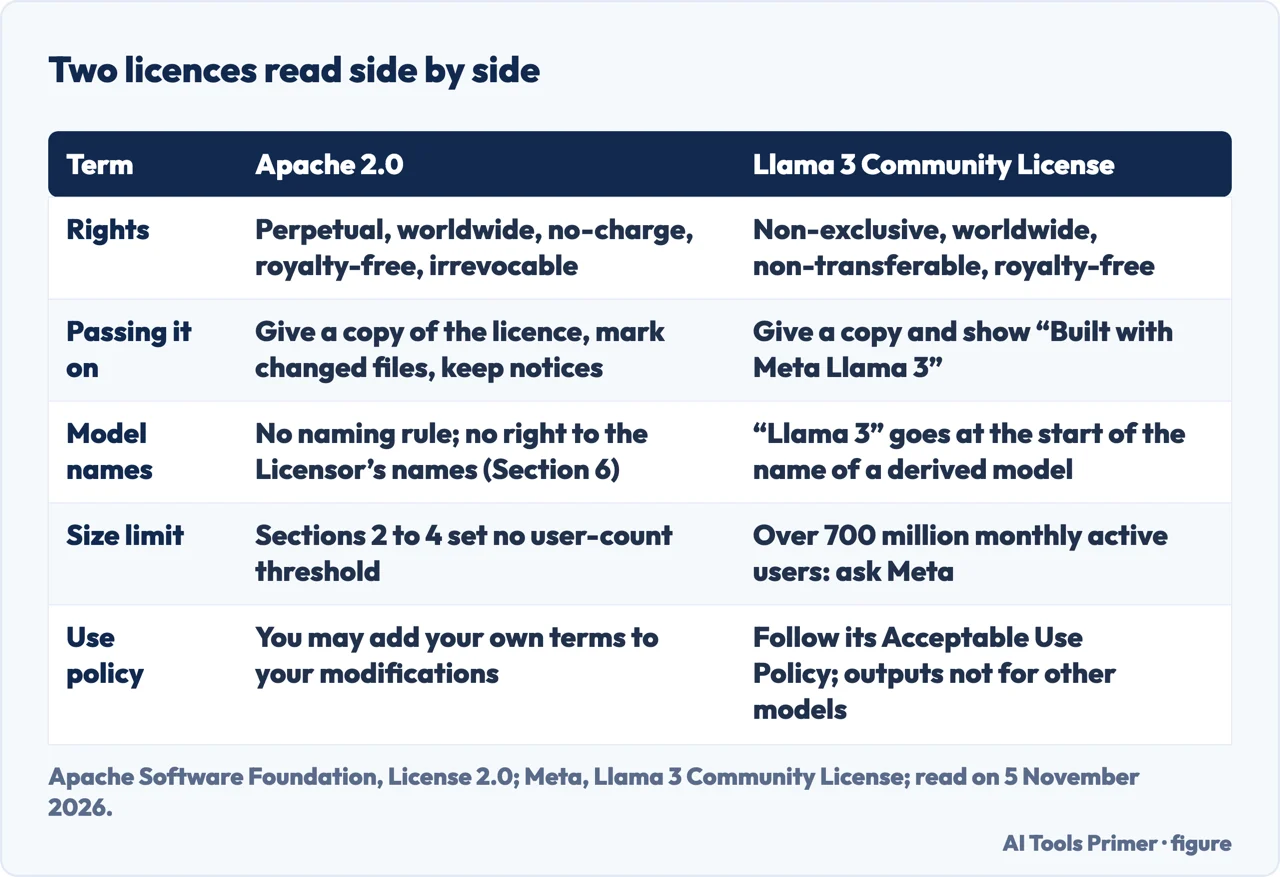
Apache 2.0, version 2.0 of January 2004, is a fixed text. Section 2 grants a perpetual, worldwide, non-exclusive, no-charge, royalty-free, irrevocable copyright licence to reproduce, prepare derivative works, display, perform, sublicense and distribute. Section 3 grants a patent licence with the same characteristics, and says it ends for you if you file patent litigation alleging that the Work infringes a patent. Section 4 lets you redistribute with or without modifications if you give recipients a copy of the licence, mark changed files, keep the notices and carry on any NOTICE file; it also lets you add your own terms for your modifications. OpenAI’s help page says Apache 2.0 allows broad use, modification and redistribution, commercial use included, subject to the gpt-oss usage policy.
Meta’s Llama 3 licence, a Community License Agreement with a version release date of 18 April 2024, is Meta’s own text. It grants a non-exclusive, worldwide, non-transferable, royalty-free limited licence to use, reproduce, distribute, copy, create derivative works of and modify what it calls the Llama Materials, Meta’s proprietary Llama 3 and documentation. Conditions follow. If you distribute the materials, you provide a copy of the agreement and display “Built with Meta Llama 3”. If you use them to create, train or fine-tune a model that is distributed, you include “Llama 3” at the beginning of its name. You follow the Acceptable Use Policy and you do not use the materials or their output to improve another large language model, apart from Llama 3 and its derivatives.
The licence’s additional commercial terms set a threshold: if, on the release date, the monthly active users of the licensee’s products or services, or its affiliates’, exceeded 700 million in the preceding calendar month, the licensee must request a licence from Meta, which may grant it in its sole discretion, and has no rights under the agreement until it does. The text we read covers Llama 3 only; we did not read the terms of later versions. It does not mention the OSI’s definition.
A model with its data and code published, and what the labels mean
Ai2 describes Olmo as a fully open language model and complete model flow, and its page links the pretraining, mid-training and post-training data. A Forbes writer, Janakiram MSV, quoted in the testimonials on Ai2’s page, says that other open language models limit access to their training data, architectures or evaluation methodologies, while Olmo gives full access. The Hugging Face card for the Olmo 3 32B model, created on 4 November 2025 according to the page’s data, says the code and model are released under Apache 2.0, and its License section adds that the model is intended for research and educational use in accordance with Ai2’s Responsible Use Guidelines; the Olmo 3 family comes in 7B and 32B sizes, in Base, Think and Instruct variants.
The OSI blog of 16 September 2026 uses Olmo as its example of what the extra components allow: researchers used the full training dataset and model checkpoints to study how a model “memorized” or “forgot” information, by injecting new information into the training data and watching what happened. Note the difference in names. The OSI’s validation result in the FAQ is about OLMo, not Olmo 3, and the OSI says such results are not certifications; the pages we read do not say that the OSI has approved Olmo 3.
On 29 May 2026 in Paris, according to an OSI post of 1 June 2026, G7 Digital and Technology ministers approved a “Vision on AI openness opportunities and shared language”, the result of a three-month partnership with the OSI. As the post summarises it, the criteria label a model under a proprietary licence “Weights Available” and a model distributed under an Open Source licence “Open Weights”. So in the G7 wording “Open Weights” is narrower than in the OSI blog and in OpenAI’s help page, where open-weight means releasing the trained weights. For Open Source AI the criteria broadly follow the OSI definition but restrict exceptions to publishing training data to cases of legal or technical impossibility, and ask for data information only when the data is absent. A further label, “Open Source AI with Open Data”, is for systems whose weights, deployment code, training code and full training data are all released under an Open Source licence. We read the OSI’s post, not the Vision itself.
Why people download them, and four questions for a model page
A Red Hat developer article of 7 January 2026 says 2025 was a year of hobbyists running models on their own hardware and of organisations that need on-premises and sovereign AI. Those uses need models you can download from a public registry such as Hugging Face and run with engines such as Ollama or RamaLama, or with an inference server such as vLLM. The article says DeepSeek showed that open weights can deliver high-value reasoning and that open models suit teams that need cost control or air-gapped deployment, and it names Llama, Qwen and Gemma as model families. We leave its benchmarks and download figures aside. IBM’s page, by contrast, is about open source tools for AI, such as TensorFlow, PyTorch and Hugging Face, and does not define what an open model is. For running a model on your own computer, see our page on installing Ollama; for the company behind gpt-oss, our page on who owns OpenAI.
Taken together, the pages above turn on four questions. Can the weights be downloaded? Under which licence, and with which conditions on use, naming and size? Are the training data, or a detailed account of them, published? Is the training code published? The OSI definition asks for the last two as well as the first, and the OSI blog says that without them you cannot fully inspect the model. The OSI blog calls a model that releases only its weights open-weight.
What we did not use
We ran no model and tested nothing. We did not read the Wikipedia list of open-source AI software, the Reddit thread, the Baseten and Folio3 rankings, the Artificial Analysis comparison or the GitHub course lesson, because they are lists, rankings or lessons and not statements of what open requires. We did not rank models. The Hugging Face page for gpt-oss is mostly metadata, so we took gpt-oss facts from OpenAI’s announcement and help page. The pages we read do not say how many people use open models or how many exist, and they do not give a running cost, which OpenAI says depends on the infrastructure. The month of the OSI definition’s first release is not on the pages we read.
Where to start
Four ways in.
- “Is open weights the same as open source?”
- What “open” means for a model — meaning
- “What does the OSI definition require?”
- The OSI’s definition, element by element — osi
- “Is there a free OpenAI model?”
- Open weights: what you get, with gpt-oss as the example — weights
- “Does the licence matter?”
- The licence decides what you may do — licences
Running one, and who is behind it
Installing a model locally, who owns OpenAI, and what OpenAI says about your data.
Questions people also ask
Is there a free OpenAI model?
OpenAI’s help page says the gpt-oss weights are free to download and use under Apache 2.0 and its usage policy, but you pay for the compute, storage or hosting you run them on. The models are not served through the OpenAI API and do not appear in ChatGPT.
Are there any truly open source AI models?
The OSI’s FAQ lists OLMo (Ai2) among systems that passed its validation, and says that is not a certification. Ai2 calls its Olmo models fully open, and the Hugging Face card for Olmo 3 32B names Apache 2.0. The pages we read do not say whether Olmo 3 meets the definition.
What are the top 10 open source AI models?
We did not rank models, and the pages we read do not give a list of ten. They give tests instead: the OSI definition asks for data information, complete code and parameters on approved terms, and Stanford HAI asks for weights, code, data or an auditable account of it, and tools.
Which AI is completely open source?
The OSI blog of 16 September 2026 says Ai2’s Olmo is released as Open Source AI, and Ai2 describes Olmo as fully open. The OSI definition sets the test: use, study, modify and share, with data information, code and parameters. OpenAI calls gpt-oss open-weight.
Not covered here. We ran no model. The statements come from the Open Source Initiative, Stanford HAI, OpenAI, Meta, Ai2, the Apache Software Foundation, Red Hat and IBM, all read on 5 November 2026.
The search volume and difficulty behind this page come from an Ubersuggest reading of 5 November 2026 (United States), which gives search volume and its own SEO difficulty score, not Semrush’s; it is to be confirmed with Semrush.
Sources
- Open Source Initiative — The Open Source AI Definition 1.0 — opensource.org, read 5 November 2026.
- Open Source Initiative — Open Source AI Definition FAQ — opensource.org, read 5 November 2026.
- Open Source Initiative — Open weights are good. Open Source is better. — opensource.org, read 5 November 2026.
- Open Source Initiative — 2024 end-of-year review: Open Source AI Definition v1.0 — opensource.org, read 5 November 2026.
- Open Source Initiative — Open Source Initiative helps G7 deliver vision on AI openness — opensource.org, read 5 November 2026.
- Stanford HAI — What is an Open-Source Model? — hai.stanford.edu, read 5 November 2026.
- OpenAI — Introducing gpt-oss — openai.com, read 5 November 2026.
- OpenAI Help Center — OpenAI open-weight models (gpt-oss) — help.openai.com, read 5 November 2026.
- Meta — Llama 3 Community License Agreement — www.llama.com, read 5 November 2026.
- Apache Software Foundation — Apache License, Version 2.0 — www.apache.org, read 5 November 2026.
- Ai2 — Olmo — allenai.org, read 5 November 2026.
- Hugging Face — allenai/Olmo-3-1125-32B — huggingface.co, read 5 November 2026.
- Red Hat Developer — The state of open source AI models in 2025 — developers.redhat.com, read 5 November 2026.
- IBM — Best Open Source AI Models — www.ibm.com, read 5 November 2026.
Written by Alberto Gulotta
Founder and editor of AI Tools Primer, writing from Palermo, Italy. Thirty-five years of taking computers apart, starting with a Commodore 64 — the long version is on the about page.
Something wrong on this page? Write to aitoolsprimer@gmail.com and it gets fixed.
Written on 5 November 2026.
Independence and limits
No affiliate links and no paid placements anywhere on this site. Nobody pays to appear here, and no company has seen this page before you did.
This is general information, not professional advice. Where a page touches money, health, safety or the law, it names its source and the date it was read — and your situation may still differ. See the privacy page and the cookie policy.