The OpenAI Foundation
The nonprofit. Worth “approximately $130B based on OpenAI Group’s current valuation”, plus a warrant for more if the share price rises more than tenfold in fifteen years.
Chat · guide
By Alberto Gulotta · Updated · 11 min read
There is no single name at the end of this question, and the reason is more interesting than a name would be. OpenAI publishes the split itself, so the figures below are the company’s own.
The OpenAI Foundation
The nonprofit. Worth “approximately $130B based on OpenAI Group’s current valuation”, plus a warrant for more if the share price rises more than tenfold in fifteen years.
Microsoft
“Microsoft holds roughly 27% of OpenAI Group…” The largest single shareholding — larger than the nonprofit’s.
Everybody else
“The remaining 47% is held by current and former employees and investors.” Not one owner but many, and no individual named.
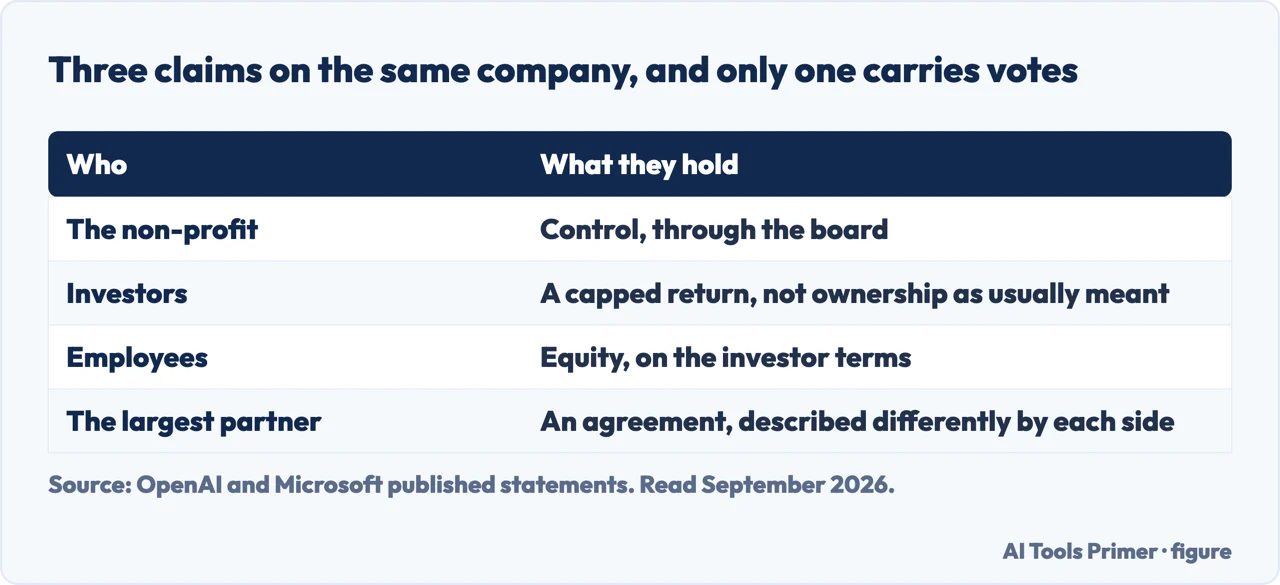
Read those three together and something stands out immediately: the nonprofit is not the largest shareholder. Microsoft is. The margin is narrow and OpenAI’s own figure for it is hedged — “roughly 27%” against the Foundation’s 26% — so the ranking matters more than the gap. If ownership were only a question of who holds the most stock, the answer here would be Microsoft.
It is not, and OpenAI explains why on the same page.
“Through special voting and governance rights held solely by the OpenAI Foundation, the OpenAI Foundation appoints all members of the board of directors of OpenAI Group and can replace directors at any time.”
This is the sentence that makes the percentages misleading on their own. Microsoft holds the larger stake; the Foundation holds the larger say. Control here does not travel with shares — it travels through a separate set of rights that only one party has. So the honest answer to who owns ChatGPT and the honest answer to who controls it are different answers.
That distinction — shares in one hand, votes in another — is the whole structure in a sentence, and it is why the ordinary phrasing of this question does not reach the answer. “Owns” asks about stock. What OpenAI documents is that the appointment of every OpenAI Group director sits with one party alone, and that party is not the largest shareholder. A stake and a say are being held separately here, and only one of them is described as controlling anything.
The next thing to be clear about is what kind of company is being controlled, because the label is doing real work.
The for-profit is “a public benefit corporation, called OpenAI Group PBC, which—unlike a conventional corporation—is required to advance its stated mission and consider the broader interests of all stakeholders”.
A public benefit corporation is an ordinary company in most respects — it raises money, issues stock, pays people — with one legal difference written into what its directors must weigh. The company describes the two halves as sharing one aim: “OpenAI Foundation and OpenAI Group have the same mission.”
It is worth being precise about what that does and does not settle. A public benefit corporation is a legal form, and OpenAI states the obligation it carries. What no page can tell you is how any particular decision was weighed — that is a question about conduct rather than about structure, and structure is all that is documented here.
How it got to this shape
Three dates, all from the company’s own account.
One detail in that history is worth stopping on. The recapitalisation was not simply announced; by OpenAI’s own account it followed “nearly a year” of dialogue with two state attorneys general. A nonprofit changing the arrangement around a for-profit subsidiary is a matter those offices supervise, and the company names them as part of how the structure was settled.
Who sits on the board. OpenAI names them: the Foundation is governed by independent directors Bret Taylor (Chair), Adam D’Angelo, Dr Sue Desmond-Hellmann, Dr Zico Kolter, retired U.S. Army General Paul M. Nakasone, Adebayo Ogunlesi and Nicole Seligman — “as well as CEO Sam Altman”. All of them also sit on OpenAI Group’s board except Dr Kolter, who is a non-voting observer there and chairs the Safety and Security Committee, a committee of the Foundation covering “the safety and security practices of all of OpenAI”. OpenAI adds that within a year of the recapitalisation a second Foundation director will also move to Foundation-only duty.
The Foundation’s own stake has a second part that the flat percentage hides. Alongside the 26%, OpenAI says it “also holds a warrant that allows it to receive additional shares in OpenAI Group if it hits a valuation milestone” — specifically, “if OpenAI Group’s share price increases greater than tenfold after 15 years”. The company explains the instrument plainly: a warrant “does not dilute existing holders today, and represents the right to buy shares at a set price”, and “the more the share price exceeds this set price at expiration (15 years), the more equity the OpenAI Foundation receives”.
OpenAI draws its own conclusion from that: with the stake and the warrant together, “the Foundation is positioned to be the single largest long-term beneficiary of OpenAI’s success”. That is the company’s characterisation rather than a measured fact, and it depends on a milestone fifteen years away — but it is on the record, and it is the intent the structure is described as serving.
One more thing has been levelled out, and it matters for reading any older account of this. “All equity holders in OpenAI Group now own the same type of traditional stock that participates proportionally and grows in value with OpenAI Group’s success.” OpenAI presents this as a change from what came before, so an older description of how its equity worked may describe an arrangement that has since been replaced.
And the largest outside interest describes the arrangement in its own words. Microsoft published the amended agreement from its side, framing it as one “to simplify our partnership and the way we work together, grounded in flexibility, certainty and a focus on delivering the benefits of AI broadly”, with “greater predictability” for both companies. Worth reading alongside OpenAI’s own account for the same reason any two-party arrangement is worth reading twice: each side chooses which parts to make prominent, and the overlap is the part neither disputes.
What this page will not tell you is what any of it is worth to you as a user. Ownership and governance describe who decides; they do not describe what will be decided. The guides below take the questions that do have documented answers — what the service says it keeps, what it says it is safe for, and what it cannot do.
Three ways in, and the second is the one the percentages do not answer.
Three holdings, one warrant, and one type of stock for everybody. All of it published by the company, and none of it adding up to a single owner.
Control runs through board appointment rights held by one party alone, not through the shareholding. It is the part that makes the ordinary question the wrong question.
A public benefit corporation controlled by a nonprofit foundation, settled with two state attorneys general. The structure is documented; the conduct is not.
Not covered here. It will not name one owner. OpenAI publishes three holdings and none of them is a majority, so a single name would be an invention rather than a simplification.
It will not say Microsoft controls OpenAI. It holds the largest stake and OpenAI states that the appointment of every OpenAI Group director rests solely with the Foundation.
And it will not judge whether the structure works as described. That would need evidence about decisions rather than about arrangements, and no such evidence is published. What holds instead is simple: who owns what here comes from OpenAI’s own account of its structure, read whole rather than summarised from someone else’s reading of it.
More guides from the site, in no particular order.
Written by Alberto Gulotta
Founder and editor of AI Tools Primer, writing from Palermo, Italy. Thirty-five years of taking computers apart, starting with a Commodore 64 — the long version is on the about page.
Something wrong on this page? Write to aitoolsprimer@gmail.com and it gets fixed.
Written on 22 August 2026 · last checked 23 September 2026.
Independence and limits
No affiliate links and no paid placements anywhere on this site. Nobody pays to appear here, and no company has seen this page before you did.
This is general information, not professional advice. Where a page touches money, health, safety or the law, it names its source and the date it was read — and your situation may still differ. See the privacy page and the cookie policy.