
Devices · guide
Is Signal safe: its policy, its court replies, its reviewers
By Alberto Gulotta · Updated · 15 min read
Is Signal safe? Signal’s own privacy policy, dated 25 May 2018, says the app registers a phone number and cannot access message content. Its published replies to government requests, a Mozilla review and a Proton article add what each source says Signal keeps, and where they differ.
| Question | Answer | Where it comes from |
|---|---|---|
| What does Signal say it cannot read? | The content of messages and calls | Signal privacy policy |
| What does it say it registers? | A phone number, when you create an account | Signal privacy policy |
| What did it say it handed over when governments asked? | The date an account was created and the date it last connected | Signal government requests |
| How does Mozilla rate it? | 9 out of 10, after 20 hours of testing, in a review of 15 October 2025 | Mozilla Foundation |
| How old is the privacy policy? | Effective and updated on 25 May 2018; the text we read does not use the words username or backup | Signal privacy policy |
What the sources mean by safe
Signal’s support page says its conversations are always end-to-end encrypted, which means they can only be read or heard by the intended recipients, and that “Privacy isn’t an optional mode”. It adds that the source code of the clients and the server is on GitHub, and that safety numbers let you confirm you are communicating with the right person. The same page says Signal runs on donations as a nonprofit. Mozilla describes the Signal Foundation as a US non-profit that handles day-to-day development through a subsidiary, Signal Messenger LLC, and eSafety calls the owner an American nonprofit.
Those statements are about message content. The rest of this page is about the other things a person can mean by safe: what the company says it keeps about an account, what it has published about requests from courts, what reviewers outside Signal found, and where the risk sits away from Signal’s servers. Signal’s own pages are Signal describing itself. The independent pages we read are Mozilla’s and eSafety’s. Proton also wrote about Signal, and Proton sells competing services, so what it says is labelled as Proton’s.
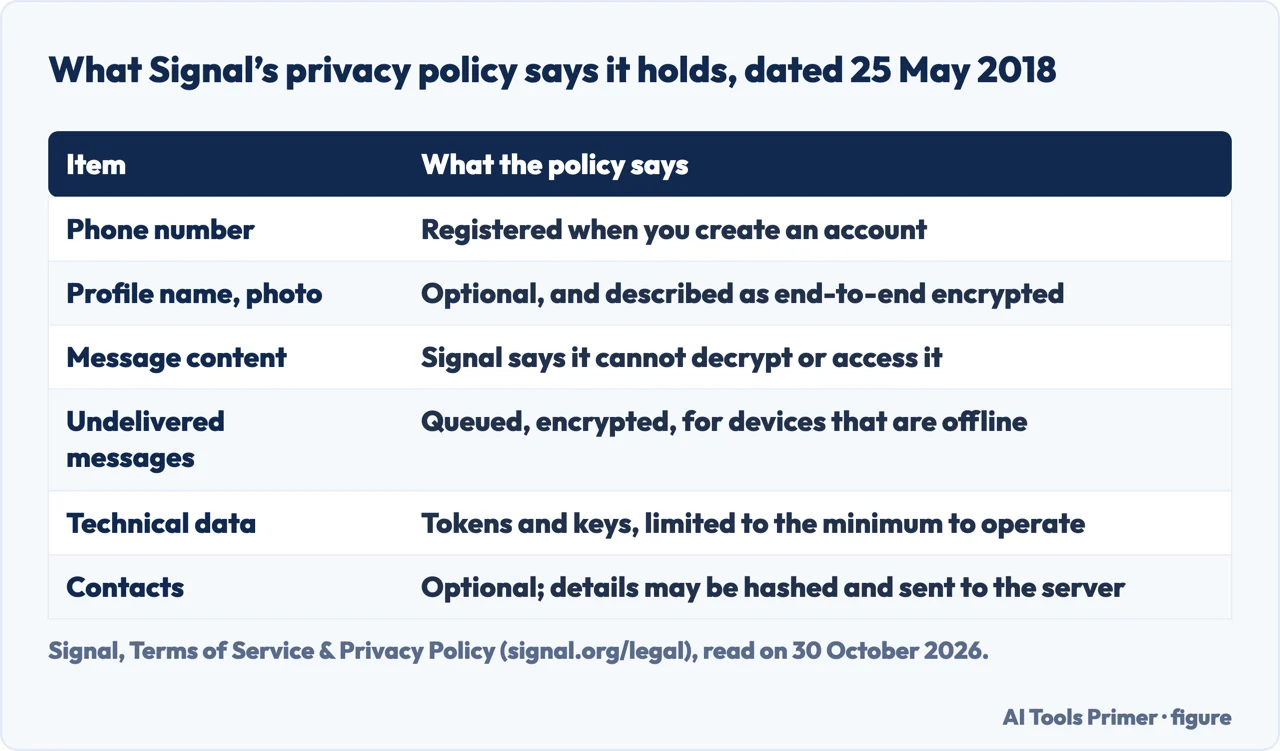
What the privacy policy says Signal holds, and its date
The privacy policy on signal.org/legal ends with the line “Effective as of May 25, 2018” and says it was updated the same day. The Terms say Signal changes the “Last Modified” date when it updates them, and the policy says Signal will update it as needed. The pages we read do not say whether the policy was rewritten after 2018. Everything in this section is from that text, except the last paragraph, which says whose words it reports.
The account. The policy says a phone number is registered when you create an account, and that numbers are used to provide the service to you and to other users. A profile name and picture can be added, and the policy describes that information as end-to-end encrypted. The Terms add that you must register with your phone number and agree to receive texts or calls with verification codes, and that third-party providers send the code.
The messages. The policy says Signal cannot decrypt or otherwise access the content of your messages or calls. It says encrypted messages are queued on the servers for delivery to devices that are temporarily offline, such as a phone whose battery has died, and that your message history is stored on your own devices. It also lists additional technical information stored on the servers: randomly generated authentication tokens, keys and push tokens, which it limits to “the minimum required” to operate the services. The pages we read do not say how long a queued message stays on the servers.
Contacts, support and sharing. Contact discovery is optional, and the policy says information from the contacts on your device may be cryptographically hashed and transmitted to the server to find out which contacts are registered. Personal data you send to user support is kept only to research the issue and contact you. The Terms say Signal does not “sell, rent or monetize” your data, and the policy lists the cases where it may share data: to meet a law or an enforceable governmental request, to enforce the Terms, to address fraud, security or technical issues, and to protect against harm. In the Terms you also agree to the transfer of encrypted information and metadata to the United States and other countries, with a verification-code provider and support tickets as the examples.
What the 2018 text does not contain. The policy we read does not use the words username or backup. Proton writes that Signal introduced usernames in 2024, and Mozilla wrote in October 2025 that Signal had “begun selling a cloud backup service”. Those features are described on later pages, not in the policy.
What Signal says it handed over when asked
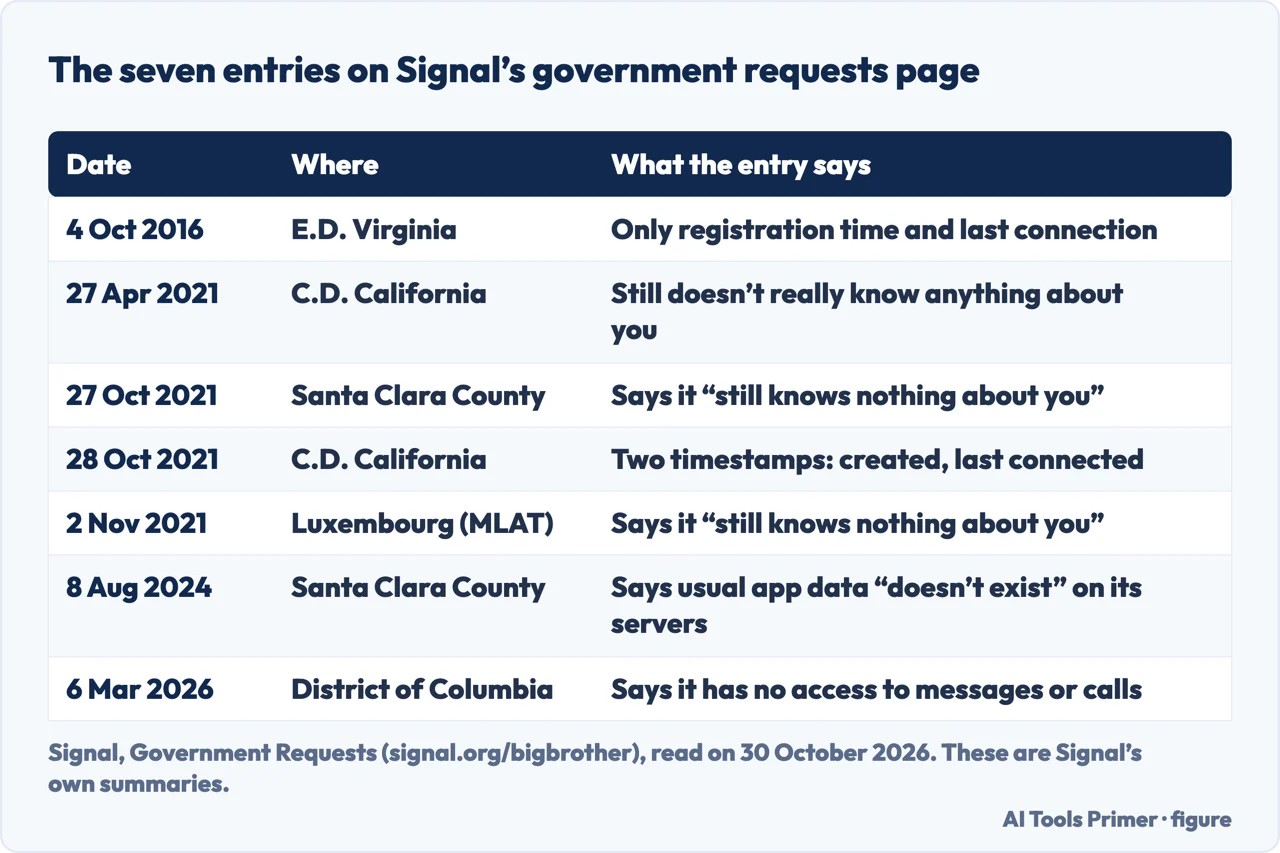
Signal publishes its replies to government requests at signal.org/bigbrother, under the line that when legally forced to provide information it will disclose the transcripts. The list we read has seven entries: 4 October 2016 (Eastern District of Virginia), 27 April 2021 (Central District of California), 27 October 2021 (Santa Clara County), 28 October 2021 (Central District of California again), 2 November 2021 (an MLAT order from Luxembourg), 8 August 2024 (Santa Clara County) and 6 March 2026 (a grand jury, District of Columbia). The pages we read do not say how many requests Signal received in all.
The 2016 entry says the only information Signal could produce was the date and time a user registered and the last date of the user’s connectivity to the service. In the entry of 28 October 2021 the subpoena asked for a wide variety of information, including name, address, correspondence, contacts, groups and calls. Signal writes that it could not provide any of that and that its response was “Unix timestamps” for when each account was created and the date each account last connected, followed by “That’s it.” In the same entry it lists what it says it does not have: messages, chat list, groups, contacts, stickers, profile name or avatar, and even the GIFs a user searches for.
The entry of 6 March 2026 says Signal end-to-end encrypts both content and metadata, and that it does not have access to things like messages, calls, profile information, group information, contacts, stories and call logs. Proton adds that the claim about registration and last connection “has been proven in court”; the pages we read do not name the case.
These are Signal’s own descriptions of its own replies. Mozilla and Proton repeat the registration and last-connection point, and the pages we read do not say they checked the documents themselves, which is why the figure below is labelled as Signal’s summaries.
What reviewers outside Signal add
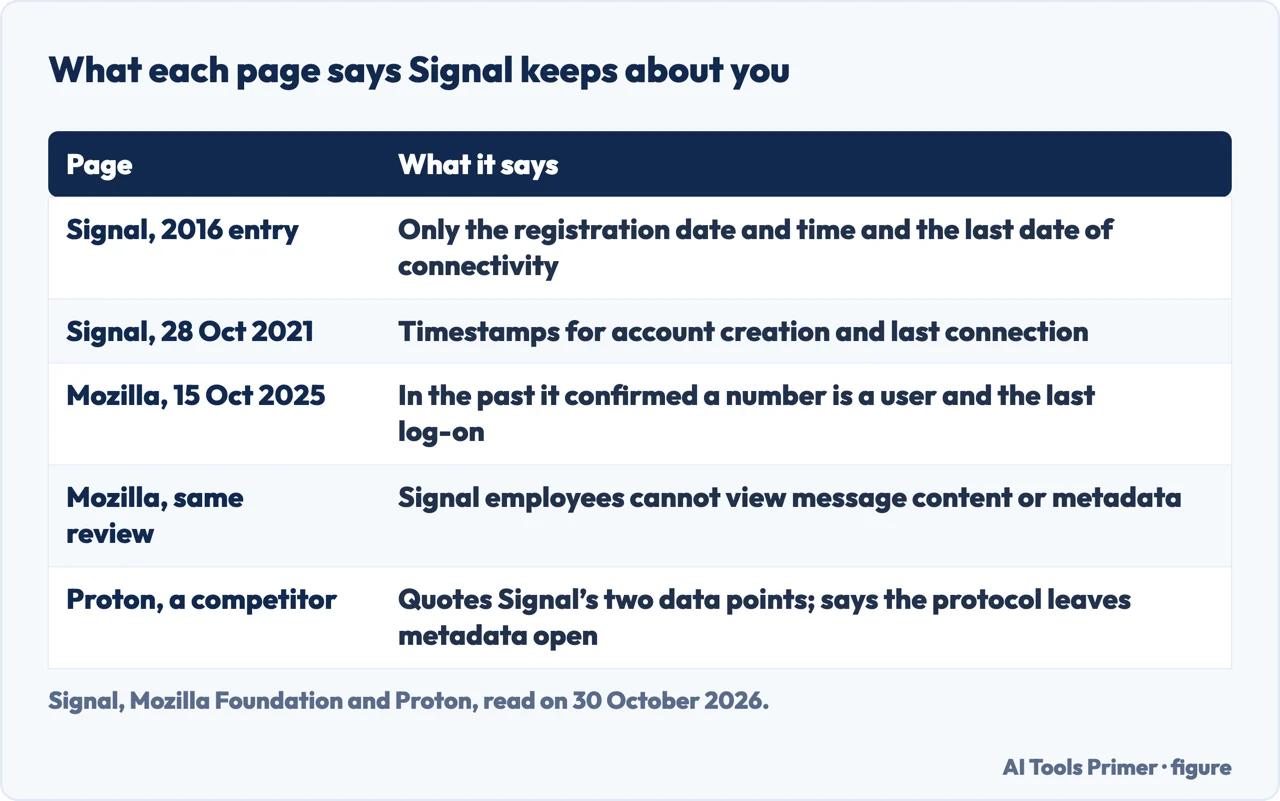
Mozilla Foundation, 15 October 2025. Its Signal review gives a rating of 9/10 after 20 hours of hands-on testing, which it describes as inspection of Android packages and Wireshark packet analysis. It says Signal asks for very little by default, “just your phone number”, and that in the past Signal complied with US court orders by confirming whether a number is associated with a Signal user and when that user last logged on. It names the phone number as the biggest issue: registration needs one, even on the desktop version. On the good side it lists encryption of the contacts list, attachments and profile picture, open-source clients and server, and Sealed Sender, which hides who a message is from while the delivery address stays visible. Link previews go through a proxy so the IP address is not exposed. The IP relay for calls protects by default only against users who are not in your contacts, and can be switched on for all calls at a cost in call quality.
On the critical side, Mozilla says Signal uses the Google Maps API for location, and that calls to it turn over metadata including the IP address you connect from. It says GIPHY and Google Maps are third-party services, and that Signal has taken steps to expose the minimum to them, including masking the IP.
eSafety, updated 2 October 2026. The Australian eSafety Commissioner’s guide says you still need a phone number to sign up even if you use a username to start chats, that by default your number is visible only to people who already have it saved, and that you can limit who finds you by number. It describes disappearing messages from 5 seconds to 4 weeks, group chats of up to 1000 people and group calls of up to 75, and says the app is free with no ads and that Signal gives 13 as the minimum age.
Three ways of saying what Signal keeps. The pages do not put it the same way. Signal’s replies say the only data it can produce is two timestamps, account creation and last connection. Mozilla says Signal employees cannot view message content or metadata, and also that Signal confirmed in the past whether a number is a user and the last log-on. Proton quotes Signal’s line about registration and last connection, and also writes that the Signal Protocol does not secure metadata by itself, so developers of an app could see who you speak to; what sets Signal apart, it says, is that the app does not harvest it.
Where the risk is not Signal’s servers
The longest list of weak points comes from Proton, which sells Proton Mail and Proton VPN, so each item below is Proton’s account. It writes that contact discovery uses Intel SGX enclaves, that SGX is vulnerable to side-channel attacks which could uncover which phone numbers are being checked, and that this poses no danger to the encrypted contents of messages or calls. Signal, Proton says, acknowledges SGX is not ideal but holds that alternatives are too slow at global scale without hardware acceleration. Proton also says Signal relies mainly on Amazon Web Services, which hosts the enclaves.
In early 2025, Proton writes, a researcher published an attack that could locate users of Signal and other apps within a 250-mile radius by abusing how content-delivery networks cache images. Cloudflare rolled out a patch; the researcher says that does not solve the problem. Signal, in Proton’s account, sees the issue as one with how CDNs work and recommends an open-source VPN or Tor when true anonymity is needed. Proton also describes an academic paper of October 2025 showing that delivery receipts can expose metadata, whether a user is online or switching devices, on several apps including Signal. The attacker has to know your phone number, so Proton says hiding it and using a username can partly reduce the risk.
On audits, Proton writes that the Signal Protocol has been through numerous independent audits, with issues found and fixed, and also that there is “no fully up-to-date audit” covering the full app ecosystem. The pages we read do not include an audit report.
The best-known incident was not a technical one. Mozilla says Signal’s actual security was not compromised when chats among high-level US national security advisors were leaked to the press: a journalist was invited to a group chat by mistake. Proton dates the episode to March 2025 and calls it purely human error, not a technical flaw in Signal.
The settings the pages point to
Mozilla’s steps are three. If you use Signal to back up settings between devices, use a strong alphanumeric PIN. Enable the lock that asks for your PIN when someone tries to register an account with your number on a new device; Mozilla calls it the authentication lock, Signal’s policy lists a Registration Lock PIN among the privacy features in Settings, and Proton writes that a registration lock PIN is meant to prevent SIM-swap hijacks, a risk our page on SIM swap covers. Third, require device authentication before the app opens; a phone passcode is the subject of our page on passcodes.
To delete an account, Mozilla says to open the mobile app, tap the profile, then Settings, Account, Delete Account, and enter your number. Removing Signal Desktop does not remove your data from Signal’s servers, because the process has to be completed from a registered mobile device. Messages you already sent stay with the people you sent them to, and after more than 24 hours they cannot be removed. Signal’s GDPR support page says you can disable your number as a Signal user by unregistering it, which needs access to that number, and that on Android local data can move between devices through Settings, Chats, Chat backups.
Signal’s Terms add that when you register on a new device, the old one stops receiving messages and calls. For comparison with other apps, our pages on WhatsApp and Telegram set out what their own pages say, and the encrypted phone page gathers the rest.
What we did not use
We installed nothing and tested nothing on a phone. We did not read the Reddit thread, the Lakeridge page, the LinkedIn article or the AVG page that Google listed. The eSafety text we read does not include its lists of benefits and risks, so we used only its description of the app. One Signal support article on how to know your communication is private was a near-empty shell when we fetched it, and we did not use it. Mozilla’s page carried a newsletter error message in its text, so we report only what its review says and make no claim about what it leaves out.
Where to start
Four ways in.
- “What does the policy say it holds?”
- What the privacy policy says Signal holds — policy
- “What did it hand over in court?”
- What Signal says it handed over when asked — requests
- “What do outside reviewers say?”
- What reviewers outside Signal add — reviewers
- “Can it be hacked?”
- Where the risk is not Signal’s servers — risk
Other messengers
What the lock covers in other apps.
Locking the account itself
Passcodes, second steps and the SIM.
Questions people also ask
Can Signal be hacked?
Proton lists a 2025 attack that located users within 250 miles through content-delivery networks, SGX side-channel risks in contact discovery and an October 2025 paper on delivery receipts. Mozilla says Signal’s security was not compromised in the leak of a US national security group chat, which started with a wrongly invited journalist.
Is Signal 100% private?
The sources describe limits. Signal’s policy says it registers a phone number, its replies to courts mention registration and last-connection timestamps, and Mozilla names the phone number and the Google Maps API for location as weaknesses.
Is Signal safer than Telegram?
None of the Signal pages we read compares the two apps. On the Telegram side, our page reports that ESET advises a strongly audited end-to-end messenger such as Signal for highly sensitive conversations, and that Norton lists user name, message time, IP address and device details as still exposed. That is their view of Telegram, not a test of both.
Why is Signal not popular?
The pages we read do not give user numbers or reasons. Mozilla and Proton both name the phone-number requirement as a drawback, and Proton says the alternatives it lists have tiny user bases by comparison.
Not covered here. We tested nothing on a phone. The statements come from Signal’s privacy policy and Terms, its government requests page and the entry of 28 October 2021, two Signal support pages, a Mozilla Foundation review, an eSafety Commissioner guide and a Proton article, all read on 30 October 2026.
The search volume and difficulty behind this page come from a Semrush reading of 29 August 2026, older than the 60 days the site normally allows.
Sources
- Signal — Terms of Service & Privacy Policy — signal.org, read 30 October 2026.
- Signal — Government Requests — signal.org, read 30 October 2026.
- Signal — Grand jury subpoena, Central District of California (again!), 28 October 2021 — signal.org, read 30 October 2026.
- Signal Support — Is it private? Can I trust it? — support.signal.org, read 30 October 2026.
- Signal Support — Signal and the General Data Protection Regulation (GDPR) — support.signal.org, read 30 October 2026.
- Mozilla Foundation — Signal Privacy Review, 15 October 2025 — www.mozillafoundation.org, read 30 October 2026.
- eSafety Commissioner — Signal (eSafety Guide) — www.esafety.gov.au, read 30 October 2026.
- Proton — Is Signal safe? (written by a company that sells competing services) — proton.me, read 30 October 2026.
Written by Alberto Gulotta
Founder and editor of AI Tools Primer, writing from Palermo, Italy. Thirty-five years of taking computers apart, starting with a Commodore 64 — the long version is on the about page.
Something wrong on this page? Write to aitoolsprimer@gmail.com and it gets fixed.
Written on 30 October 2026.
Independence and limits
No affiliate links and no paid placements anywhere on this site. Nobody pays to appear here, and no company has seen this page before you did.
This is general information, not professional advice. Where a page touches money, health, safety or the law, it names its source and the date it was read — and your situation may still differ. See the privacy page and the cookie policy.