
Footprint · guide
How to remove my address from the internet: four jobs, not one
By Alberto Gulotta · Updated · 21 min read
How to remove my address from the internet comes down to four jobs: ask Google to drop pages, opt out of people search sites one by one, accept that public records stay, and give the mail another place to go. The FTC, NNEDV, Google, Washington and USPS each cover part of it.
| Question | Answer | Where it comes from |
|---|---|---|
| Does a Google removal take the page down? | No: the info stays on the source page, and Google says to contact the website’s owner | Google Search Help |
| Does leaving a people search site clear public records? | No: the FTC says someone could still find public records on a government website | FTC |
| How often do I check again? | The FTC says periodically; NNEDV says every 3-6 months | FTC, NNEDV |
| Can a substitute address be used everywhere? | Washington says its state and local agencies must accept it; private businesses and federal agencies are not required to | Washington Secretary of State |
| What does a PO Box add? | USPS lists keeping a home address private; Street Addressing, if available, takes packages from other carriers | USPS |
Where the address comes from
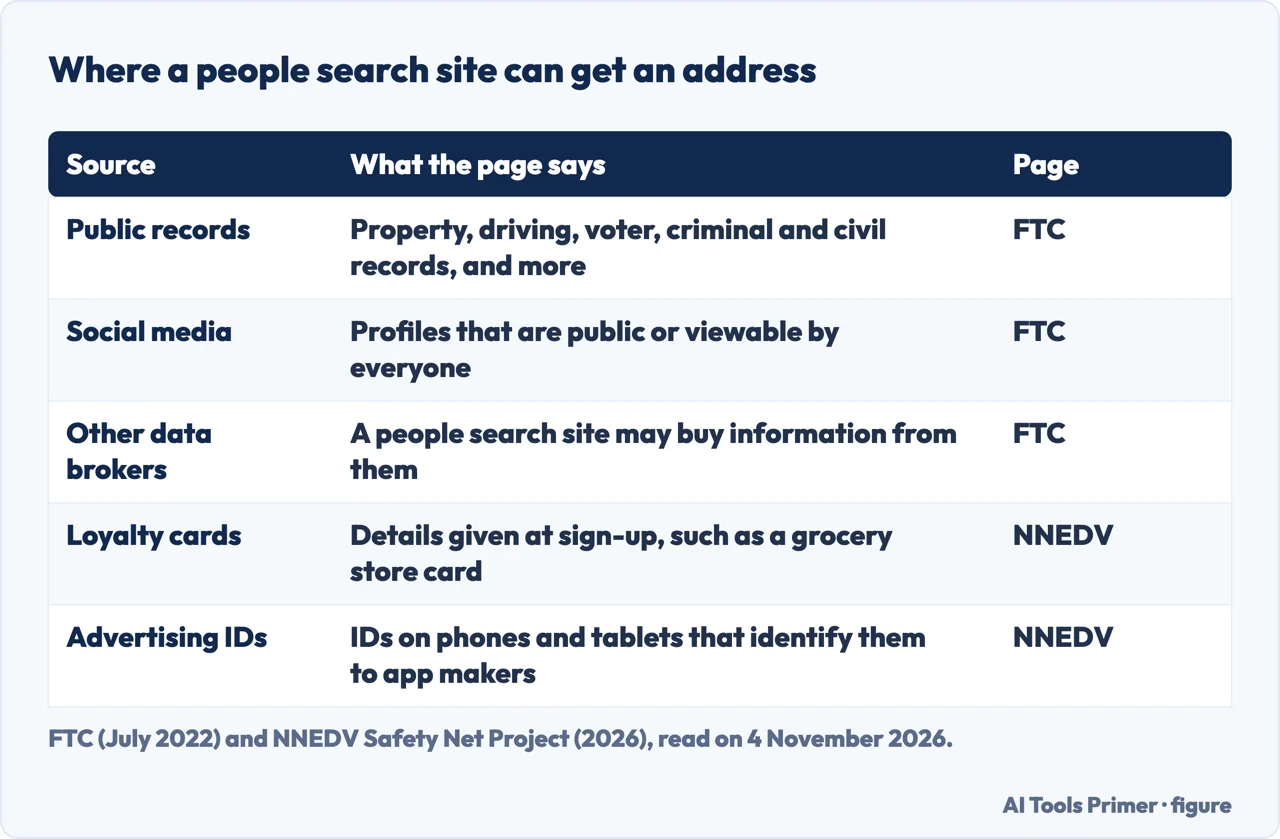
The FTC says a people search site builds a report in three ways: it may buy information from other data brokers, collect it from social media profiles that are public or viewable by everyone, and compile it from federal, state and local government public records. The records it lists are property records, driving records, voter registration information, criminal records, civil actions and judgments, birth, marriage, divorce and death records, and professional licenses, like those for pilots, doctors, lawyers or architects.
NNEDV, the National Network to End Domestic Violence, whose Safety Net Project wrote a guide on data brokers, adds consumer data to that list: voting and property records, but also the information given when signing up for a loyalty card at a grocery store. It names advertising IDs on smartphones and tablets as another route and points to the Electronic Frontier Foundation for turning that tracking off; we did not read the EFF page. For the consumer sources it can be controlled at the point of sign-up, NNEDV suggests, where a loyalty card or mailing list asks for details: use a partial version of your name, or a made-up name if the store allows; an email address created only for shopping, or a mask from a tool like Mozilla Relay or SimpleLogin; and, if a phone number is required, a VoIP number such as Google Voice, MySudo or TextNow. NNEDV says property records are a source where the options are limited. Privacy Rights Clearinghouse, in a tutorial posted in April 2017, lists government and public records, warranty cards, sweepstakes entries, contests and surveys, social media sites such as Facebook and LinkedIn, and retailers, magazine subscriptions and online services. It adds that data brokers are not transparent about where their data comes from.
What a report holds is more than an address. The FTC says that someone with just one piece of information, like a name or phone number, could buy a report that tells them a lot about you, like your current and previous addresses, the properties you have bought or sold, and the name and address of your family members, along with age, marital status, education and employment history, and records such as bankruptcies, liens and judgments. NNEDV describes the free version of these sites as a partial profile that may still include a full name, a phone number, close relatives or a home address, with the full version for paid users. It says that for most, information gradually appears on these sites while the person is in the 18 to mid-20s age range, and that a record can be blended with other people’s information, especially relatives the person has lived with.
The FTC says people buy these reports for different reasons: some might want to find an old friend, look up a potential love interest or connect with a neighbor. It adds that survivors of domestic violence or stalking may not want anyone to find out where they live, or the name and address of their family members. The pages we read do not say how many people search sites exist today. Consumer Reports wrote in 2020 that they were “in the hundreds”; NNEDV writes that there are dozens of data brokers.
Taking it out of Google
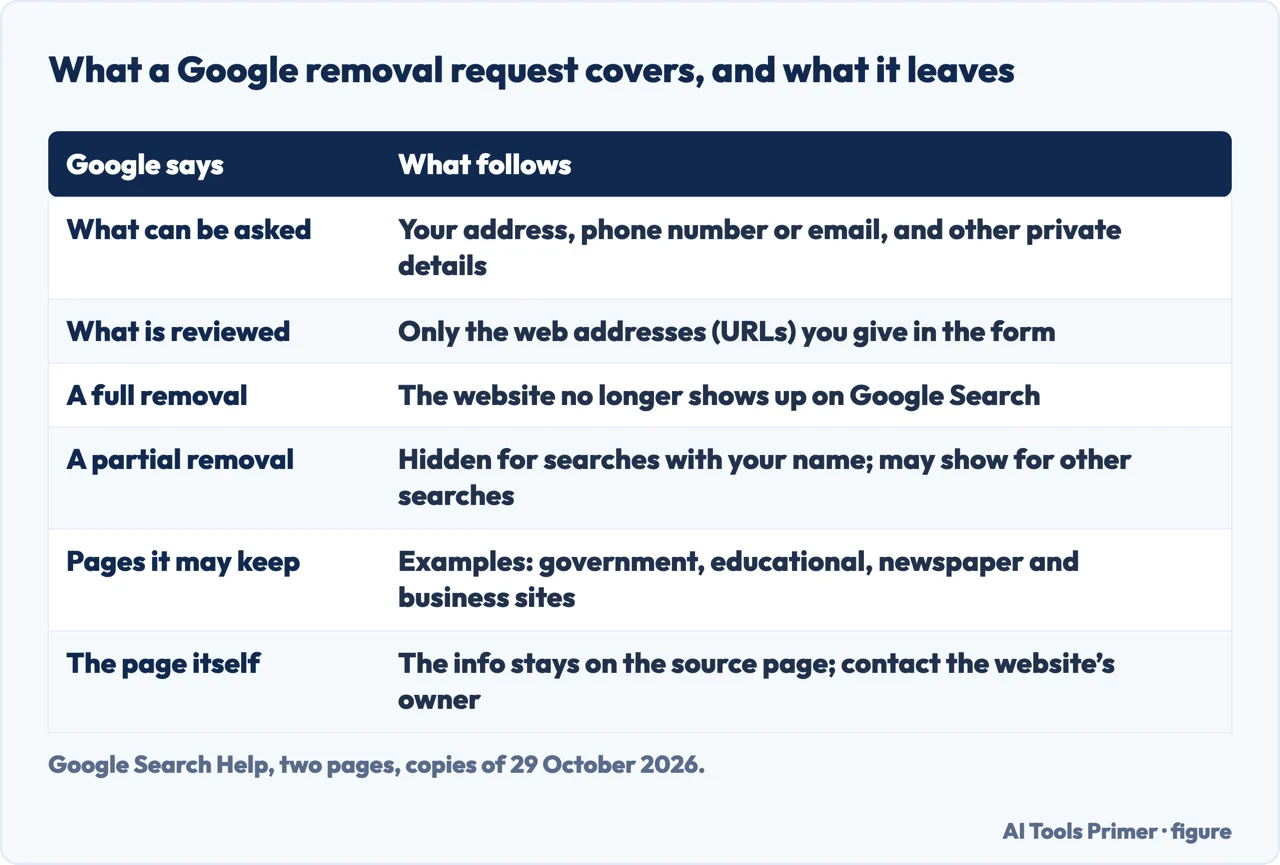
Google’s Search Help page on removing private info from Search lists what you can ask to be removed: your address, phone number or email; confidential government IDs such as Social Security or tax ID numbers; a bank account or credit card number; pictures of your signature or ID; private records like medical records; and confidential usernames and passwords. A tip on that page sends anyone looking for results with an address, phone number or email to the Results about you feature, which can also set up notifications for new results. We keep the steps for that tool on our page about Results about you and do not repeat them here.
Google says that if the information is about you, you or a representative can ask for it to be taken down. The request form asks for the website addresses (URLs) of the pages that have your information, and Google says only those URLs are reviewed. To find results that show your contact info, its Results about you page suggests searching for your name and your home city, or your name and your home address; our page on searching for yourself goes through that kind of search. In the form, one type of contact info is enough, an old address can be entered if that is what the result shows, and the same URL does not need several requests.
Google describes two outcomes. In a full removal, the website no longer shows up on Google Search. In a partial removal, it does not show up for searches that contain your name or identifier but might show up for something else. For requests made through Results about you, the page says in most cases an approved URL does not appear for any search query; the exceptions, which Google calls query-based removal, are covered on our Results about you page.
Two limits come from Google itself. The first is that it can only remove things from Google Search results: whether a request is approved or denied, the information still exists on the source web page, and for that Google says to contact the website’s owner. It adds that people might still find the information through links, social media or other search engines. The second is that Google considers some results valuable to the public, and gives government or educational websites, online newspapers and business websites as examples; for a result from a site like that, the page says there is no Remove result option.
After a request, Google says you get an email confirmation within a few hours, and the Results about you page shows whether each request is in progress, approved, denied or undone. It also says there may be a delay between approval and the result disappearing, and that you can check whether the information is gone within a few hours after approval. The pages we read do not say how long the delay lasts. Separately, NNEDV warns that after data brokers remove your information, search results may still show previews of the pre-removal information for a period of time, and it points to its own guide on removing sensitive content from the internet, which we did not open.
People search sites, one by one
The FTC says most of these sites have a way to ask them to stop selling your information, which it calls opting out. The sites let you opt out of sharing certain types of information, like your address or phone number, but not other information, like sex offender status. There are two ways, it says: do it yourself, one by one, for free, or pay a service to do it. After you opt out, the site stops selling your existing information. Its steps for doing it yourself are four:
- Search for your name or other identifying information on a people search site, starting with a phone number or address.
- If you find a report with information about you, look for a link about opting out and follow the steps. If there is no link, search online for the site’s name with phrases like “opt out” or “remove my information”.
- Repeat those two steps on other people search sites.
- Check the sites periodically, and submit a new opt-out request if you find new information.
The FTC adds that the process may ask you for information to verify your identity. Privacy Rights Clearinghouse wrote in 2017 that some sites ask for detailed personal information, such as a state-issued ID, before suppressing the data, and that this often deters people from asking; it left the decision to the reader.
Which sites to start with is a question NNEDV answers with a search. Its method is to search combinations of your name and the current and former towns you have lived in, look at the sites and profile links on the first two pages of results, list the ones that show current information on you or close relatives, and opt out of each. Its example uses searches such as a name with Houston, Texas, then Dallas, Texas, then Texas alone. Most opt-outs need an email address or phone number, and NNEDV says a new email address can be created for the forms. It lists three possible aims: only the most popular data brokers, those easiest to find in a search for your name, or as many as possible. For instructions it points to the free do-it-yourself guides from DeleteMe, Incogni and Optery, noting that all three also sell paid removal.
One worked example comes from Security.org, a site that links to paid removal services, in a page updated on 9 June 2026. For Whitepages it says to search your name on whitepages.com, click View Details, copy the web address of your page, paste it into the Whitepages opt-out page and click Next, then press Remove Me, give a reason and enter a phone number to get a call with a verification code. It warns not to press View Full Report, which asks for payment. We read those steps on Security.org, not on Whitepages.
The FTC lists limits. Your information may still appear in the reports of relatives, neighbors or associates, and if the information in your public records changes it could reappear for sale. NNEDV makes the same point about new data coming in and says that if you do manual opt-outs you can keep a list and check those sites every 3-6 months, while paid services do the checking for you. The two differ on timing: the FTC gives no interval, and NNEDV gives a range. NNEDV also suggests repeating the work for relatives who live with you or have lived with you, because a search for your name can lead to their records; it notes that most data brokers require you to say you are opting out for yourself or for someone who gave permission.
On effort, Consumer Reports published in August 2020 an article by Mara Hvistendahl whose headline calls the job nearly impossible. The article says that people who track the problem estimate between six business days and two weeks of full-time work to delete data from brokers’ sites, that the author’s own opt-outs spread over months, and that the sites kept trawling driver’s license registration records, voter registration databases and address information from the U.S. Postal Service to build listings to replace the removed ones. The author then joined a service that charged $129 per year, and wrote that even dedicated services miss some of the sites. That is a 2020 account, not a current price. For what a paid service scans, sends and charges today, see our page on removal services; the FTC asks three questions before signing up: how many sites it covers, whether it gives a report on them, and how often it scans and deletes what reappears. California residents have a free state request called DROP, which our page on data broker opt-outs covers.
What stays public
Both the FTC and NNEDV draw the same line. The FTC says opting out of people search sites does not delete your information from public records, so someone could find public records about you on a government website. NNEDV says removing information from data brokers does not delete the original records the brokers used, for example court or voter records, but that to get them a person would need to make more effort, know more about the sources and how to get them, or spend more money. It adds that for some sources, like property records, your options are limited. The pages we read do not explain how to take an address out of property records.
NNEDV also says that it is difficult, if not impossible, to fully remove your data from all data brokers. Security.org, a site that links to paid removal services, says an address may be online for various reasons, that it is a matter of public record and that it can be found on Whitepages unless you have specified otherwise.
On legal rights, Privacy Rights Clearinghouse wrote in 2017 that no federal law gives a right to see, correct or opt out of the data brokers hold, unless the broker is a credit reporting agency. We did not check whether that has changed. It described two California rules: victims of domestic violence, stalking or sexual assault registered with the Safe at Home program can submit an opt-out form that prevents an online data broker from posting their information, and designated California public safety, elected or appointed officials have a right under Government Code section 6254.21 to have home addresses and telephone numbers removed from the Internet.
A different address for the mail
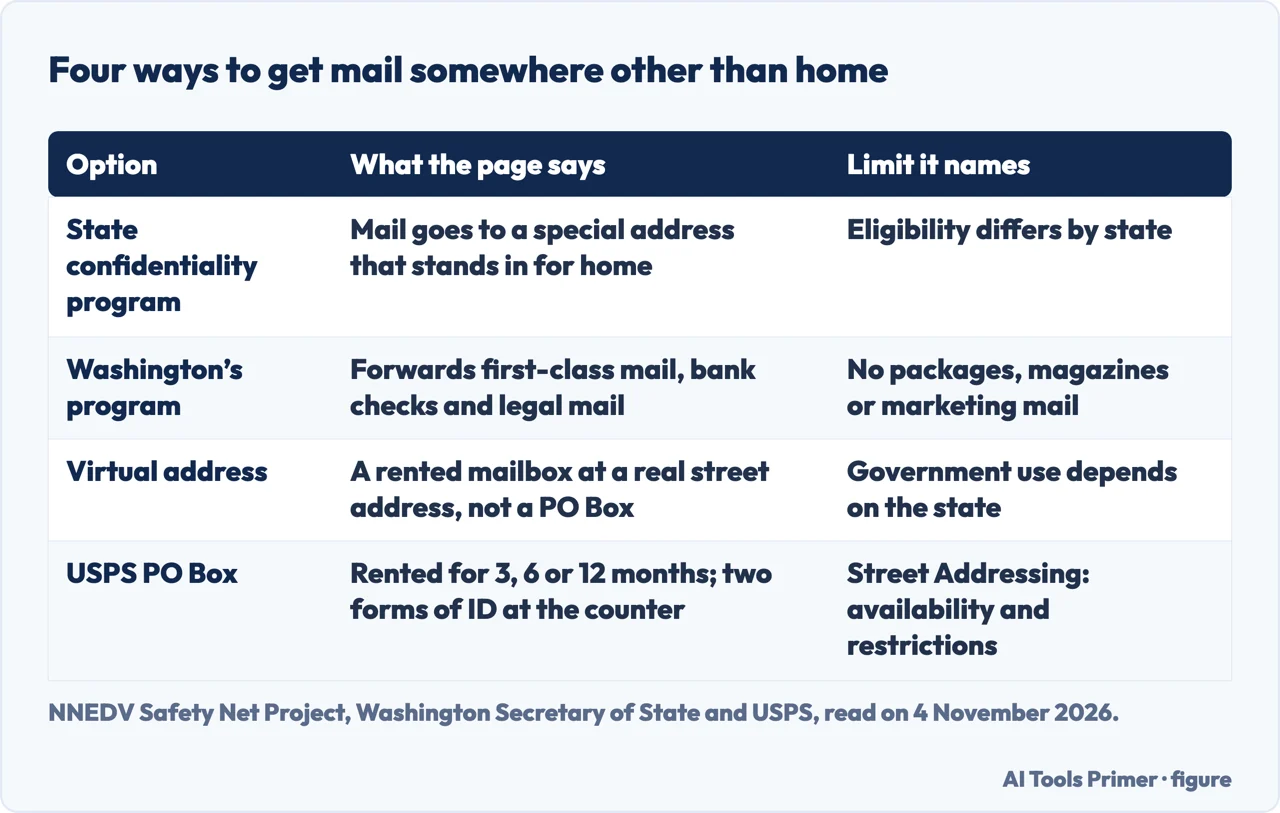
NNEDV points to the records themselves. It writes that most US states have an address confidentiality program (ACP) that lets victims of certain crimes, usually domestic violence, sexual assault or stalking, receive mail at a special address that is not where they live and use it for government purposes that ordinarily require a real address, such as a driver’s license or voter registration. The real address is then kept out of those public records, which NNEDV says helps keep it away from data brokers. Programs differ in scope and eligibility, it can help to work with an advocate, and some states require the application to be filled out by one. NNEDV also says some states let other categories of people keep voter registration private and points to a chart from the Election Assistance Commission, which we did not open. It keeps a table of state programs as a PDF, last updated in March 2023, which we did not open either.
Washington’s Secretary of State describes one program in detail. To qualify, an applicant must live in Washington and be an adult survivor of domestic violence, sexual assault, stalking or trafficking who fears for their safety; or be a parent or guardian acting for a minor or incapacitated survivor; or be a criminal justice affiliate, elections official or protected health care worker who is a target of threats or harassment. The page adds that the program is most effective if the applicant has recently moved or plans to. An applicant meets an advocate designated as an Application Assistant to create or review a safety plan and threat assessment before applying, and participants are certified for four years unless they withdraw or are cancelled.
On what the substitute address does, the Washington pages say that state and local agencies must accept it, with very few exceptions, and cannot require the real address. Private businesses and federal agencies are not required to accept it but may work with a participant upon request. The office forwards all first-class mail, including registered and certified mail, personal mail, bills, cards, letters and bank checks, but cannot forward packages, magazines or marketing mail. It discloses the real address to a third party only in response to a valid court order or a law enforcement request signed by the agency’s chief officer. Participants are told not to register to vote online or at a state government office. The address, county and voting precinct are confidential, while participation status, the substitute address, the state and records created before enrollment are not. The page also says participation “does not guarantee safety”, that the program is not a crisis center, and to call 9-1-1 in immediate danger.
For someone who does not qualify for a state program, NNEDV names a commercial mail receiving agency, which rents a virtual address: a mailbox at a real street address, not a PO Box, which forwards mail or digitizes it. It lists UPS, US Global Mail, iPostal and Physical Address among examples. Some states may allow a virtual address for a driver’s license or other government needs, and NNEDV says you will need to check with agencies in your state. Even where it cannot be used for government purposes, NNEDV says using it to sign up for consumer services can reduce the information flow to data brokers.
USPS offers a third option. Its PO Box page lists privacy among the reasons to rent one and says terms run 3, 6 or 12 months. To open one you complete PS Form 1093, which the online application generates, and bring two forms of acceptable U.S. identification to the counter; USPS support adds that one must have a photograph and the other must confirm your physical address. Street Addressing, if available, lets you use the Post Office’s street address with your box number to receive packages from carriers such as UPS, FedEx, DHL and Amazon, subject to availability and restrictions. The pages we read do not say whether a PO Box is accepted for a driver’s license or voter registration, and we did not read the USPS Customer Agreement that Street Addressing refers to.
If the address has already been published alongside threats, our page on doxxing, the first hour covers what to do first. NNEDV says doing opt-outs can be stressful, especially with an active or expected threat, that an advocate or a friend may help with the work, and that you can process emotionally through a hotline such as the National Domestic Violence Hotline.
What we did not use
We sent no request to Google and opted out of no site. Google blocked our network with a CAPTCHA on 4 November, so the two Google Search Help pages are the copies we saved on 29 October 2026. We did not open the Google page about blurring a home on Street View, the Electronic Frontier Foundation page, the Minnesota House list of people search sites or the state table that NNEDV links. Incogni’s page is a seller’s, and we took nothing from it. NNEDV’s list of paid services was written in April 2026 and says the descriptions may no longer be accurate; we give no service’s price from it.
Where to start
Four ways in.
- “Why is my address on the internet?”
- Where the address comes from — where
- “How do I stop it showing on Google?”
- Taking it out of Google — google
- “How do I get off those sites?”
- People search sites, one by one — sites
- “What can I give instead of my home address?”
- A different address for the mail — mail
Taking it down
Google, the broker sites and the paid services.
Before and after
Looking, the emergency and the legal right.
Questions people also ask
How can I remove my personal information from the internet for free?
The FTC says you can opt out of people search sites yourself, one by one, for free, and NNEDV points to free do-it-yourself guides. The Google pages we read do not mention a fee for a removal request, and California residents have a free state request called DROP.
How do I stop my address from showing up on Google?
Google says to ask for removal with the web addresses of the pages, or through its Results about you tool. That takes the page out of Google Search results only; the information stays on the source page, so Google says to contact the website’s owner.
Why is my address on the internet?
The FTC says people search sites compile data from public records, public social media profiles and other data brokers. NNEDV adds loyalty cards and advertising IDs, and Privacy Rights Clearinghouse adds warranty cards, sweepstakes entries and surveys.
How much does it cost to remove your information from the internet?
The pages we read give one price: Consumer Reports said in 2020 that a service cost $129 per year. NNEDV’s April 2026 list gives none, and our page on removal services covers current charges. The FTC calls the one-by-one route free.
Not covered here. We tested nothing on a form or a site. The statements come from the FTC, NNEDV, two Google Search Help pages, the Washington Secretary of State, USPS, Consumer Reports, Privacy Rights Clearinghouse and Security.org, read on 4 November 2026 except Google’s, copied on 29 October.
The search volume and difficulty behind this page come from a Semrush reading of 29 August 2026, older than the 60 days the site normally allows, so it expired on 28 October 2026 and should be read again.
Sources
- FTC — What To Know About People Search Sites That Sell Your Information (July 2022) — consumer.ftc.gov, read 4 November 2026.
- NNEDV Safety Net Project — Data Brokers: What They Are and What You Can Do About Them — www.techsafety.org, read 4 November 2026.
- NNEDV Safety Net Project — Address Confidentiality Programs — www.techsafety.org, read 4 November 2026.
- Google Search Help — Remove my private info from Google Search — support.google.com, read 29 October 2026.
- Google Search Help — Find and remove personal info in Google Search results — support.google.com, read 29 October 2026.
- Washington Secretary of State — Address Confidentiality Program (ACP) — www.sos.wa.gov, read 4 November 2026.
- Washington Secretary of State — Do I Qualify? — www.sos.wa.gov, read 4 November 2026.
- Washington Secretary of State — Agencies and Businesses — www.sos.wa.gov, read 4 November 2026.
- USPS — Rent a PO Box — www.usps.com, read 4 November 2026.
- USPS — PO Boxes Support — www.usps.com, read 4 November 2026.
- Consumer Reports — I Tried to Get My Name off People-Search Sites. It Was Nearly Impossible. (August 2020) — www.consumerreports.org, read 4 November 2026.
- Privacy Rights Clearinghouse — Tutorial: Data Brokers and People Search Sites (April 2017) — privacyrights.org, read 4 November 2026.
- Security.org — How to Remove Your Address From the Internet (updated 9 June 2026) — www.security.org, read 4 November 2026.
Written by Alberto Gulotta
Founder and editor of AI Tools Primer, writing from Palermo, Italy. Thirty-five years of taking computers apart, starting with a Commodore 64 — the long version is on the about page.
Something wrong on this page? Write to aitoolsprimer@gmail.com and it gets fixed.
Written on 4 November 2026.
Independence and limits
No affiliate links and no paid placements anywhere on this site. Nobody pays to appear here, and no company has seen this page before you did.
This is general information, not professional advice. Where a page touches money, health, safety or the law, it names its source and the date it was read — and your situation may still differ. See the privacy page and the cookie policy.