
Footprint · guide
People search sites: what the FTC, Experian and NNEDV say
By Alberto Gulotta · Updated · 15 min read
People search sites collect personal details from public records, public social profiles and other data brokers, then sell reports built around a name or phone number. The FTC, Experian and the National Network to End Domestic Violence describe what a report shows, what free covers, and what opting out leaves behind.
| Question | Answer | Where it comes from |
|---|---|---|
| What are they? | A type of data broker that compiles a report about a person and sells it | FTC, Experian |
| Where does the data come from? | Public records, public social profiles and forums, other data brokers, private companies | FTC, Experian |
| Is it free? | Basic results generally are; more detail takes a report or a subscription | Experian, NNEDV |
| Can you opt out? | Most sites have a way; it stops the sale of existing data but leaves the public records | FTC |
| Does it stay done? | Not necessarily: entries can return, so the pages say to check again | FTC, Experian, NNEDV |
What a people search site is
The Federal Trade Commission’s consumer page, dated July 2022, says people search sites, also known as people finder sites, collect personal information about us from a variety of sources, compile it into a report, and sell those reports to anyone willing to pay for them. It calls them a type of data broker, a term it uses for companies that collect information about us and sell or share it with others. Experian’s article of 19 February 2025 files them under the same heading: a data broker is a company that specializes in collecting, storing and selling information. The National Network to End Domestic Violence’s Safety Net Project, in a guide with a 2026 copyright date, calls people search “one important type of data broker” and describes sites that let a visitor search for specific people, phone numbers or addresses.
Whitepages, which sells this service, describes itself as a directory that returns phone numbers, street addresses, email addresses, relatives and public records when you enter a person’s name. We use its pages only for what it says about itself. The FTC lists the reasons people buy a report: finding an old friend, looking up a potential love interest, or connecting with a neighbor. Experian adds a new roommate or a first date, and says private investigators, law enforcement and the media could also turn to these sites. Both pages then name the other side. The FTC says survivors of domestic violence or stalking may not want anyone to find out where they live, and Experian says there is a danger that hackers, identity thieves and stalkers use the sites.
For the wider group of companies, our page on data broker opt-outs covers California’s DROP request and the route elsewhere, and we do not repeat it here.
Where the data comes from, and what a report can show
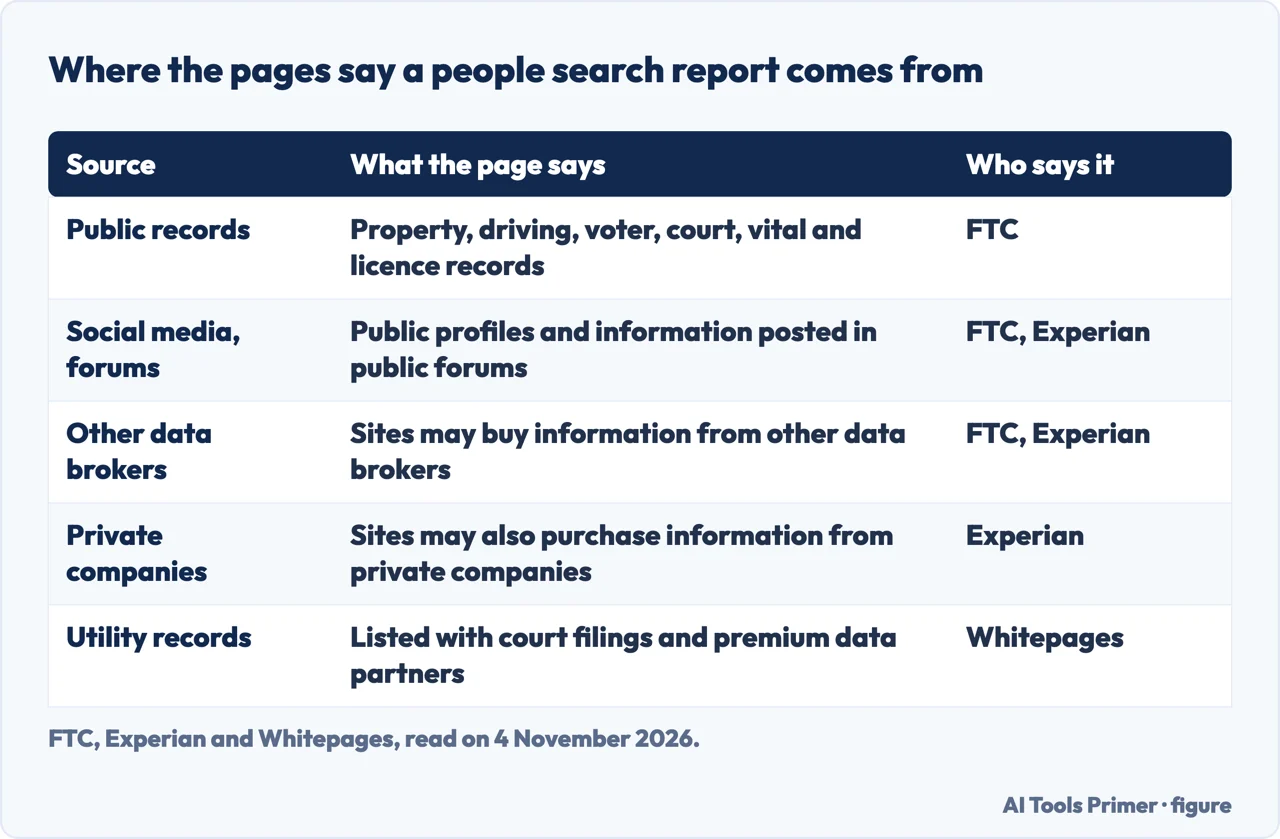
According to the FTC, a site may buy information from other data brokers, collect information from social media profiles that are public or “viewable by everyone”, and compile data from federal, state and local government public records. It lists the records: property, driving, voter registration, criminal records, civil actions and judgments, birth, marriage, divorce and death records, and professional licenses such as those for pilots, doctors, lawyers or architects. Experian adds information posted in public forums and purchases from private companies, including other types of data brokers. Whitepages, for its part, names public records, court filings, utility records and premium data partners.
Someone who has just one piece of information, such as a name or phone number, could buy a report that tells them a lot, the FTC says: age, date of birth and gender; other names used; current and previous addresses; properties bought or sold; marital status; education and employment history; criminal and civil records including bankruptcies, liens and judgments; and the name and address of family members. Experian’s list, which it says varies by person and by site, includes previous names and aliases, past roommates, phone numbers, email addresses, divorces, family members including children, social media profiles, an estimated income, political affiliations and property records.
The NNEDV guide adds two details. It says the “associates” on a profile often mean, in practice, roommates, and that people of any age may find their record blended with other people’s information, especially that of relatives they have lived with. It also says most people’s information gradually appears on these sites in the age range from 18 to the mid-20s. Experian points out that several of the best-known sites are related: PeopleConnect, it says, also runs TruthFinder, Intelius, Instant Checkmate, USSearch and several other people search sites. The same article names sixteen sites in all, including BeenVerified, Radaris, Spokeo and Whitepages.
What it costs, and why free is partial
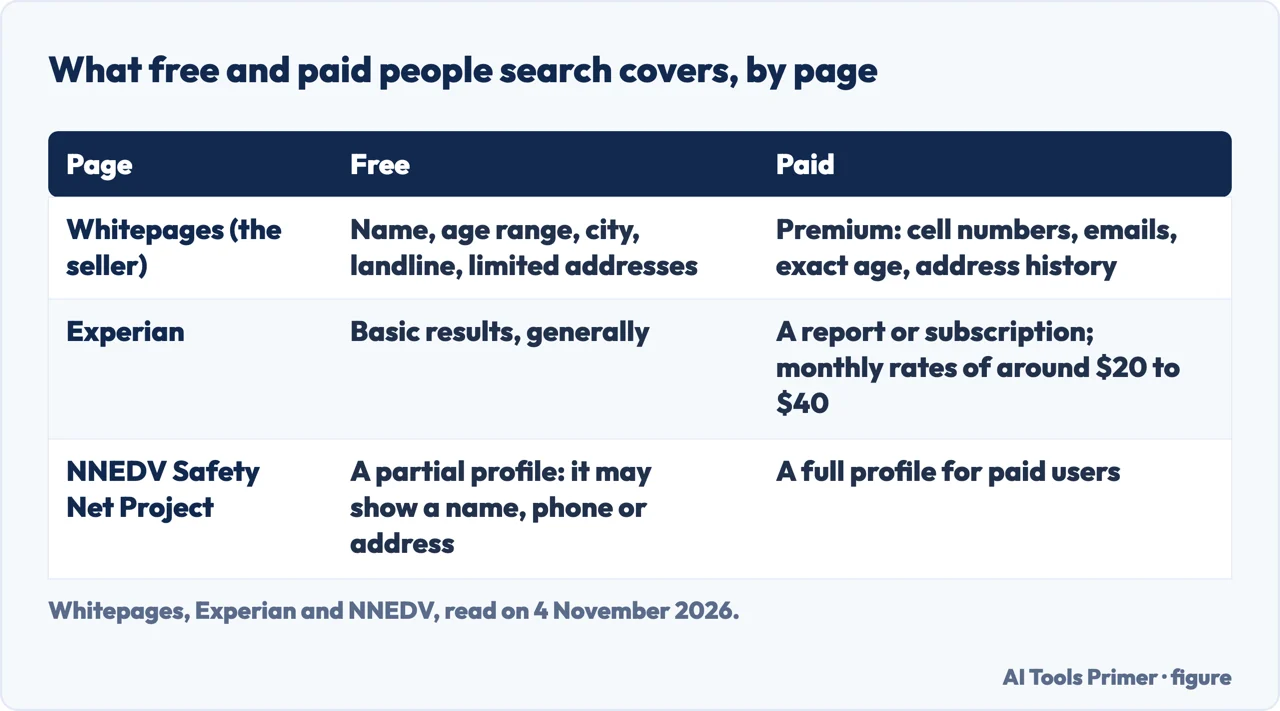
Experian says basic results from these sites can generally be had without paying, but that more details, or several searches, may need a report or a subscription. It says monthly rates may range from around $20 to $40, lower for a multi-month subscription, that some sites offer a short trial for a small fee, that plans can differ between searching by name and a reverse lookup from a phone number, email or address, and that a fee may apply to download a copy of the report. It also says the price is sometimes not visible, and the need to pay not clear, until the end of a lengthy process of looking someone up.
The NNEDV guide describes the same split without prices: a partial version of a profile for free and a full version for paid users, with the partial version still able to include a full name, a phone number, close relatives or even a home address. Whitepages sets out its own line. Its free results list a name, age range, city and state, current and past addresses in a limited view, landline numbers, possible relatives in a limited view, and property ownership status. Premium, it says, adds full phone numbers and email addresses, exact age and date of birth, complete address history, the list of relatives, and background check access.
One warning comes from Fortunly, a site that ranks these services and carries affiliate links, last updated on 1 November 2026. Its FCRA Disclaimer says people search sites are not consumer reporting agencies regulated by the Fair Credit Reporting Act, so they should not be used for tenant screening, reviewing someone’s credit or vetting potential employees. We read the page only for that statement, and the FTC, Experian and NNEDV pages we read do not mention the rule.
Checking what they hold on you
The FTC’s method for opting out starts with a search: look for your name or other identifying information on a people search site, and start with information like a phone number or address. Experian suggests a search of your own name plus the name of the site, and notes that even without a profile of your own, your name could be in the profile of a relative. NNEDV recommends trying combinations of your name and city, both current and previous ones, and looking at the first two pages of results. Our page on searching for yourself covers the general way to do it.
The FTC warns that there are a lot of people search sites. A reader who does not know any by name is sent to the NNEDV guide and to a list from the Minnesota House of Representatives; the second is a PDF we could not read, so we did not use it. NNEDV says there are dozens of data brokers, and it points to a free list in Michael Bazzell’s book that names over a hundred and which, NNEDV says, takes a month or two to work through at a few a day. The pages we read do not say how many people search sites exist in all.
Experian also offers a personal privacy scan, a one-time free scan that looks for your name, address, phone number and email on people search sites. It is Experian’s own product, and the article says removal help comes with a paid premium membership. Our results about you page covers Google’s tool, which scans search for your phone, address and email, and asks for removal.
Opting out, and what it does not do
The FTC says most people search sites have a way to tell them to stop selling your information, and that you can do it on your own, one site at a time and for free, or pay a service. Its steps: look for the opt-out link on the report that shows you; if there is none, search online for the site’s name with a phrase like “opt out” or “remove my information”; repeat for each further site; check the sites periodically and file a new request if new information appears. It adds that the process may need you to give some information to verify your identity. Experian says these sites typically need to give users a way to opt out, and gives the usual steps: search for your profile, submit a form online, by mail or by fax, click the verification link in an email, then use a private browsing tab several days or weeks later to confirm you no longer appear.
Whitepages has an opt-out form, which is a page the seller itself provides. Its first step, which is all we read, says you can opt out and have your listing removed, and asks you to copy and paste the URL of your profile. The form is marked as one of five steps, and we did not read the other four. NNEDV adds that most brokers ask you to state that the opt-out is for yourself or that you have permission, and that you can create an email address just for the forms.
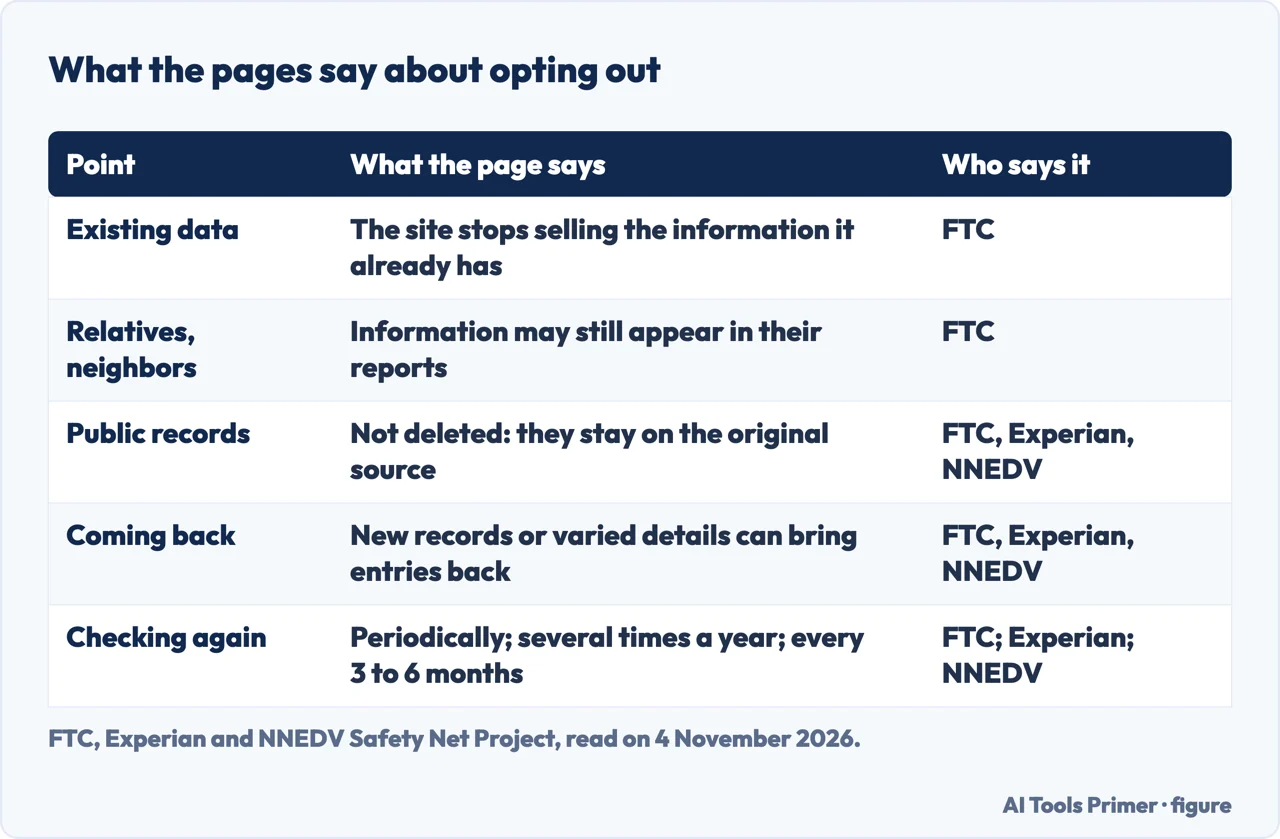
The pages agree on the limits. After an opt-out the FTC says the site will stop selling your existing information, but your information may still appear in the reports of relatives, neighbors or associates, and if your public records change, it could reappear. The FTC adds that sites will let you opt out of sharing some information, like an address or phone number, but not other information, like sex offender status. Experian says the same about the sources: removing an entry does not remove it from the records it came from, and sites regularly check for new information. It adds that a removal can usually be requested but is tricky to keep, and that some states have data privacy laws that can put legal weight behind the request. NNEDV says the original records, such as court or voter records, remain, and that obtaining them takes more effort, more knowledge or more money.
Keeping it short, and checking again
The three pages do not give the same rhythm. The FTC says to check “periodically”. Experian says a new search several times a year may be worth doing, because recent information can be added back, especially if some details vary: its example is a removal under a legal name while new public records are tied to a nickname. NNEDV says to keep a list of the sites you did and check them every 3 to 6 months, and to repeat the work for relatives you have lived with.
On order of work, NNEDV says you may choose to opt out only of the most popular brokers, only those most easily found in search results for your name, or as many as possible, and notes that some have a “trickle down” effect where opting out of one automatically opts you out of others. It describes opting out as mostly a preventative step. It also lists steps further upstream: address confidentiality programs that most states run for victims of certain crimes, a rented virtual address, and for loyalty cards a partial name, a made-up name where the store allows it, an email created for shopping, or a VoIP number.
If you are weighing a paid service, the FTC suggests asking three things before you sign up: how many websites it covers, whether it gives a report of the sites it has opted you out of, and how often it scans those sites and deletes information that has reappeared. Experian says such services tend to be subscriptions that scan and send new requests, and that they might not cover every people search site. NNEDV lists free instructions from DeleteMe, Incogni and Optery, which also sell removal, and says it does not approve any paid service. Our page on removal services covers one test of them. For someone already being targeted, the first hour after doxxing is the better place to begin.
What we did not use
We tested nothing: we searched for no one and sent no opt-out request. We did not read the Minnesota House list that the FTC points to, because the file could not be opened, and we did not read the pages of two other sellers. Fortunly’s ranking was left out, and so was its statement that these sites must offer an opt-out, which we did not check. The pages we read do not say how long a full exit takes, what share of requests are accepted, or give the text of a federal law that makes these sites legal or illegal. Fortunly alone says these sites are legal to use.
Where to start
Four ways in.
- “What do they know about me?”
- Where the data comes from, and what a report can show — data
- “Is it really free?”
- What it costs, and why free is partial — cost
- “How do I get off?”
- Opting out, and what it does not do — optout
- “Will it come back?”
- Keeping it short, and checking again — again
Looking and asking
Finding what is there, and the rights behind a request.
Taking it down
Opt-outs, paid services and emergencies.
Questions people also ask
What is the best free people search site?
The FTC, Experian and NNEDV pages we read do not name a best one. Experian says basic results from people search sites can generally be had without paying, and NNEDV says the free version of a profile is partial but can still show a name, phone number, relatives or an address.
What is a good website to search for people?
The pages we read do not rank sites. Experian names sixteen well-known ones, from BeenVerified to Whitepages, and notes that some share a parent company. Fortunly ranks them, with affiliate links, and we left its list out.
Are people finder sites legal?
Only Fortunly states it: it says the sites are legal to use because they aggregate public data, and adds that they are not regulated by the Fair Credit Reporting Act and should not be used for tenant, credit or hiring decisions. Experian says some states have privacy laws that can put legal weight behind a removal request.
Is there a free website to locate a person?
Whitepages, which sells the service, says its free results show a name, age range, city and state, and landline numbers, with Premium adding cell numbers and emails. NNEDV describes the free version of a profile as partial, and Experian says basic results are generally free.
Not covered here. We tested nothing on a people search site. The statements come from the FTC, Experian, the NNEDV Safety Net Project, Whitepages (a seller, for its own claims only) and Fortunly (for one statement only), all read on 4 November 2026.
The search volume and difficulty behind this page come from a Semrush reading of 29 August 2026, older than the 60 days the site normally allows.
Sources
- FTC Consumer Advice — What To Know About People Search Sites That Sell Your Information — consumer.ftc.gov, read 4 November 2026.
- Experian — What Are People Search Sites? — www.experian.com, read 4 November 2026.
- NNEDV Safety Net Project — Data Brokers: What They Are and What You Can Do About Them — www.techsafety.org, read 4 November 2026.
- Whitepages — People Search (the seller’s own page) — www.whitepages.com, read 4 November 2026.
- Whitepages — Opt-out form, first step only — www.whitepages.com, read 4 November 2026.
- Fortunly — Best People Search Sites (for the FCRA statement only) — fortunly.com, read 4 November 2026.
Written by Alberto Gulotta
Founder and editor of AI Tools Primer, writing from Palermo, Italy. Thirty-five years of taking computers apart, starting with a Commodore 64 — the long version is on the about page.
Something wrong on this page? Write to aitoolsprimer@gmail.com and it gets fixed.
Written on 4 November 2026.
Independence and limits
No affiliate links and no paid placements anywhere on this site. Nobody pays to appear here, and no company has seen this page before you did.
This is general information, not professional advice. Where a page touches money, health, safety or the law, it names its source and the date it was read — and your situation may still differ. See the privacy page and the cookie policy.