Malware · guide
ESET antivirus: what NOD32 covers and what the labs tested
By Alberto Gulotta · Updated · 16 min read
ESET antivirus can mean NOD32, which ESET calls a fast and light program for Windows and macOS, or the ESET HOME Security plans above it. The two 2026 lab reports we read tested ESET HOME Security Essential and ESET Security Ultimate, and the pages we read do not mention NOD32 in either report. The answer depends on the product.
| Question | Answer | Where it comes from |
|---|---|---|
| What is NOD32? | A “fast and light” antivirus for Windows and macOS, for basic browsing, email and gaming | ESET |
| What are the other home plans? | ESET HOME Security Essential, Premium and Ultimate, the 2026 edition | ESET |
| Can I try it first? | A free 30-day trial, and a 30-day return policy with a full refund of the purchase price | ESET |
| What did AV-Comparatives find? | ESET HOME Security Essential blocked 394 of 400 cases, 98.5%, in cluster 2, February to May 2026 | AV-Comparatives |
| What did AV-TEST find? | ESET Security Ultimate scored 6.0 in protection, performance and usability, July and August 2026 | AV-TEST |
| Was NOD32 named in those two reports? | The pages we read do not mention NOD32 | AV-Comparatives, AV-TEST |
| Where is ESET from? | A Slovak company headquartered in Bratislava, founded in 1992 | Wikipedia |
What ESET sells for the home
The name ESET covers two kinds of home product. The first is NOD32 Antivirus. ESET’s page for it calls the program “fast and light” and says it suits basic browsing, email and gaming. The same page says NOD32 can secure only desktop and notebook computers running Windows or macOS, and it points anyone who wants to protect a phone or tablet to ESET Mobile Security for Android.
The second is the ESET HOME Security family. ESET’s protection plans page calls it the 2026 edition and lists three levels: Essential, Premium and Ultimate. ESET says the three are multi-platform solutions that secure Windows, macOS and Android devices under one subscription, and that the buyer chooses how many devices to cover. The VPN limit grows with the level. According to ESET, Premium allows the VPN on up to 3 devices when the plan covers up to 10 devices and on up to 5 when it covers more than 10, while Ultimate allows up to 10 and up to 25. The NOD32 page’s feature table tags VPN for Router, Identity Protection and Ransomware Remediation as Ultimate, and the compare page lists identity recovery with $1M of insurance among the identity features.
The older names have left ESET’s own list. A question on the plans page asks whether ESET Internet Security or ESET Smart Security Premium can still be bought, and the answer says those subscriptions have been replaced by the Essential and Premium tiers. Another question asks whether NOD32 can still be bought, and the answer is yes. ESET adds that NOD32 technology stays at the core of all of its security products, including every ESET HOME Security plan.
What NOD32 includes and what it leaves out
ESET’s NOD32 page lists what is inside. Its feature table for Windows shows antivirus and antispyware, AI-powered threat detection, LiveGrid, Anti-Phishing, Advanced Machine Learning, Multithread Scanning, Gamer Mode and a Small System Footprint. Elsewhere on the page ESET says the machine-learning detection analyzes a threat’s digital DNA, that Gamer Mode pauses background tasks and silences pop-ups during full-screen activities, and that Multithread Scanning is tuned for speed. The page marks the AI security in NOD32 as “limited”, and says advanced AI security capabilities come with the Essential, Premium and Ultimate plans.
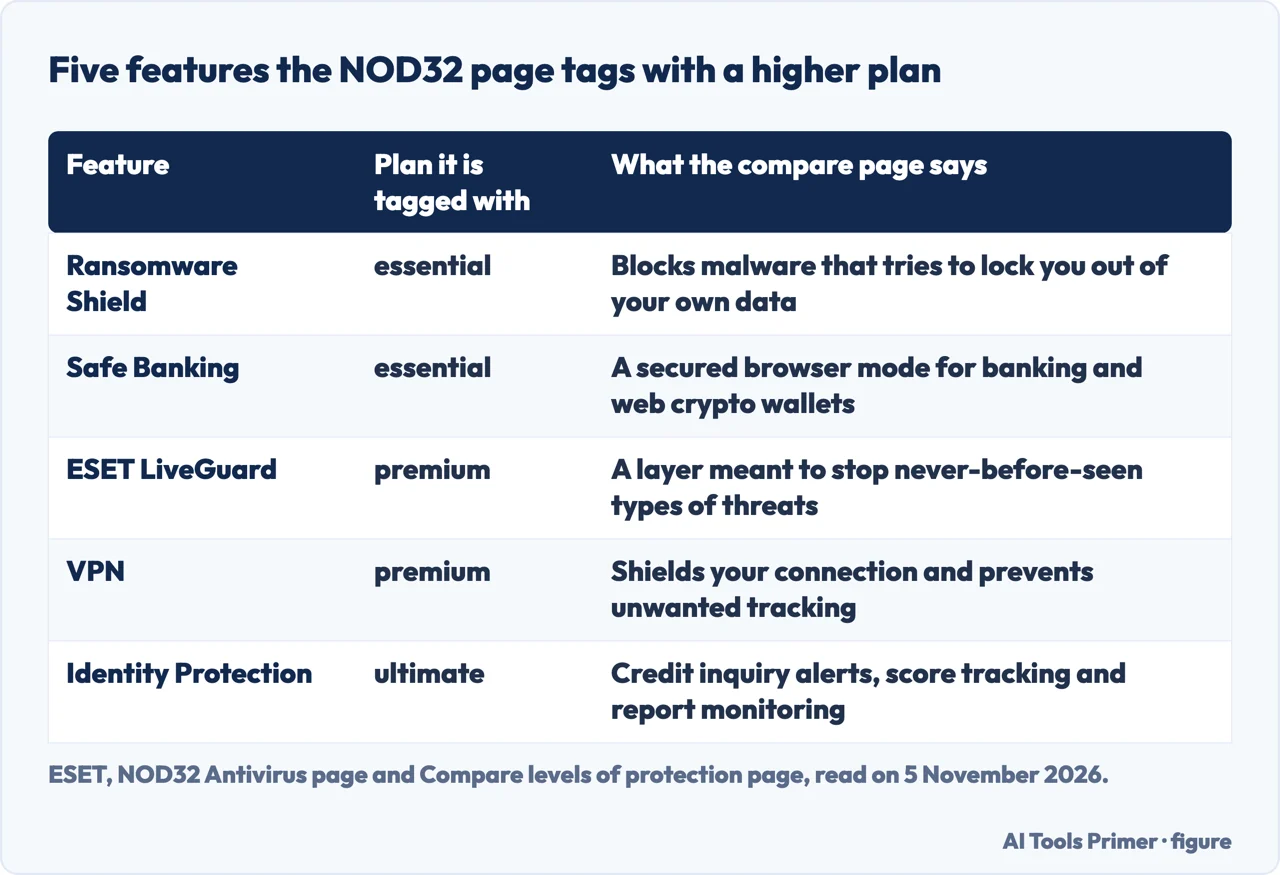
The same table tags other features with a plan name, and ESET’s note above them says that features marked as not included are available in its ESET HOME Security plans. On Windows, Ransomware Shield, Botnet Protection, Anti-Theft and Parental Control carry the tag essential, ESET LiveGuard and ESET Folder Guard carry premium, and Ransomware Remediation carries ultimate. Under privacy, Safe Banking, Safe Browsing, Webcam Protection, Microphone Monitor and several other items are tagged essential, Secure Data and VPN premium, and Identity Protection ultimate. The firewall and network attack protection are tagged essential too. The first figure below sets five of these tags beside the one-line description the compare page gives for each.
ESET’s FAQ gives the short version of the difference. It says NOD32 provides antivirus and anti-malware protection and is meant for users who want basic protection without extra privacy features. The HOME plans, it says, offer everything in NOD32 plus online banking protection, ransomware defense, a browser privacy and security extension, identity protection and unlimited VPN.
ESET’s pages do not line up on ransomware. The FAQ on the NOD32 page answers a question about ransomware by saying that Ransomware Shield “detects and blocks threats” that try to lock a user out of their own data. The feature table on the same page tags Ransomware Shield essential, one of the entries marked as not included in NOD32. The plans page then separates two things: Ransomware Shield detects and blocks, while Ransomware Remediation, in Ultimate and Small Business Security, backs up and restores automatically. The pages we read do not say how the FAQ answer and the table tag fit together, so this page reports both.
Requirements, trial and refund
For NOD32, ESET lists Microsoft Windows 10, 11 and higher, with a note that some features are not supported on Windows on ARM, and macOS 13 and higher. The plans page gives more detail. ESET Cyber Security and ESET VPN run on macOS 13 and higher, ESET Mobile Security runs on Android 9.0 and higher, and ESET Mobile Security for iPhone needs iOS 18 or higher. An internet connection is required throughout. VPN for Router needs a router model with VPN client support for OpenVPN or WireGuard. The plans page marks the iOS app as “available soon” and says its release depends on Apple App Store approval.
ESET offers a free 30-day trial. The NOD32 page says the trial has full features and needs no credit card, and the compare page says there is no commitment. On refunds, the plans FAQ says ESET has a 30-day return policy and will give a full refund of the purchase price to a buyer who is not completely satisfied.
The NOD32 and plans pages say the displayed price is valid for the first term only, that prices are subject to change, and that ESET will send a notification email in advance. The ESET pages we read do not include a price figure, so this page gives none of ESET’s; security.org lists its own NOD32 prices, which are not ESET’s. The FAQ also says auto-renew continues until it is turned off in the account, and that turning it off does not cancel the subscription: protection runs until the subscription expires, and ESET says it will notify the buyer before expiration.
What two labs measured
The two lab reports we read for 2026 tested ESET products on Windows 11. The AV-Comparatives and AV-TEST pages we read do not mention NOD32 Antivirus. AV-Comparatives tested ESET HOME Security Essential, and AV-TEST tested ESET Security Ultimate. The numbers below therefore describe the products those two labs named.
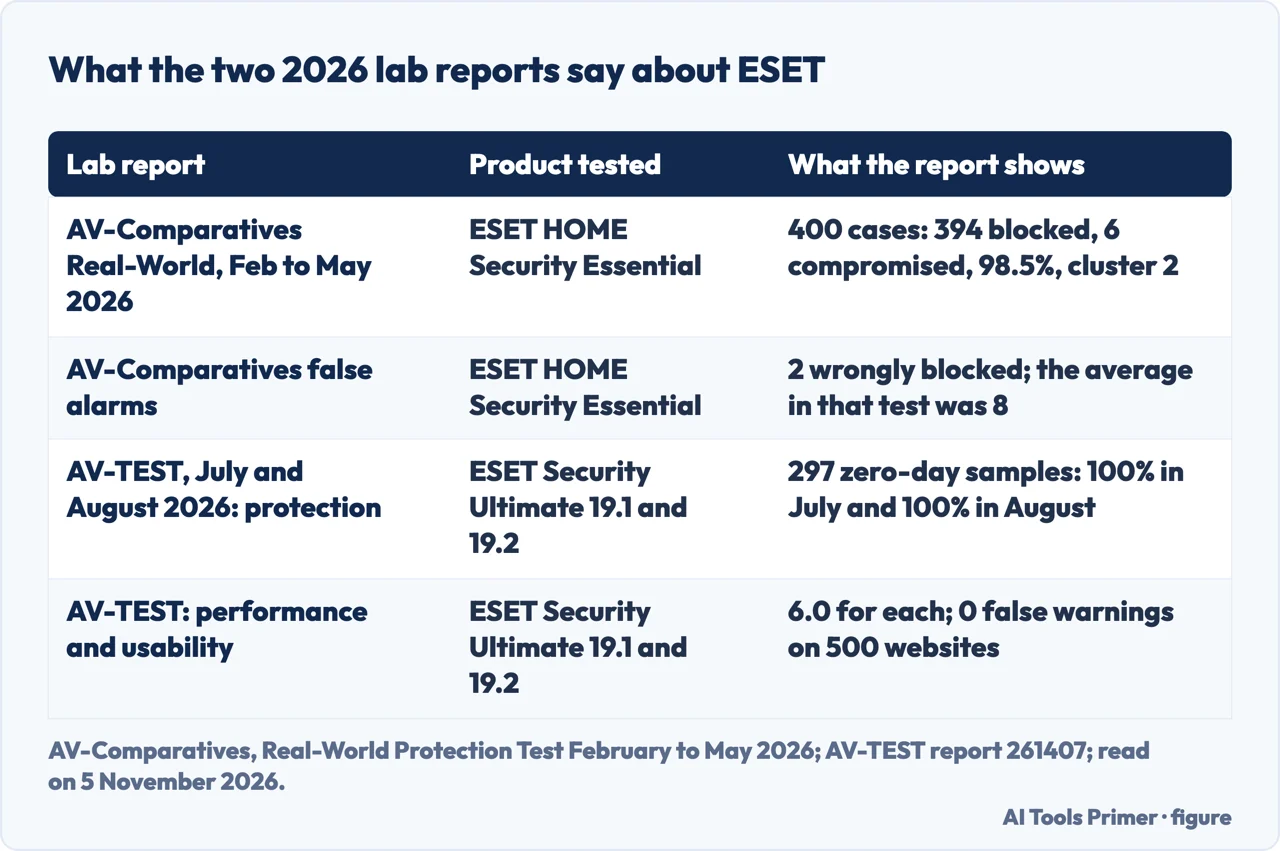
AV-Comparatives. Its Real-World Protection Test ran from February to May 2026 with 400 test cases, was published on 15 June 2026 and included a false-alarm test. The lab allowed the products to update and use their cloud connection. ESET HOME Security Essential blocked 394 of the 400 cases, left 6 compromised, and scored a protection rate of 98.5%, in cluster 2 together with K7 and McAfee. The top rate in the table was Kaspersky’s 399 blocked, 99.8%, in cluster 1. Cluster 1 also holds Bitdefender with 398, Avast, AVG and Norton with 397, Microsoft and TotalAV with 396, and F-Secure and Malwarebytes with 395. On false alarms, ESET had 2 wrongly blocked domains or files, against 0 for Microsoft, 1 for Total Defense and an average of 8 across the test. The lab says that because of the number of test cases it treats all products in a cluster as equally effective, provided their false-alarm rate is below the industry average. ESET appears in the report’s list of award winners, but the award level is shown as a graphic that the text we read does not spell out, so this page does not give it.
AV-TEST. Its report covers July and August 2026, when the lab evaluated 15 home-user security products with default settings on Windows 11 Professional, 64-bit. ESET Security Ultimate 19.1 and 19.2 scored 6.0 out of 6.0 for protection, performance and usability. Protection covered 297 zero-day samples, with 100% in July and 100% in August, and a reference set of widespread malware found in the previous four weeks, also at 100% in both months. For usability, the report shows 0 false warnings on 500 websites. AV-TEST’s scale tops out at 18 points, and 17.5 or more earns its TOP PRODUCT award. The three scores add up to 18, but the page text we read does not show a TOP PRODUCT line for ESET, so this page does not say ESET received it.
The two readings should not be set side by side as 98.5% against 100%. They come from different labs, different months, different sample sets and different ESET products.
Where ESET comes from
Wikipedia, in a page last edited on 5 October 2026, describes ESET as a Slovak cybersecurity company headquartered in Bratislava. It was founded in 1992 by Miroslav Trnka, Peter Paško and Rudolf Hrubý, and grew out of the NOD antivirus program that Trnka and Paško developed in 1987, which ran on MS-DOS. Wikipedia says the company is privately owned and took its name from the Slovak name of Isis, the Egyptian goddess of health, marriage and love. NOD32 1.0 for Windows came out in 1998 and version 2.0 in 2003. Security.org, in a review dated 21 October 2025, also calls ESET a Slovakia-based company founded in 1992, with its first code for NOD written in 1987 in what was then Czechoslovakia.
Wikipedia lists 2,400 or more employees and revenue of €733 million for 2025, and says 40% of the employees work in research. It dates ESET’s macOS products to 2010, and says LiveGrid, a cloud-based reputation system that evaluates unknown samples sent in by ESET-protected devices, replaced ThreatSense.NET in 2011. Among the research it names is the discovery of LoJax, which it calls the first UEFI rootkit found in the wild.
ESET describes itself in larger numbers. Its NOD32 page says it secures over one billion internet users worldwide, with 11 global R&D centers. The user count comes from ESET’s own pages, and the pages we read do not give an outside count. The same NOD32 page also gives the company’s age two ways, as 35+ years in one heading and as 30 years in an FAQ answer.
What an outside review adds, and where the sources differ
Security.org’s ESET review, dated 21 October 2025, carries a notice that the site may earn compensation from some providers. It scores ESET 8.4 out of 10 and says ESET detected 99.8 percent of the most widespread malware. It also reports its own test: it installed NOD32 on a virtual machine running Windows 10 and scanned five files that contained viruses. Four were detected and the .xlsm file was not. Among its drawbacks it lists a cluttered interface and a weak U.S. privacy policy, noting that ESET has one privacy policy for the European Union and another for the United States, and that the data ESET collects includes email address, phone number, IP address and some device fingerprinting. It says the iOS app does not include antivirus protection; the app it describes is called ESET Secure Authentication. Its tip is that NOD32 is more than enough for someone who is only worried about viruses and malware.
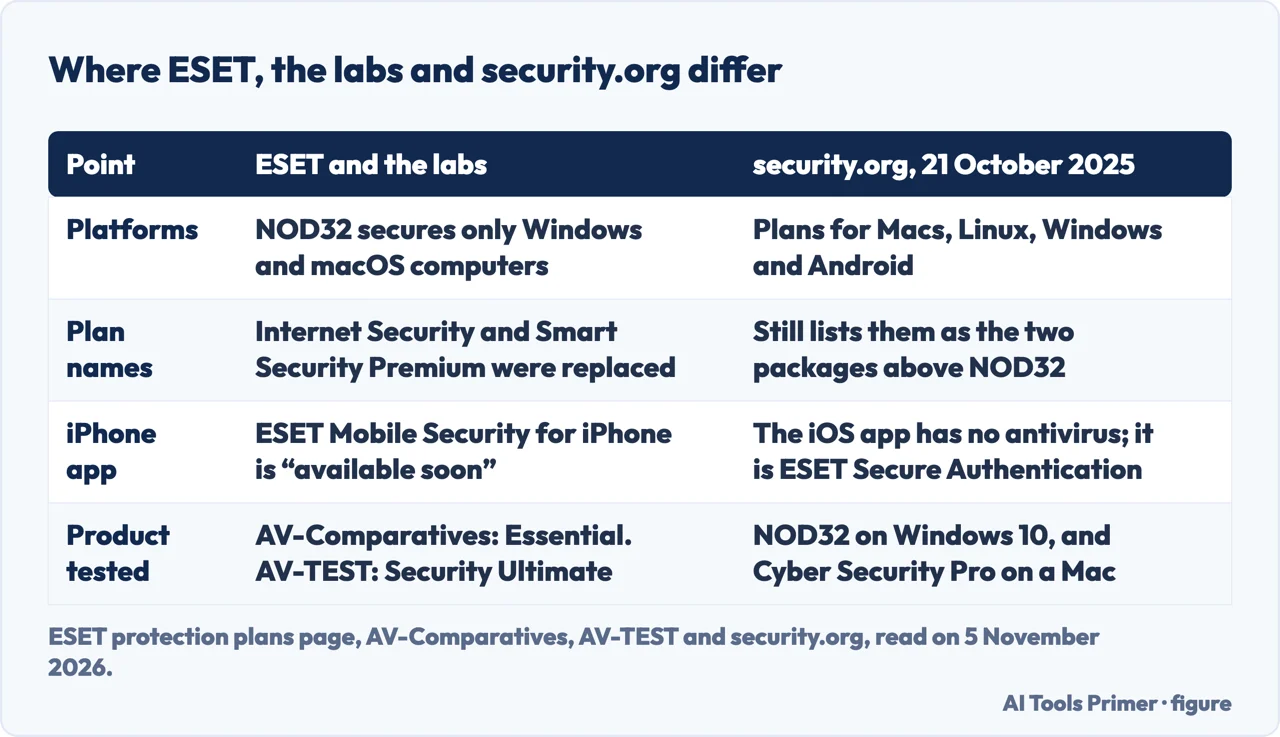
The review differs from ESET’s pages and from the labs on four points, which the third figure sets out.
- Platforms. ESET’s NOD32 page says NOD32 secures only Windows and macOS computers. Security.org describes plans for Macs, Linux, Windows and Android.
- Plan names. Security.org describes three Windows packages: NOD32, ESET Internet Security and ESET Smart Security Premium. ESET’s plans page says the last two have been replaced by Essential and Premium.
- The iPhone. ESET’s plans page says its Mobile Security app for iPhone is available soon, while security.org describes the iOS app it found as having no antivirus.
- What was tested. Security.org tested NOD32 on Windows and Cyber Security Pro on a Mac. AV-Comparatives tested ESET HOME Security Essential and AV-TEST tested ESET Security Ultimate.
Some questions stay open in the pages we read. ESET’s own pages do not give a price for its products; the prices in the security.org review are that site’s figures, dated 21 October 2025, and are not repeated here. They do not report a lab test of NOD32 Antivirus or a lab test of ESET on a Mac. They do not compare ESET with Norton in one table, apart from the AV-Comparatives results above. The award level in the AV-Comparatives report is not in the text we read. Customer reviews and forum threads are not among the pages we read either.
Where to start
Six ways in.
- “Which ESET product is which?”
- What ESET sells for the home — products
- “What does NOD32 leave out?”
- What NOD32 includes and what it leaves out — nod32
- “What does it need, and can I try it?”
- Requirements, trial and refund — requirements
- “Is it good in the lab tests?”
- What two labs measured — labs
- “Is ESET Russian?”
- Where ESET comes from — origin
- “What do reviews say?”
- What an outside review adds — outside
The other programs
ESET is one of several names, and each of these pages reads one of the others.
Around the program
What antivirus software does, how to scan, and how to tell whether anything got through.
Questions people also ask
Is ESET a reliable antivirus?
The pages we read give two lab readings, both on products other than NOD32. AV-Comparatives put ESET HOME Security Essential at 98.5% in cluster 2 for February to May 2026, with 2 false alarms. AV-TEST gave ESET Security Ultimate 6.0 for protection, performance and usability for July and August 2026. The periods and samples differ.
Is ESET Antivirus Russian?
Wikipedia describes ESET as a Slovak cybersecurity company headquartered in Bratislava and founded in 1992. Security.org calls it Slovakia-based. The NOD software it grew from dates to 1987, in what was then Czechoslovakia.
What are the disadvantages of ESET?
Security.org lists a cluttered interface, a weak U.S. privacy policy and an iOS app without antivirus. ESET’s own NOD32 page tags features such as Ransomware Shield, the firewall, Safe Banking and VPN with a higher plan and marks them as not included in NOD32.
Is ESET better than Norton?
The pages we read do not compare them directly. In AV-Comparatives’ February to May 2026 table, Norton blocked 397 of 400 (99.3%, cluster 1) with 5 false alarms, and ESET HOME Security Essential blocked 394 (98.5%, cluster 2) with 2. The lab treats products in one cluster as equally effective.
Not covered here. We tested nothing on a computer. The statements come from three ESET pages (NOD32 Antivirus, Compare levels of protection and Protection plans), an AV-Comparatives report, an AV-TEST report, a security.org review dated 21 October 2025 and the Wikipedia article on ESET, last edited on 5 October 2026, all read on 5 November 2026. The ESET pages we read carry no date.
The search volume and difficulty behind this page come from an Ubersuggest reading of 5 November 2026 (United States), inside the 60 days the site normally allows; the difficulty is Ubersuggest’s own SEO score, not Semrush’s, and awaits confirmation.
Sources
- ESET — NOD32 Antivirus for Windows and macOS (features, requirements, FAQ) — www.eset.com, read 5 November 2026.
- ESET — Compare ESET’s levels of protection for your devices — www.eset.com, read 5 November 2026.
- ESET — ESET Home Cyber Security Plans (2026 edition, requirements, refund, FAQ) — www.eset.com, read 5 November 2026.
- AV-Comparatives — Real-World Protection Test February to May 2026 — av-comparatives.org, read 5 November 2026.
- AV-TEST — ESET Security Ultimate 19.1 and 19.2 for Windows 11, July and August 2026 — www.av-test.org, read 5 November 2026.
- Security.org — ESET Internet Security and Antivirus Review 2026 (updated 21 October 2025) — www.security.org, read 5 November 2026.
- Wikipedia — ESET (last edited 5 October 2026) — en.wikipedia.org, read 5 November 2026.
Written by Alberto Gulotta
Founder and editor of AI Tools Primer, writing from Palermo, Italy. Thirty-five years of taking computers apart, starting with a Commodore 64 — the long version is on the about page.
Something wrong on this page? Write to aitoolsprimer@gmail.com and it gets fixed.
Written on 6 November 2026.
Independence and limits
No affiliate links and no paid placements anywhere on this site. Nobody pays to appear here, and no company has seen this page before you did.
This is general information, not professional advice. Where a page touches money, health, safety or the law, it names its source and the date it was read — and your situation may still differ. See the privacy page and the cookie policy.