
Malware · guide
What is a botnet? What the FBI, CISA and the FTC say
By Alberto Gulotta · Updated · 9 min read
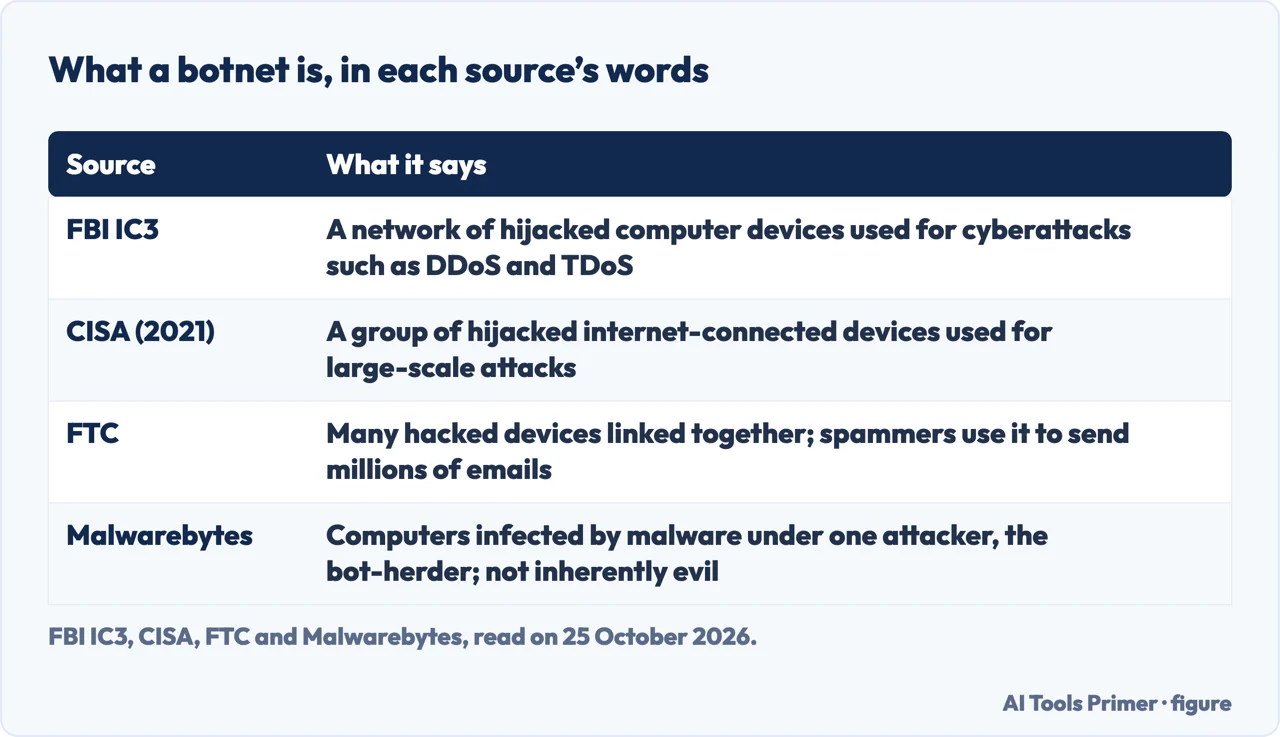
What is a botnet? The FBI calls it a network of hijacked computer devices used for cyberattacks such as DDoS attacks. CISA says its infected devices are victims too, and the FTC says spammers use botnets to send millions of emails. This page sets out their definitions, Mirai, the signs and fixes, and where the vendors differ.
| Question | Answer | Where it comes from |
|---|---|---|
| What is a botnet? | A network of hijacked computer devices used for cyberattacks such as DDoS and TDoS attacks | FBI IC3 |
| What do the infected devices do? | They take part in attacks and are also victims of them | CISA |
| Which devices are targeted? | Home routers, network cameras and digital video recorders in the 2016 Mirai attacks | CISA |
| What do botnets send? | The FTC says spammers use them to send millions of emails at once | FTC |
| Are they illegal? | Malwarebytes says operating one for malicious purposes is highly illegal | Malwarebytes |
What the FBI, CISA and the FTC say it is
The FBI’s Internet Crime Complaint Center defines a botnet as a network of hijacked computer devices used to carry out cyberattacks such as Distributed Denial of Service (DDoS) and Telephony Denial of Service (TDoS) attacks or other nefarious activities. It defines a DDoS attack as one that overwhelms servers with a high level of internet traffic originating from many different sources, making it impossible to mitigate at a single source, and notes that DDoS-for-hire services let any motivated actor conduct disruptive attacks regardless of experience. CISA, in a page dated 1 February 2021, says attackers often leverage a botnet, a group of hijacked internet-connected devices, to carry out large-scale attacks by controlling numerous devices through command and control software. It adds that botnets may be rented out to attack-for-hire services, which allow unskilled users to launch DDoS attacks.
The FTC explains it for consumers: when many hacked devices link together they make up a botnet, a network spammers use to send millions of emails at once. It says millions of computers, phones and internet-connected devices such as smart cameras or voice assistants are part of botnets, and that most spam is sent this way. That is the answer to what is a botnet in one line from each: hijacked devices, controlled together, used for attacks and spam.
Mirai in 2016, and routers in 2026
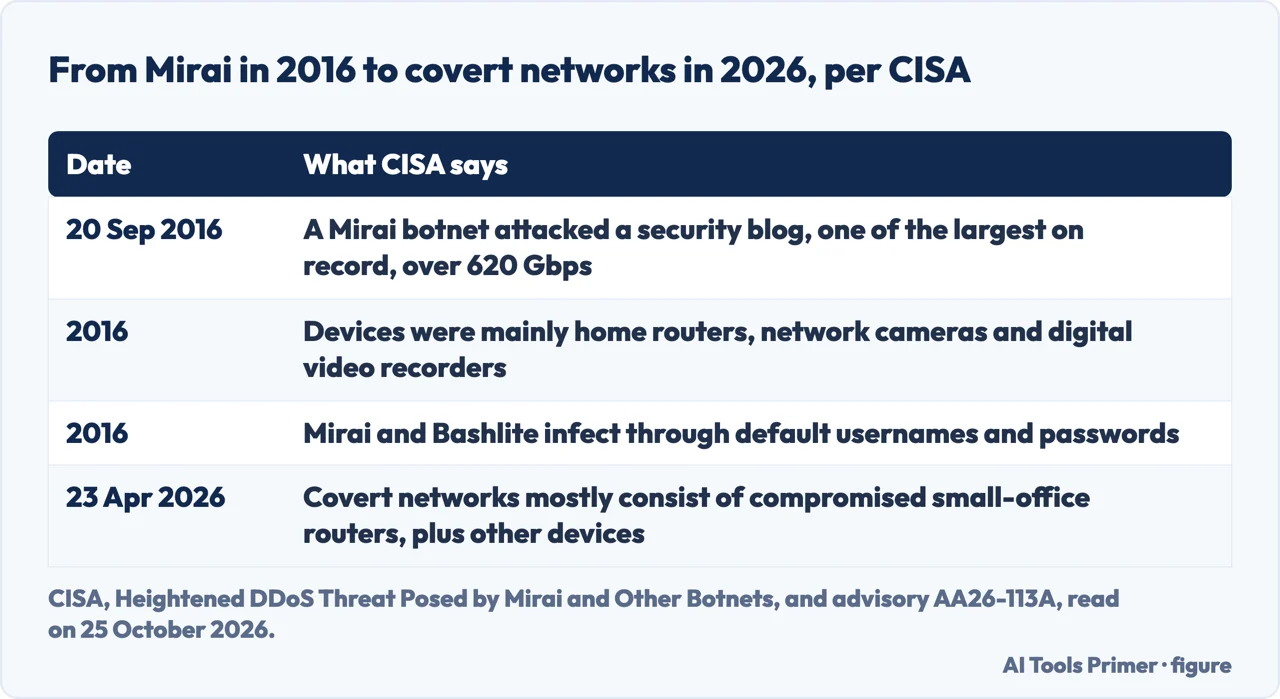
CISA’s alert on Mirai and other botnets, last revised on 17 October 2017, describes IoT botnets as networks of devices infected with self-propagating malware. On 20 September 2016 a security blog was targeted by a DDoS attack, one of the largest on record, exceeding 620 gigabits per second, created by an IoT botnet powered by Mirai. CISA says Mirai continuously scans the internet for vulnerable IoT devices and uses a short list of 62 common default usernames and passwords to scan for them; the devices affected were primarily home routers, network-enabled cameras and digital video recorders. Bashlite, another malware family, also infects through default usernames and passwords, and the publication of Mirai’s source code increased the risk of more botnets.
A CISA and UK NCSC advisory published on 23 April 2026 describes a shift: China-nexus actors moving from individually procured infrastructure to large-scale networks of compromised devices, which it calls covert networks. It says they mostly consist of compromised small office and home office routers but pull in any vulnerable device that can be exploited at scale. It names Raptor Train, which in 2024 infected more than 200,000 devices worldwide and was made up of thousands of routers and IoT devices such as web cameras and video recorders, firewalls and network-attached storage, and the KV Botnet. Malwarebytes tells the Mirai story too, with routers and security cameras and weak default passwords, and SentinelOne names GameOver Zeus as a botnet that stole money from enterprises through phishing emails.
How to tell, and what to do
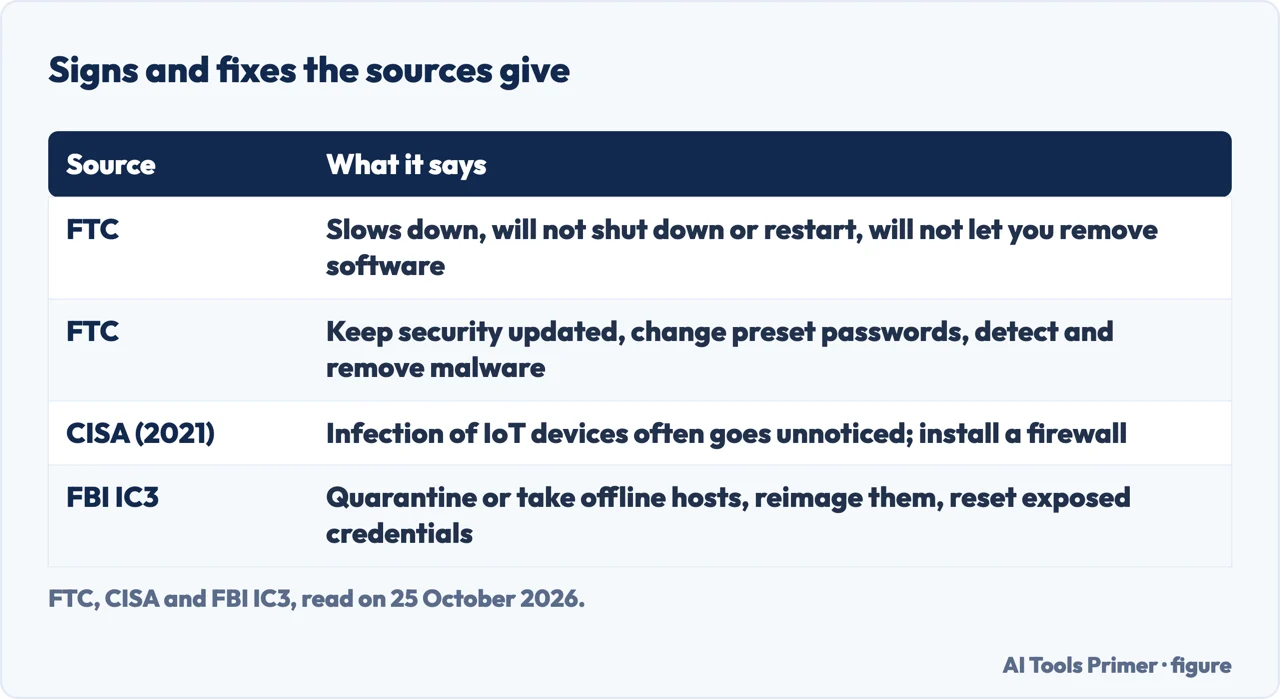
The sources agree it is hard to tell. CISA says infection of IoT devices often goes unnoticed by users, and that an attacker could compromise hundreds of thousands of them without the owners’ knowledge. The FTC lists warning signs: a device that suddenly slows down, won’t shut down or restart, or won’t let you remove software. Fastly asks whether a device randomly began running slowly or became very hot without unusual use. CISA warns that the symptoms of a DoS attack can resemble non-malicious availability issues, and says the best detection is monitoring network traffic through a firewall or intrusion detection system.
The fixes are plain. The FTC says to keep your device’s security updated, change preset passwords because hackers know how to find default passwords easily, and detect and remove malware; it also mentions slowdowns, legal trouble if attacks are traced to you, and identity theft if hackers stole your personal information. CISA recommends installing a firewall. The FBI’s advice for an organization under attack is to quarantine or take offline affected hosts, reimage compromised hosts as soon as possible unless told to preserve them for forensics, reset exposed credentials and file a complaint. For the signs on any computer see how to tell if your computer has a virus.
Illegal, or not necessarily? Where the sources differ
Malwarebytes, which sells security software, says there is nothing inherently evil about a botnet: botnets can perform repetitive tasks and let an operator speed up work by using participants’ resources, and it points to crowdsourced scientific experiments as an example. It also says that operating one for malicious purposes is highly illegal and violates laws on unauthorised access, computer intrusion, data breaches and cybercrime in many jurisdictions. In the pages we read, the FBI, CISA and the FTC describe the devices as hijacked or hacked and give no legitimate use. The two positions are not in conflict about attacks; they differ about the word.
Vendors add the technical picture that the public pages leave out. Palo Alto Networks, Fastly and SentinelOne describe how the bots receive instructions: from a command and control server or, as Fastly and SentinelOne say of newer botnets, peer to peer, so that bots pass on commands without a central server. Palo Alto and SentinelOne call the infected devices zombies, SentinelOne and Malwarebytes call the operator a bot-herder, and SentinelOne says a bot-herder may sell or rent control of the botnet. None of the vendor pages we read says, as CISA does, that the infected devices are themselves victims of the attack, or names small office routers as the base of the 2026 covert networks. Several of these companies sell security products.
Where to start
Four ways in.
- “Just the definition.”
- What the FBI, CISA and FTC say — what
- “An example.”
- Mirai and routers — mirai
- “Am I in one?”
- Signs and fixes — signs
- “Is it illegal?”
- Where sources differ — differ
Malware, explained and removed
Signs, trojans and removal.
Questions people also ask
How do I know if I am in a botnet?
It is hard to tell. The FTC lists slowdowns, a device that will not shut down or restart, or will not let you remove software; CISA says IoT infections often go unnoticed.
What is a botnet example?
Mirai, which CISA says infected home routers, network cameras and digital video recorders in 2016, and Raptor Train, which CISA and the NCSC say infected more than 200,000 devices in 2024.
Are botnets illegal?
Malwarebytes says operating a botnet for malicious purposes is highly illegal in many jurisdictions, and that botnets are not inherently evil. The FBI, CISA and the FTC describe hijacked devices.
What is the difference between a botnet and malware?
Malware is the software; the botnet is the network of devices infected with it and controlled together. Malwarebytes describes a botnet as computers infected by malware under one attacker.
Not covered here. We did not find or analyse a botnet. The statements come from the FBI’s Internet Crime Complaint Center, CISA (the Mirai alert, last revised 17 October 2017; the denial-of-service page, 1 February 2021; the advisory AA26-113A, 23 April 2026), the FTC’s consumer advice on spam, and vendor pages by Malwarebytes, Palo Alto Networks, Fastly and SentinelOne, used for what they claim. The IC3, FTC and vendor pages carry no date that we could read.
Wikipedia, Reddit and a Huntress page behind a browser check were not used. Law differs between countries; Malwarebytes’s statement is general.
The search volume and difficulty behind this page were read in Semrush on 29 August 2026.
Sources
- FBI Internet Crime Complaint Center — Botnets, DDoS, and TDoS — www.ic3.gov, read 25 October 2026.
- CISA — Heightened DDoS Threat Posed by Mirai and Other Botnets (last revised 17 October 2017) — www.cisa.gov, read 25 October 2026.
- CISA — Understanding Denial-of-Service Attacks (1 February 2021) — www.cisa.gov, read 25 October 2026.
- CISA and NCSC — Defending Against China-Nexus Covert Networks of Compromised Devices, AA26-113A (23 April 2026) — www.cisa.gov, read 25 October 2026.
- FTC — How To Get Less Spam in Your Email — consumer.ftc.gov, read 25 October 2026.
- Malwarebytes — What is a Botnet? — www.malwarebytes.com, read 25 October 2026.
- Palo Alto Networks — What is a Botnet? — www.paloaltonetworks.com, read 25 October 2026.
- Fastly — What is a botnet? — www.fastly.com, read 25 October 2026.
- SentinelOne — What is Botnets in Cybersecurity? — www.sentinelone.com, read 25 October 2026.
Written by Alberto Gulotta
Founder and editor of AI Tools Primer, writing from Palermo, Italy. Thirty-five years of taking computers apart, starting with a Commodore 64 — the long version is on the about page.
Something wrong on this page? Write to aitoolsprimer@gmail.com and it gets fixed.
Written on 25 October 2026.
Independence and limits
No affiliate links and no paid placements anywhere on this site. Nobody pays to appear here, and no company has seen this page before you did.
This is general information, not professional advice. Where a page touches money, health, safety or the law, it names its source and the date it was read — and your situation may still differ. See the privacy page and the cookie policy.