
Scams · guide
Verification code scam: the stories and the steps the pages give
By Alberto Gulotta · Updated
A verification code scam asks you to read out or forward a code sent to your phone or email. The FTC and the FBI describe several stories around that one request, and what each code opens; Apple and WhatsApp describe their own codes. Their steps for a code already given sit on separate pages, so we order them ourselves.
| Question | Answer | Where it comes from |
|---|---|---|
| What is the code for? | It is the second key after your password; a login needs both | FTC, 2024 |
| What do the scammers say? | That your account has a problem, that they want to check you are real, or that your provider has seen odd activity | FTC, FBI, FTC blog |
| Who is the code for? | Only you, at your own login | FTC, Apple, WhatsApp |
| If someone asks for it? | Do not engage, hang up, block the number, stop texting, and report it | FTC, 2024 |
| If it is already given? | Change the password, turn on two-factor authentication, and ask the payment method about any money sent | FTC, 2026 |
Why someone wants the code
The FTC’s page of March 7, 2024, starts from the ordinary case. When you log into your bank or credit card account, it says, you might get a text message or email with a verification code, which you enter at the login screen to confirm it is really you. The FTC calls that a form of two-factor authentication. It compares the account password and the code to the lock on a doorknob and a deadbolt: if you unlock the doorknob but not the deadbolt, you cannot get in. The same goes for a scammer, who needs both keys, and that is why the FTC says scammers try to trick you into sharing the code.
The FTC’s page on two-factor authentication adds what the code is like. A passcode sent by text or email is typically six digits long but can be longer, it is good for one login and it expires automatically. The same page lists the limits. Hackers can take over a phone number through a SIM card swap and receive the text messages sent to it, verification codes included, before you notice. If the code comes by email, the FTC says to protect the email account with a strong password and two-factor authentication. And if a text or email code is the only option an account offers, the FTC calls it better than nothing, but says an authenticator app or a security key is safer where available, because an app’s passcode is not exposed to a SIM swap.
Our page on SMS codes for two-factor goes through the limits of a code sent by text in more detail, and the pages on a Shop code or a Link code cover a code that arrives with nobody asking.
Apple and WhatsApp describe their own codes in the same spirit. Apple’s support page, published on September 26, 2024, says never to give your Apple Account password, verification codes, device passcode, recovery key or account security details to anyone else, and says Apple does not ask for this information. WhatsApp’s help page says the registration code has six digits, arrives by SMS or phone call (or by email if you added and verified one earlier), and is not to be shared with anyone. The FTC and the FBI give the general rule; Apple and WhatsApp describe the code of one service each.
The stories the pages describe
The bank or identity story. The FTC’s 2024 page says the scammer pretends to be someone you can trust and says there is a problem with one of your accounts, or that someone is using your identity. The scammer may know some things about you, may sound very convincing, and may sound sympathetic, offering to help you set things right. Then comes the request for the verification code to get into your account. If you give it, the FTC says, the scammer can log in and transfer all the money out of your savings or investment accounts.
The buyer or the pet finder. The FTC’s page of October 29, 2021, says the scammers go after people who list something for sale on Craigslist or Facebook Marketplace and people looking for a lost pet. They say they want to buy the item or that they found the pet, then feign hesitation: they have heard about fake listings and want to verify that you are a real person, or that you are the true owner of the pet. They send a text message with a Google Voice verification code and ask you for it. The FBI’s Portland office told the same story on January 4, 2022. It adds that you do not need a Google Voice account to be hit, that the contact arrives by text or email, that the sender says the code from Google will confirm you are a person and not a bot, and that the code reaches you as a text message or a voice call and is followed by a request to repeat it.
The provider’s alert. An FTC blog post dated July 1, 2015, on the Military Consumer site, tells a story with a different order. A hacker who has someone’s email address and mobile number goes to the login screen, clicks “Forgot Password” and asks for a code by text message. The code arrives on the real owner’s phone. Then a second text, pretending to come from the email provider, says it has detected unusual activity and asks the owner to reply with the code. The post says the owner forwards it and the hacker has what is needed to finish the login.
The senior official. The FBI’s Internet Crime Complaint Center issued a public service announcement on December 19, 2025, about messages that claim to come from a current or former senior U.S. official. The contact starts by text or voice message and moves quickly to an encrypted messaging application. Among the later requests the notice lists is one for an authentication code, which lets the actors link their own device to the victim’s contacts.
The registration code. WhatsApp’s pages do not tell a scammer’s script. They describe what the code is, a six-digit registration code, and what recovery looks like when someone else has taken over an account. We use them in the steps below.
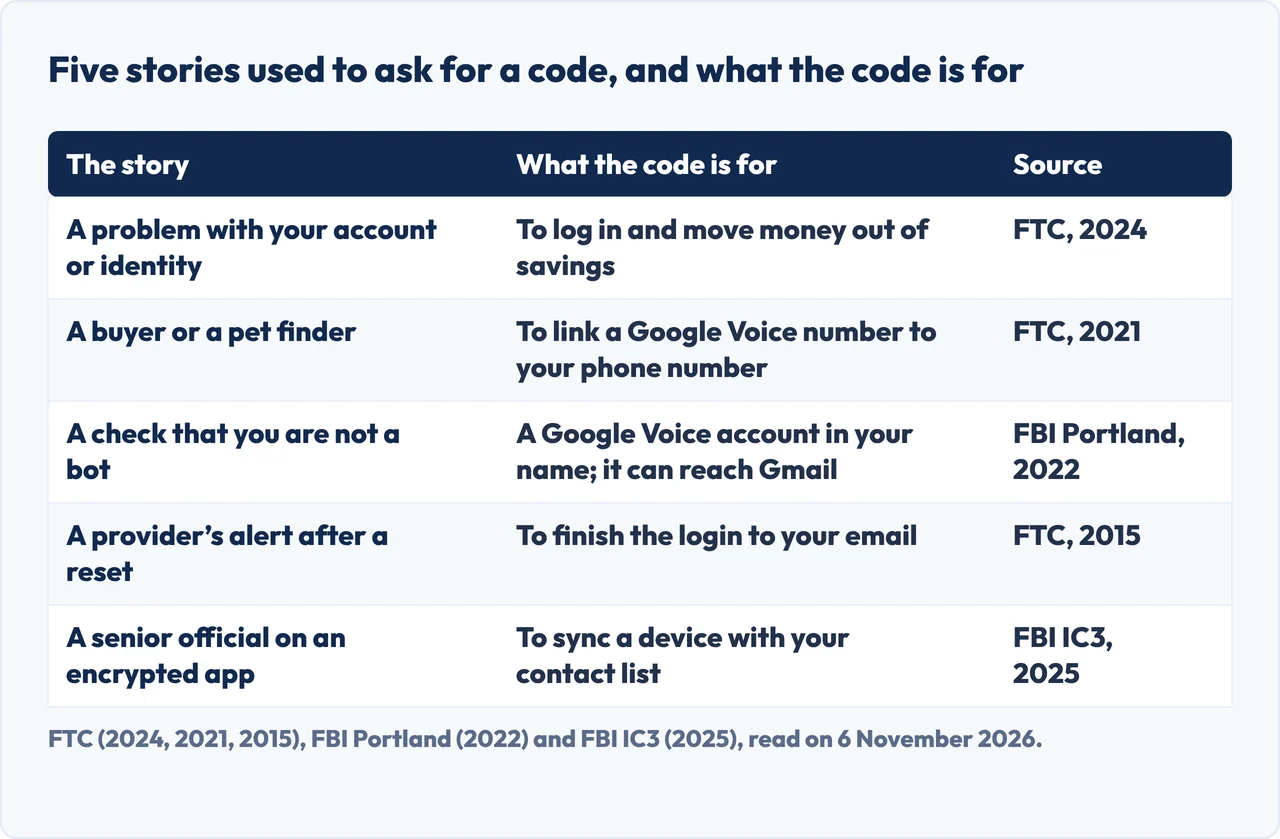
What the code lets someone do, by source
The pages do not agree on one outcome, because the code is for a different thing in each story. The FTC’s 2024 page ends in the money: log in to the account and move it out. The FTC’s 2021 page says the scammers use the code to try to create a Google Voice number linked to your phone number, and that the number can be used to rip off other people while concealing the scammer’s identity. It adds that these scammers are sometimes after other information about you as well, and that with enough of it they could pretend to be you to reach your accounts or open new ones in your name.
The FBI’s Portland page describes the Google Voice account being set up in your name, with your real phone number as the verification, and adds that the code can also be used to gain access to, and take over, your Gmail account. The FTC’s page does not mention Gmail, and neither page says that the Google account is always taken: the FBI says the code can be used that way. In the IC3 notice, the contact list is the prize. With access to it, the notice says in a footnote, the actors send out another round of messages, impersonating the last victim or another notable figure the new target would logically know.
In the 2015 FTC post, what the hacker gets is the email account. The post says the hacker could gather a lot of information while snooping through the email and could change the settings so that future emails are forwarded to the hacker, and that it could be a long time before the owner notices. The FTC’s page on hacked accounts explains why email matters so much: someone inside an email account can request a password reset link for any of your other accounts, take the link from your inbox, change the password and lock you out.
For WhatsApp, the help page says that someone who has taken over an account can impersonate you in chats and groups, which is why it tells you to notify family and friends. It also says that WhatsApp encrypts chats end to end and keeps messages on your own device, so a person who registers your number on a new phone cannot read your earlier conversations.
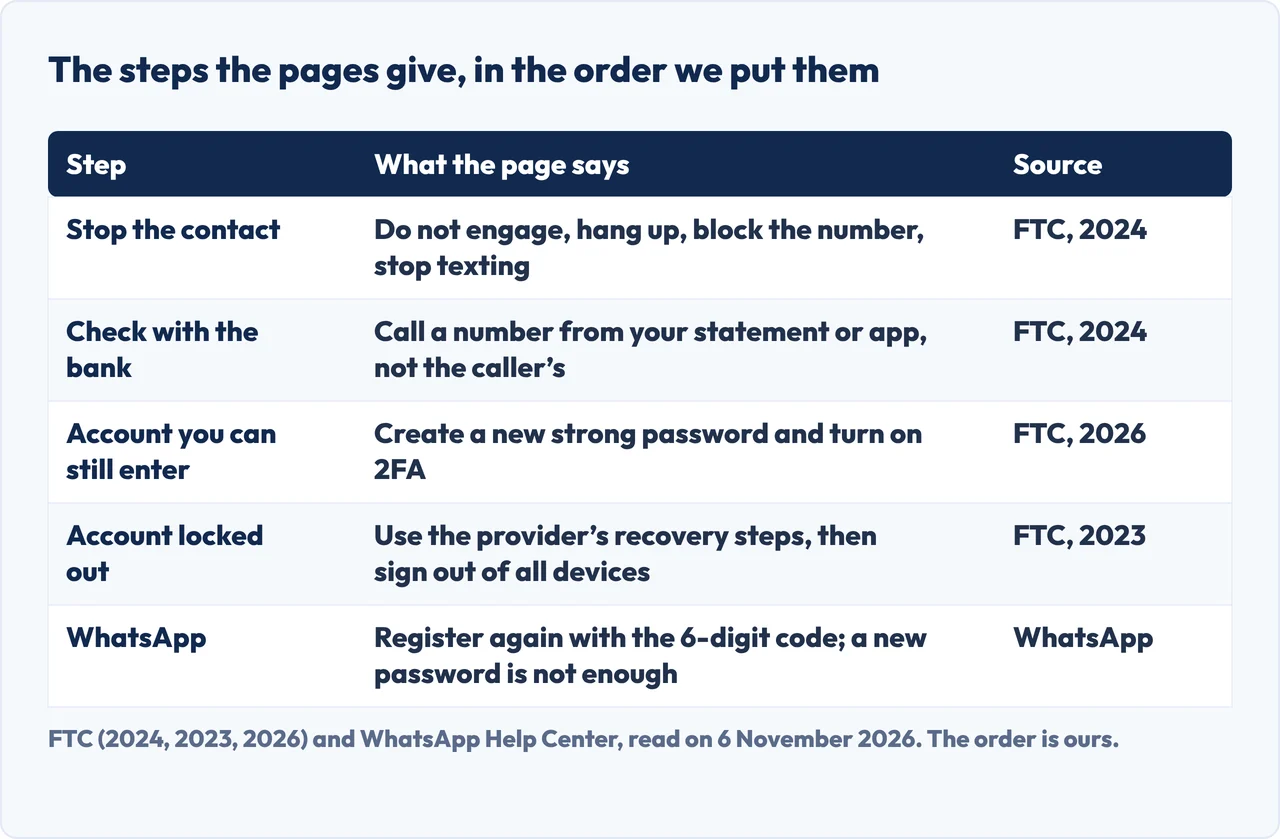
The steps the pages give, in the order we put them
The pages we read do not frame this as a ten-minute routine, and the steps do not appear together in a single list. The order here is ours, made from steps that sit on different pages, and each step names the page it comes from.
1. Stop the contact. If someone asks for your verification code, the FTC’s 2024 page says not to engage: hang up, block the number, stop texting, and then report it at ReportFraud.ftc.gov. The FTC’s 2015 post adds a rule for the code itself: use it only on the login page, and if a code you did not request arrives, let your provider know, since it could be a sign that someone is tampering with your account.
2. If a bank is involved, call it yourself. If you are worried about a problem with an account, the FTC says to contact your bank, credit union or investment advisor directly, using a number you trust, such as the one on your statement or in your app. It says the number the caller gave you will take you to the scammer.
3. If you can still log in, change the password and turn on 2FA. The FTC’s June 2026 page says to create a new, strong password for the account that was compromised, to change it on any other account where you use the same one, and to turn on two-factor authentication. Apple’s page adds that if you get a notification of a change you do not remember making, someone else may have accessed the account and you should change the password immediately. The FBI’s December 2025 notice says to keep two-factor authentication on, never disable it, and never hand a code to anyone over email, SMS or MMS, or an encrypted messaging app.
4. If you are locked out, follow the provider’s recovery steps. The FTC’s page on hacked accounts, from August 2023, lists the signs: you cannot log in, you get a notice of a username or password change you did not make, a login from a device or place you do not know, or friends report messages you did not send. It says to make sure your computer’s security software is up to date and run a scan first, then follow the provider’s recovery instructions, and it links to those for Facebook, Google, Instagram, LinkedIn, Microsoft, WhatsApp, X and others. After you are back in, it says to change the password, sign out of all devices, turn on 2FA, check that the recovery email addresses and phone numbers are yours, look for email rules that forward your messages and delete any you did not set, look through the sent and deleted folders, and tell your contacts.
5. If it was a Google Voice code. The FTC says to follow Google’s steps to reclaim your number, and the FBI says to check Google’s website for how to take back control of the account.
6. If it was a WhatsApp code. WhatsApp says the only way to remove someone who has taken over your account is to register the account again with the six-digit code sent to your phone number; changing the password does not remove them, and re-registering logs out every device. If you are asked for a two-step verification PIN you do not know, it says to wait 7 days and try again. It says to tell family and friends, and warns that reporting the account you are trying to recover can get it banned, so it recommends recovering first. It also says an account cannot be recovered without a SIM card holding the same phone number.
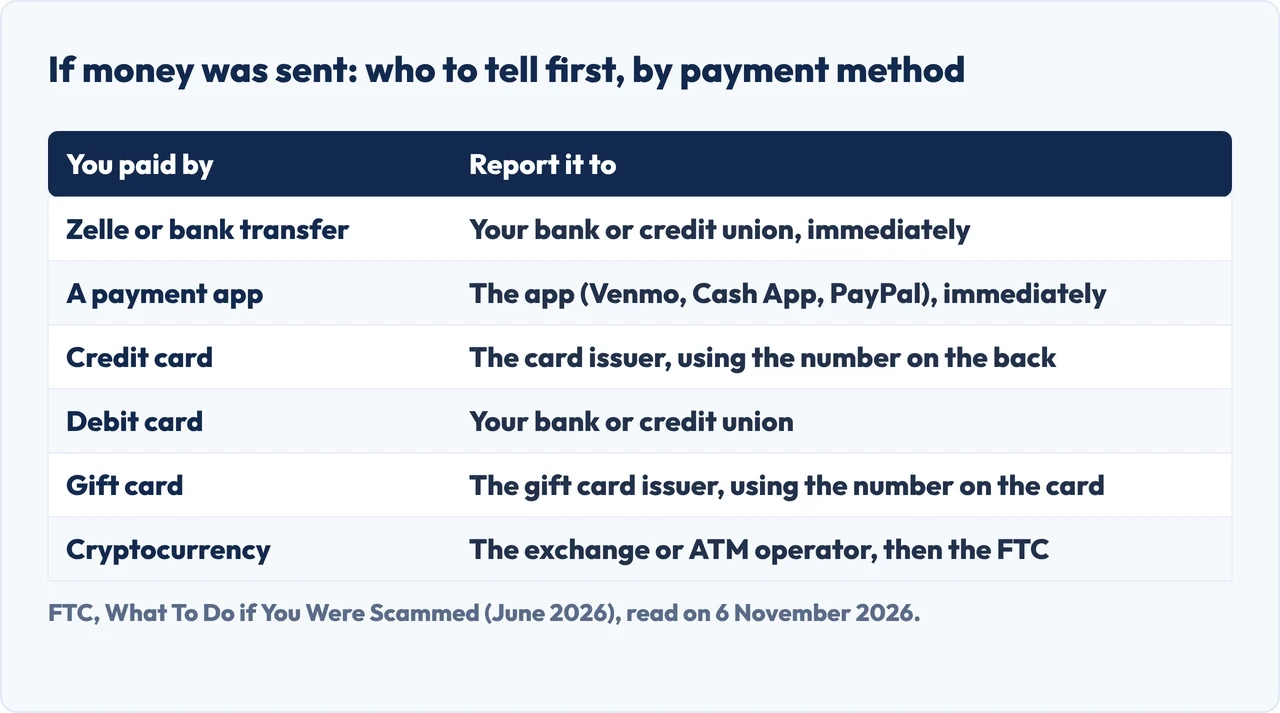
If money went, and if more than a code was given
The FTC’s page What To Do if You Were Scammed, dated June 2026, starts with a warning: scammers ask you to pay in ways that make them hard to track, so if you paid, your money might be gone already, but it is always worth asking the company you used to send it whether there is a way to get it back. The page gives a different first call for each way of paying, and our table follows it. For Zelle or a bank transfer, and for a payment app such as Venmo, Cash App or PayPal, it says to report it right away and ask for the payment to be reversed and refunded. For a credit card or a debit card, it says to report the use to the issuer or your bank immediately, using the number on the back of the card, and says federal law protects you from unauthorized use of those cards. For a gift card, it says to contact the issuer. For cryptocurrency, it says to contact the exchange or the ATM operator and to report it to the FTC, and that cryptocurrency payments do not have the same legal protections as credit and debit cards. The page also covers wire transfers and cash sent by mail or another delivery service.
The FTC’s 2024 page on the verification code does not talk about refunds, and the pages we read do not promise that money comes back or say how long it takes.
If more than a code was given, the same June 2026 page has separate lines. If you gave a scammer your Social Security number and it was used, it says to go to IdentityTheft.gov to report it and get a customized recovery plan; if it was not used or you are not sure, it points to IdentityTheft.gov/databreach. If you gave a scammer access to a phone or computer, it says to update your security software, run a scan and delete what it finds, and change your passwords and turn on two-factor authentication. Our page on what to do after a phishing click covers that situation in more detail.
Where the pages say to report it
The FTC pages we read send you to ReportFraud.ftc.gov, including the 2021 page, which says that sharing a code with someone you did not contact first is a scam, every time. The FBI’s Portland page names ic3.gov or your local FBI office, and the IC3 notice asks victims of the campaign it describes to report to the Internet Crime Complaint Center and, if relevant, to contact their security officials. Our page on where to report scams goes through the forms.
The Portland page also gives advice for the buyer and pet-finder version: deal with buyers, sellers and people who say they found a lost pet in person, use legitimate payment processors, do not give out your email address, and do not let yourself be rushed, since it says pressure may be an attempt at manipulation. For a code that arrives unasked, with no request attached, we have a page on a Link verification code.
About the sources
The pages we read on the code do not give a count of how many people are caught by this scam, and they do not say whether a Google Voice code always leads to a Gmail takeover; the FBI says it can. The FTC’s 2015 post is old.
Where to start
Four ways in.
- “Why do they want my code?”
- Password and code are two keys — why
- “What could they do with it?”
- What the code lets someone do, by source — can do
- “I already gave it.”
- The steps the pages give — steps
- “Money went.”
- The first call for each way of paying — money
Codes that reach your phone
Where a code comes from, and what a text code can and cannot protect.
After the contact
What to do about a click, a call or a report.
Questions people also ask
Why did I get a verification code I didn’t request?
The FTC’s 2015 post says a code you did not request could be a sign that someone is tampering with your account, and that you should let your provider know. In the scheme it describes, the sender had the email address and mobile number, clicked “Forgot Password” and asked for the code by text.
What can someone do with my verification code?
It depends on the story. The FTC says a bank code lets a scammer log in and move money out, and a Google Voice code can link a number to yours. The FBI says an account in your name, with Gmail access. The IC3 notice says a code can sync a device with your contact list.
Why would a scammer send me a code?
In the FTC’s 2021 account, the scammer texts a Google Voice code and asks for it back, to link a number to yours. In the FTC’s 2024 account, the code is the second key to your account, so the scammer needs you to share it.
What is the newest text scam?
The pages we read do not rank text scams by date. The most recent source we used on a specific scam is the FBI IC3 notice of December 19, 2025, which describes texts and voice messages claiming to come from senior U.S. officials and lists a request for an authentication code among the later asks.
The statements come from FTC pages (2024, 2021, 2015, 2023 and June 2026), the FBI’s Portland office, an FBI IC3 notice, Apple Support and two WhatsApp Help Center pages, all read on November 6, 2026.
Sources
- FTC — What’s a verification code and why would someone ask me for it? (March 7, 2024) — consumer.ftc.gov, read November 6, 2026.
- FTC — The Google Voice scam: How this verification code scam works and how to avoid it (October 29, 2021) — consumer.ftc.gov, read November 6, 2026.
- FBI Portland — Oregon FBI Tech Tuesday: Google Voice authentication scams (January 4, 2022) — www.fbi.gov, read November 6, 2026.
- FBI IC3 — Senior U.S. Officials Continue To Be Impersonated (PSA, December 19, 2025) — www.ic3.gov, read November 6, 2026.
- FTC — Use Two-Factor Authentication To Protect Your Accounts — consumer.ftc.gov, read November 6, 2026.
- FTC, Military Consumer blog — A Text Message Mess (July 1, 2015) — www.militaryconsumer.gov, read November 6, 2026.
- FTC — What To Do if You Were Scammed (June 2026) — consumer.ftc.gov, read November 6, 2026.
- FTC — How To Recover Your Hacked Email or Social Media Account (August 2023) — consumer.ftc.gov, read November 6, 2026.
- Apple Support — Security and your Apple Account (September 26, 2024) — support.apple.com, read November 6, 2026.
- WhatsApp Help Center — About registration and two-step verification — faq.whatsapp.com, read November 6, 2026.
- WhatsApp Help Center — How to recover a compromised account — faq.whatsapp.com, read November 6, 2026.
Written by Alberto Gulotta
Founder and editor of AI Tools Primer, writing from Palermo, Italy. Thirty-five years of taking computers apart, starting with a Commodore 64 — the long version is on the about page.
Something wrong on this page? Write to aitoolsprimer@gmail.com and it gets fixed.
Independence and limits
No affiliate links and no paid placements anywhere on this site. Nobody pays to appear here, and no company has seen this page before you did.
This is general information, not professional advice. Where a page touches money, health, safety or the law, it names its source and the date it was read — and your situation may still differ. See the privacy page and the cookie policy.