
Scams · guide
Romance scam: the pattern the FTC, AARP and Secret Service describe
By Alberto Gulotta · Updated · 17 min read
A romance scam is a confidence scheme in which a scammer wins trust through a romantic relationship, then asks for money. The FTC, AARP and the Secret Service describe one path: contact on a social platform or app, a move to private messages, an excuse never to meet, then an emergency, a favor or an investment tip.
| Question | Answer | Where it comes from |
|---|---|---|
| How does it begin? | Contact on social media, a dating app or a messaging app, or a “wrong number” text | Secret Service, AARP |
| Why does the money come late? | AARP says the criminal moves slowly, for weeks or months, before an urgent request | AARP |
| What is asked for? | Money for an emergency, a ticket or a visa; gift cards; an investment | FTC, Secret Service, AARP |
| How is it paid? | Wire transfer, gift card PINs, a money transfer app or cryptocurrency | FTC |
| What does the FTC say never to do? | Send money or gifts to a sweetheart you have not met in person | FTC |
| Does a video call prove who it is? | The Secret Service says video calls and messaging apps are not enough proof | Secret Service |
How it starts: the first message and the move to a private chat
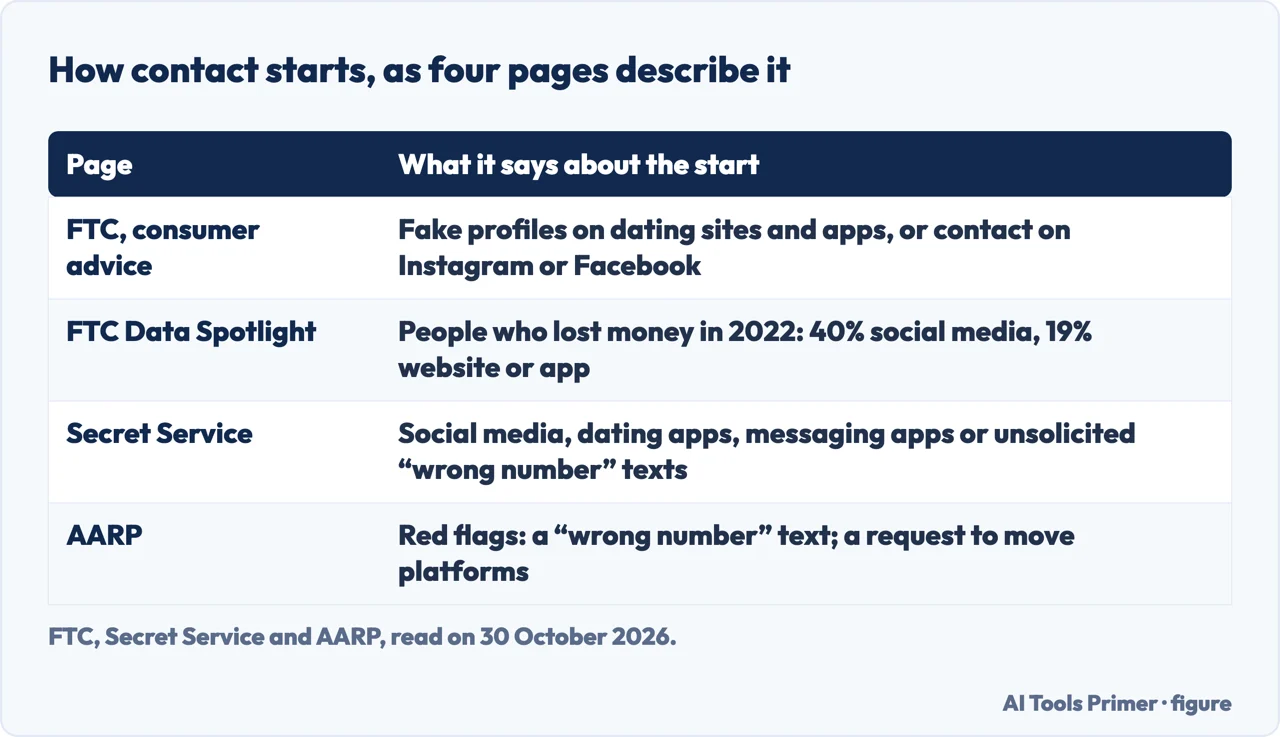
The FTC’s consumer page describes the opening this way: you meet someone special on a dating website or app, and soon the other person wants to email, call or message you off the platform. The story is that the two of you are in love but the other person lives far away, maybe for work or because of the military. The FTC adds that scammers create fake profiles on dating sites and apps, or make contact through Instagram or Facebook, and that they build up trust by sometimes chatting several times a day before making up a story and asking for money.
The Secret Service lists the ways in: social media, dating applications, messaging applications and unsolicited “wrong number” text messages. It says the scammer typically claims to be abroad for work or vacation, or to be from a foreign country, and may offer photos or videos to reassure the victim. AARP gives the same text as its first red flag: if you reply, you will soon find yourself in conversation, and Mark Solomon, president of the International Association of Financial Crimes Investigators, is quoted saying that a relationship is created out of thin air. AARP also says that when the two of you met on a dating site, the scammer will quickly ask for your number or suggest WhatsApp or another messaging platform, because, in Solomon’s words, those companies can identify and block scammers.
The move to another app shows up in the FTC’s numbers too. The FTC Data Spotlight of 9 February 2023 says many people reported that the sweet talk was quickly moved to WhatsApp, Google Chat or Telegram, and a footnote puts the share at about 40% of the 2022 loss reports with detailed narratives, which it defines as at least 2,000 characters long. The same Spotlight says the excuse for not meeting is often baked into the fake identity: a faraway military base is the most popular, and an offshore oil rig worker is another common occupation. The FTC consumer page lists living or traveling outside the country, an oil rig, the military and an international organization. The Secret Service adds immigration problems and a lack of money for travel, and AARP says plans to meet are made but something always comes up.
On how to tell a scammer from a person, the pages we read do not offer one test. They list signs, and the figure below puts four of the pages side by side.
The slow build, and how long it lasts
AARP says what sets a romance scam apart from other scams is speed, or the lack of it. Solomon is quoted saying that instead of an urgent appeal for immediate payment, the criminal moves slowly. The scammer will communicate many times, sometimes over a span of weeks or months, to gain trust and make an emotional connection, and only then comes the urgent request for money or the mention of an investment opportunity. AARP sums it up at the top of its page as trust built over weeks or months before urgent financial requests.
The Secret Service describes the groundwork. Criminals do extensive research on potential victims, it says, looking through social media and dating sites for posts that reveal information about their lives and personalities, and then use those open, personal posts against the victims, cultivating them over a long period of time. AARP quotes Petros Efstathopoulos, vice president of research at RSAC, saying that people who overshare about a recent heartbreak or a recent widowhood tell the scammer at once that the person is vulnerable. The FTC’s business blog of 9 February 2023 describes a related tactic: teasing out a target’s likes and dislikes and mirroring them back, so that football fans find that the new love is a fan too. AARP calls constant contact, with texts at all hours and promises of a life together, love bombing.
How long does a romance scam usually last? The pages give a range, not an average. AARP says weeks or months. Wikipedia says the messages are exchanged over a period of time, sometimes months or even an entire year, until the scammer feels connected enough to ask for money. The Secret Service says only a long period of time, and the FTC consumer page says the scammers strike up a relationship to build up trust without giving a length. The same Wikipedia page says that scammers who work in groups can have someone online at any hour, and that a rotation between different scammers all claiming to be the same person is hard to detect in text but, it says, would be obvious if a different person showed up for a face-to-face meeting or in a video or telephone call.
The Secret Service also says victims are often reluctant to report because they are embarrassed, and that the intimate information they give can be used for identity theft and financial account takeover. AARP says that when the scam comes to light, victims are often devastated.
The request: an emergency, a favor, an investment, an account
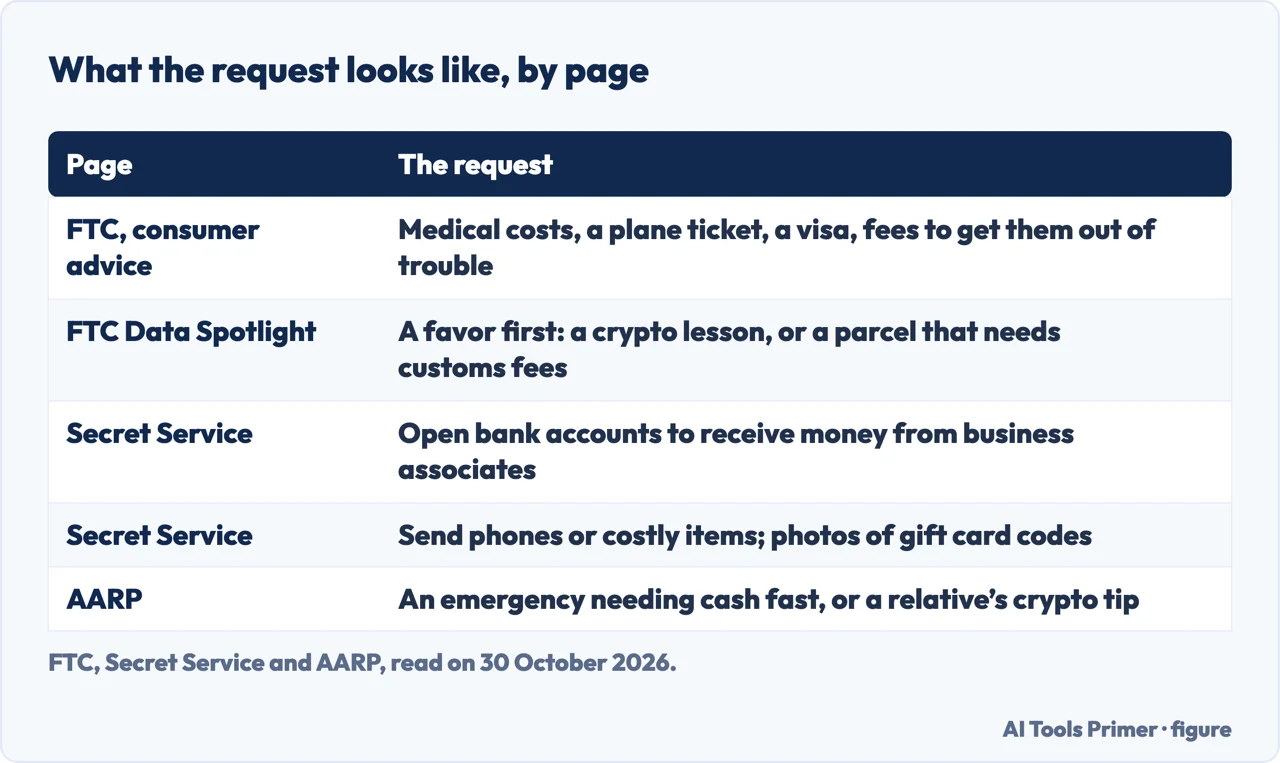
The FTC consumer page lists what scammers ask for once trust is built: help paying medical expenses for the scammer or a family member, a ticket to visit you, a visa, or fees to get them out of trouble. The FTC business blog calls this the stage when the sob stories start, with hospital bills or bail as examples. The Data Spotlight of 2023 adds that many scammers operate by offering to do you a favor. One claims to be a successful cryptocurrency investor who will teach you how it is done, and the Spotlight says any money you put in goes into the scammer’s own wallet. Another says a valuable package has been shipped and asks for money for “customs” or some other made-up fee, and the package never turns up. The business blog calls these customs fees up front.
The FTC Data Spotlight of 27 April 2026 says that, according to reports, scammers often tailored their act to a person’s profile and later invented a crisis that required money, or casually offered investment advice to draw the person onto a fake investment platform. AARP lists the investment angle as a relative who has done well in cryptocurrency and wants you to benefit. Our page on pig butchering covers the fake investment platform. The Spotlight adds that other scammers trick people into sending nude photos and then threaten to send them to the person’s social media contacts; our page on sextortion covers that.
The Secret Service goes furthest on what else can be asked. Its red flags are money for travel or business expenses, family emergencies and investments; a request to open bank accounts to receive money from business associates for projects or investments; a request to send phones or other expensive items to addresses in the United States or other countries, for example a laptop for a child in school; a request to buy gift cards and send pictures of the codes through a messaging application; and added urgency about medical emergencies, a death in the family, legal or tax issues or border detainment. It says scammers may even convert victims into unwitting criminals by convincing them to launder and move fraudulent funds, for which the victim is then liable, both financially and potentially criminally. Its rules are never to open bank accounts or start businesses on behalf of someone else, and never to send or receive money on behalf of someone else.
The pages we read do not list typical scammer phrases as sentences. What they give is the kinds of story above, the “wrong number” text, and the excuse that always comes up when a meeting is planned.
The numbers and how the money is taken
The FTC Data Spotlight of 2023 says that in 2022 nearly 70 thousand people reported a romance scam and reported losses hit $1.3 billion, with a median reported loss of $4,400. Its first footnote gives the yearly series of reported losses: $493 million for 2019, $730 million for 2020, $1.3 billion for 2021 and $1.3 billion for 2022. The same notes say that the median should not be compared with earlier Spotlights, because reports from the Internet Crime Complaint Center are now included, and that because the vast majority of frauds are not reported to the government, the figures reflect just a small fraction of the public harm.
On the channel, the Spotlight says 40% of people who said they lost money to a romance scam in 2022 said the contact started on social media and 19% said it started on a website or app. Of the social media reports that named a platform, 29% named Instagram and 28% named Facebook. The Spotlight of 27 April 2026 says nearly 60% of people who reported losing money to a romance scam in 2025 said it started on a social media platform. The two shares are for different years and the footnotes describe slightly different exclusions, and the pages we read do not compare them. The 2026 Spotlight also says $298 million was reported lost to romance scams that began on social media in 2025, a distant second to investment scams at $1.1 billion. It notes that this is not the total for romance scams that year, and the pages we read do not give that total. The Spotlight adds that reports were not collected by the FTC during the 2025 government shutdown.
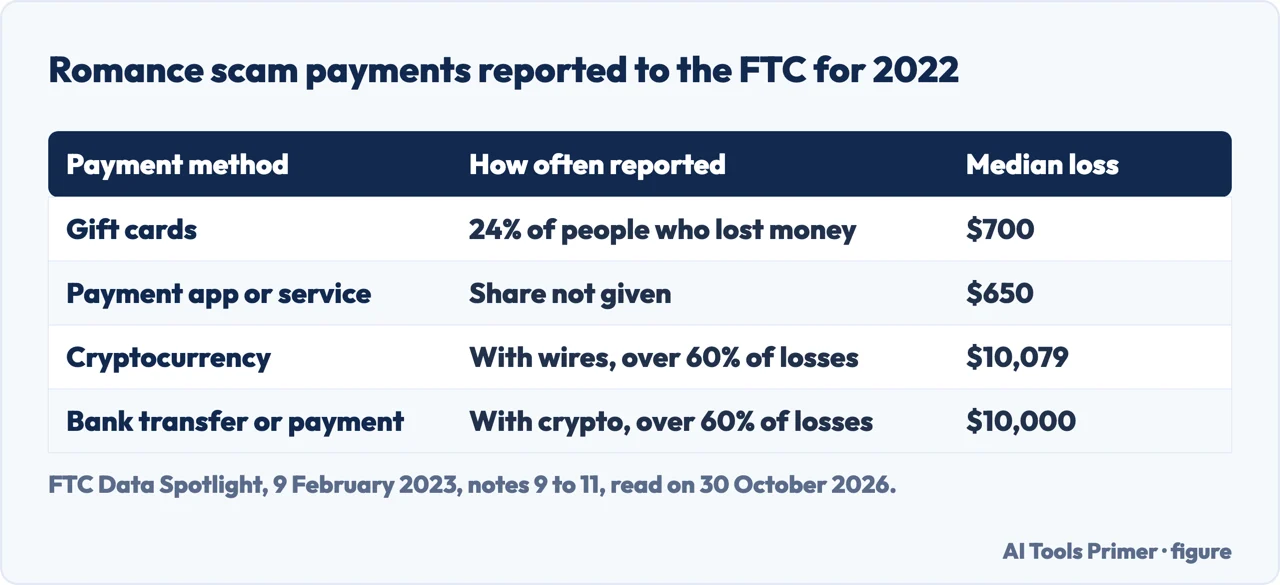
On payment, the 2023 Spotlight says cryptocurrency and bank wires together accounted for more than 60% of reported losses in 2022. Gift cards were the most frequently reported method, with 24% of people who lost money, but not the costliest: the median reported loss was $700 with gift cards and $650 with a payment app or service, against roughly ten thousand dollars with cryptocurrency or a bank transfer. The FTC consumer page explains why scammers choose these methods: they want money in a way that makes it hard for you to get it back.
AARP gives its own count: more than 70 thousand people reported romance scams to the FTC in 2025, and it says romance scams are a subcategory of impostor scams, for which victims reported $3.5 billion stolen that year. That is a different year from the FTC’s 2022 figure, so the two counts should not be set against each other. AARP also reports a 2026 survey of more than 1,000 American adults aged 50 and older, in which 1 in 10 said they had interacted online with a potential romantic partner who eventually asked for money or encouraged them to invest in cryptocurrency, and people aged 50 to 64 were more than twice as likely to say so as those 65 and older.
What the pages say to do, in their order
The FTC’s bottom line is to never send money or gifts to a sweetheart you have not met in person. If you suspect a romance scam, it says to stop communicating with the person immediately and to talk to someone you trust, noting whether friends or family are concerned. It suggests searching online for the type of job the person claims plus the word “scammer”, such as an oil rig or the US Army, and doing a reverse image search of the profile picture to see whether it is tied to another name or to details that do not match. AARP also recommends a reverse image search, saying that a picture that shows up elsewhere with a different name may have been stolen. The FTC business blog of 9 February 2023 gives a rule that needs no investigation: the minute an online romance turns to finance, call it quits, because nobody legit will ever ask you to help, or insist you invest, by sending crypto, wiring money or giving numbers on a gift card. The Secret Service page we read does not mention a reverse search and says instead that video calls and messaging applications are not enough proof of someone’s real identity.
If you already paid, the FTC says that for a gift card, wire transfer, credit or debit card or cryptocurrency you should contact the company or your bank right away, say you paid a scammer and ask for a refund. The pages we read do not say how a refund works on a cryptocurrency platform, only to contact the company. The FTC says to report to ReportFraud.ftc.gov and to tell the social networking site or app where you met the scammer. AARP adds the local police and the FBI’s Internet Crime Complaint Center at IC3.gov, and notes that not every complaint leads to enforcement action. The Secret Service tells you to contact your local field office. AARP lists a free Fraud Watch Network Helpline at 877-908-3360.
AARP’s defenses before anything happens are to avoid oversharing online, set social media accounts to private, filter email, texts and calls, and discuss new love interests with family and friends, adding that a request to keep the relationship secret is a big red flag. It also says to avoid investing with someone you met online and to cut off contact if you suspect a scammer. Because the Secret Service says intimate information can feed identity theft, our page on identity theft is the next stop if personal details went out, and the scam calls and messages guide covers the other ways scammers reach you.
What we did not use
We tested nothing and contacted no one. We could not read the FBI page that Google listed first: it answered with an anti-bot wall, so there are no FBI figures here, and IC3 appears only as the place AARP says to report. Wikipedia quotes IC3 counts from a report we did not open, so we left them out. The FTC Data Spotlight of 2023 shows its list of favorite lies as an image that we did not download, and we used its text only. The AARP page says it was first published in 2018 and updated, and that its key takeaways were created with generative AI and reviewed by an editor. The Google AI box was not read.
Where to start
Four ways in.
- “Is this person real?”
- How it starts: the first message and the move to a private chat — start
- “Why has it gone on so long?”
- The slow build, and how long it lasts — slow
- “Now they want money.”
- The request: an emergency, a favor, an investment, an account — ask
- “I already paid.”
- What the pages say to do, in their order — now
Scams that start with a stranger
The same first move, different ends.
Other scams that arrive by message
Calls, caller IDs and parcel texts.
Questions people also ask
How do you tell a romance scammer?
The pages we read give signs, not one test: a “wrong number” text, a quick move to another app, an excuse never to meet, constant contact, and then a request for money or an investment. The Secret Service says video calls are not enough proof of identity.
What are common romance scammer phrases?
The pages we read do not list phrases. They describe stories instead: living or working abroad, in the military or on an oil rig, then a medical bill, a ticket, a visa, customs fees or a crypto tip.
How long does a romance scam usually last?
The pages we read give no average. AARP says weeks or months before the urgent request; Wikipedia says sometimes months or even an entire year.
How do I know if I am chatting with a scammer?
The FTC says to stop communicating, talk to someone you trust, search the claimed job plus “scammer” and run a reverse image search of the profile picture. It also says never to send money or gifts to a sweetheart you have not met in person.
Not covered here. We tested nothing. The statements come from three FTC pages, the FTC Data Spotlight of 2026, AARP and the Secret Service, all read on 30 October 2026, and from Wikipedia for definitions, the length of the build and the rotation between scammers, leaving out its figures.
The search volume and difficulty behind this page come from a Semrush reading of 29 August 2026, older than the 60 days the site normally allows.
Sources
- FTC Consumer Advice — What To Know About Romance Scams — consumer.ftc.gov, read 30 October 2026.
- FTC Data Spotlight — Romance scammers’ favorite lies exposed (9 February 2023) — www.ftc.gov, read 30 October 2026.
- FTC Business Blog — Bad Romance: Top “Love Game” lies told by romance scammers (9 February 2023) — www.ftc.gov, read 30 October 2026.
- FTC Data Spotlight — Reported losses to scams on social media eight times higher than in 2020 (27 April 2026) — www.ftc.gov, read 30 October 2026.
- AARP — How to Protect Yourself Against Online Romance Scams — www.aarp.org, read 30 October 2026.
- U.S. Secret Service — Stay Safe Online: Avoid Romance Scams — www.secretservice.gov, read 30 October 2026.
- Wikipedia — Romance scam (definitions, length of the build, rotation of scammers; figures not used) — en.wikipedia.org, read 30 October 2026.
Written by Alberto Gulotta
Founder and editor of AI Tools Primer, writing from Palermo, Italy. Thirty-five years of taking computers apart, starting with a Commodore 64 — the long version is on the about page.
Something wrong on this page? Write to aitoolsprimer@gmail.com and it gets fixed.
Written on 30 October 2026.
Independence and limits
No affiliate links and no paid placements anywhere on this site. Nobody pays to appear here, and no company has seen this page before you did.
This is general information, not professional advice. Where a page touches money, health, safety or the law, it names its source and the date it was read — and your situation may still differ. See the privacy page and the cookie policy.