
Tor · guide
Is Tor legal to use, or to run as a relay? What sources say
By Alberto Gulotta · Updated · 15 min read
Is Tor legal? Three questions hide behind it. For using Tor to browse, a 2019 FindLaw article says it is not illegal. For running a relay, the EFF’s legal FAQ says it believes it is legal under U.S. law, with no guarantee. The Tor Project’s censorship page names four countries and describes blocks, not bans.
| Question | Answer | Where it comes from |
|---|---|---|
| Is using Tor to browse illegal? | FindLaw says just using Tor to browse the Internet is not illegal | FindLaw, 21 March 2019 |
| Is running a relay legal? | The EFF says it believes running a relay is legal under U.S. law, and that it cannot guarantee an operator will never face liability | EFF legal FAQ, reviewed March 2023 |
| Is an exit relay riskier? | Its traffic can be traced back to the relay’s IP address, so the EFF suggests a bridge or middle relay for anyone unwilling to take that risk | EFF legal FAQ, Tor Project |
| Where is Tor blocked? | The Tor Project names China, Russia, Turkmenistan and Belarus, in a page about blocks | Tor Project |
| Does Tor make a crime lawful? | The EFF says Tor is not designed or intended for breaking the law; FindLaw says it may not keep a person hidden from law enforcement | EFF legal FAQ, FindLaw |
Using Tor to browse: what FindLaw and the EFF say
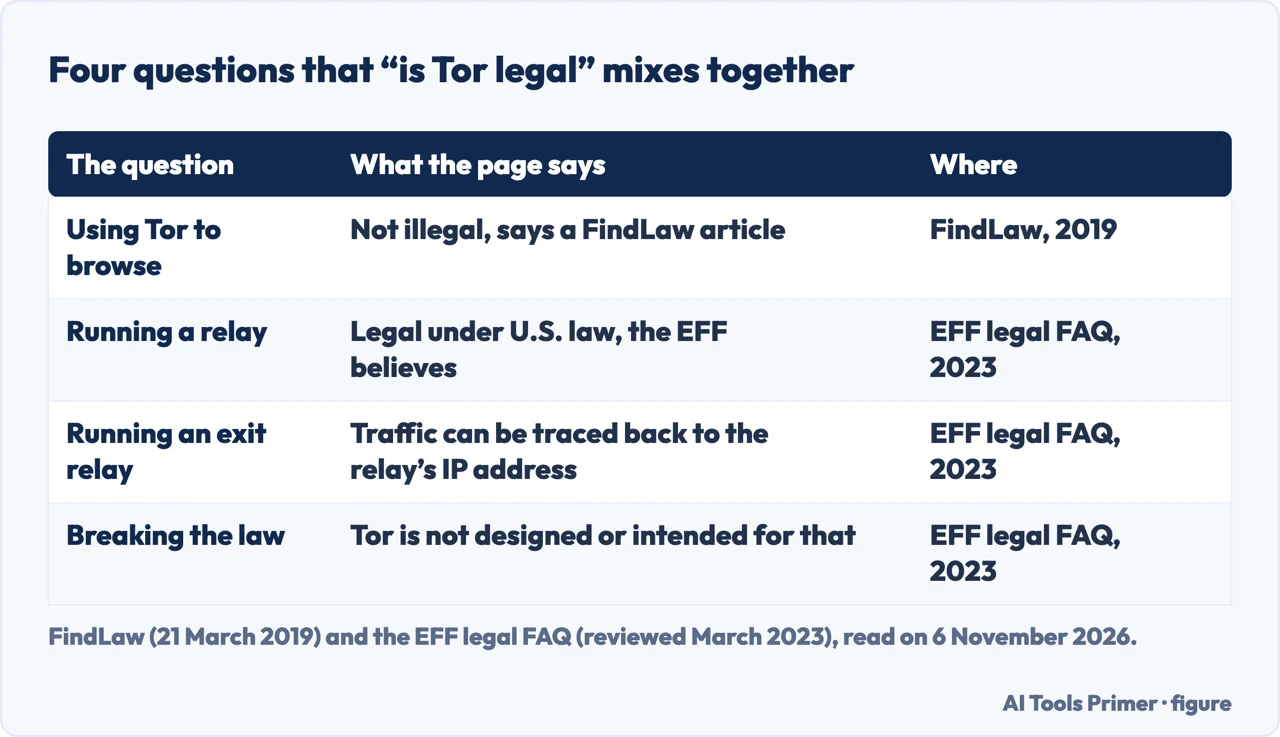
FindLaw’s article is the one source we read that answers the question about use directly. It was last updated on 21 March 2019 and is signed by an attorney, and it says that just using Tor to browse the Internet is not illegal. It adds that the download is free and that hiding your IP address and browsing history is not, in and of itself, illegal. The article speaks of the NSA, the FBI and Comcast and does not go country by country.
The same article adds cautions. It says many of the people who use Tor use it for anonymity because they are doing something illegal, that Tor may not be perfect at hiding a user’s identity, that the NSA and the FBI have specifically targeted Tor users in the past, and that Comcast has threatened to cut service to customers using Tor. Its closing image is a ski mask set against an invisibility cloak: for someone who breaks the law online, Tor is the first and not the second. The article is from 2019, and we read nothing newer that answers the question about use.
Two EFF guides say something that matters just as much to a person who wants to use Tor. The Surveillance Self-Defense guide to using Tor, reviewed on 28 January 2025, says that anyone who can see your network activity can also see that you are using Tor. Its censorship guide, reviewed on 1 February 2024, says the same in nearly the same words. The first guide also says Tor Browser sends only the browsing you do inside the browser through the Tor network, and that other apps on the device are not routed through it. Neither guide says that being seen using Tor is itself against the law.
Blocked is not the same as banned
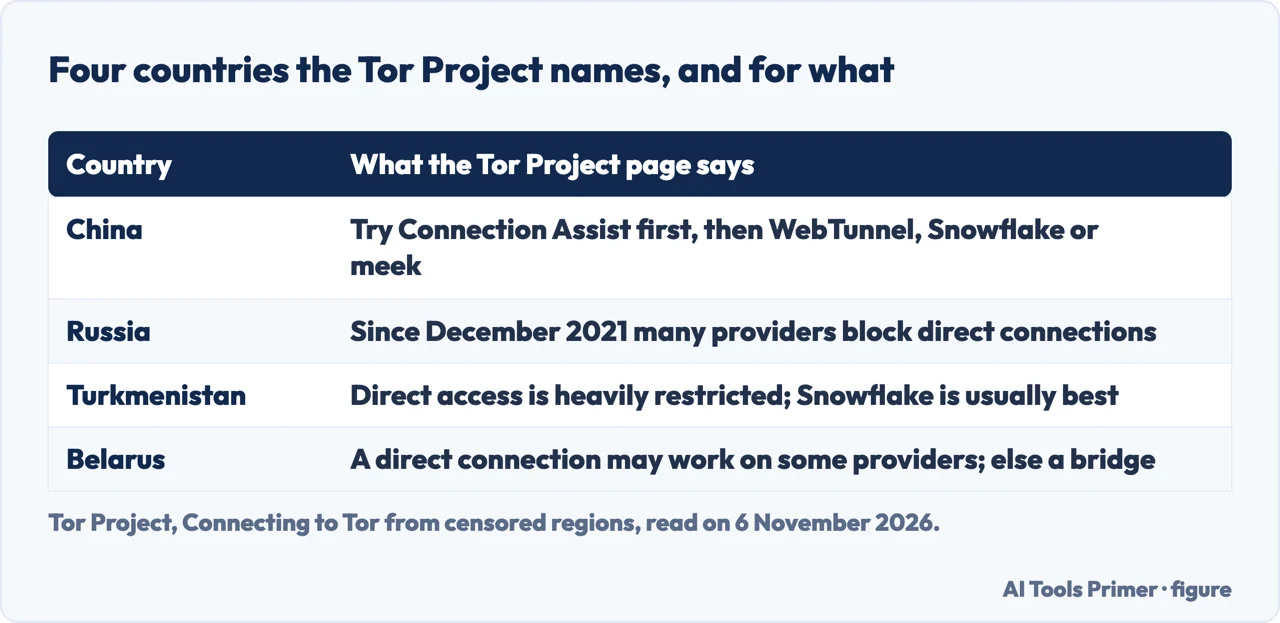
The Tor Project’s support page on connecting from censored regions opens with a sentence about technical blocking: in some countries the providers of Internet service, or national firewalls, stop direct connections to the Tor network. It then gives guidance for four countries, China, Russia, Turkmenistan and Belarus, and the text we read carries no date. The pages we read do not describe a ban on using Tor in any of the four. What they describe is a block, and ways around it.
For China, the page says to get Tor Browser from a Telegram bot or by email, to let Connection Assist try a bridge or Snowflake first, and then to try WebTunnel bridges, which it says make the traffic look like a regular HTTPS connection to a web server. Snowflake and meek come after, and the page says meek is quite slow because of a bandwidth limit. For Russia, it says that since December 2021 many Internet providers have been blocking direct connections, so users generally need to connect through a bridge; the page names obfs4 as the bridge type in wide use there, but some mobile providers have begun blocking it, and it suggests WebTunnel bridges on less well-known hosting providers.
For Turkmenistan, the page says direct access is heavily restricted and that Snowflake with AMP cache as the front domain is usually the most reliable way to connect. For Belarus, it says a direct connection may be available on some providers and, if not, obfs4, WebTunnel or Snowflake can be tried, because the Tor Project is not aware of a specific bridge blocking mechanism there. Our page on Tor bridges and censorship goes through the transports in more detail.
The Russian case has its own post. The Tor Project blog entry of 7 December 2021 says that since 1 December some Internet providers in Russia had started to block access to Tor, and that Roskomnadzor, which it calls a Russian government bureaucratic entity, was threatening to censor torproject.org. An update added to the post says the Russian government then officially blocked the main website, with a mirror offered as the way round. The post says the default Snowflake bridges and the obfs4 bridges obtained through Moat were not working in some places in Russia. It reads as an account of censorship, and it does not mention a criminal offence for users.
One caution comes from the EFF’s censorship guide, not from the Tor Project. It says the OONI Probe tool, which helps find out what kind of blocking you face, can put you at risk because whoever runs your network will know you are running it, and that certain countries may block the tool entirely. The same guide says Connection Assist can choose a bridge for you using your location. The pages we read do not say whether a person who connects through a bridge in a blocked country faces any penalty.
Running a relay: what the EFF and the Tor Project say
The EFF’s Legal FAQ for Tor Relay Operators, marked as last reviewed in March 2023 and also hosted by the Tor Project, is the most detailed legal page we read, and it is about relays, not about people who only browse. It opens with a note: the FAQ is for information and is not legal advice, it aims to describe the legal issues around Tor in the United States, different facts and different legal jurisdictions will give different answers, and a reader with a specific problem should see a lawyer licensed in their jurisdiction.
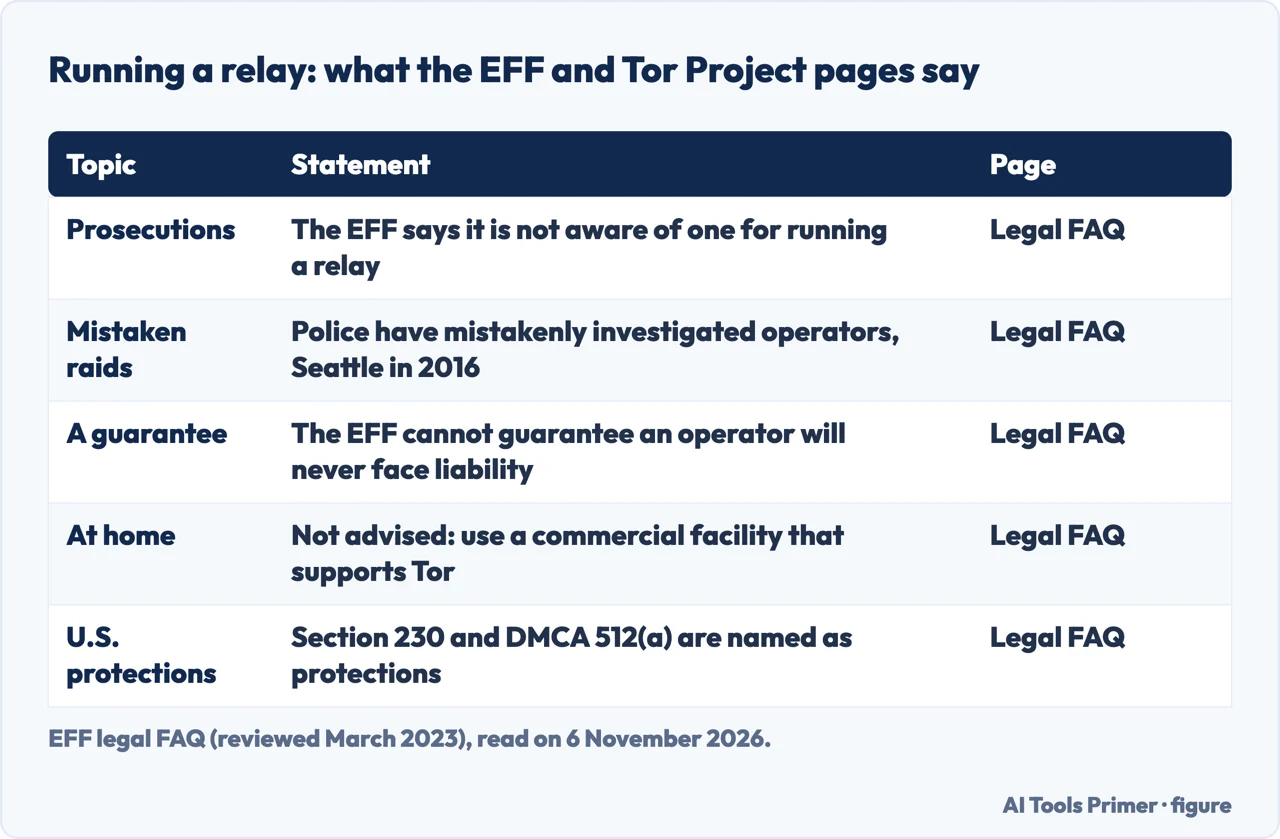
Within that frame the EFF says it believes that running a Tor relay, including an exit relay, is legal under U.S. law. It also says it is not aware of an individual being sued, prosecuted or convicted for running a relay, and that police in the United States and other countries have occasionally investigated relay operators by mistake. Its examples are the 2016 raid by Seattle police on the home of a privacy activist who ran an exit relay, and the arrest in Russia of the relay operator Dmitry Bogatov, whom the authorities later cleared of charges. Asked whether it can promise that an operator will not get into trouble, the FAQ answers no: the EFF cannot guarantee that an operator will never face legal liability. It adds that it runs its own middle relay.
The FAQ names two U.S. laws as protections. Section 230 of the Communications Decency Act, which it cites as 47 U.S.C. § 230, gives immunity to online intermediaries that host or republish speech, with exceptions for some criminal and intellectual property claims. Section 512(a) of the Digital Millennium Copyright Act, 17 U.S.C. § 512(a), offers a safe harbor for material that is simply transmitted without modification, as a relay does. On copyright, the FAQ says no court has yet addressed these questions in the context of Tor itself.
Exit relays are where the FAQ sees special concerns. The traffic leaving an exit can be traced to the relay’s IP address, the EFF says it is practically impossible to stop an exit from being used for illegal activity, and police have mistakenly attributed such traffic to the operator. For anyone unwilling to take that risk, it suggests a bridge or middle relay, which does not forward traffic directly to the Internet. It advises against running an exit from home, advises telling the Internet provider, and advises being open about running it. It also says not to monitor the plaintext traffic leaving a relay, because doing so could create liability under wiretap laws. The Tor Project’s support page on what to expect from an exit agrees on the practical side: because the relay’s IP address appears as the source of users’ traffic, the operator may receive abuse complaints and DMCA notices, or face service blocks. Our page on Tor exit nodes covers what an exit can see and already summarises the EFF position on exit relays, so this page keeps to the full legal frame of the FAQ.
Outside the United States, the Tor Project’s Exit Guidelines page has a Legal section that lists only two entries: the DMCA for the United States, and for Germany section 7 of the DDG with Article 4 of Regulation (EU) 2022/2065. It asks readers to add their own country, and to contact the Tor Project if they know a lawyer who can give a legal opinion for a country that is missing. The pages we read do not give an answer for any other country.
The same FAQ also says what to do when the question stops being theoretical, which is the part a relay operator is most likely to need. If police question you, it says you have the right to ask for an attorney before and during questioning, suggests saying “I want my attorney and I choose to remain silent”, and warns that lying to law enforcement may cause more trouble than whatever they wanted to ask about. If you receive a subpoena or another information request, it says to educate the requester about Tor, since properly configured relays will have no useful data, and not to hand over any logs you do keep to a third party without first consulting a lawyer; it adds that, at least in the United States, a gag order does not stop you from calling a lawyer. For a DMCA notice from an ISP or university, the EFF offers a response template, which refers only to U.S. jurisdictions. On help, the EFF says it may assist an operator in assessing the situation and in finding counsel, including outside the United States, but cannot promise representation. It also warns that messages sent to Tor’s developers are not protected by any legal privilege and could be subpoenaed, so legal questions belong with a lawyer, not with them. (EFF Legal FAQ, reviewed March 2023.)
What Tor does not make lawful, and what the pages leave out
The EFF’s FAQ asks whether a person should use Tor, or encourage others to use it, for illegal purposes, and the answer is a plain no. It says Tor was developed as a tool for free expression, privacy and human rights, and was not designed or meant for breaking the law, whether by users or by relay operators. FindLaw reaches a similar place from another direction: using Tor is not illegal, but it may not protect someone who is breaking the law. The two sources do not contradict each other, and they do not claim that Tor settles anything for a person who commits a crime.
The sources also answer different questions, which is why the single question is hard to answer with one line:
- Using Tor. FindLaw, 2019: not illegal to browse with it, with cautions about attention from the NSA, the FBI and a provider.
- Running a relay. The EFF legal FAQ, reviewed March 2023: legal under U.S. law, with no guarantee, and with exit relays carrying the most practical risk.
- Reaching Tor from a censored country. The Tor Project: blocks in four named countries and the bridges that get round them.
The pages we read do not put the three together, and they do not mention a list of countries where using Tor is a crime. They also do not say whether the answer about use differs outside the United States, or whether a person who connects through a bridge in a blocked country faces a penalty. We have not written that Tor is illegal anywhere, because nothing we read says so. For a lawyer’s view of a specific situation, the EFF’s own note sends readers to a lawyer licensed in their jurisdiction.
Two related pages cover the questions this one stops short of. Our page on whether Tor Browser is safe goes through the habits the Tor Project says undo its protection, and our page on whether VPNs are legal covers the same question for a different tool. For a side-by-side of the two tools, see Tor or VPN.
What we left unread
Each statement on this page is traced to the sources listed below, and the wording was checked against them. The list of pages we looked at came from a web search. We did not open the Windscribe blog, the guides from Privacy Savvy, AllAboutCookies, Cyberly and vpnMentor, or the short listing of the CCDCOE overview, because, going by the search listing, the first five appear to come from VPN vendors and security sites and the last showed almost no text. We read a 2017 question on the Tor Project mailing list about countries where using Tor is illegal and did not use it, because it is a reader’s question and not an answer from a source.
Where to start
Four ways in.
- “Is it illegal to use Tor?”
- Using Tor to browse: what FindLaw and the EFF say — use
- “Is Tor banned anywhere?”
- Blocked is not the same as banned — blocked
- “Is it legal to run a relay?”
- Running a relay: what the EFF and the Tor Project say — relay
- “Does Tor make a crime lawful?”
- What Tor does not make lawful, and what the pages leave out — limits
Questions next to the law
Safety, and the same question for VPNs.
The network behind the question
Relays, bridges and the VPN comparison.
Not covered here. The statements come from a FindLaw article, the EFF legal FAQ, two EFF Surveillance Self-Defense guides and pages and a blog post of the Tor Project, all read on 6 November 2026.
The search measurement behind this page is an Ubersuggest reading of 5 November 2026 for the United States, which gives its own SEO difficulty score and not the KD of Semrush; a Semrush check is still to be made.
Sources
- EFF and Tor Project — The Legal FAQ for Tor Relay Operators (reviewed March 2023) — www.eff.org, read 6 November 2026.
- Tor Project community — The Legal FAQ for Tor Relay Operators — community.torproject.org, read 6 November 2026.
- Tor Project — Tor Exit Guidelines — community.torproject.org, read 6 November 2026.
- Tor Project — What to expect when running a Tor exit relay — support.torproject.org, read 6 November 2026.
- Tor Project — Connecting to Tor from censored regions — support.torproject.org, read 6 November 2026.
- Tor Project blog — Responding to Tor censorship in Russia (7 December 2021) — blog.torproject.org, read 6 November 2026.
- EFF Surveillance Self-Defense — How to: Use Tor (reviewed 28 January 2025) — ssd.eff.org, read 6 November 2026.
- EFF Surveillance Self-Defense — How to Understand and Circumvent Network Censorship (reviewed 1 February 2024) — ssd.eff.org, read 6 November 2026.
- FindLaw — Is It Illegal to Use the Tor Network? (21 March 2019) — www.findlaw.com, read 6 November 2026.
Written by Alberto Gulotta
Founder and editor of AI Tools Primer, writing from Palermo, Italy. Thirty-five years of taking computers apart, starting with a Commodore 64 — the long version is on the about page.
Something wrong on this page? Write to aitoolsprimer@gmail.com and it gets fixed.
Written on 7 November 2026.
Independence and limits
No affiliate links and no paid placements anywhere on this site. Nobody pays to appear here, and no company has seen this page before you did.
This is general information, not professional advice. Where a page touches money, health, safety or the law, it names its source and the date it was read — and your situation may still differ. See the privacy page and the cookie policy.