
Temp mail · guide
Burner phone apps: the price, the route and what stays
By Alberto Gulotta · Updated · 21 min read
A burner phone app puts a second number on the phone you already carry. Burner lists one number from $7.99 a month on its website and $9.99 in the App Store, and its standard calls run through your main number. Burner, Hushed and Google Voice each say something different about what stays after a number is deleted.
| Question | Answer | Where it comes from |
|---|---|---|
| What is it? | An app that gives a second number for calls and texts on the phone you already have | Burner FAQ |
| What does one number cost? | From $7.99 a month on Burner’s website, from $9.99 through the app stores | Burner FAQ, pricing page |
| Is it free? | Free to download; a 3-day trial only if you sign up in the app, then a paid plan | Burner FAQ |
| Do calls use my carrier? | Standard calling routes calls through your own cell number, so they may use carrier minutes | Burner support |
| What stays after I delete a number? | It differs by service, and on Burner by page | Burner, Hushed, Google |
What the app is, and how a call travels
Burner’s FAQ says Burner is an app that gives you a real second phone number on the phone you already have, for calls, texts and picture messaging. It works on iOS and Android, with a web app for signing up and managing an account. The FAQ says it is made by Ad Hoc Labs, Inc., a company based in Los Angeles, and that it launched in 2012; Wikipedia says the iPhone app was released in August 2012 and the Android version in April 2013. Burner gets the longest treatment on this page because the answers sit in its own pages. Hushed and Google Voice join where their pages speak.
Burner’s support page on protecting your real number explains the route. It says Burner forwards calls on your Burner through you to your main cell number, and that the person on the other end sees only your Burner number on the caller ID. When you dial out, the app redirects the call through your Burner line, which is why it looks as if you are calling your own Burner. When a call comes in and you answer, you hear “Press 1 to accept this call”, which the page says stops callers reaching your main cell voicemail.
A 2018 article by Keepsafe, another company, names two modes in burner apps. In VoIP, calls and texts travel over an encrypted internet connection, like a Skype call. In bridge dialing, the app calls your real number first and, when you answer, calls the recipient with your burner number as caller ID. Burner’s FAQ describes standard calls as routed through your main cell number and does not use either name. The article is eight years old, so we use it only to explain the idea.
The phone bill follows from the route. Burner’s support page, last updated on 10 September 2026, says texts sent through Burner do not use your carrier’s SMS plan and will not appear on your bill. With standard calling, it says, calls may use minutes from your carrier plan and appear on the bill as calls to or from your Burner number, while the number of the person you are speaking with does not appear. The Play Store listing carries a similar line: phone calls use cell phone minutes. For someone who signed in with Apple or Google, the support page says texts are handled entirely within the app, but you must attach your main cell number to make calls.
Signing up does not always need that number. The FAQ says new users can sign in with Apple or Google without a main cell phone number, and that some account types and calling setups use one. A separate support page says that after you log out, texts are received once you log back in, and that with standard calling, calls still forward to your main number. If you delete the app, it says the same rules apply, with one exception: a Sign in with Apple or Google user, or anyone with in-app calling, no longer gets a call notice. A second option, Burner Dual SIM, is described in the FAQ as using eSIM on a supported iPhone to add a second mobile number in the native Phone and Messages apps, without cellular data. Our page on setting up an eSIM on iPhone covers the eSIM side. Hushed’s support page says the person you call sees only your Hushed number, and its terms say the service needs your own internet connection and that messages are not itemized on your wireless invoice.
What a month costs, and what is free
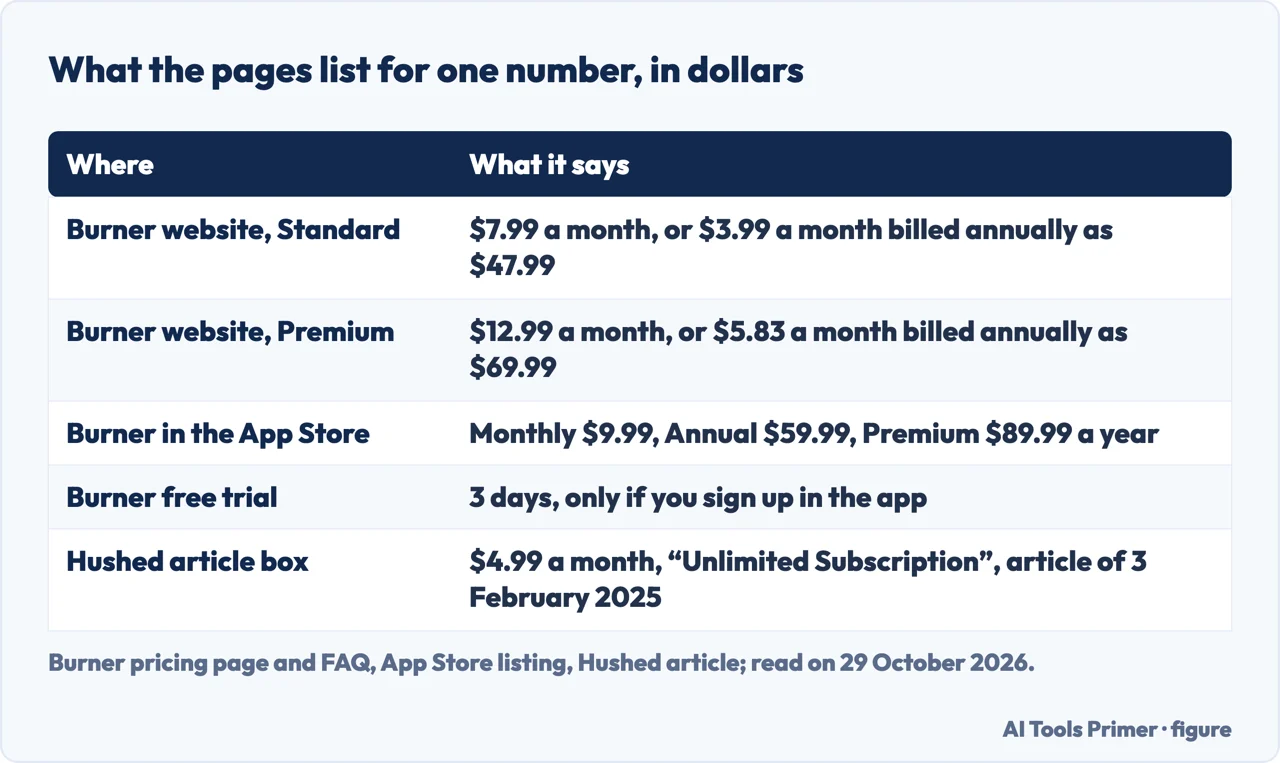
Burner’s FAQ says the app is free to download and that one number starts from $7.99 a month or $47.99 a year on burnerapp.com. Buying through the App Store or Play Store costs a little more, it says, from $9.99 a month or $59.99 a year. The pricing page shows two plans. Standard is $7.99 a month, or $3.99 a month billed annually as $47.99. Premium is $12.99 a month, or $5.83 a month billed annually as $69.99. It says every subscription includes one number, unlimited calls and texts, spam blocking and auto-reply, and that subscribing online saves 20 percent against the app stores.
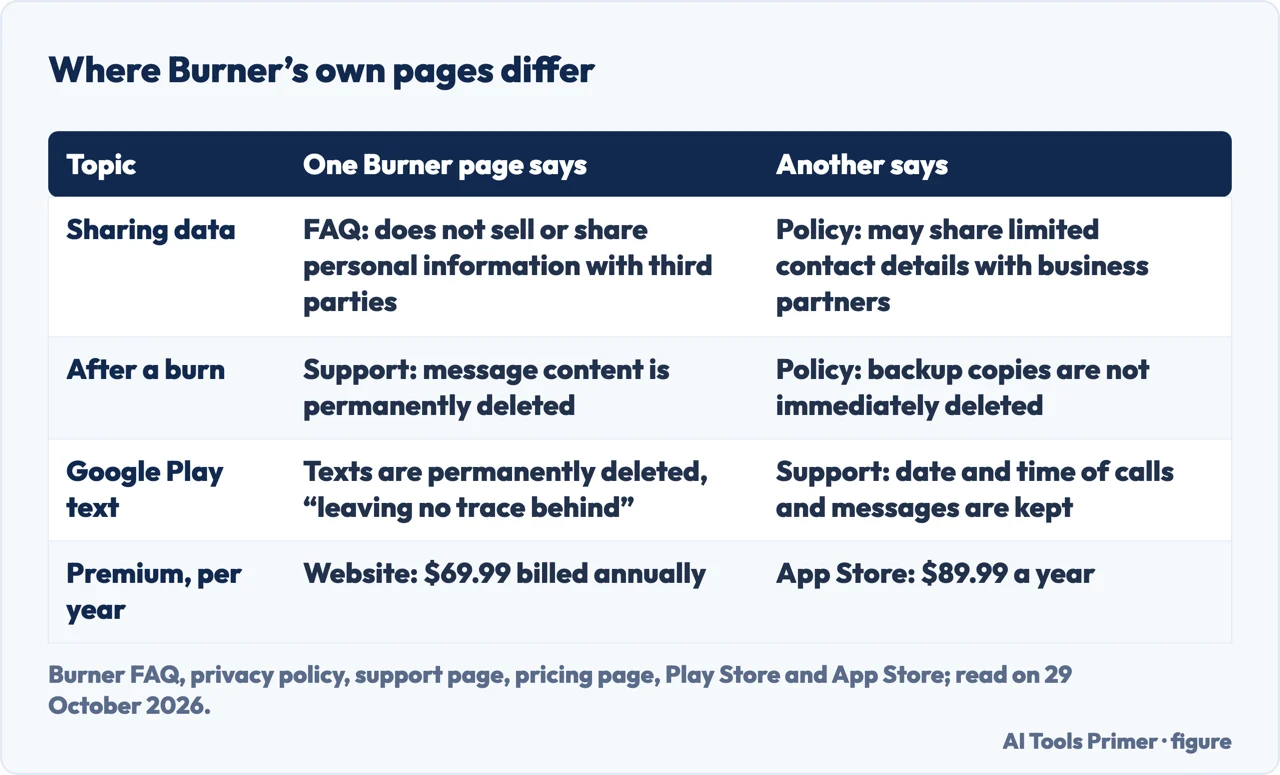
The App Store listing, at version 7.21.0, shows Monthly $9.99, Annual $59.99 and Premium $89.99 a year. That sets two of Burner’s own numbers side by side: Premium billed annually is $69.99 on the website and $89.99 in the App Store. The FAQ names the trade between channels. The website is cheaper, but the 3-day free trial only runs when you sign up in the app, and the FAQ says eligible new users get it and that a paid plan is required after it. The Play Store listing says Burners are free for a trial period only.
The pricing page adds that subscriptions auto-renew unless cancelled, that free trials convert to paid unless cancelled before they end, and that you cancel through the platform you bought on. For refunds it says iOS requests go through Apple, while Android and web buyers contact support with a receipt. It also says credits are used to buy prepaid numbers instead of a subscription. On how many numbers you can hold, the FAQ says plans currently support up to 100 on iOS, 10 on Android and 3 through the web app.
Premium is listed on the FAQ as including a VPN with a no-logging policy, Number Lookup, Personal Info Protection and, on iPhone, AI voicemail transcription. Personal Info Protection, it says, scans supported data broker sites and can begin removal requests for eligible listings, and enrolled users are rescanned quarterly. The Hushed side is thinner. An article on Hushed’s site dated 3 February 2025 carries a box reading $4.99 a month for an “Unlimited Subscription”. That is an advertising box on a blog page, read on 29 October 2026, not a pricing page, and we did not open Hushed’s pricing page. We read no price for Google Voice. We left out the prices in Gadget Hacks’ comparison, which come from an older edition of its review.
What stays after you delete a number
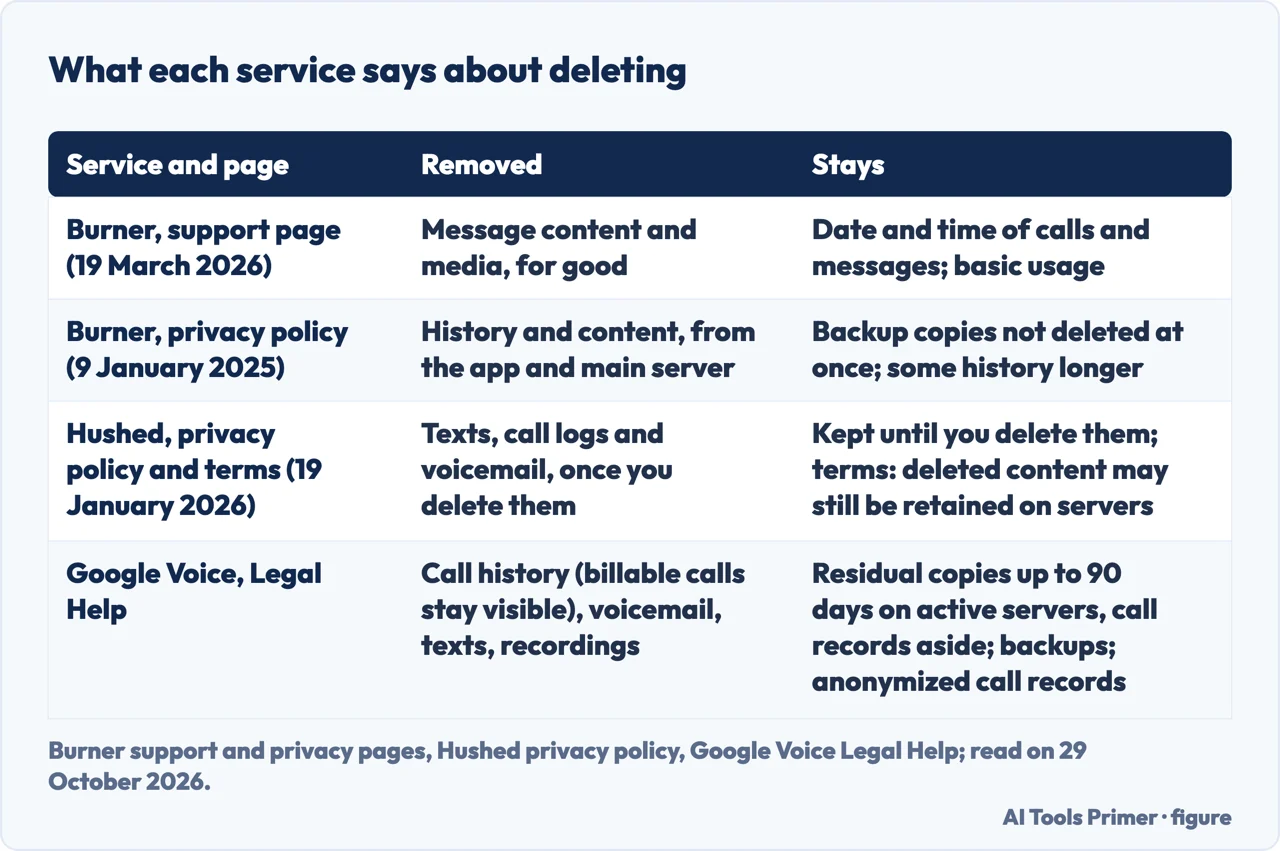
Burner’s FAQ says deleting a Burner number is permanent and removes the associated calls, texts and voicemail from your account. It adds that the number stops receiving, but messages already delivered stay on the recipient’s device; the support page on protecting your real number says that if you delete messages, they are deleted only for you and not for the recipient. Two further Burner pages speak to what the company keeps, and they do not read the same way.
The support page on message retention, last updated on 19 March 2026, says that once a number has expired or been burned, all associated message content, texts and media, is permanently deleted from its system. It then says Burner may retain “limited activity records”, such as the date and time a call or message was sent or received and basic usage activity, and that these do not include the content of messages or calls. The privacy policy, last updated on 9 January 2025, says that when you burn a number it deletes all its history and message content from the app and from its “primary working server”. It then says backup copies of this data are not immediately deleted, and that some aspects of user history are kept longer on the primary server to reconcile records and manage the business. The policy gives no number of days for the backups.
The policy’s general retention paragraph says the company keeps information for the period needed for its stated purposes, unless a longer period is required or permitted by law, and may keep backups of certain data longer for security and business continuity. The pages we read do not say which records the “limited activity records” are beyond the two examples, or how long they stay, and they do not say whether the later support page replaces the policy’s wording on backups. Numberbarn, a seller of numbers, wrote on 22 September 2026 that once a Burner number is deleted it cannot be restored and Burner support cannot retrieve the data, and that after a missed payment the grace period before data is deleted automatically is short.
Hushed’s privacy policy, updated on 19 January 2026, ties retention to your own deleting. Message content and the source and destination numbers are stored on the app until you delete the message history, the associated number or the account. Call detail records, which hold time, duration, completion status and the numbers, are kept until you delete the call log, the number or the account, and voicemail recordings and greetings follow the same rule. A separate section says the company keeps personal information only as long as necessary under applicable laws, and that on a deletion request it may refrain from granting it, for example if it must keep the information in business records. The terms, also updated on 19 January 2026, say the company stores content on its servers and may monitor it, with no obligation to, and add that even if you delete your content it may be retained on the company’s or its service providers’ servers and could be produced if the law requires; they also describe the numbers as “temporary phone numbers for limited time use only”, of which you are not the owner. If an account is suspended or closed, the terms say numbers may be reassigned to other customers.
Numberbarn lists Google Voice among its examples of burner apps “in a roundabout sort of way”, so its pages belong here. Google’s page on how Voice works says it stores call history, voicemail greetings and messages, texts and recorded conversations, and that you can delete them, though call history for billable calls may remain visible. Some information may stay on active servers temporarily for billing or business purposes, residual copies may remain in backup systems, and anonymized copies of call records are kept for reporting and auditing. Google’s Legal Help page says residual copies of deleted data, except call record information, may take up to 90 days to leave active servers and may remain in backups. The help page on deleting says that after you delete a conversation, call or voicemail you cannot access it again, that it may be stored on your devices or on the devices you contacted, and that each conversation must be deleted individually. These pages describe deleting items and accounts; the ones we read do not describe deleting a number on its own.
What the paperwork says about who else sees it
Burner’s privacy policy lists what the company collects. It includes your mobile phone number, from which it may derive your mobile carrier, and in some cases a name, postal address, email address and payment information through payment processors. It also lists IP address, MAC address, device identifiers including Apple’s IDFA and Android’s advertising ID, general location such as city and state taken from the IP address, and data gathered through SDKs, cookies, tracking pixels and web server logs. Among its uses of information the policy names “lookalike modeling”, marketing and advertising.
On sharing, two sets of Burner words sit side by side. The FAQ says Burner is ad-free and does not sell or share your personal information with third parties, and the support page on protecting your real number says the company never sells or shares it. The privacy policy says the company is not in the business of selling information, and then says it may share a limited amount of contact information and identifiers, such as an email address or a device ID, with business partners to encourage similar individuals to try the service, with an opt-out link. Its table of disclosures for Californians lists affiliates and subsidiaries, transactional support providers, marketing and advertising services, technical service providers and governmental entities as recipients of contact information and identifiers. All of this is Burner’s own text, and the pages we read do not say how the two sets of statements fit together.
The store listings repeat the picture in the developer’s own words. The App Store listing says the developer, Ad Hoc Labs, indicated its practices may include the data below, and that Apple has not verified this. It lists identifiers as data that may be used to track you across apps and websites owned by other companies. Data linked to you includes purchase history, email address, user ID, product interaction, phone number, contacts, emails or text messages, photos or videos and audio data. The Play Store listing, filled in by the developer, says the app may share personal and financial information among other types with third parties, may collect personal and financial information among others, encrypts data in transit, and lets you request deletion.
Then there is the law. Burner’s FAQ says Burner is a US company that complies with lawful requests, so a Burner number is not untraceable, and that it adds a layer of privacy, not invisibility. The policy says the company may disclose information if required by law or to comply with legal process and government requests, and that it has no control over data captured by third parties such as your carrier, internet service provider or platform providers like Apple or Google. Wikipedia says the company has stated it would comply with law enforcement requests related to search warrants. Hushed’s terms say it may preserve content and disclose conversations, texts and other content, including call logs and phone number records, if the law requires, that it may notify affected users, and that it is not required to. Its privacy policy says it will not rent or sell personal information to any person. Numberbarn says neither burner phones nor burner apps are truly anonymous, and names connection to a cell tower, an IP address and an IMEI identifier.
Where a burner app falls short, and what to weigh
Some sites turn away a number from an app. Burner’s FAQ says some sites reject app-based numbers at sign-up, and that Verified Numbers is a separate Burner subscription for a number that behaves more like a traditional mobile one, accepted more widely, on sites like Instagram, Facebook and Amazon. The pages we read do not test any named site. The Play Store listing adds that the app may not work with SMS shortcode services, works in the US and Canada only, and that area code availability varies. Our page on receiving SMS online covers the shared numbers that Burner’s FAQ contrasts with its own: it says some temporary-number sites use shared or public inboxes, while a Burner number is assigned to your account. If a text code guards the account, our page on codes by text message covers what that code does and does not protect.
Emergency calls are the plainest limit. Burner’s privacy policy says the service cannot and should not be used for 911 or emergency calling, the Play Store listing says it is not for 911, and Hushed’s terms say the same. Other limits come from how a number is held. Burner’s FAQ says it does not support porting numbers into the app, though a number can be ported out with help from support, and that it does not support forwarding calls or texts to another number. Hushed’s terms say you do not own its numbers, and they define an account as inactive when it has not been accessed for 24 consecutive months, among other conditions. They also say unpaid credits given at no cost expire six months after being deposited, or sooner if the account becomes inactive.
The pages also point to a few habits. Burner’s FAQ says Nomorobo spam and robocall filtering is on by default for every new number, and that a number that attracts spam can be deleted or switched according to your plan. Hushed’s support page says to turn off your caller ID under Settings, Phone, Show My Caller ID, to stick to messaging apps that need no number, and never to post your number in an online forum. Our page on spam calls on iPhone covers Apple’s own settings, and what someone can do with your phone number covers what a number alone can reach.
Before paying, these are the points the pages we read raise. The price differs by where you buy, and the free trial only runs in the app. Standard calls on Burner may use your carrier minutes and show on your bill as calls to your Burner number. A sign-in with Apple or Google keeps texts in the app but needs your main number attached for calls. Hushed needs a data plan or Wi-Fi. The policies differ on what remains after a number is deleted, and the app can only reach the sites that accept it. Each of these points comes from a page we read, not from a phone in our hands.
What we did not use
We tested nothing. We did not install the apps, place a call or send a text, so every statement here comes from a page we read on 29 October 2026. We did not read the web app at app.burnerapp.com, which needs a login, or any Reddit thread on the subject. We read Hushed’s privacy policy, terms and two support pages, but not its pricing page, and we read no Google Voice price. The Burner support pages, the privacy policy and the store listings are the company’s own descriptions, and the App Store privacy details are declared by the developer and not verified by Apple. The Keepsafe article is from 2018, and the Numberbarn post comes from a company that sells numbers.
Where to start
Four ways in.
- “How much is it?”
- What a month costs, and what is free — cost
- “Does it actually work?”
- What the app is, and how a call travels — how
- “What happens when I delete a number?”
- What stays after you delete a number — deleted
- “Who else sees it?”
- What the paperwork says about who else sees it — paperwork
Numbers, texts and who calls
Shared inboxes, what a number alone can reach, and the spam.
Lines and codes on an iPhone
Calling over Wi-Fi, a second line by eSIM, and the code by text.
Questions people also ask
Does the burner phone app actually work?
Burner’s pages describe a working second number for calls, texts and picture messages, with standard calls routed through your main cell number. They also list limits: some sites reject app numbers, shortcode services may not work, and the app is not for 911. We did not test it.
Is there a free burner phone number app?
Burner’s FAQ says the app is free to download and that eligible new users who sign up in the app get a 3-day free trial, after which a paid plan is required. The Play Store listing says Burners are free for a trial period only.
What is a burner phone app?
Burner’s FAQ calls it an app that gives you a real second phone number on the phone you already have. Numberbarn, a seller of numbers, separates it from a burner phone, which it describes as typically a physical device loaded with a prepaid SIM card.
How much is a burner phone app?
Burner’s FAQ says one number starts from $7.99 a month or $47.99 a year on its website, and from $9.99 a month or $59.99 a year through the app stores. An advertising box on a Hushed article shows $4.99 a month.
Not covered here. We tested nothing. The statements come from pages of Burner, Hushed and Google, the App Store and Play Store listings, Wikipedia, Numberbarn and Keepsafe, all read on 29 October 2026.
The search volume and difficulty behind this page come from a Semrush reading of 29 August 2026, older than the 60 days the site normally allows.
Sources
- Burner — FAQ — www.burnerapp.com, read 29 October 2026.
- Burner — Pricing & Plans — www.burnerapp.com, read 29 October 2026.
- Burner — Privacy Policy — www.burnerapp.com, read 29 October 2026.
- Burner Support Center — Message Retainment — support.burnerapp.com, read 29 October 2026.
- Burner Support Center — How Does Burner Appear on Phone Bill — support.burnerapp.com, read 29 October 2026.
- Burner Support Center — How We Protect Your Real Number — support.burnerapp.com, read 29 October 2026.
- Burner Support Center — If I log out of the app, will I still receive texts and calls? — support.burnerapp.com, read 29 October 2026.
- App Store — Burner: Second Phone Number — apps.apple.com, read 29 October 2026.
- Google Play — Burner: Second Phone Number — play.google.com, read 29 October 2026.
- Hushed — Privacy Policy — hushed.com, read 29 October 2026.
- Hushed — Terms of Service — hushed.com, read 29 October 2026.
- Hushed Support — Do my contacts know I am using Hushed? — support.hushed.com, read 29 October 2026.
- Hushed Support — How to keep my phone number private — support.hushed.com, read 29 October 2026.
- Hushed — Hushed: Temporary Phone Number App (article) — hushed.com, read 29 October 2026.
- Google — How Google Voice works — policies.google.com, read 29 October 2026.
- Google Legal Help — Manage your information (Google Voice) — support.google.com, read 29 October 2026.
- Google Voice Help — Archive or delete messages, calls, or voicemails — support.google.com, read 29 October 2026.
- Wikipedia — Burner (mobile application) — en.wikipedia.org, read 29 October 2026.
- NumberBarn — How Burner Phones and Burner Apps Work, and Their Alternatives — www.numberbarn.com, read 29 October 2026.
- Keepsafe — What Is A Burner Phone App? (14 February 2018) — medium.com, read 29 October 2026.
Written by Alberto Gulotta
Founder and editor of AI Tools Primer, writing from Palermo, Italy. Thirty-five years of taking computers apart, starting with a Commodore 64 — the long version is on the about page.
Something wrong on this page? Write to aitoolsprimer@gmail.com and it gets fixed.
Written on 29 October 2026.
Independence and limits
No affiliate links and no paid placements anywhere on this site. Nobody pays to appear here, and no company has seen this page before you did.
This is general information, not professional advice. Where a page touches money, health, safety or the law, it names its source and the date it was read — and your situation may still differ. See the privacy page and the cookie policy.