
Detect · guide
Free AI detectors: what the free versions limit and claim
By Alberto Gulotta · Updated · 16 min read
A free AI detector comes with limits that differ: GPTZero caps a scan at 10,000 characters, QuillBot at up to 1,200 words and 6 scans a day, Pangram at twenty checks a day. Four providers state accuracy from 98.4% to 99.9%, independent tests found a wide spread, and the pages word what happens to your text differently.
| Question | Answer | Where it comes from |
|---|---|---|
| What does “free” limit? | A size per scan and a number of scans: GPTZero 10,000 characters, QuillBot up to 1,200 words and 6 scans a day | GPTZero, QuillBot |
| Do two pages give the same limit? | Not for QuillBot: Scribbr’s July 2026 text says no limit on checks, QuillBot’s page says 6 a day | Scribbr, QuillBot |
| What accuracy do providers state? | From 98.4% to 99.9%, by GPTZero, ZeroGPT, Grammarly and QuillBot | The four tool pages |
| What did the tests find? | 52% to 78% for GPTZero, ZeroGPT and QuillBot on 30 texts; 0% to 100% on one AI text across ten tools | Scribbr, a 2024 journal study |
| What happens to pasted text? | ZeroGPT’s FAQ and policy word it differently; GPTZero says website inputs are stored; Pangram keeps a history | ZeroGPT, GPTZero, Pangram |
What the free versions limit
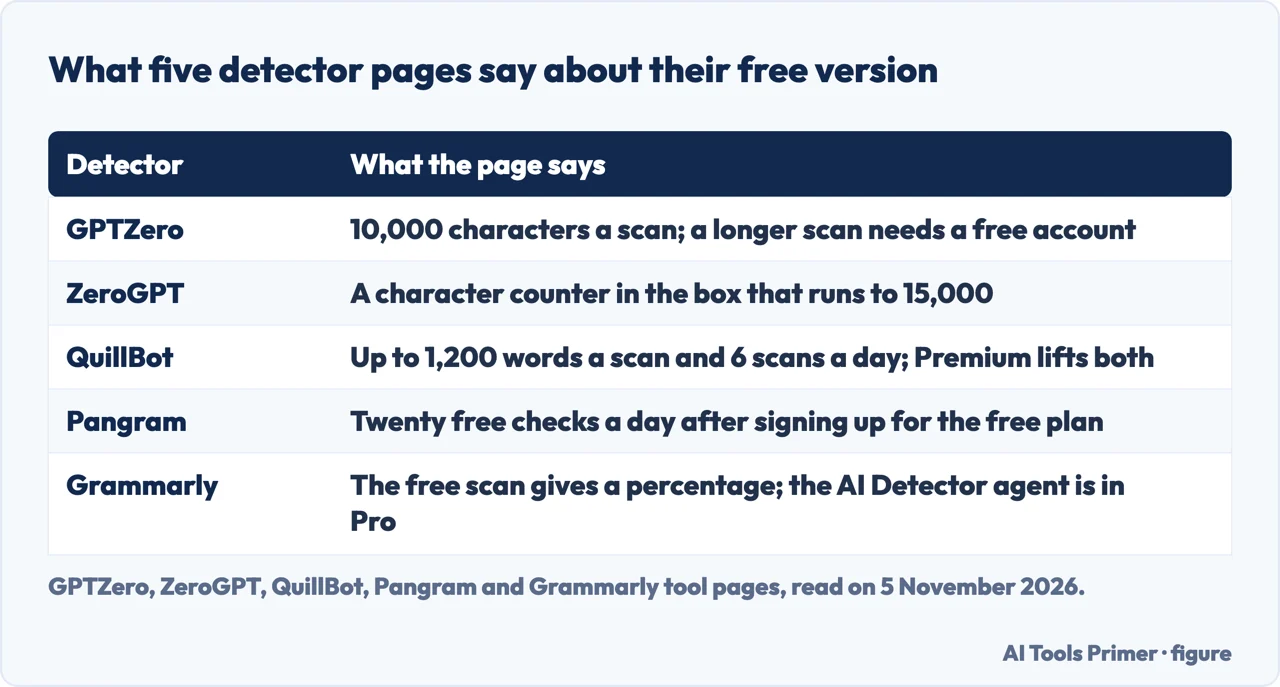
On GPTZero’s page the text box reads “0 / 10,000 characters”, and the page says that for scans over 10,000 characters you should create a free account first. ZeroGPT’s box carries a counter that reads 0/15,000 characters. QuillBot sets its limits out in a table: the free column lists up to 1,200 words per scan, up to 6 scans per day and 1 free explainer card, and ends in a Create account button, while the Premium column lists no word limit for detection scans and unlimited scans. Pangram says it offers twenty free checks a day after signing up for its free plan, with additional credits and plagiarism detection available through a subscription.
Grammarly’s page is the one where the free limit is a feature rather than a number. You paste text or upload a document, click Scan for AI and see a percentage of the text that appears to be AI-generated. The page says that Grammarly Pro adds an AI Detector agent that goes beyond a score: it shows which parts may sound AI-generated, helps refine them in real time and adds formatted citations. The page we read gives no word or character cap. Surfer’s page says its detector has only been trained on content written in English.
Three pages also say how much text the tool wants. QuillBot says to make the text at least 80 words long, and that longer texts of at least 300 words produce more reliable scores than short inputs. ZeroGPT’s FAQ recommends about 150 words or more and says longer text improves stability. GPTZero says accuracy improves with longer inputs and is strongest on English prose.
Pages written at different dates give different limits. In Scribbr’s comparison, revised on 21 July 2026, QuillBot’s free detector scans up to 1200 words per check with no limit on the number of checks and no sign-up. QuillBot’s own page, read on 5 November 2026, lists 6 scans per day and a Create account button. Scribbr gives its own free detector up to 500 words per check. Scribbr’s FAQ also says Originality.ai offers three free scans per day with a 300-word limit per scan; that is Scribbr’s statement, and we did not read Originality’s page. Because providers can change these limits, the tool pages here were read on 5 November 2026, and Scribbr’s comparison is dated 21 July 2026.
What the providers claim
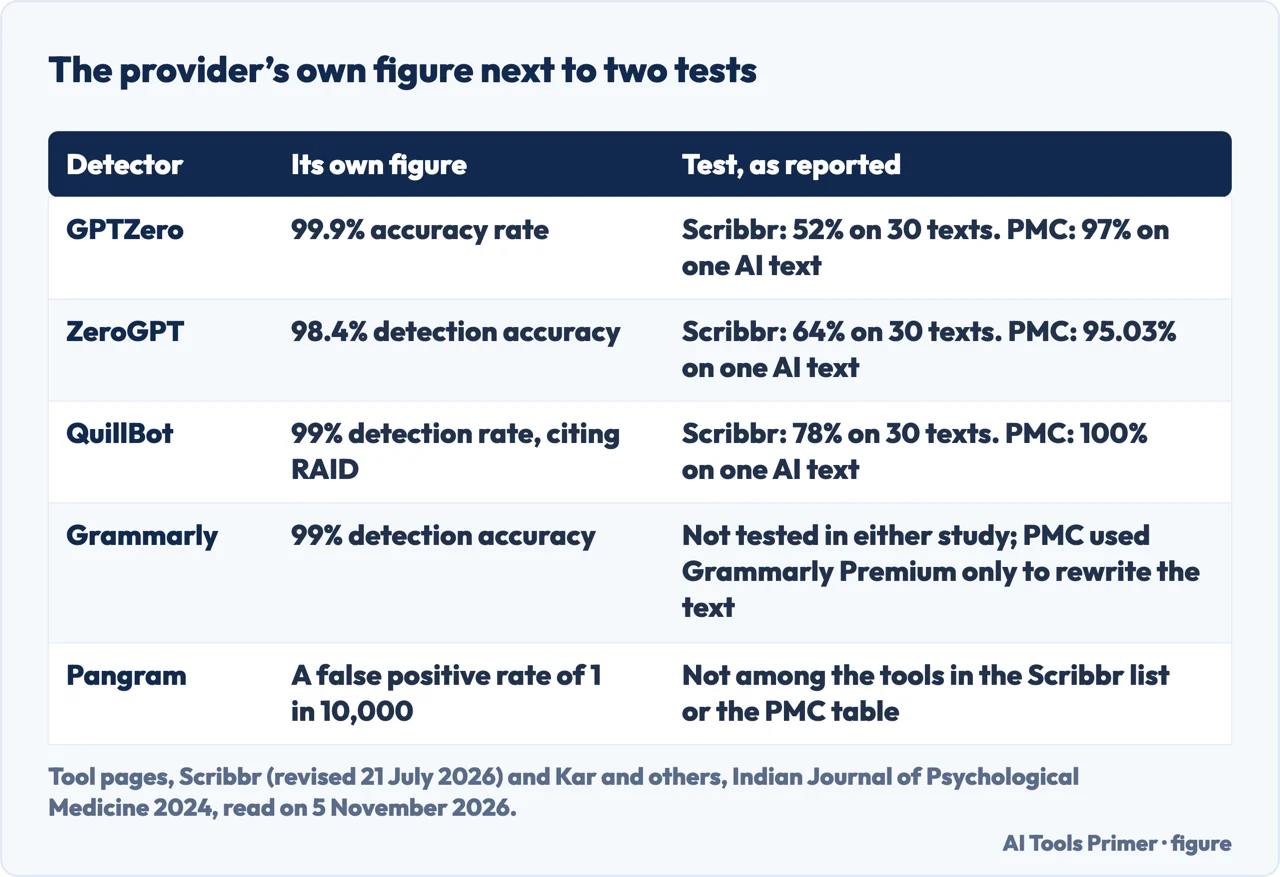
GPTZero’s page states a 99.9% accuracy rate when spotting AI-generated text against human writing, and says that on the RAID benchmark it detected 95.7% of AI texts while incorrectly predicting 1% of human texts as AI. ZeroGPT’s front page shows 98.4% detection accuracy and a false positive rate below 1%, and its FAQ says the company is pushing toward more than 98% on “internal evaluations”. Grammarly’s page states 99% detection accuracy and a number one rank on RAID’s independent benchmark. QuillBot’s page states a 99% detection rate, according to independent evaluations from RAID. Pangram gives a different kind of figure: a false positive rate it calls currently 1 in 10,000, calculated on an aggregate of public datasets, and a post on its page, dated 26 October 2026, reports zero false positives across nine datasets of essays by students who write in English as an additional language.
The same pages hedge. GPTZero says “No AI detector is 100% accurate” and that results should not be used to punish or as the final verdict. Grammarly’s page uses the same sentence and adds that detectors cannot definitively conclude whether AI was used, that human-written text can be flagged, and that lightly edited AI-generated text may evade detection. QuillBot’s page says “Scores are signals, not verdicts”, and that heavily paraphrased writing and highly formulaic content, such as legal jargon or academic writing, is more likely to produce a false positive.
Three providers describe themselves as first. GPTZero’s page calls its detector the most accurate, Grammarly’s ranks it number one on RAID, and Pangram’s describes itself as ranked the most accurate by independent researchers. Those statements sit side by side on separate pages; QuillBot’s page also cites RAID, for a 99% detection rate. We did not test any detector, so we do not rank them.
What two tests found
A study in the Indian Journal of Psychological Medicine (2024) looked at the free versions of ten detectors. The authors took the first ten programs with a free version that they found by searching Google for “AI detector free” and that accepted at least 500 words. They had ChatGPT 3.5 write one text of under 500 words on a psychiatric treatment, on 11 January 2024, and ran it through each detector the next day. The sensitivity ranged from 0% to 100%. Five of the ten, Copyleaks, QuillBot, Sapling, Undetectable AI and Wordtune, scored 100%; ZeroGPT scored 95.03%, GPTZero 97%, Content Detector AI 78.26%, Scispace 61% and Dupli Checker 0%. It is one short text, written entirely by AI, so the study measures how much of that one text each detector caught, not how often a detector flags a human writer.
Scribbr, which lists its own premium and free detectors in the comparison, tested 12 detectors on 30 texts in six categories of five: human-written, from GPT-3.5, from GPT-4, human mixed with GPT-3.5, GPT-3.5 paraphrased by QuillBot and human paraphrased by QuillBot, each between 1,000 and 1,500 characters. Its page, revised on 21 July 2026, gives 84% for Scribbr’s premium detector and 78% for both QuillBot’s free detector and Scribbr’s free one. It gives 68% for Sapling, 66% for Copyleaks, 64% for ZeroGPT and 52% for GPTZero. Scribbr says four of the 12 tools had a false positive, and writes that the claims some companies make about reliability “are not supported by our testing”. For Copyleaks it notes 66% is much lower than the 99% claimed on the site.
Put the numbers next to each other and the gaps are wide, but they are not the same test. GPTZero states 99.9%, scored 97% on the single AI text in the journal study and 52% in Scribbr’s test, where Scribbr says it only ever called a text entirely AI or entirely human. ZeroGPT states 98.4% against 95.03% and 64%. A provider’s figure, one short text and thirty mixed ones answer three different questions.
What happens to the text you paste
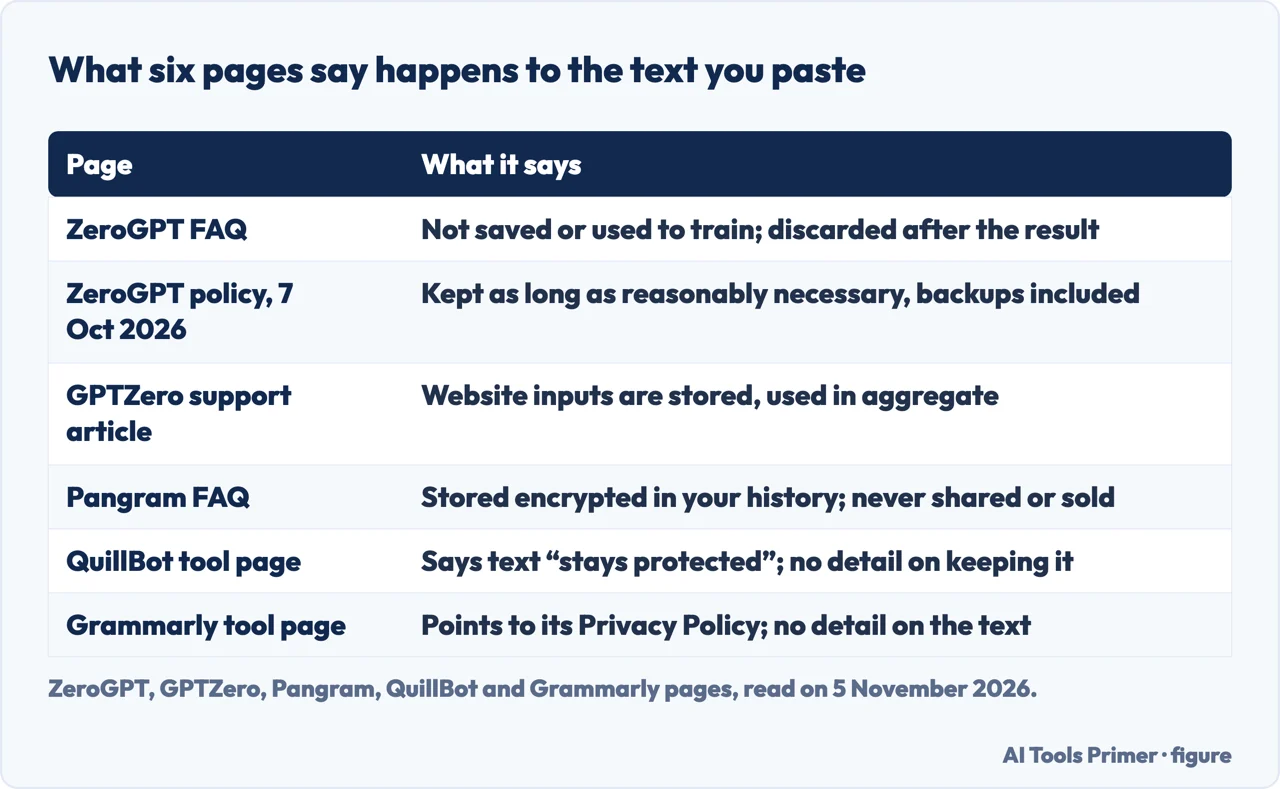
ZeroGPT’s FAQ says that when you check text on it, the text is not saved, shared, published online or used to train its detection model, and that the input is processed only to generate the result and then discarded. Its privacy policy, last updated on 7 October 2026, agrees that it does not use private user content to train or develop AI models. On keeping the text the wording differs: private content not intentionally saved as part of an account feature is retained only for “the period reasonably necessary” to run the service, including temporary processing, security, abuse-prevention, diagnostic and backup requirements, and the policy adds that deletion from active systems may not be immediate in backup systems. The policy text we read gives no number of days. The FAQ says discarded; the policy says kept for a reasonable period, backups included.
GPTZero gives two answers depending on where the text goes. Its support article says that by default it does not store documents passed into calls to its API, with two exceptions, and then that it stores inputs from calls made from its dashboard, the websites gptzero.me and app.gptzero.me, and uses that data only in aggregate to improve the service. The article also says it does not share data with third parties and that a check will not have the text flagged by plagiarism-checking tools. The privacy notice, last updated on 2 April 2026, says that text submitted by API subscribers directly by API is not stored by default nor used for product improvement; the section we read is about API subscribers and does not mention text pasted into the website.
Pangram’s FAQ says all user data is encrypted and stored securely on its servers to be displayed in your history, and that it never shares or sells data to third parties. The page does not say whether the history is used for training. It adds that the detector looks only at the text submitted and does not compare it with a database or the web, as plagiarism checkers do. QuillBot’s page says “Privacy-first design” and that sensitive or unpublished content stays protected, without detail on keeping the text or on training; we did not read its privacy policy. Grammarly’s tool page says that by signing up you agree to its Terms and Conditions and Privacy Policy and does not describe what happens to the text; our page on whether Grammarly is safe reads its policy.
We read the policies of ZeroGPT and GPTZero, not those of QuillBot, Grammarly or Pangram, so the figure above shows only what each tool page, FAQ or support article says.
Why free against paid is not the whole story
The journal study cites an earlier one, by Walters and others, which tested 16 publicly accessible detectors on 126 documents in three sets of 42: ChatGPT-3.5, ChatGPT-4 and student-written. In the journal’s account, Copyleaks, Originality and Turnitin could tell the three sets apart, and the accuracy of a detector was only moderately associated with its free or paid status.
Rewriting changes the picture. In the journal study, after QuillBot’s free version rewrote the AI text, GPTZero found 29% of it and ZeroGPT 32.31%, while QuillBot itself found 90%. After Grammarly Premium rewrote it, GPTZero found 38%. After ChatGPT rewrote it, GPTZero found 97% and ZeroGPT 90.61%. The authors conclude there is “wide variation in the sensitivity” of the tools. Scribbr reports the same difficulty: texts combined with human writing or paraphrased are hard to detect, and its premium detector finds only 60% of them, while GPT-4 texts were generally harder to detect than GPT-3.5 ones.
Scribbr’s own figures differ between its pages. Its page on accuracy, a different page from the comparison, reports a test of 10 tools with an average accuracy of 60%, the best free tool at 68% and the best premium one at 84%. The comparison revised on 21 July 2026 tested 12 tools and gives 78% for the best free ones. Both are Scribbr statements about a test of its own, so we date each.
Illinois State University’s Center for Integrated Professional Development says there is “not full transparency” in how detectors are built, and explains two signals they may use, perplexity and burstiness. It describes a study of submissions to a peer-reviewed medical journal in which commercial detectors identified AI content about 63% of the time with false positive rates of 24.5% to 25%, and says paraphrasing through GPT 3.5 cut detection accuracy by 54.83%. It also cites a January 2025 study in which detectors “remain consistently inconsistent”, giving different scores on the same files in later checks. For instructors it suggests version history and track changes in a shared folder, which would show whether large amounts of text were pasted in. The page’s date was not in the text we read.
The wider questions have pages of their own: how accurate detectors are, what a score means and what to do after a false accusation.
What we did not use
We pasted no text into any detector and ran no test of our own. We did not open the pages of YouScan or StoryChief, the Benchmark Forum thread, the Reverbico article or the Medium article, and we did not read Pangram’s blog on its best detector tools. The PubMed entry for the journal study is a shell, so we read the full text on PubMed Central. The reading tool warned that the text we got from Scribbr’s comparison may be incomplete (the page sits behind a browser check), so we report only what the text says, and we do not claim that Scribbr leaves anything out. We do not rank the detectors: three providers call their own tool the most accurate or number one, Scribbr’s test puts its own premium detector first, and we ran no test to settle it.
Where to start
Four ways in.
- “What does free actually limit?”
- What the free versions limit — limits
- “How accurate do they say they are?”
- What the providers claim — claims
- “What did the tests find?”
- What two tests found — tests
- “What happens to my text?”
- What happens to the text you paste — text
How the numbers are made
Accuracy, scores and false accusations.
Detectors named on this page
GPTZero, QuillBot and Grammarly.
Questions people also ask
Are there any reliable free AI detectors?
The pages we read disagree. Providers state 98.4% to 99.9%; Scribbr’s test put the best free tools, QuillBot’s and its own, at 78%, and a 2024 journal study found sensitivity from 0% to 100% on one AI text across ten free tools.
Are any AI detectors 100% accurate?
GPTZero and Grammarly both say “No AI detector is 100% accurate”, QuillBot says no AI Detector can provide 100% accuracy, and Scribbr says that because of how they work detectors can never provide it.
Is Turnitin 100% accurate?
The pages we read give no accuracy figure for Turnitin. The journal study reports that an earlier study found Copyleaks, Originality and Turnitin could tell three sets apart, with no percentage. GPTZero, Grammarly and QuillBot say no detector is 100% accurate, without mentioning Turnitin. Our page on Turnitin’s AI detection covers it.
Can Turnitin actually detect ChatGPT?
The journal study describes an earlier study of 126 documents in which Turnitin was one of three detectors that could tell ChatGPT-3.5 texts, ChatGPT-4 texts and student-written texts apart; the ChatGPT texts were generated in the first week of April 2023, so this is dated evidence, not a current test. The pages we read did not test Turnitin themselves.
Not covered here. We pasted no text into any detector. The statements come from the tool pages of GPTZero, ZeroGPT, QuillBot, Pangram, Grammarly and Surfer, the privacy texts of ZeroGPT and GPTZero, Scribbr, a 2024 journal study and Illinois State University, all read on 5 November 2026.
The search volume and difficulty behind this page come from an Ubersuggest reading of 5 November 2026 (United States), which gives search volume and its own SEO difficulty score, not Semrush’s; a Semrush check is still to be made.
Sources
- GPTZero — AI detector (tool page) — gptzero.me, read 5 November 2026.
- GPTZero — Privacy policy — gptzero.me, read 5 November 2026.
- GPTZero Support — Are you storing data from API calls? — support.gptzero.me, read 5 November 2026.
- ZeroGPT — AI detector (tool page) — www.zerogpt.com, read 5 November 2026.
- ZeroGPT — FAQ — www.zerogpt.com, read 5 November 2026.
- ZeroGPT — Privacy policy — www.zerogpt.com, read 5 November 2026.
- QuillBot — AI detector (tool page) — quillbot.com, read 5 November 2026.
- Pangram — AI detector (tool page and FAQ) — www.pangram.com, read 5 November 2026.
- Grammarly — AI detector (tool page) — www.grammarly.com, read 5 November 2026.
- Surfer — AI content detector (tool page) — surfer.ai, read 5 November 2026.
- Scribbr — 12 best AI detectors, tested — www.scribbr.com, read 5 November 2026.
- Scribbr — How accurate are AI detectors? — www.scribbr.com, read 5 November 2026.
- Kar and others, Indian Journal of Psychological Medicine, 2024 — How sensitive are the free AI-detector tools? — pmc.ncbi.nlm.nih.gov, read 5 November 2026.
- Illinois State University, Center for Integrated Professional Development — Why don’t AI detectors work? — prodev.illinoisstate.edu, read 5 November 2026.
Written by Alberto Gulotta
Founder and editor of AI Tools Primer, writing from Palermo, Italy. Thirty-five years of taking computers apart, starting with a Commodore 64 — the long version is on the about page.
Something wrong on this page? Write to aitoolsprimer@gmail.com and it gets fixed.
Written on 5 November 2026.
Independence and limits
No affiliate links and no paid placements anywhere on this site. Nobody pays to appear here, and no company has seen this page before you did.
This is general information, not professional advice. Where a page touches money, health, safety or the law, it names its source and the date it was read — and your situation may still differ. See the privacy page and the cookie policy.