
Docs · guide
What a proforma invoice is and how it differs from an invoice
By Alberto Gulotta · Updated · 18 min read
A proforma invoice is a quote written in the form of an invoice. That is how the US export agency ITA describes it, and HMRC says a UK one used to make an offer should be marked as not a VAT invoice. Start with the comparison by source, then the payment section: the sources describe different uses.
| Point | Source and scope |
|---|---|
| A pro forma invoice is a quote in an invoice format | ITA, US Department of Commerce (US exports) |
| When used to make an offer, it should be clearly marked not a VAT invoice, and cannot be used to reclaim input tax | HMRC, VAT Notice 700 section 17.3 (UK VAT) |
| Legal status: a declaration by the seller in one source, not legally binding in two others | ITA (US); DHL Express (New Zealand); Salesforce (Australia) |
| Whether to pay against one: the sources describe different uses | HMRC (UK); Salesforce (Australia); DHL Express (New Zealand) |
| US customs uses the same name for the importer’s own statement, not the seller’s quote | CBP and 19 CFR 141.85 (US imports) |
What is a proforma invoice, and who writes it?
The International Trade Administration (ITA), the US Department of Commerce agency that advises American exporters, defines a pro forma invoice as “a quote in an invoice format”. In ITA’s account the seller writes it: its page on common export documents says the seller should use it to quote at the beginning of an export transaction, and calls it a negotiating tool between the seller and the buyer before an export shipment. ITA adds that a pro forma invoice carries much of the same information as the formal quotation, so in many cases it can be used in place of one, and that it can provide a quote to a potential foreign buyer.
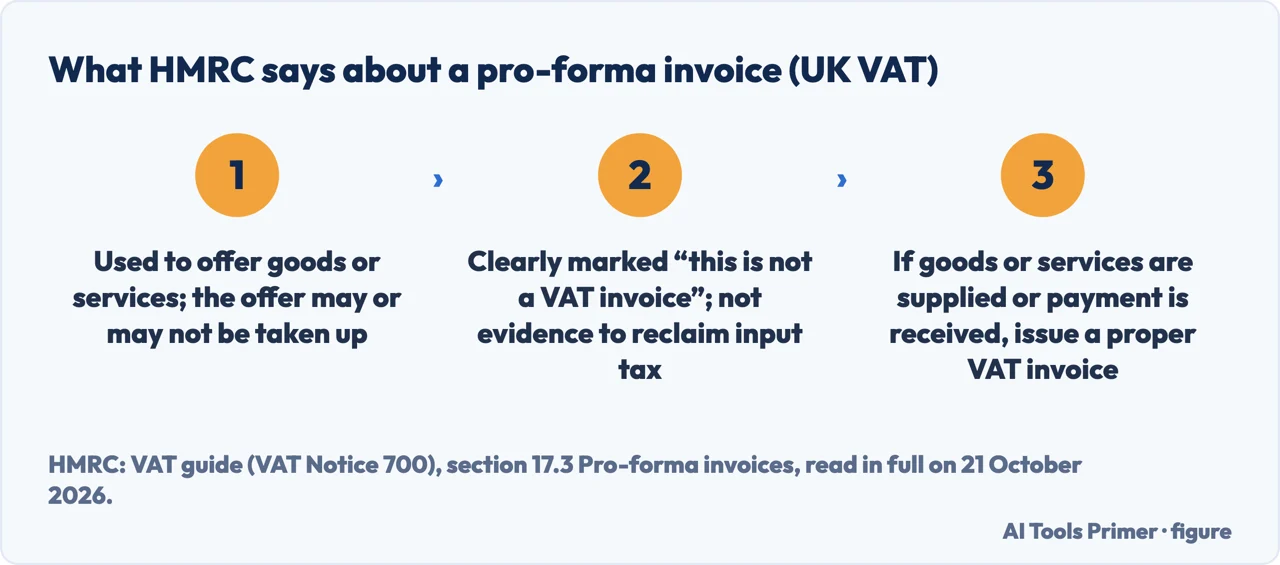
HMRC, the UK tax authority, describes the same kind of document from the side of VAT. Section 17.3 of its VAT Notice 700 says pro-forma invoices are often used to offer goods or services to potential customers, and that such an offer may or may not be taken up.
Two companies that sell related services word it differently. DHL Express, a carrier, says on its New Zealand site that the document states the seller’s offer or preliminary bill to provide specific products at a given price. Salesforce, a software seller, writes in its Australian blog that a proforma invoice is a preliminary bill of sale that a vendor sends to a prospective customer before the final sale or shipment, typically when the buyer has confirmed the sale but details such as quantity, materials or delivery date are still to be settled. Only part of the DHL page was read for this page, so it is used sparingly and always as a carrier’s statement.
The name is spelled three ways across these publishers, and DHL New Zealand uses two of them. ITA, US Customs and Border Protection (CBP) and the US customs regulations write pro forma; HMRC writes pro-forma; the UK government’s business.gov.uk export guidance and Salesforce in Australia write proforma; DHL writes both pro forma and proforma. This page uses the last spelling in its own words and keeps each publisher’s spelling when it names that publisher. None of the sources read for this page gives the document another name, so this page does not offer one. For the neighbouring documents and the generators that produce them, the invoice page on what must be on an invoice is the hub this page belongs to.
What goes on a proforma invoice?
ITA’s pro forma page gives a list of eleven points for the seller to include, introduced as the points mentioned for the quotation. ITA does not group them; the table below sorts them into six rows, in ITA’s order. The first row names the parties and the order: the seller’s name and address, the buyer’s name and address, and the buyer’s reference. The second gives the items quoted and the prices per unit and extended totals. The third holds the details: the weights and dimensions of the quoted products, and any discounts. The fourth is the terms of sale or Incoterm used, with the delivery point included, and the fifth the terms of payment. The list ends with two dates, the estimated shipping date and the validity date.
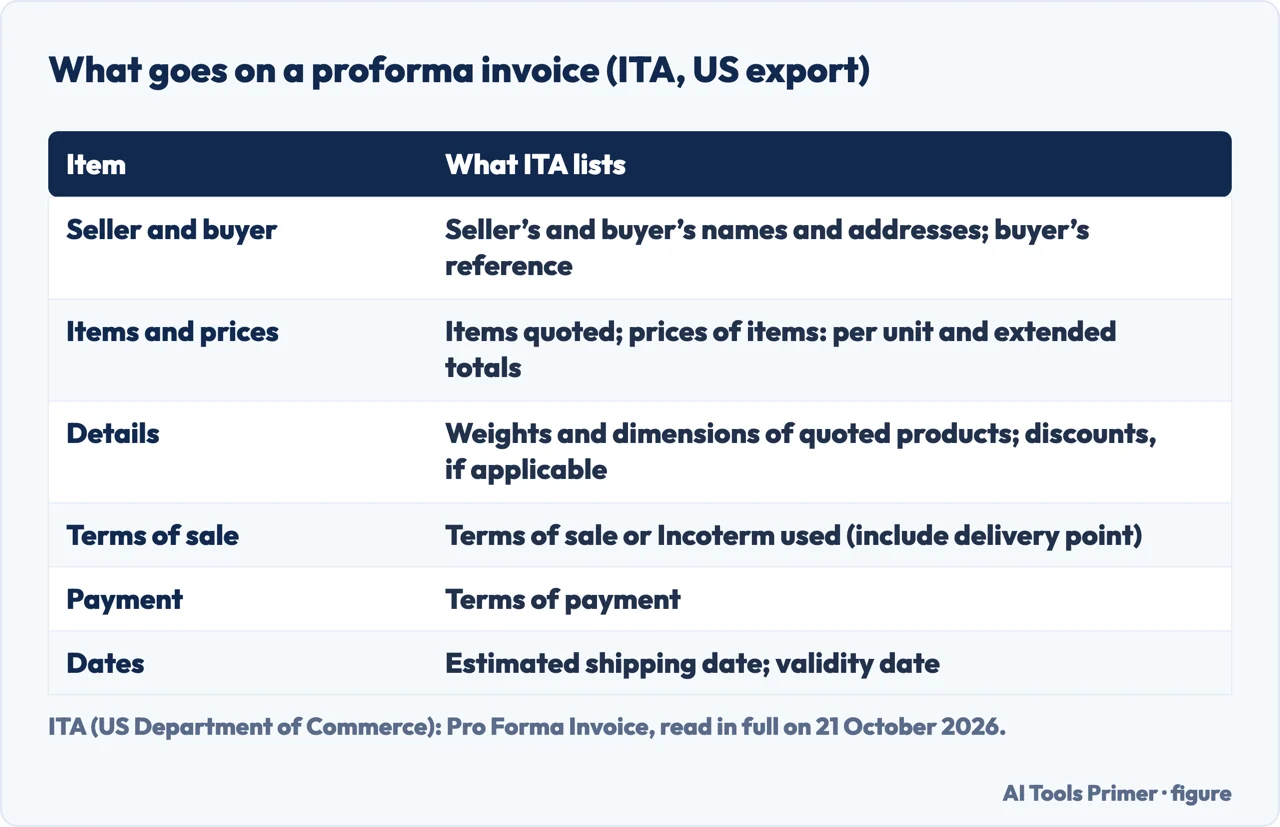
The same ITA page says the document should give the buyer as much information about the order as possible, so that arrangements can be made efficiently. It adds that these invoices inform the buyer and the appropriate import government authorities about the details of the future shipment, and that changes should not be made without the buyer’s consent. That is guidance for US exporters; the page does not say what any other country’s authorities ask for.
The list is a list for an offer, not for a finished invoice. What a government requires on a real invoice is a different and longer question, and how to write an invoice sets it out for two countries. Software that issues invoices and keeps the accounts is covered in accounting software, CRM and project tools.
How does a proforma invoice differ from an invoice and a commercial invoice?
The sources do not agree on one answer, so this section takes them one country at a time and does not merge them.
United States, exports: a step towards the commercial invoice
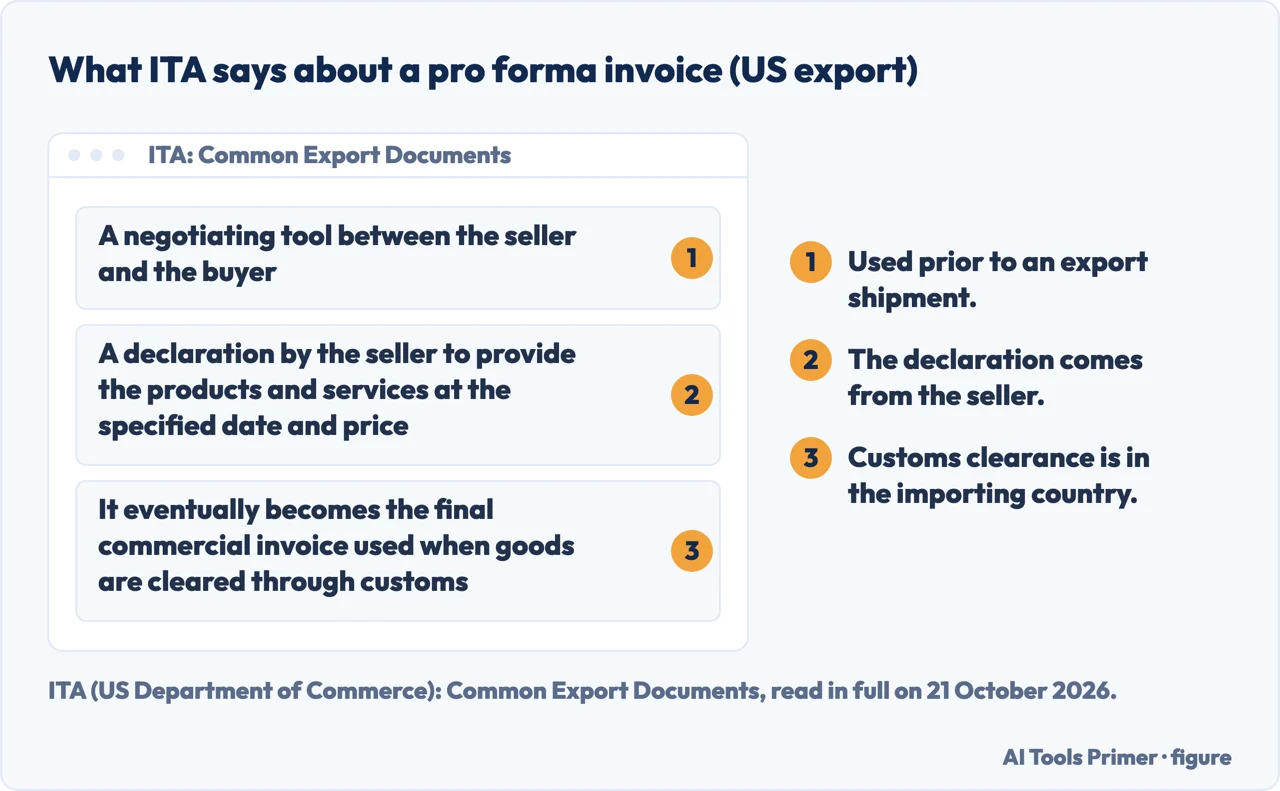
ITA describes the pro forma as the start of a sequence. On its common export documents page, it says the pro forma will eventually become the final commercial invoice used when goods are cleared through customs in the importing country. On its commercial invoice page, ITA says that in addition to the information on the pro forma invoice, the commercial invoice may include the Harmonized System (HS) code.
United Kingdom: not a VAT invoice
HMRC separates the two documents more sharply, for VAT. Its Notice 700 says that a pro-forma invoice used to make an offer should be clearly marked “this is not a VAT invoice”, and that it cannot be used as evidence to reclaim input tax, even if it shows all the details required for a VAT invoice. If, after issuing one, you supply the goods or services or receive payment, HMRC says you must issue a proper VAT invoice. All of this is UK VAT guidance and says nothing about other taxes or other countries.
On the export side, the UK government’s business.gov.uk guide tells exporters that the commercial invoice should give the number and date of related paperwork, which it says could be the proforma invoice, purchase order or sales contract. That treats the proforma as separate paperwork the commercial invoice points back to, where ITA describes it becoming the commercial invoice. The two descriptions come from different countries and are set side by side here, not reconciled. Who keeps which document, and for how long, is a separate question: how long to keep business records gives the periods two tax authorities publish, and how to organise receipts covers the buying side.
Australia and New Zealand: what two commercial sources say
The Australian and New Zealand sources here are commercial. Salesforce, a software seller, says in its Australian blog that a proforma invoice is not a tax invoice and is not acknowledged for the purpose of business accounts, unlike a regular invoice. DHL Express, a carrier, says that unlike a commercial invoice a pro forma invoice is not legally binding. No Australian or New Zealand government page was read for this page, so these points are reported as what those two publishers say, not as the rules in either country.
Should you pay on a proforma invoice?
The sources read do not answer that, and this page gives no advice on it. What they do is describe the document being used in different ways.
HMRC, writing about UK VAT, describes a pro-forma invoice used to offer goods or services in which “the goods or services will not be supplied unless payment is received”. Salesforce, a software seller, says in its Australian blog that a proforma invoice does not request payment. DHL Express, a carrier, presents it differently again: a New Zealand importer can use one to budget for shipping costs and to apply for import permits. ITA, for US exports, adds uses a buyer may have for it, such as opening a letter of credit; its full wording is in the importer section below.
So the same word covers an offer that is held until money arrives, a document that asks for no money, and a document that helps a buyer arrange paperwork and finance. Which of these a given proforma invoice is, these publishers do not settle. Once a real invoice exists, the mechanics and costs of being paid by card or transfer are in getting paid: card payments, transfers and fees.
Is a proforma invoice legally binding?
Here the sources disagree, and the disagreement follows the country and the kind of publisher.
United States, ITA. On its common export documents page, the US government’s export agency calls the pro forma “a declaration by the seller to provide the products and services to the buyer at the specified date and price”. Its pro forma page adds that changes should not be made without the buyer’s consent. ITA does not use the word binding.
New Zealand, DHL Express. The carrier says that, unlike a commercial invoice, the document is “not legally binding”. That comes from the part of the page that was read, which is an extract.
Australia, Salesforce. The software seller says a proforma invoice is “not a legally binding agreement and doesn’t request payment”.
A declaration by the seller to provide goods at a price and a document that is not legally binding are not obviously the same thing, and nothing in the sources reconciles them. They come from a government agency in one country and from two commercial publishers in two others. No source read for this page says what a court in any country would do with a proforma invoice, so this page does not say either, and it is not legal advice.
Does an importer or a customs office need a proforma invoice?
ITA, for US exports, says a pro forma invoice may be required by the buyer to apply for an import licence, to contract for a pre-shipment inspection, to open a letter of credit or to arrange a transfer of hard currency. The word is may: it depends on the buyer. ITA also says a pro forma may not be a required shipping document, but that it can provide the detailed information buyers need in order to import the product legally.
DHL Express in New Zealand, a carrier, says an importer there can use one when applying for import permits. Salesforce, a software seller in Australia, goes further and says proforma invoices are often required for clearing goods in international shipping, because they state estimated costs clearly. That is a seller’s statement, set beside ITA’s more cautious wording.
No customs authority’s page on a seller-issued proforma invoice was read for this page. The only customs rules read are the US ones in the next section, and they concern a different document.
Why does US customs use the same name for a different document?
Two US government publishers use the words pro forma invoice for two documents. ITA’s is the seller’s quote, written before the sale. US Customs and Border Protection (CBP) means something else, set out in the customs regulations at 19 CFR 141.85: a form headed “Importers Statement Of Value Or The Price Paid In The Form Of An Invoice”. In it the importer says they are not in possession of a commercial seller’s or shipper’s invoice and asks customs to accept the statement of value or price paid, in the form of an invoice, instead.
The form asks for the names of the shipper, seller, consignee and purchaser, the quantities, description and unit and total prices, and the country of origin, and the importer states that the prices are true and correct to the best of their knowledge and belief. CBP’s importers’ guide says a pro forma invoice is not prepared by the exporter and is filed by the importer.
When is one filed? An undated edition of CBP’s guide says that if the required commercial invoice is not filed at the time the merchandise is entered, a statement in the form of an invoice, a pro forma invoice, must be filed by the importer at the time of entry. Two examples from the regulations are these. Under 19 CFR 141.83(d), where a commercial invoice is not required for certain goods and none is available, a pro forma or substitute invoice is filed; that applies to the categories of goods listed in that paragraph, not to imports in general. Under 19 CFR 141.82(c), for installment shipments arriving within a period of 10 days, if the required invoice is not filed with the first entry of the series, a pro forma invoice must be filed with each entry made before the required invoice is produced, with a bond for its production. Other sections of the same part, among them 19 CFR 141.84, 141.86(c) and 141.92, also mention a pro forma invoice.
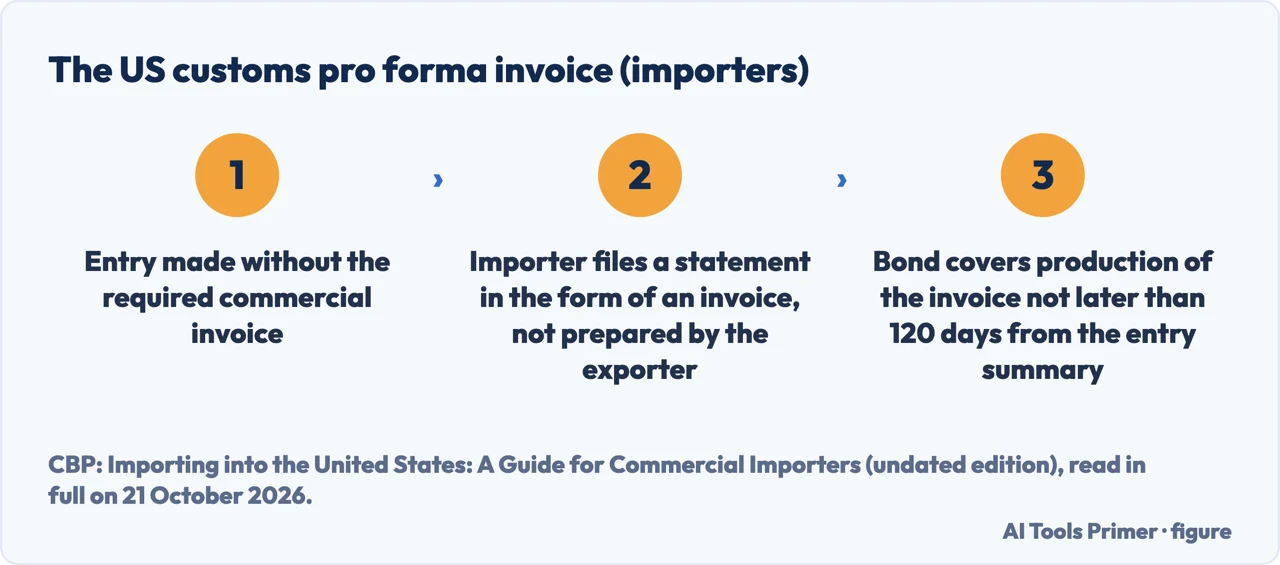
The same edition of the guide says the bond is given for production of the required invoice not later than 120 days from the date of the entry summary, or the entry if there is no entry summary. All of this is US import practice. It does not describe the seller’s proforma invoice in the earlier sections, and nothing in these US sources says that one stands in for the other.
Where to start
Six ways in.
- “Is it a quote or an invoice?”
- Start with the definitions — what a proforma invoice is
- “What goes on one?”
- See the eleven points — what goes on a proforma invoice
- “Can it count as a real invoice?”
- Compare by country — proforma invoice vs invoice
- “Should I pay before it ships?”
- See how the sources differ — should you pay on a proforma invoice
- “Does it bind the seller?”
- Read the three answers — is a proforma invoice legally binding
- “Customs asked for one.”
- Check which document — the customs form with the same name
Around the proforma invoice
The documents that come before and after it, and the paperwork around them.
Questions people also ask
What is a proforma invoice?
The US export agency ITA calls it a quote in an invoice format, a negotiating tool between seller and buyer before a shipment. US customs uses the same words for a different document: the importer’s own statement of value, filed in the form of an invoice when the commercial invoice is missing.
What is the difference between a proforma invoice and an invoice?
In the UK, HMRC says a pro-forma used to make an offer should be marked as not a VAT invoice and cannot be used to reclaim input tax; if the goods or services are then supplied or paid for, a proper VAT invoice must be issued. ITA, for US exports, says a commercial invoice may add a Harmonized System code.
Should you pay on a proforma invoice?
HMRC says that when a UK pro-forma is used to make an offer, the goods or services will not be supplied unless payment is received. Salesforce in Australia, a software seller, says a proforma invoice does not request payment. This page gives no advice on whether to pay.
What is another name for a proforma invoice?
The sources read spell it three ways: ITA and US customs write pro forma, HMRC pro-forma, and the UK business.gov.uk guidance and Salesforce in Australia proforma. None gives the document another name, so this page does not offer one.
Not covered here. This page does not say what a court in any country would do with a proforma invoice, and it gives no tax or legal advice or advice on whether to pay. It covers only the countries and publishers named above, and it does not rank invoice generators or templates; the invoice page explains what must be on an invoice. Where a claim rests on a single publisher, the text names the publisher and the country it speaks for, and a rule from one country is not offered as a rule for another.
Sources
- ITA (US Department of Commerce) — Pro Forma Invoice: the definition as a quote in an invoice format, the buyer’s possible uses, and the list of eleven points. US exports — www.trade.gov, read 21 October 2026.
- ITA (US Department of Commerce) — Common Export Documents: the pro forma as a negotiating tool, a declaration by the seller, and the invoice it eventually becomes. US exports — www.trade.gov, read 21 October 2026.
- ITA (US Department of Commerce) — Commercial Invoice: the HS code the commercial invoice may add to the pro forma information. US exports — www.trade.gov, read 21 October 2026.
- ITA (US Department of Commerce) — Negotiate an Export Sale: the pro forma as a quote to a potential foreign buyer. US exports — www.trade.gov, read 21 October 2026.
- HMRC — VAT guide (VAT Notice 700), section 17.3 Pro-forma invoices, and the section on reclaiming VAT on purchases: the offer, the marking, input tax and the proper VAT invoice. UK, VAT; published 17 December 2014, updated 25 June 2026 — www.gov.uk, read 21 October 2026.
- CBP — Importing into the United States: A Guide for Commercial Importers (undated edition): the importer’s pro forma invoice, not prepared by the exporter, and the 120-day bond. US imports — www.cbp.gov, read 21 October 2026.
- CBP / Legal Information Institute — 19 CFR 141.85 Pro forma invoice, with 141.82(c), 141.83(d), 141.84, 141.86(c) and 141.92: the form text and when a pro forma invoice is filed. US imports — www.law.cornell.edu, read 21 October 2026.
- business.gov.uk (UK government) — How to create a commercial invoice for export: the proforma invoice as related paperwork cited on the commercial invoice. UK exports — www.business.gov.uk, read 21 October 2026.
- DHL Express (a carrier) — Commercial vs Proforma Invoices: Key Differences Explained, DHL New Zealand, 5 August 2025: not legally binding, and use for budgeting and import permits. New Zealand; partial extract only — www.dhl.com, read 21 October 2026.
- Salesforce (a software seller) — What is a proforma invoice?, Salesforce ANZ blog: its definition, and its statements on legal status, payment, tax invoices and business accounts. Australia; a vendor’s blog, a secondary source — www.salesforce.com, read 21 October 2026.
Written by Alberto Gulotta
Founder and editor of AI Tools Primer, writing from Palermo, Italy. Thirty-five years of taking computers apart, starting with a Commodore 64 — the long version is on the about page.
Something wrong on this page? Write to aitoolsprimer@gmail.com and it gets fixed.
Written on 21 October 2026.
Independence and limits
No affiliate links and no paid placements anywhere on this site. Nobody pays to appear here, and no company has seen this page before you did.
This is general information, not professional advice. Where a page touches money, health, safety or the law, it names its source and the date it was read — and your situation may still differ. See the privacy page and the cookie policy.