
Study · guide
ACS citation generator
By Alberto Gulotta · Updated · 10 min read
An acs citation generator for chemistry. The three shapes below were read out of the ACS Style Quick Guide, which the American Chemical Society publishes free as part of its guide to scholarly communication, and each one carries in the code the example it was checked against.
ACS reference generator
Fill in what you have. Empty fields are left out. Nothing leaves your browser.
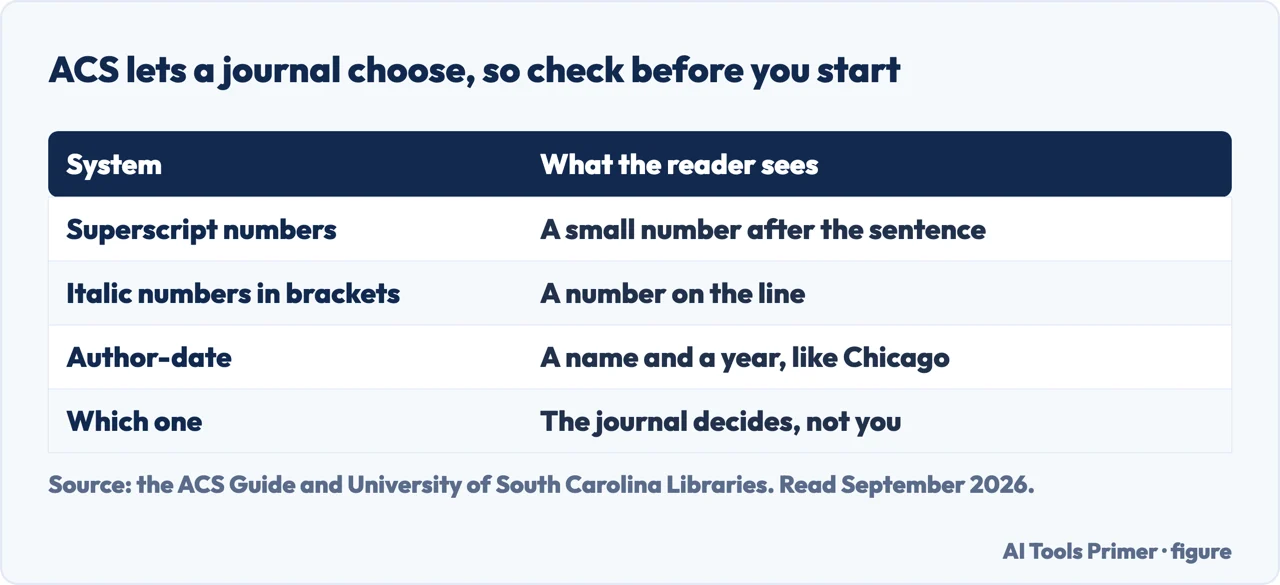
ACS looks unlike the other technical styles at a glance, and the reason is a single punctuation decision: authors are separated by semicolons, not commas. The printed form runs Bard, A. J.; Faulkner, L. R. — surname, comma, spaced initials with full stops, then a semicolon before the next person. Commas already do a job inside each name, so a comma between names would be ambiguous, and the style resolves that rather than living with it.
The second thing that sets it apart is the order of year and volume. Most styles put the volume next to the journal and the year somewhere else; ACS puts the year immediately after the journal name, then the volume, then the issue in brackets, then the pages. The printed example reads Nature Chemistry 2022, 14 (10), 1174–1184. Anyone assembling that by memory from another style will reverse the first two, and the result stays plausible.
Books use a semicolon too, in a place no other style does: before the publisher. The guide prints Francl, M. Steeped: The Chemistry of Tea; Royal Society of Chemistry, 2024 — title, semicolon, publisher, comma, year. With an edition it becomes Concepts in Physical Chemistry, 2nd ed.; Royal Society of Chemistry, 2024, the edition riding with the title rather than with the publisher.
There is a part of this style a text box genuinely cannot carry, and it is worth saying plainly rather than pretending otherwise. In print, ACS sets the journal name in italics, the year in bold and the volume in italics. The generator above produces the words, the order and the punctuation correctly; the emphasis you apply yourself once the reference is in your document. A tool that claimed to hand you a finished ACS reference in plain text would be claiming something the format does not allow.
The field the tool cannot check for you is the journal abbreviation. ACS uses the Chemical Abstracts Service forms, which are not the full journal title and are not what a database record will hand you. That is a fact about the journal rather than about your reference, so no form field can supply it — and it is the single commonest difference between output pasted from a reference manager and a reference that matches the style.
A note on how this page came to exist, because it says something about the tools that compete for this question. The quick guide is free and public, and an automated reader is stopped by an ordinary bot check in front of it; a person with a browser waits a few seconds and reads it. That gap is why so much of the chemistry referencing advice online is second-hand, and why the generators that rank for this term do not say which document they implement. This one does, and names the date it was read.
One more habit that separates ACS from its neighbours, and it looks like an omission rather than a rule. There is no comma between the journal name and the year: the reference runs straight from one into the other, and the only thing marking the boundary in print is that the journal is italic and the year is bold. In plain text those two words simply sit next to each other, which is correct and looks, to anyone used to another style, like a missing punctuation mark.
Taken together, the semicolons between authors, the year before the volume and that absent comma make ACS one of the least forgiving styles to assemble by hand. Every one of those is a place where a habit from another style produces something that still reads as a reference. That is the argument for a form: it does not carry habits from anywhere else.
What this page will not tell you is that the output is finished. A generator formats the metadata it is given, and chemistry bibliographies carry preprints, datasets, spectra and patents whose treatment is genuinely more involved than three shapes can cover. For those, the quick guide itself is the next stop, and it is a few seconds away.
And a library guide is where the working version lives. The University of South Carolina summarises ACS as a style “developed by the American Chemical Society and… commonly used in the field of chemistry”, whose citations “consist of in-text citations and a list of references”, and points at the official guide as a purchase. That is the practical situation with most society styles: the manual is a book, the free description is at a university, and the two agree on everything a student actually needs.
The rest of this guide, for when the next reference is in a different style: IEEE, Turabian, APSA, BibTeX, AMA and ASA. Every one of them is a working generator, and every one was built from a document that could be read and names the page it came from. Three of the seven took two attempts to source, and those pages say which and why.
Where to start
Four ways in.
- “I have the details and I need the reference.”
- The tool is at the top, under generator
- “Which document is this from?”
- The source is named in checked against the guide
- “My reference looks wrong and I cannot see why.”
- Start at what goes wrong
- “I need a different style.”
- The other styles are in Citation generator and study tools
Checked against the guide
Where each shape comes from in the ACS Style Quick Guide, so a rule can be traced to the example it was read from.
What goes wrong
The parts of an ACS reference that come out of a generator or a manager incorrect often enough to be worth a minute of checking.
Around the style
ACS sits among the technical styles and most practical questions here are comparative.
Not covered here. It will not hand you a finished reference in plain text. ACS sets the journal in italics, the year in bold and the volume in italics, and a text box cannot carry any of that.
It will not fix a journal abbreviation. That is a fact about the journal, not about your reference.
It will not send anything anywhere. The generator runs entirely in the page.
And it will not carry an affiliate link to a reference manager. What holds instead is simple: the three shapes were read out of the ACS Style Quick Guide published by the American Chemical Society.
Sources
- ACS Style Quick Guide, part of the ACS Guide to Scholarly Communication, published by the American Chemical Society — the journal-article form with authors separated by semicolons, the year placed before the volume and the bracketed issue; the book form with a semicolon before the publisher and the edition riding with the title; and the chapter form combining both — pubs.acs.org, read 30 August 2026.
- University of South Carolina Libraries — ACS style: the shape of the style and the relationship between the in-text citation and the reference list, from an institution that sells nothing — guides.library.sc.edu, read 4 September 2026.
Written by Alberto Gulotta
Founder and editor of AI Tools Primer, writing from Palermo, Italy. Thirty-five years of taking computers apart, starting with a Commodore 64 — the long version is on the about page.
Something wrong on this page? Write to aitoolsprimer@gmail.com and it gets fixed.
Written on 30 August 2026 · last checked 7 September 2026.
Independence and limits
No affiliate links and no paid placements anywhere on this site. Nobody pays to appear here, and no company has seen this page before you did.
This is general information, not professional advice. Where a page touches money, health, safety or the law, it names its source and the date it was read — and your situation may still differ. See the privacy page and the cookie policy.