
Study · guide
AMA citation generator
By Alberto Gulotta · Updated · 10 min read
An ama citation generator for medicine and the health sciences. The four shapes below were read out of two sources published by the American Medical Association and its publisher before this page was written, and each one carries in the code the document it came from.
AMA reference generator
Fill in what you have. Empty fields are left out. Nothing leaves your browser.
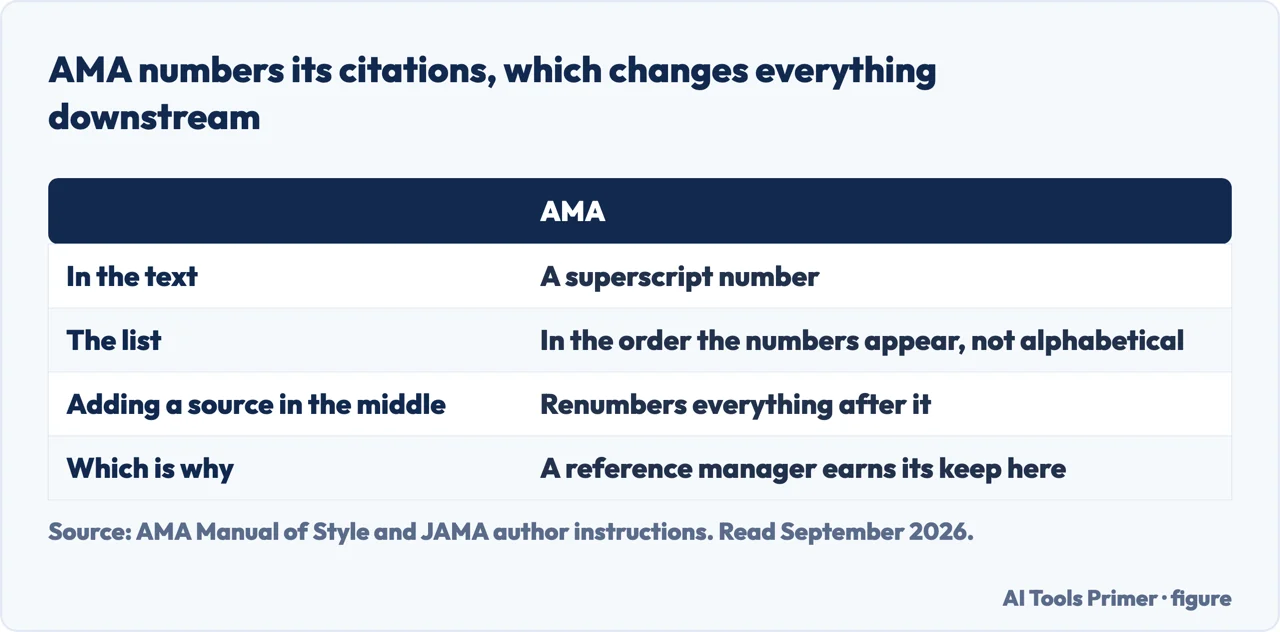
Getting to those sources took two attempts, and the story is worth one paragraph because it explains what this tool is standing on. The AMA Manual of Style itself is behind a subscription, which for a while looked like the end of it. It is not: the publisher runs a public Guide to Citing page whose examples are themselves written in AMA style, and JAMA — the association’s own journal — prints worked references inside its instructions for authors. Between the two, all four shapes are covered by primary sources.
The house habits that make AMA look different from every other style on this guide, and that a tool has to get right because they are invisible until they are wrong. Initials carry no full stops and no space: the printed form is Rivara FP, not R. F. P. or Rivara, F. P. Authors are separated by commas rather than semicolons or the word and. And after three names the list stops with et al — the printed example runs Christiansen S, Iverson C, Flanagin A, et al, which is three names and no fourth.
The article shape is the compressed one. After the title and the abbreviated journal comes a run of punctuation with no spaces in it at all: year, semicolon, volume, issue in brackets, colon, pages. The printed example is 2003;157(4):321-324. People retyping that by hand put spaces in it, because every other style they have used has spaces there, and the result looks close enough to pass a glance and wrong to anyone who knows the style.
The DOI has its own convention, and it is not the one most other styles on this guide use. AMA prints doi: immediately followed by the identifier, with no space and no link wrapper — the example ends with the prefix and the bare identifier, nothing else. A generator that emits a full https://doi.org address is producing something a reader can click and an editor will send back.
Books and chapters move the year to the end and attach it with a semicolon: publisher, semicolon, year. A chapter adds the page range after a colon on the same run, so the tail of the reference reads Oxford University Press; 2020:505–550. An online source keeps the book shape and adds the date you read it, spelled out, before the address.
The fields worth checking before a reference goes into a manuscript. The journal abbreviation is the first and the tool cannot help with it: AMA uses the abbreviations from the National Library of Medicine’s catalogue, and a record exported from a database will usually give you the full title instead. The edition is the second, because it is easy to omit and it is required whenever a book is not the first. And the author count is the third: a paper with fifteen authors becomes three names and et al, and a reference manager set to a different style will happily print all fifteen.
There is a reason this style compresses so hard, and it is not aesthetic. Medical papers carry long reference lists — a systematic review can run to several hundred entries — and every space and full stop removed from a reference is multiplied by that number across a whole journal. The punctuation that looks fussy when you are formatting one reference is a decision about how many pages a bibliography occupies, taken by people who print a great many of them.
That also explains the shape of the errors here. A style built on the absence of things fails quietly: an extra space, a full stop between initials, a fourth author where the list should have stopped. None of it looks broken. It looks like a reference, and it is a reference in a slightly different style, which is the kind of thing that gets noticed by exactly one reader and that reader is marking your work.
What this page will not tell you is that the output is finished. The manual is the authority and it is not public; what is public is the association’s own application of it, which is what this tool was built from. That is a strong source and it is not the same as the book. Where they could differ — an unusual source type, a rule that changed between editions — the manual wins, and a library subscription is the way to reach it.
The rest of this guide, for when the next reference is in a different style: IEEE, Turabian, APSA, BibTeX, ACS and ASA. Every one of them is a working generator, and every one was built from a document that could be read and names the page it came from. Three of the seven took two attempts to source, and those pages say which and why.
Where to start
Four ways in.
- “I have the details and I need the reference.”
- The tool is at the top, under generator
- “Where did these formats come from?”
- The sources are named in where the shapes came from
- “My reference looks wrong and I cannot see why.”
- Start at what goes wrong
- “I need a different style.”
- The other styles are in Citation generator and study tools
Where the shapes came from
The manual is behind a subscription and the association still publishes enough to check a tool against. Which document gave which shape, and how far that gets you.
What goes wrong
The habits that make AMA look unlike every other style, and that are invisible in a finished reference until somebody who knows the style reads it.
Around the style
AMA sits among the technical styles and most of the practical questions people bring here are comparative.
Not covered here. It will not claim to be the manual. The book is the authority and it is not public; this tool was built from the association’s own published application of it.
It will not fix a journal abbreviation for you. That is a fact about the journal, not about your reference, and no form field can supply it.
It will not send anything anywhere. The generator runs entirely in the page.
And it will not carry an affiliate link to the manual or to a reference manager. What holds instead is simple: the four shapes were read out of the publisher’s guide to citing and JAMA’s instructions for authors.
Sources
- Guide to citing, AMA Manual of Style, Oxford University Press — a public page whose examples are themselves written in AMA style: the book form with edition, publisher and semicolon before the year; the chapter form with In: followed by the editors and the page range after a colon; and the online form adding an accessed date before the address — academic.oup.com, read 30 August 2026.
- JAMA Instructions for Authors, American Medical Association — worked references in AMA style showing the journal-article form, with authors as surname plus initials without full stops, the compressed year, volume, issue and page run, and the doi written without a space or a link wrapper — jamanetwork.com, read 30 August 2026.
Written by Alberto Gulotta
Founder and editor of AI Tools Primer, writing from Palermo, Italy. Thirty-five years of taking computers apart, starting with a Commodore 64 — the long version is on the about page.
Something wrong on this page? Write to aitoolsprimer@gmail.com and it gets fixed.
Written on 30 August 2026 · last checked 7 September 2026.
Independence and limits
No affiliate links and no paid placements anywhere on this site. Nobody pays to appear here, and no company has seen this page before you did.
This is general information, not professional advice. Where a page touches money, health, safety or the law, it names its source and the date it was read — and your situation may still differ. See the privacy page and the cookie policy.