
Study · guide
ASA citation generator
By Alberto Gulotta · Updated · 10 min read
An asa citation generator for sociology. The three shapes below come from the reference examples that American Sociological Review — the association’s own flagship journal — publishes for authors, and those instructions name the edition they follow: the ASA Style Guide, seventh edition, 2022.
ASA reference generator
Fill in what you have. Empty fields are left out. Nothing leaves your browser.
That edition line matters more here than it would elsewhere, and it is the reason this page took two attempts to write. The ASA Style Guide is sold as a book. What is freely reachable is an older quick guide — the third edition, printed in 2007 — and it opens, it looks authoritative, and it is authoritative for a version of the style that has been revised four times since. A tool built on it would produce references that were confidently, consistently and invisibly nineteen years out of date.
This is the failure that catches careful people, and it is worth naming because it is not specific to sociology. A paywall announces itself: you are told to subscribe and you know exactly where you stand. An old edition announces nothing. The way past it was not to find the book but to find the association applying its own current guide in public, which is what a journal’s author instructions are.
The shape itself is author-date, and the year sits immediately after the author rather than at the end. The printed example runs Goodman, Leo A. 1947a. "The Analysis of Systems of Qualitative Variables…" American Journal of Sociology 79(5):1179–1259. Note the letter attached to the year: where one author has more than one work in the same year, ASA distinguishes them with a, b, c, and the reference list and the in-text citations have to agree about which is which.
One detail separates ASA from its closest relative and it is a single character. ASA prints 79(5):1179–1259 — no space before the bracket. APSA, which is also author-date and also descends from Chicago, prints 74 (3): 651–69 with the space. Two styles that look interchangeable in a reference list and are not, and the difference survives proofreading because it reads as a typographical accident rather than a rule.
Chapters take a shape that no other style on this guide uses: the page range comes before the book, introduced by Pp. The example reads Sampson, Robert J. 1992. "Family Management and Child Development…" Pp. 63–93 in Advances in Criminology Theory, Vol. 3. Anyone assembling that from memory puts the pages at the end, where every other style keeps them.
The author list follows the family convention and the association prints it: Deschenes, Elizabeth Piper, Susan Turner, and Joan Petersilia. The first name inverts so the list can be sorted; every name after it reads normally. The generator applies that rather than inverting all of them, which is the commonest fault in output pasted from a reference manager set to a neighbouring style.
A word about the letter after the year, because it is the part people delete thinking it is a typing error. Where one author published more than one thing in the same year, ASA marks them 1947a, 1947b, and so on, ordered by the title. Those letters are load-bearing: the in-text citation says which of the two you meant, and removing them from the reference list leaves the reader unable to tell.
The ordering rule is the part a generator cannot do for you, and it is worth knowing why. Which work becomes a and which becomes b depends on the alphabetical order of the titles across your whole bibliography, so it is a decision about the list rather than about any single entry. The tool above builds one reference at a time and takes the year exactly as you type it, letter and all.
What this page will not tell you is that the output is finished. The seventh edition is the authority and it is a book; what this tool was built from is the association applying that edition in its own journal, which is a strong source and is not the same thing. Sociology bibliographies also carry dissertations, datasets and archival material, and those have treatments the three shapes here do not cover.
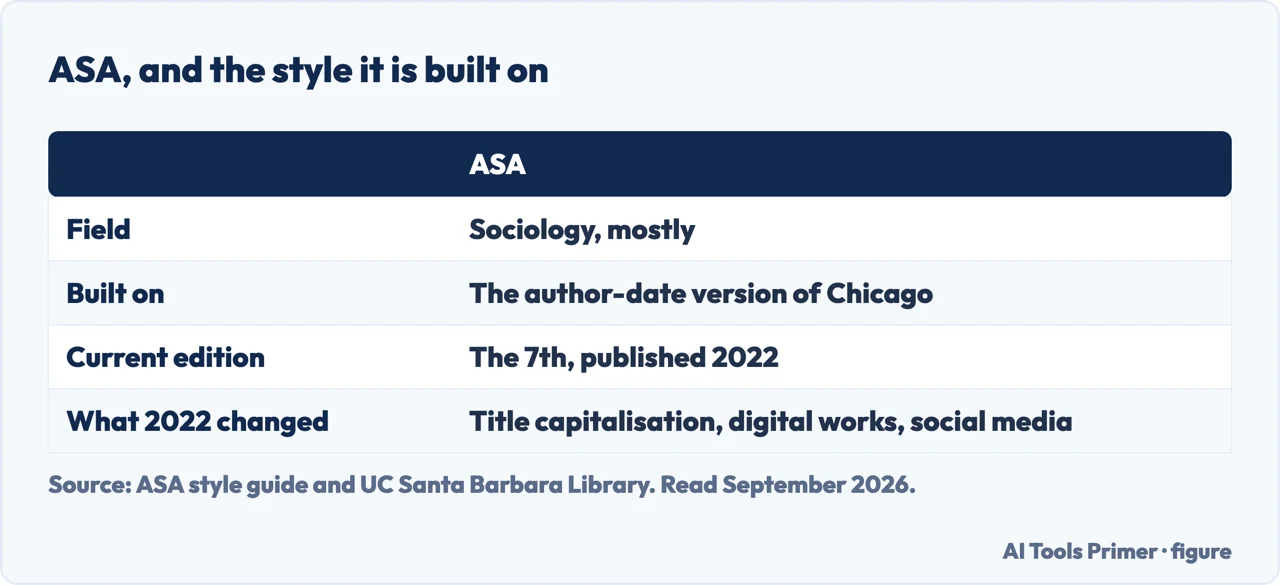
Where the style sits, from a library rather than from the association. The University of California, Santa Barbara describes ASA as “primarily used in the field of sociology and… based on the author-date version of the Chicago citation style”, and dates the current manual to 2022, with changes “in title capitalization, clarifications on citing digital works and social media”. Two useful things follow: if you know Chicago author-date you already know most of ASA, and a guide written before 2022 is describing a different edition.
The rest of this guide, for when the next reference is in a different style: IEEE, Turabian, APSA, BibTeX, AMA and ACS. Every one of them is a working generator, and every one was built from a document that could be read and names the page it came from. Three of the seven took two attempts to source, and those pages say which and why.
Where to start
Four ways in.
- “I have the details and I need the reference.”
- The tool is at the top, under generator
- “Which edition is this?”
- The source and the edition are named in where the shapes came from
- “My reference looks wrong and I cannot see why.”
- Start at what goes wrong
- “I need a different style.”
- The other styles are in Citation generator and study tools
Where the shapes came from
The guide is a book and the association still applies it in public. Which document gave which shape, and why the edition on it is the thing to check first.
What goes wrong
The details that make an ASA reference look almost right, which is the state in which errors survive proofreading.
Around the style
ASA is one of several author-date styles descended from Chicago, and knowing which one you are marked against settles most questions.
Not covered here. It will not build on the 2007 guide. That copy is freely reachable, four editions out of date, and does not announce it.
It will not claim to be the style guide. The seventh edition is a book; this tool was built from the association applying it in its own journal.
It will not send anything anywhere. The generator runs entirely in the page.
And it will not carry an affiliate link to the guide or to a reference manager. What holds instead is simple: the three shapes come from the reference examples American Sociological Review publishes for the seventh edition.
Sources
- Submission Guidelines, American Sociological Review, published by Sage for the American Sociological Association — the reference examples naming the ASA Style Guide seventh edition of 2022: the journal-article form with the year after the author and the volume, bracketed issue and pages run together without a space; the book form with place and publisher; the chapter form putting the page range before the collection after Pp.; and a multiple-author entry inverting only the first name — journals.sagepub.com, read 30 August 2026.
- UC Santa Barbara Library — ASA citation style: where the style comes from, what the 2022 edition changed, and its relationship to Chicago author-date — guides.library.ucsb.edu, read 4 September 2026.
Written by Alberto Gulotta
Founder and editor of AI Tools Primer, writing from Palermo, Italy. Thirty-five years of taking computers apart, starting with a Commodore 64 — the long version is on the about page.
Something wrong on this page? Write to aitoolsprimer@gmail.com and it gets fixed.
Written on 30 August 2026 · last checked 4 September 2026.
Independence and limits
No affiliate links and no paid placements anywhere on this site. Nobody pays to appear here, and no company has seen this page before you did.
This is general information, not professional advice. Where a page touches money, health, safety or the law, it names its source and the date it was read — and your situation may still differ. See the privacy page and the cookie policy.