
Study · guide
A Harvard Referencing Generator for the Leeds Variant
By Alberto Gulotta · Updated · 20 min read
There is no single Harvard referencing generator that is correct for every reader: Leeds, Imperial, Sheffield and York publish their own book, article and web-page formats, with different punctuation, and Harvard’s library, read on 15 October 2026, says no official guide to the format exists. The shortest path is matching your institution’s published examples, then generating in that exact shape.
| Fact | Source |
|---|---|
| “There is no official guide to the format” | Harvard Library (Harvard University’s own library), read 15 October 2026 |
| Leeds closes a book with a colon; Imperial closes the same shape with a comma | University of Leeds and Imperial College London published examples |
| Newest declared edition of Cite Them Right among the generators checked: 13th, 2025 | CiteMe’s own FAQ page |
| The printed Cite Them Right book costs $21.95, discounted to $15.36, on Bloomsbury’s US store | Bloomsbury’s own product page |
Harvard Referencing Is a Family, Not One Style
The University of Leeds names its own version Leeds Harvard, and Imperial College London says plainly that different versions of Harvard referencing exist, advising readers to check a lecturer or course handbook whenever a detail looks uncertain. The University of York’s guide takes the strongest position on origin, saying the style “originated at Harvard University” and with no set manual. Harvard Library — Harvard University’s own library, read 15 October 2026 — disagrees: “There is no official guide to the format”. AUT University goes further, saying the “Harvard System” “has no official institutional connection with Harvard University”, and traces the name instead to Harvard faculty among the style’s early users — a habit of naming, not a licence any institution granted. Even inside one university the guide can split: The Open University follows Cite Them Right for most students but runs a separate guide for Law undergraduates in modules W1xx, W2xx and W3xx.
Sellers of Harvard generators already use similar language without showing the punctuation it implies. MyBib, which sells a Harvard reference generator, says there isn’t “one true way” to do it, because “many universities have their own slightly different guidelines”. CiteMe, which sells a Harvard reference generator, read 15 October 2026, calls Harvard a family of author-date styles with university-specific variants, naming Cardiff, Leeds and Bath as examples with minor formatting differences. Neither shows two universities’ formats side by side, which is what follows.
Book, Article and Web Page, Compared Across Four Universities
Start with the book. Leeds Harvard’s own example is “Finch, E. and Fafinski, S. 2015. Legal skills.… Oxford: Oxford University Press.” — a colon joins place and publisher, year unbracketed. Imperial’s own example, “Simons, N. E., Menzies, B. & Matthews, M. (2001)… London, Thomas Telford Publishing.”, brackets the year and uses a comma instead — the one mark separating two otherwise similar shapes.
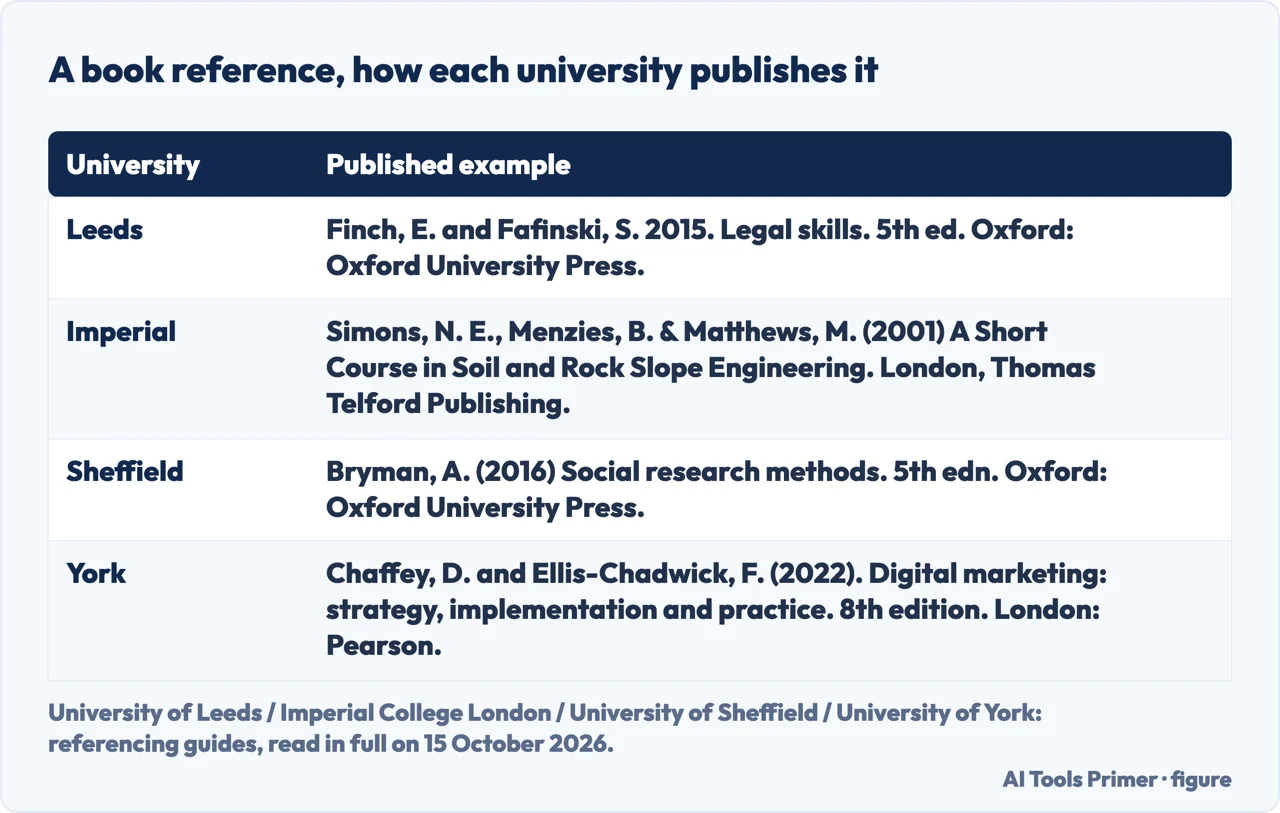
Sheffield, which names Cite Them Right (2016) 10th edition, brackets the year and keeps the colon: “Bryman, A. (2016)… Oxford: Oxford University Press.” York’s own example agrees on the bracket and the colon, but spells out “edition” where Sheffield abbreviates to “edn.”
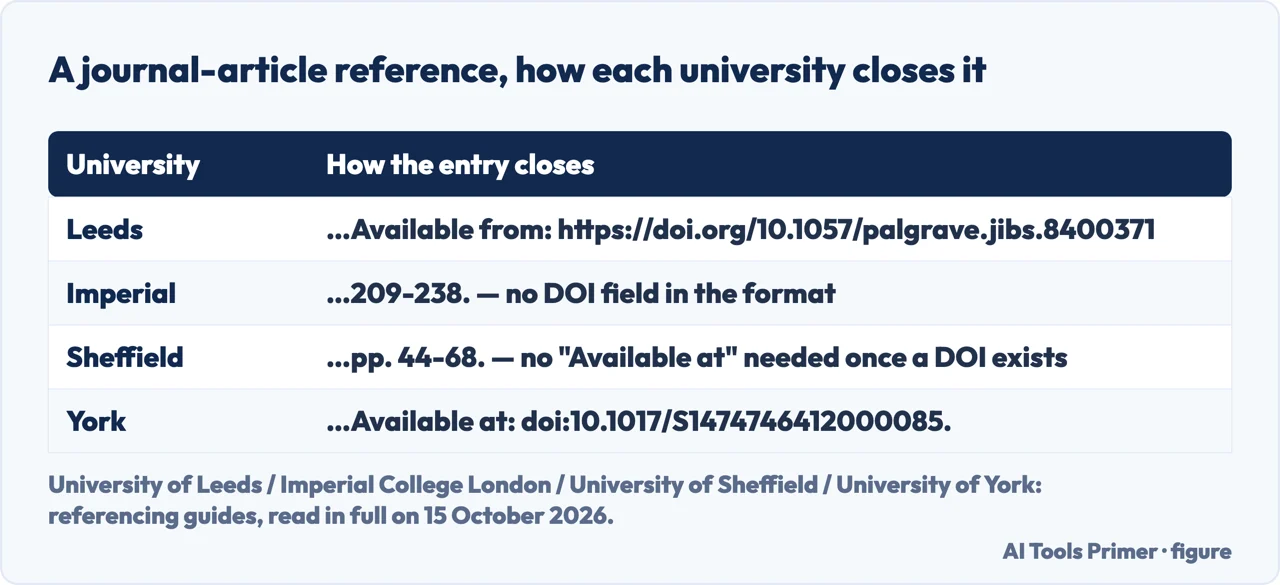
A journal article pulls the four further apart, mostly over the DOI. Leeds Harvard’s own example writes “Available from:” before it: “… Journal of International Business Studies. [Online]. 39(4), pp.652-669. [Accessed 3 April 2024]. Available from:” a doi.org link. Imperial’s own example has no DOI field at all and ends on the page range alone: “… Journal of Law & Economics. 42 (1), 209-238.”
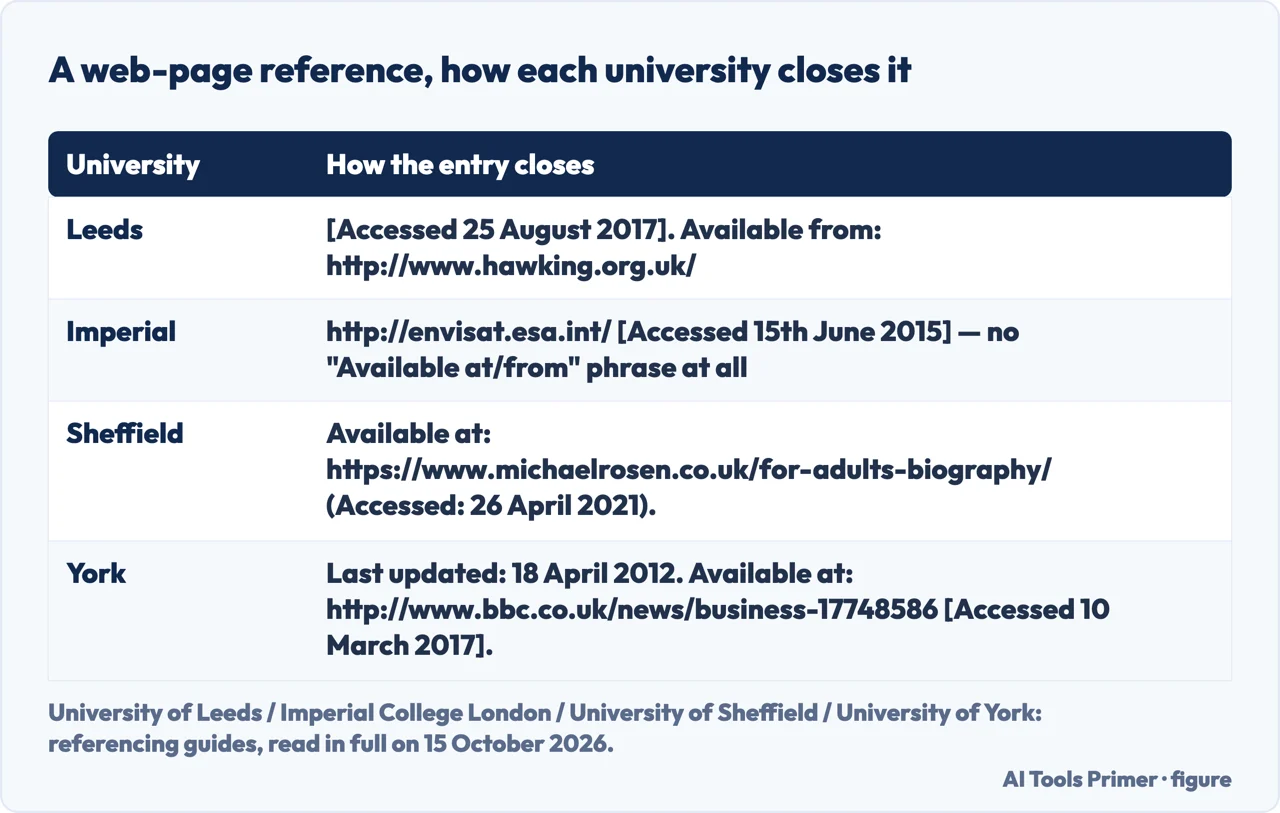
The web page repeats the pattern. Leeds Harvard’s own example closes “… [Accessed 25 August 2017]. Available from: http://www.hawking.org.uk/”. Imperial’s own example, “… http://envisat.esa.int/ [Accessed 15th June 2015]”, has no “Available at” or “Available from” phrase at all — the URL simply follows the title. Sheffield’s own example puts “(Accessed: 26 April 2021)” in brackets after the URL, where Leeds puts its accessed date before the URL instead. York’s own example adds a line none of the other three have: “Last updated: 18 April 2012. Available at: http://www.bbc.co.uk/news/business-17748586 [Accessed 10 March 2017].” Four universities agree a web page needs an author, a year and a title; they disagree on nearly every mark of punctuation after that.
A Leeds Harvard Reference Generator, Built From the Published Examples
The generator below produces only the Leeds Harvard shape, because Leeds Harvard’s own guide states its exceptions — et al., a corporate author, no ibid — on the very pages read for this guide.
Leeds Harvard reference generator
Builds a book, journal-article or web-page reference in the Leeds Harvard shape only. Nothing you type leaves your browser.
Two Leeds Harvard habits are built in rather than left for a reader to remember. Once a source has three or more authors, Leeds Harvard’s own guide says “the name of the first author should be given, followed by the phrase ‘et al.’” — a lower threshold than the technical styles on this site. And it treats an organisation the same way as a named author, so an organisation’s name goes in the authors field exactly as printed. It will not add “ibid” for a repeat citation either: Leeds Harvard “does not use ibid to refer to previously cited items”, so the full reference repeats every time — and it will not choose a Cite Them Right edition for you, because Leeds Harvard’s guide does not name one at all.
Formatting a DOI in a Harvard Reference
This is the How DOI format a reference citation in Harvard style? question, and the four universities read for this page do not agree. Leeds Harvard writes “Available from:” immediately before the DOI, as shown above. Sheffield takes the opposite approach: its own journal example carries no DOI phrase at all, and it says why — a DOI “you don’t need to include ‘Available at’ or ‘(Accessed: date)’ in the reference”, because a DOI is stable while a URL can change. York disagrees with Sheffield directly, writing “Available at: doi:” before the same kind of identifier Sheffield says needs no such phrase. Leeds says “Available from”, York says “Available at”, Sheffield says neither is needed. The generator below follows Leeds Harvard’s own convention, because that is the variant it builds.
Which Edition of Cite Them Right Each Generator Uses
Cite Them Right, published by Bloomsbury, is the book two of the universities above declare outright — Sheffield and the Open University; Leeds, Imperial, York and AUT do not mention it in the pages read here. Sheffield names its own edition: “Cite Them Right (2016) 10th rev. and expanded edn.”. Cite This For Me, which sells a Premium citation tool, “currently uses the Cite Them Right 10th Edition” too.
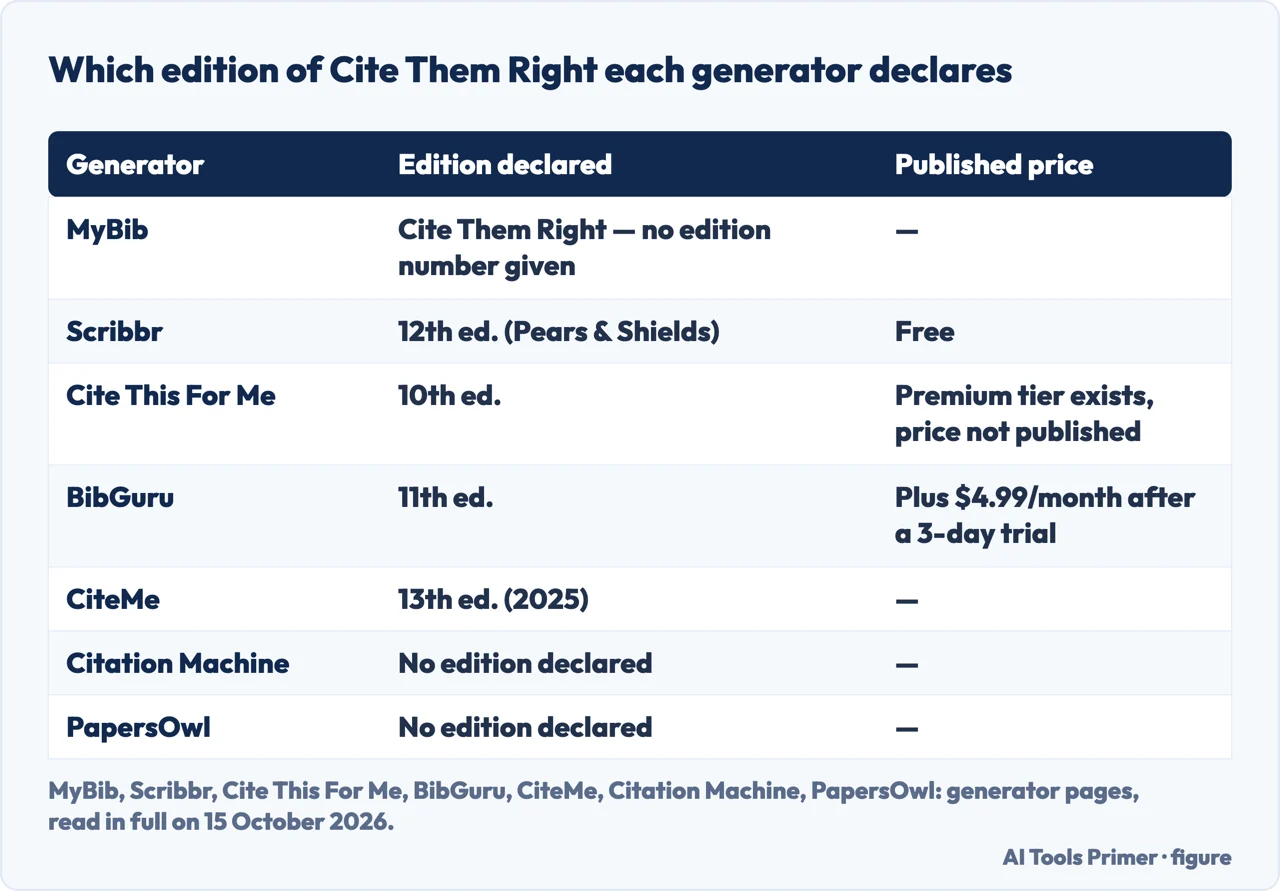
Three more vendors each name a different edition, read 15 October 2026. Scribbr follows the “12th edition… by Richard Pears and Graham Shields”; BibGuru’s own page says it is based on the 11th edition; and CiteMe declares the newest, naming the 13th edition (2025) and its headline change — dropping the place of publication before the publisher. Four generators declare four editions — 10th (Cite This For Me), 11th (BibGuru), 12th (Scribbr) and 13th (CiteMe) — while the University of Sheffield, not a commercial generator, also uses the 10th. MyBib, Citation Machine and PapersOwl name none at all.
The book itself keeps moving: Bloomsbury’s US store lists the printed Cite Them Right as the 13th edition, published 10 July 2025, priced at $21.95 and discounted to $15.36 there. Its online platform sells only “to universities, colleges, schools and public libraries… via an institutional subscription”, no individual price published. A reference built to one edition can look, by a different generator’s own rule, like it used the wrong one.
The Claim That Harvard University Created This Style
Bibcitation, which sells a Harvard citation generator, describes the Harvard Referencing Style on its own page as one created by Harvard University, read 15 October 2026. Two more directly relevant sources contradict it. AUT University says the “Harvard System” “has no official institutional connection with Harvard University”. And Harvard Library — Harvard University’s own library, read 15 October 2026 — says “There is no official guide to the format” at all. The two agree with each other and disagree with Bibcitation.
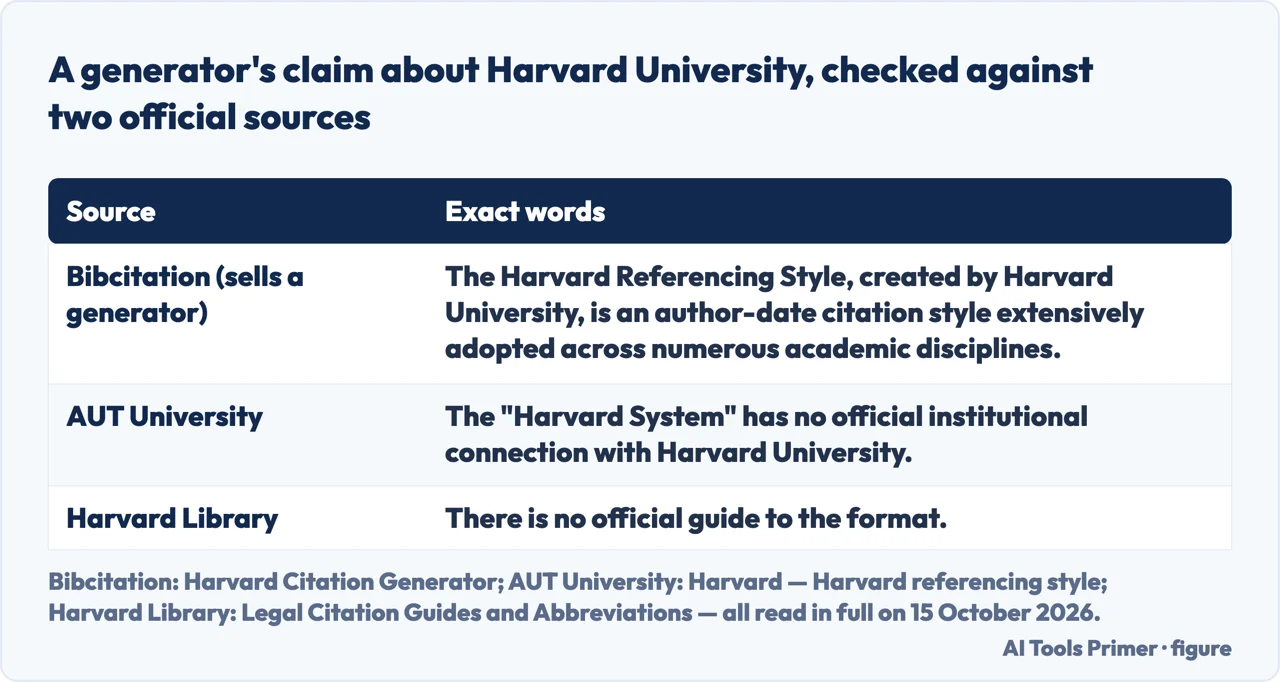
Neither AUT nor Harvard Library sells a citation tool. The name stuck for a historical reason, not an institutional one — which is also why naming a bibliography, reference list or works-cited list has a cleaner, documented answer than the origin of “Harvard” does.
Where to start
Five ways in.
- “Is there really more than one Harvard style?”
- Start at harvard is a family not one style
- “Can you give me an example of Harvard referencing?”
- Four universities, side by side, in book article and web page formats compared
- “How to generate Harvard referencing?”
- The working tool is in generator
- “How DOI format a reference citation in Harvard style?”
- Three conventions, compared in formatting a doi in a harvard reference
- “Which edition does my generator use?”
- Seven generators, compared in which cite them right edition each generator uses
Other citation generators on this site
Harvard is one style among several this site builds a working generator for, and each one follows a different publisher’s own manual.
The questions underneath this one
Whether a single reference is right is often downstream of a question about the list it sits in, or the source it describes.
Questions people also ask
How to generate Harvard referencing?
Start from your own institution’s published guide, because formats differ: this page builds a working generator for Leeds Harvard’s book, article and web-page shapes, verified against the examples the University of Leeds itself publishes.
Can you give me an example of Harvard referencing?
One example is not enough: the four universities read for this page agree a reference needs an author, a year and a title, then disagree on nearly every mark of punctuation after that — see the book, article and web-page examples compared above.
How DOI format a reference citation in Harvard style?
It depends on the guide: the University of Leeds writes “Available from:” before the DOI, the University of Sheffield says a DOI needs no “Available at” at all, and the University of York writes Available at followed by the DOI — three conventions, not one.
Is Harvard writing style APA or MLA?
Neither: APA and MLA are each published by one body with one manual, while Harvard is a family of institution-specific variants with no single publisher — Harvard’s own library, read 15 October 2026, says there is no official guide to the format.
Not covered here. This page builds a working reference generator only for the Leeds Harvard variant, because Leeds Harvard’s own guide is the most explicit of the four read here about the exceptions a generator has to handle — et al., a corporate author, and no ibid. Readers at Imperial, Sheffield or York, or at Cardiff and Bath — which CiteMe names as further variants with minor punctuation and italicisation differences — or at Manchester Metropolitan University and the University of the West of England, two more variants MyBib’s generator supports, check their own institution’s published guide rather than this generator’s output.
It does not cover other citation styles and their own generators: the APA generator, the MLA generator, the Chicago generator and the IEEE generator each work from a different publisher’s manual. Nor does it explain the difference between a bibliography, a reference list and a works-cited list, citing a website outside the Harvard format specifically, citing a YouTube video (that page covers APA and MLA, not Harvard), or footnotes and the numbered systems that an author-date style such as Harvard does not use. What holds instead is simple: Harvard referencing is a family rather than a standard, with local variations set by each institution.
Sources
- University of Leeds — Leeds Harvard basics / introduction: the general statement that Leeds uses its own named variant, and the model for citing several authors in text — library.leeds.ac.uk, read 15 October 2026.
- University of Leeds — Book, Leeds Harvard referencing examples: the book template and worked example, the ban on “ibid”, corporate authorship, and the three-or-more-authors rule the generator uses — library.leeds.ac.uk, read 15 October 2026.
- University of Leeds — Journal article, Leeds Harvard referencing examples: the journal-article template, worked example, and when page numbers are required — library.leeds.ac.uk, read 15 October 2026.
- University of Leeds — Website or webpage, Leeds Harvard referencing examples: the web-page template and worked example the generator follows — library.leeds.ac.uk, read 15 October 2026.
- Imperial College London — Harvard style: the statement that different versions of Harvard referencing exist and the advice to check a course handbook — www.imperial.ac.uk, read 15 October 2026.
- Imperial College London — Your reference list and bibliography: the book, journal-article and web-page examples compared against Leeds, Sheffield and York — www.imperial.ac.uk, read 15 October 2026.
- University of Sheffield — Harvard referencing: the declared Cite Them Right (2016) 10th edition, the book, article and web-page examples, and the DOI note — librarydevelopment.group.shef.ac.uk, read 15 October 2026.
- University of York — Subject Guides: Referencing styles: Harvard: the book, article and web-page examples, and the claim that the style originated at Harvard University — subjectguides.york.ac.uk, read 15 October 2026.
- The Open University — Quick guide to Harvard referencing (Cite Them Right): the statement that different versions of Harvard referencing exist, and the separate guide for OU Law undergraduates — university.open.ac.uk, read 15 October 2026.
- Auckland University of Technology (AUT) — Harvard, Harvard referencing style: the account of the name’s origin and the lack of an institutional link to Harvard University — aut.ac.nz.libguides.com, read 15 October 2026.
- Harvard Library / Harvard Law School Library — Legal Citation Guides and Abbreviations: Harvard University’s own statement that it has not issued an official style guide for referencing under its own name — guides.library.harvard.edu, read 15 October 2026.
- Bloomsbury Publishing, declared here as the publisher and seller of the book — Cite Them Right: The Essential Referencing Guide: the 13th edition’s publication date, page count and price — www.bloomsbury.com, read 15 October 2026.
- Bloomsbury Publishing, declared here as the seller of the online platform — Cite Them Right, For Librarians: the institutional-subscription-only sale of citethemrightonline.com — www.citethemrightonline.com, read 15 October 2026.
- MyBib, declared here as the seller of a Harvard reference generator — Free Harvard Referencing Generator: the “one true way” statement and the undeclared Cite Them Right edition — www.mybib.com, read 15 October 2026.
- Scribbr, declared here as the seller of a Harvard reference generator — Free Harvard Referencing Generator: the declared Cite Them Right 12th edition and the free-to-use claim — www.scribbr.co.uk, read 15 October 2026.
- Cite This For Me (Chegg Inc.), declared here as the seller of a Premium citation tool — FREE Harvard Referencing Generator: the declared Cite Them Right 10th edition and the undeclared Premium price — www.citethisforme.com, read 15 October 2026.
- Citation Machine, declared here as the seller of a Harvard citation generator — Free HARVARD Citation Generator and Format: no declared edition anywhere in the page — www.citationmachine.net, read 15 October 2026.
- BibGuru, declared here as the seller of a Harvard reference generator with a paid Plus tier — Free Harvard referencing generator: the declared Cite Them Right 11th edition and the Plus subscription price — www.bibguru.com, read 15 October 2026.
- Bibcitation, declared here as the seller of a Harvard citation generator — Free Harvard Citation & Bibliography Generator: the claim, checked against AUT University and Harvard Library, that the style was created by Harvard University — www.bibcitation.com, read 15 October 2026.
- CiteMe, declared here as the seller of a Harvard reference generator — Free Harvard Referencing Generator for UK Universities: the declared Cite Them Right 13th edition (2025) and the Cardiff, Leeds and Bath variants it names — citeme.app, read 15 October 2026.
- PapersOwl, declared here as the seller of an essay-writing service with a Harvard citation generator — Harvard Style Citation Generator: no declared edition anywhere in the page — papersowl.com, read 15 October 2026.
Written by Alberto Gulotta
Founder and editor of AI Tools Primer, writing from Palermo, Italy. Thirty-five years of taking computers apart, starting with a Commodore 64 — the long version is on the about page.
Something wrong on this page? Write to aitoolsprimer@gmail.com and it gets fixed.
Written on 15 October 2026.
Independence and limits
No affiliate links and no paid placements anywhere on this site. Nobody pays to appear here, and no company has seen this page before you did.
This is general information, not professional advice. Where a page touches money, health, safety or the law, it names its source and the date it was read — and your situation may still differ. See the privacy page and the cookie policy.