
Study · guide
IEEE citation generator
By Alberto Gulotta · Updated · 12 min read
An ieee citation generator is a small, mechanical job: IEEE publishes the order of the elements and the punctuation between them, and a program can apply that order faster and more consistently than a person at two in the morning. What a program cannot do is know which manual it is following. This one follows the IEEE Reference Guide, and the shapes below were checked against it before this page was written.
IEEE reference generator
Fill in what you have. Empty fields are left out. Nothing is sent anywhere — this runs in your browser.
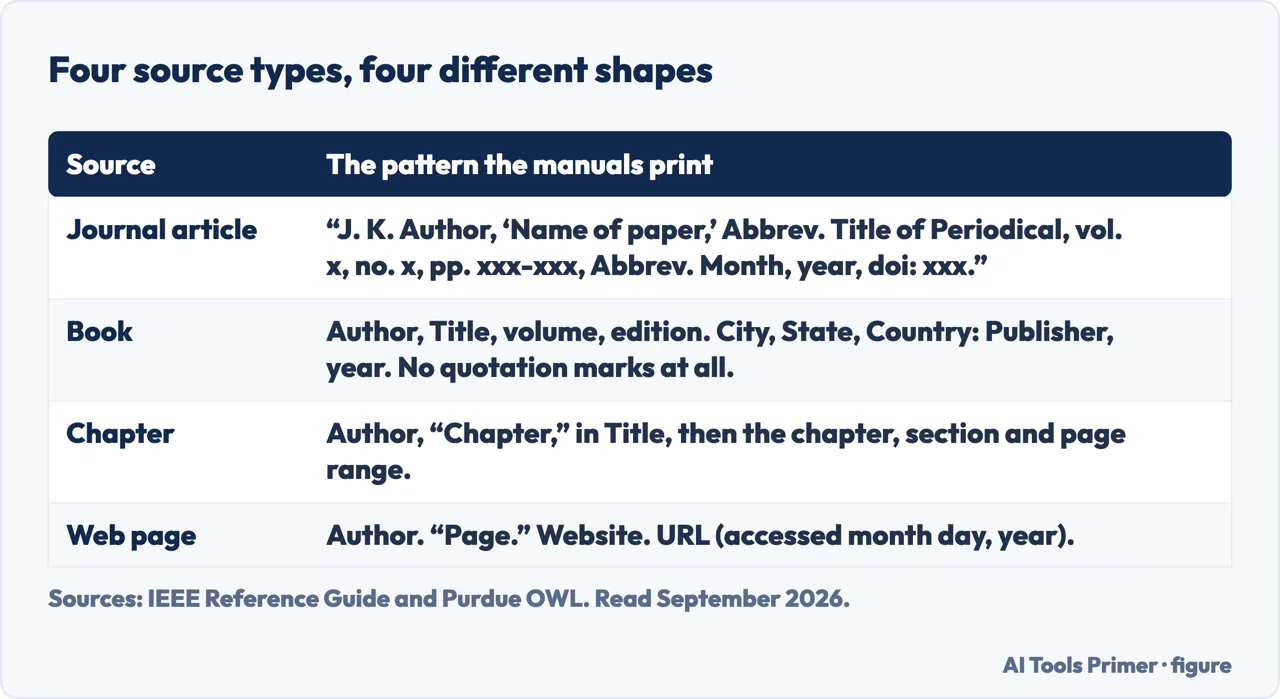
Four source types, because IEEE does not have one shape. This is the part that most generators get wrong, and it is not a detail of punctuation: a journal article, a book, a chapter inside a book and a web page are four different patterns in this style, and a tool that knows only the article pattern will produce a book reference that looks correct and is not.
The article pattern puts the title in quotation marks with the comma inside them, then the abbreviated journal name, then volume, issue and pages, then the month and year. The book pattern has no quotation marks at all: the title runs on, followed by the place of publication, a colon, the publisher and the year. A chapter combines both, with the chapter in quotation marks and the book title after the word in. A web page drops volumes and pages entirely and ends with the date you looked at it, in brackets.
“J. K. Author, ‘Name of paper,’ Abbrev. Title of Periodical, vol. x, no. x, pp. xxx-xxx, Abbrev. Month, year, doi: xxx.”
The basic format for a journal article, quoted from the IEEE Reference Guide published by the IEEE Periodicals Transactions/Journals Department, read 30 August 2026. The generator above was written against that document rather than from memory, and each of its four shapes carries the page it was checked on. That is the whole reason this page exists: a reference has to match a manual, and this one names the manual it followed.
A second document, written by people with no journal to sell, agrees on the parts that decide whether a reference is right. Purdue’s writing lab publishes its own IEEE reference guide, and three of its rules are the ones a generator has to get correct. On authors: “for references with up to six authors, list all authors in the order they are presented in the publication’s byline”, and “for publications with seven or more authors, list the first author followed by et al.” On months, it prints the list the abbreviation comes from: “Jan., Feb., Mar., Apr., May, June, July, Aug., Sept., Oct., Nov., Dec.” And on capitals, a distinction no program can make for you: titles of books and journals “are set in title case”, titles of articles and technical reports “are set in sentence case”, and if you are unsure, “err on the side of following the original capitalization”.
Three things this generator does, all of them taken from the guide rather than invented here. It has a month field, because the basic format for a periodical includes an abbreviated month, and a generator without that field cannot produce the printed shape. It writes the DOI with a doi: prefix inside the sentence rather than as a bare link tacked on at the end, which is what the printed examples show. And it applies the rule that IEEE publications list all authors up to six names, using et al. only beyond that — so a five-author paper gets five names, not the first one and an abbreviation.
The fields worth checking every time, in the order they go wrong. The journal abbreviation is the first: IEEE prints abbreviated periodical titles, and a generator fed a database record will often give you the full name instead. Nothing in this page can check that for you, because the abbreviation is a fact about the journal rather than about your reference. The page range is the second, because databases disagree about whether an article has pages at all when it is online-only; IEEE has a separate form for that, using an article number. And the author order is the third, because a reference manager that imported a record badly will sometimes reverse a name, and a reversed name is invisible once it is formatted.
What this page will not do is tell you that the output is ready to submit. A generator produces a reference from the metadata it is given, and metadata is frequently incomplete: a missing issue number, a year that belongs to the online-first version rather than the printed one, a journal name that changed. The output is a draft that is correctly shaped, which is a genuine saving over formatting it by hand, and it is not the same thing as a correct reference.
One more thing about this question, and it is the reason this page is a tool rather than an essay. People looking for ieee format are looking for a guide, and there are already a great many of them, most reproducing the same rules second-hand from an edition nobody names. People looking for an ieee citation generator want the reference, now. Those are different needs and they deserve different pages, and this is the second one.The rest of this guide, for when the next reference is in a different style: Turabian, APSA, BibTeX, AMA, ACS and ASA. Every one of them is a working generator, and every one was built from a document that could be read and names the page it came from. Three of the seven took two attempts to source, and the pages say which and why.
Where to start
Four ways in.
- “I have the details and I need the reference.”
- The tool is at the top of this page, under generator
- “Which manual does this follow?”
- The quoted format is in checked against the guide
- “My reference looks wrong and I cannot see why.”
- Start at what goes wrong
- “I need a different style.”
- The other styles are in Citation generator and study tools
Checked against the guide
Where each shape in the generator comes from, page by page, so that a rule can be traced back to the document it was taken from rather than to a study site repeating it.
What goes wrong
The fields that come out of a generator incorrect often enough to be worth a minute of checking, with what each error looks like once it has been formatted.
Around the style
The questions that arrive with IEEE referencing but are not about the punctuation of a reference.
Not covered here. It will not claim the output is finished. A generator formats what it is given, and the fields above are the ones worth a look before the reference goes into a paper.
It will not quote a rule without naming where it came from. Every shape in the tool cites the page of the IEEE Reference Guide it was checked against, and the date it was read.
It will not send anything anywhere. The generator runs entirely in the page; nothing you type reaches this site or any other, and there is no account to make.
And it will not carry an affiliate link to a reference manager, including the ones that pay well for exactly this question. What holds instead is simple: every shape in the generator was checked against the IEEE Reference Guide before this page was written.
Sources
- IEEE Reference Guide, IEEE Periodicals Transactions/Journals Department — the basic format for a periodical with volume, issue, pages, abbreviated month and doi (p. 12); the book and chapter formats with place, publisher and year (p. 4); the website format with the accessed date (p. 17); and the rule that IEEE publications list all authors up to six names — journals.ieeeauthorcenter.ieee.org, read 30 August 2026.
- Purdue Online Writing Lab (Purdue OWL) — IEEE Style, Reference List (that references are listed and numbered in order of citation rather than alphabetically; that authors are referred to by surname and initials; that all authors are listed for references with up to six authors and the first author followed by et al. for seven or more; that names of months are shortened to three or four letters, given as Jan., Feb., Mar., Apr., May, June, July, Aug., Sept., Oct., Nov., Dec.; that titles of books and journals are set in title case while titles of articles and technical reports are set in sentence case, with the instruction to follow the original capitalization when unsure; and the shape for a web page, Author. “Page.” Website. URL, accessed month day, year) — owl.purdue.edu, read 5 September 2026.
Written by Alberto Gulotta
Founder and editor of AI Tools Primer, writing from Palermo, Italy. Thirty-five years of taking computers apart, starting with a Commodore 64 — the long version is on the about page.
Something wrong on this page? Write to aitoolsprimer@gmail.com and it gets fixed.
Written on 30 August 2026 · last checked 5 September 2026.
Independence and limits
No affiliate links and no paid placements anywhere on this site. Nobody pays to appear here, and no company has seen this page before you did.
This is general information, not professional advice. Where a page touches money, health, safety or the law, it names its source and the date it was read — and your situation may still differ. See the privacy page and the cookie policy.