
Study · guide
APSA citation generator
By Alberto Gulotta · Updated · 10 min read
An apsa citation generator serves one discipline, and the American Political Science Association publishes its style manual free. That is unusual enough to be worth saying at the door: the three shapes the tool below builds were read out of that manual rather than copied from a study site, and the page of the manual each one came from is recorded in the code.
APSA reference generator
Reference-list entries, author-date. Fill in what you have; empty fields are left out. Nothing leaves your browser.
APSA is Chicago author-date with its own house preferences, and the manual says so directly. The practical consequence is that the year moves forward: it sits immediately after the author, before the title, rather than at the end of the entry. Anyone arriving from a style that puts the date last will find that the single most disorienting thing about the format, and it is also the thing a generator gets right automatically.
The three shapes differ in what follows the title. A journal article takes the periodical name, the volume, the issue in brackets and the page range after a colon. A book takes the place of publication, a colon and the publisher. A chapter in an edited book is the longest: the chapter title in quotation marks, then the word In, the book title, the editors after the abbreviation eds., the page range, and then place and publisher.
One detail that a tool can get right and a person copying a pattern usually will not: the space before the bracketed issue number. The manual prints American Political Science Review 74 (3): 651–69 — volume, space, bracket. It is a small thing that is wrong in a great deal of the material that repeats this style second-hand, and it is the kind of error that survives proofreading because it looks like a typographical accident rather than a rule.
The author list follows the same convention as the rest of the Chicago family, and the manual prints it: Mefford, Dwain, and Brian Ripley. 1987. The first name inverts so that the reference list can be sorted; every name after it reads in normal order. The generator applies that rule rather than inverting everything, which is the commonest fault in output pasted out of a reference manager set to the wrong style.
What the tool does not offer is a shape for a web page, and the omission is deliberate. The manual sets out how to treat electronic sources in prose, but the reference-list examples this page was built from cover articles, books and chapters. Rather than infer a fourth pattern and present it with the same confidence as the three that were read, the menu stops at three. A gap you can see is safer than a shape that was guessed.
The fields worth checking before an entry goes into a paper. The page range in the manual is condensed — 651–69 rather than 651–669 — and database records almost always give the long form. The journal title is set in italics, which a plain-text box cannot carry: the order and the punctuation are what the tool guarantees, and the italics you apply when you paste. And the editors of an edited volume arrive from databases in a dozen different arrangements, so that field is a free text box on purpose: it prints what you type.
There is one more thing worth knowing about this style, and it is not about punctuation. The APSA manual is free. That sounds like an administrative detail and it is not: most of the confusion around citation styles exists because the authoritative text is a book somebody has to buy, so the web fills with second-hand summaries that quietly drift from each other and from the source. When the manual is a public document, a disagreement about a rule can be settled by opening it. That is why this page can name a page number for each shape it builds, and why the entry it produces can be checked rather than trusted.
It also changes what a tool like this is for. Where the manual is locked away, a generator is the only practical access most students have to the rules, and it becomes an authority by default — which is exactly the position no unchecked tool should occupy. Here it can be the faster route to something you are able to verify yourself, which is a much smaller and much more honest claim.
And a library guide is usually the free version of the manual. Lamar University publishes an APSA guide with in-text examples, reference formats by source type, and a section on formatting the paper — the parts students actually need, from an institution that sells nothing. Worth knowing because the association’s own manual is a purchase: when the style guide is behind a price, the university library is where the working version lives.
What this page will not do is tell you the reference is finished. A generator formats the metadata it is handed, and political science bibliographies are full of working papers, conference presentations and government documents whose details are genuinely contested. The three shapes here are the ones the manual prints, checked and dated, which is what a tool can honestly promise.The rest of this guide, for when the next reference is in a different style: IEEE, Turabian, BibTeX, AMA, ACS and ASA. Every one of them is a working generator, and every one was built from a document that could be read and names the page it came from. Three of the seven took two attempts to source, and the pages say which and why.
Where to start
Four ways in.
- “I have the details and I need the reference.”
- The tool is at the top, under generator
- “Which manual is this from?”
- The pages are named in checked against the manual
- “My entry looks wrong and I cannot see where.”
- Start at what goes wrong
- “I need a different style.”
- The other styles are in Citation generator and study tools
Checked against the manual
Where each shape comes from, so a rule can be traced to the page it was read on rather than to a guide repeating it.
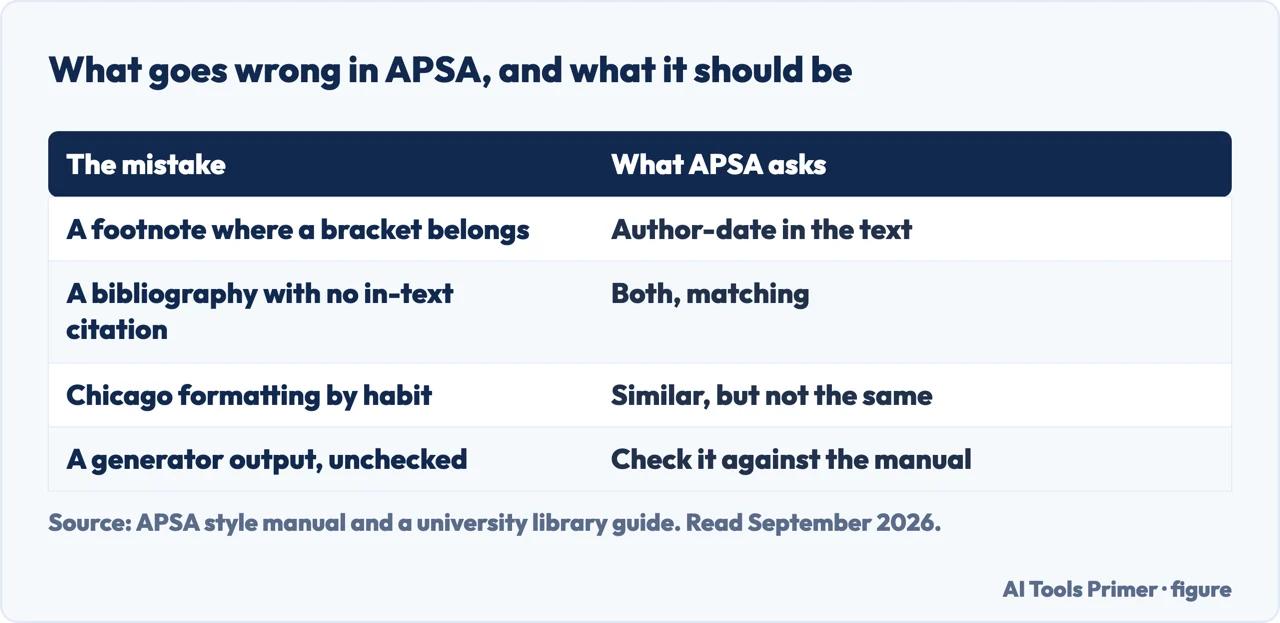
What goes wrong
The fields that come out of a generator or a reference manager incorrect often enough to be worth a minute of checking.
Around the style
APSA sits inside the Chicago family, and knowing that answers several questions before they are asked.
Not covered here. It will not offer a shape it has not read. There is no web-page form in the tool because the reference-list examples this page was built from do not print one.
It will not tell you the output is ready to submit. A generator formats what it is given, and the fields above are the ones worth a look first.
It will not send anything anywhere. The generator runs entirely in the page and there is no account to make.
And it will not carry an affiliate link to a reference manager. What holds instead is simple: the three shapes in the generator were read out of the APSA Style Manual before this page was written.
Sources
- Style Manual for Political Science, American Political Science Association, revised 2018 edition — the reference-list form for a journal article with the volume, the bracketed issue and the condensed page range (p. 52); the form for a chapter in an edited book with In, the editors and the place of publication; the book form with place and publisher; and a multiple-author entry showing that the first name inverts and later names do not (p. 58) — connect.apsanet.org, read 30 August 2026.
- Lamar University Library — APSA Citation Guide: in-text examples and reference formats by source type, from an institution that sells nothing — libguides.lamar.edu, read 4 September 2026.
Written by Alberto Gulotta
Founder and editor of AI Tools Primer, writing from Palermo, Italy. Thirty-five years of taking computers apart, starting with a Commodore 64 — the long version is on the about page.
Something wrong on this page? Write to aitoolsprimer@gmail.com and it gets fixed.
Written on 30 August 2026 · last checked 4 September 2026.
Independence and limits
No affiliate links and no paid placements anywhere on this site. Nobody pays to appear here, and no company has seen this page before you did.
This is general information, not professional advice. Where a page touches money, health, safety or the law, it names its source and the date it was read — and your situation may still differ. See the privacy page and the cookie policy.