Tor · guide
Onion sites and onion services: how they work and who runs them
By Alberto Gulotta · Updated · 20 min read
Onion sites are websites reachable only through the Tor network, and this page, built from Tor Project pages, ProPublica and Wikipedia, explains what a 56-character .onion address is, how a visit works without an IP address, why newsrooms such as ProPublica and Mediapart run one, and what the address does not protect.
| Question | Answer | Where it comes from |
|---|---|---|
| What is an onion site? | A service, like a website, that is only accessible through the Tor network; formerly called a hidden service | Tor Project support page |
| What does the address look like? | 56 letters and numbers followed by .onion; it is also the service’s public key | Tor Project support and community pages |
| Do the old 16-character addresses work? | The support page says that kind of address no longer works on today’s Tor network | Tor Project support page, Wikipedia |
| Does a visit use an exit relay? | Wikipedia and the Tor Project say connections to onion services do not use exit relays | Wikipedia, Tor Project |
| Why would a newsroom run one? | ProPublica, Mediapart, Deutsche Welle and the BBC each give a reason tied to privacy or censorship | ProPublica, Tor Project |
| What does the address not cover? | The Tor Project says a site can still record data if the user logs in | Tor Project properties page |
What an onion site is
The Tor Project’s support page defines onion services, formerly known as “hidden services”, as services, like websites, that are only accessible through the Tor network. Its community overview puts it as services that can only be accessed over Tor. The name has moved over time. A ProPublica article of 13 January 2016 says a Tor hidden service is sometimes called an “onion site” or an “onion service”, while the Tor Project’s pages today say onion service. This page uses the three names for the same thing.
Wikipedia describes .onion as a special-use top-level domain name for an anonymous onion service. It says such addresses are not actual DNS names and that the .onion domain is not in the Internet DNS root, and that programs such as web browsers can reach them with the appropriate proxy software, which sends the request through the Tor network. It also says ICANN, IANA and the IETF designated .onion a special use domain on 9 September 2015.
The support page adds a plain condition: as with any other website, you must already have the address of an onion service before you can connect to it. In the overview’s example of a newspaper that receives anonymous tips, the reader finds the address from a public website or a friend. This page does not print any onion address, list sites or point to mirrors; where it needs to describe the shape of an address, it does so in words.
What the address is
The support page says an onion address consists of 56 letters and numbers, followed by .onion. Wikipedia gives the detail: the strings are generated automatically from a public key when the service is configured, they can use any letter of the alphabet and the digits 2 to 7 in base32, and the 56 characters stand for a 256-bit ed25519 public key along with a version number and a checksum.
The Tor Project’s overview says the address looks random because it is the identity public key of the onion service, and that this is one reason the service can offer its security properties. The support page draws a practical consequence: the address is generated automatically, so the operator does not need to buy a domain name. The overview draws another: a visitor knows the content can only come from that particular onion, and it says impersonation is not possible, which it notes is generally not the case on the ordinary web, where a man-in-the-middle can reroute a visit through attacks such as DNS attacks.
The length changed. A Tor Project blog post of 21 September 2021 says version 3 addresses run to 56 characters rather than 16 because each one carries the complete ed25519 public key and not merely a hash of it. Wikipedia says that beginning in October 2021 stable releases of Tor software no longer support the 16-character version 2 addresses, and the support page says that kind of address no longer works on today’s Tor network. The Tor Project blog post of 24 January 2018 that we read shows addresses of the shorter kind, so older write-ups can describe addresses that no longer work.
Wikipedia also says a partly readable address, for instance one starting with an organization’s name, can be set up by generating massive numbers of key pairs until a sufficiently desirable one turns up. ProPublica’s 2016 walkthrough calls that approach debatable, because readers may learn to look for the prefix and ignore the rest of the address.
How a visit works without an IP address
The Tor community overview lists four benefits. The first is location hiding: onion services are an overlay network on top of TCP/IP, it says, so IP addresses are not even used in the protocol. The others are end-to-end authentication, encryption from the client to the onion host, and NAT punching, meaning a service needs no open ports because it only establishes outgoing connections.
The overview tells the protocol as nine acts. The service first asks some Tor relays to act as its introduction points and builds long-term anonymized circuits to them. It then assembles a descriptor that lists those points, signs it with the private key that matches the public key in its address, and uploads it to a distributed hash table that is part of the Tor network. A client holding the address downloads the descriptor and checks the signature with the public key encoded in the address; the overview says this gives the end-to-end authentication. The client then picks a relay as its rendezvous point and gives it a one-time secret. The introduction point passes the details to the service, which connects to the rendezvous point and sends the same secret, and the rendezvous point relays the end-to-end encrypted messages in both directions.
In general, the overview says, the complete connection consists of 6 relays: 3 picked by the client, the third being the rendezvous point, and 3 picked by the onion service. Our page on onion routing covers the three-relay circuit of an ordinary visit.
The Tor Project’s properties page says that, with an onion service, the whole path between the two ends stays inside the Tor network. Wikipedia adds that, since a visit to an onion service never passes through an exit relay, tampering by an exit node does not apply to it. A Tor community page adds that this frees exit bandwidth for others, since it calls exit relays a small fraction of the network that is in general overloaded; we have not used its count, which changes. Our page on exit nodes covers what the last relay can see on an ordinary visit.
Running an onion service is not the same as running a relay. The same community page says an onion service behaves like any other Tor client, and that running one does not result in the operator’s IP address being publicly listed anywhere, nor does the service relay other Tor traffic.
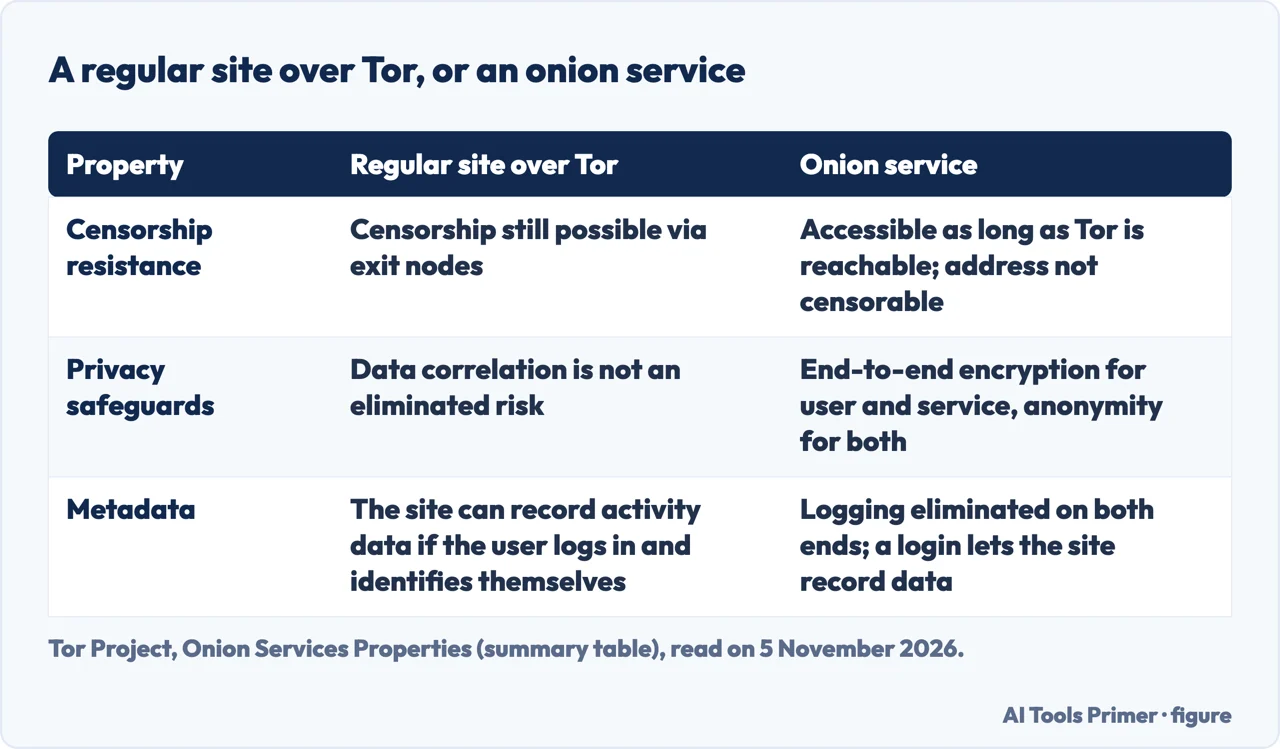
A Tor Project blog post of 21 September 2021 explains one reason for the version 3 change. It says that in version 2 the data published to the hidden service directory was uploaded in plain text, so relays holding that role could learn from it. Version 3 encrypts the data, and the client asks for an identifier it works out from the address and the current date, which the post calls a blinded public key. The post, a guest contribution from researchers at JKU Linz, also reports an experiment with 50 relays from 1 March 2021: it says a vast majority of the uploaded blinded public keys were never downloaded, which it reads as services that are barely used, and that many requests asked for services that are no longer operational. The properties page sums up the comparison in a table, drawn as the first figure below.
Why a newsroom runs one
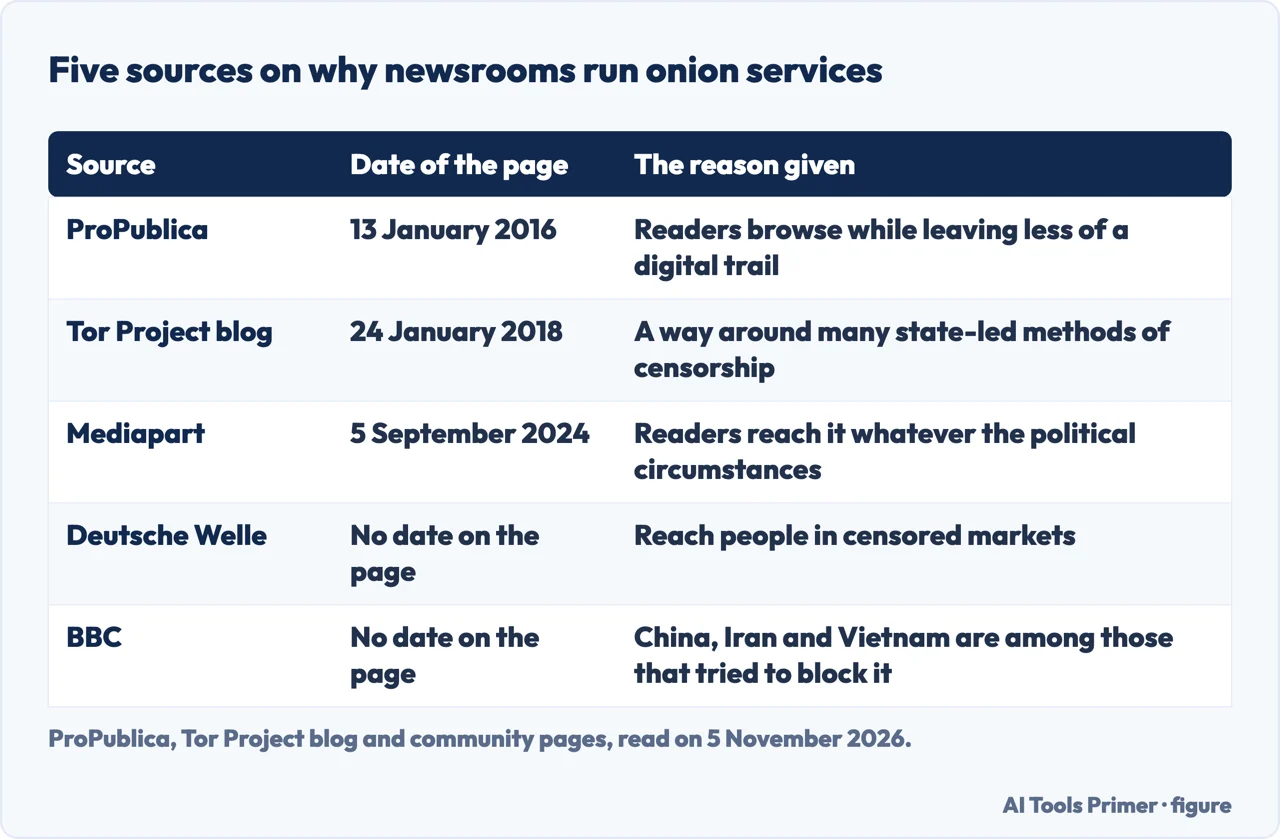
ProPublica, in its article of 13 January 2016, says it made its site available as a Tor hidden service because its readers should never need to worry that somebody else is watching what they do on the site. The stated aim was to let readers browse while leaving behind less of a digital trail. The article says the service began quietly as an experiment the year before, after an interactive on online media censorship in China, and that recent versions of Tor Browser and Brave Browser tell readers about the onion address and can redirect to it from the regular site.
ProPublica also states a limit. The hidden service is, for the most part, the same website people see on the regular Internet, with embedded code from outside services such as Google Analytics and Facebook “Like” buttons. The article says Tor Browser obscures the identifying metadata those services can see, such as the IP address, the location and details about the computer, and that raising the Tor Browser security level to high is its way to block them.
A Tor Project blog post of 24 January 2018 urged news organizations to put their sites on onion services. It says that in September 2017, one day after Human Rights Watch released a report on torture in Egypt’s jails, Egypt blocked access to the Human Rights Watch website. Publishing a website with onion services over the Tor network, the post says, is a way to circumvent many state-led methods of censorship.
On 5 September 2024 the Tor Project blog welcomed Mediapart, a French investigative online newspaper that the post says was created in 2008. The post ties the launch to the blocking of European media outlets in Russia. Carine Fouteau, the publication’s president and publishing editor, is quoted on the French National Assembly’s dissolution in June 2024: being available on the Tor network, Fouteau says, guarantees readers access to the information whatever the political circumstances, including subscribers who live abroad.
The post’s technical interview, with the outlet’s DevSecOps engineer Yassine Zouggari, says the onion service also makes it easier to let legitimate Tor traffic reach the site, because the site’s own defenses sometimes block Tor on the ordinary address. It names Onionspray, a tool that sets up HTTPS rewriting proxies between existing websites and Tor users. Zouggari says the technical setup took about a week for one engineer, and that the bulk of the work was adapting security measures to rate-limit requests per user so that one brute-forcer does not affect the whole service.
A Tor community page written to help people advocate for onion services says major media organizations, among them Deutsche Welle, the BBC and The Markup, have made their websites available over onion services. It quotes Deutsche Welle calling it a logical step to use Tor to reach people in censored markets with limited or no access to free media, and the BBC saying that countries including China, Iran and Vietnam have tried to block access to its news website or programmes. The same page names tools built on onion services that journalists use with sources: SecureDrop, which it describes as an open source whistleblower submission system maintained by the Freedom of the Press Foundation, GlobaLeaks, a whistleblowing framework, and OnionShare, which hosts files on your own computer for sharing. This page does not explain how to use any of them.
Lists of newsrooms age. Wikipedia says The New York Times joined in October 2017 but discontinued its onion site in April 2025, while the January 2018 blog post lists the paper as having one. Wikipedia is open to edits, so we give that as Wikipedia’s statement. The pages we read do not give a current count of newsrooms with an onion site.
Newsrooms are not the only operators in the pages we read. ProPublica says Facebook launched an onion site in 2014, and Wikipedia says the first certificate for an onion site issued by a certificate authority went to Facebook in October 2014. The community page names email providers such as Riseup and Systemli among those using onionmx, and says Proton lets users read and send email through a web client served as an onion site.
For the operator’s side, ProPublica’s walkthrough shows a Tor configuration file with two lines, one for the service’s directory and one for its port, and says Tor then writes the address into a file called hostname. The 2018 blog post points to the Enterprise Onion Toolkit, and the Tor Project’s properties documentation lists a page titled Migrating from EOTK under Onionspray.
How Tor Browser shows it
The support page says Tor Browser shows an onion icon in the address bar when a site uses an onion service, displaying the state of the connection, and that clicking the icon and the adjacent circuit display tells you more. A second route is Onion-Location, which the page describes as a non-standard HTTP header websites can use to advertise their onion counterpart. When a site has one, a purple suggestion pill reading “.onion available” appears at the address bar, and clicking it reloads the page at the onion counterpart.
The Tor community page on the feature says a site operator can set the header on the web server or add an HTML meta attribute. For the header to be valid the value must be a URL with the http: or https: protocol and a .onion hostname, the page defining it must be served over HTTPS, and that page must not itself be an onion site.
The support page also explains the icon variants. A plain onion means the service is served over HTTP or HTTPS. For HTTP the page says this is not a security issue, since the onion service protocol is already end-to-end encrypted, though the icon then says nothing about being on the “right site”; the same holds for an HTTPS certificate that is only domain validated, while an extended validation certificate means a certificate authority checked that the site belongs to the entity it names. An onion with a red slash means the service is served with a script from an insecure URL. An onion with a caution sign covers an HTTPS self-signed or expired certificate, a wrong domain, or a mixed form over an insecure URL.
Some onion services ask for a key. The support page says an authenticated onion service requires the client to provide an authentication token; Tor Browser shows a little gray key with a tooltip, and you enter your private key in the field, having first obtained access credentials from the operator. The Tor community page on client authorization calls it a method to make an onion service private and authenticated: for version 3 it uses a pair of keys, the service configured with the public key and the client holding the private one, and the page notes that once it is configured, anyone with the address alone will no longer get in. ProPublica’s test setup, without that step, is readable by anybody who knows the address unless the underlying web app has its own authentication.
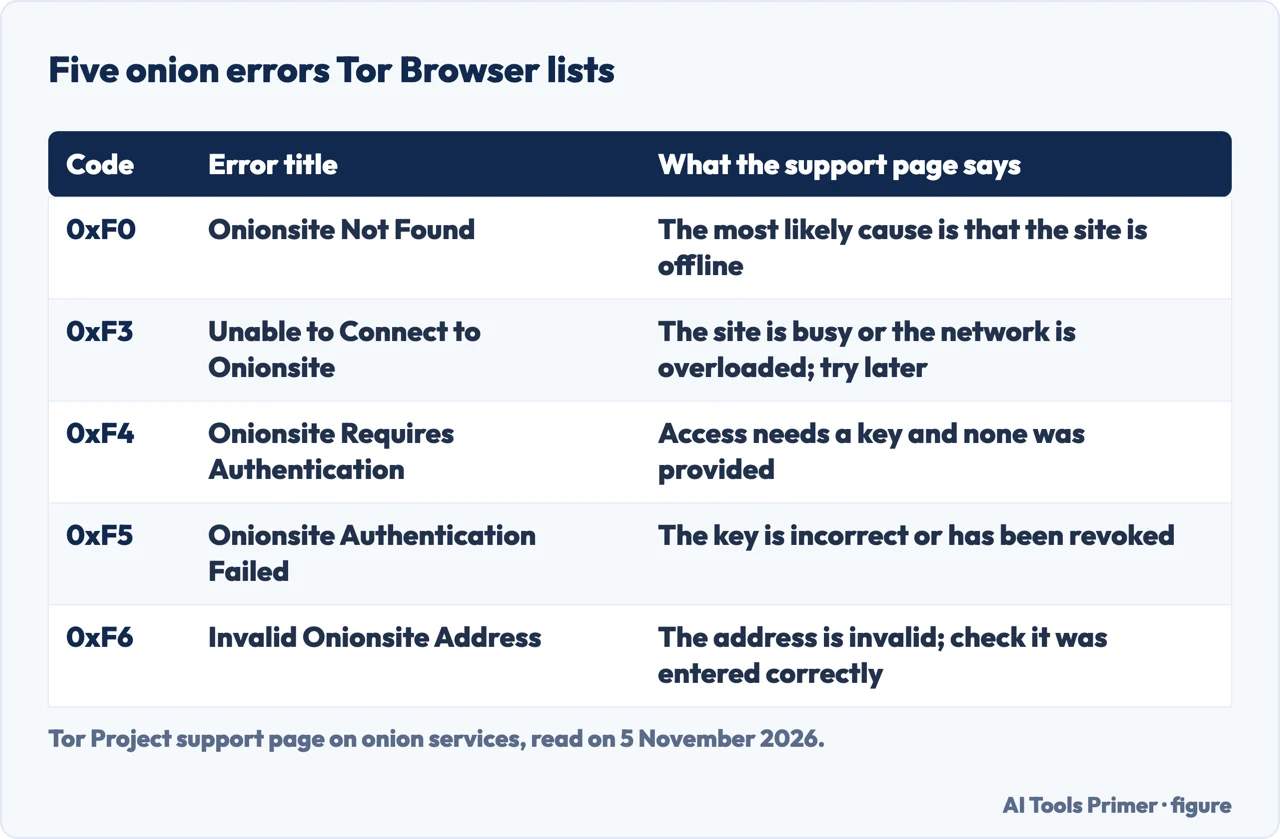
When a connection fails, the support page says Tor Browser gives a specific error, with codes from 0xF0 to 0xF7; the third figure below shows five of them. The other three are 0xF1, a site that cannot be reached because of an internal error; 0xF2, where the site has disconnected, for which the page gives offline as the most likely cause; and 0xF7, where creating the circuit to the site timed out, possibly because of a poor network connection. Its troubleshooting advice is to check the address, because even a small mistake will stop Tor Browser reaching the site; to remember that the 16-character kind no longer works; to test another onion service, naming DuckDuckGo’s; and to try again later, since the site operators may have allowed it to go offline without warning. Our page on whether Tor Browser is safe covers the browser itself.
What an onion address does not do
The Tor Project’s properties page rates an onion service “very good” on metadata, but with a condition in the same cell: metadata logging is eliminated on both ends, yet the website can record data if the user logs in. The pages we read do not say that an onion service makes what a person types into a form anonymous. ProPublica’s own limit is the other half: a service that embeds outside code is mostly the same website as the regular one.
Whether an address belongs to the organization you have in mind is a separate question from whether the connection is protected. ProPublica’s walkthrough advises confirming an onion site’s domain by corroborating it at a variety of sources, and notes that someone could generate many lookalike addresses.
Gateways are a third case. Wikipedia says proxies such as Tor2web let non-Tor browsers, and search engines that are not Tor-aware, reach onion services. By using a gateway, it says, users give up their own anonymity and trust the gateway to deliver the correct content, and both the gateway and the onion service can fingerprint the browser and access IP address data.
An address can also simply lead nowhere. The support page says a site may have gone offline without warning, ProPublica says a service run on a laptop goes offline when the laptop does, and the 2021 blog post reports many requests for services that are no longer operational. The Tor Project’s pages that we read do not give a current number of onion services.
Finally, ProPublica says sites like these are often grouped under the “dark web”, though the term is contentious in the Tor developer community. Our pages on what the dark web is and on deep web against dark web take up the word, dark web search covers how people look for things, and how to access the dark web safely covers getting started with the browser.
What we did not use
We tested nothing on a live onion service. We did not read the Tor Project’s version 3 specification, and we did not read the Tor Browser known-issues page, so the page says nothing about which platforms support Onion-Location.
Where to start
Five ways in.
- “What is an onion site?”
- What an onion site is — what
- “What does the address mean?”
- What the address is — address
- “How does a visit work?”
- How a visit works without an IP address — visit
- “Who runs one, and why?”
- Why a newsroom runs one — newsrooms
- “What does Tor Browser show?”
- How Tor Browser shows it — browser
The network around it
The rest of the Tor network, from the exit relay to the bridge.
The word and the search
Where onion sites sit in what people call the dark web.
Questions people also ask
What are .onion sites and onion services?
The Tor Project’s support page calls onion services, formerly hidden services, services like websites that are only accessible through the Tor network. A .onion site is one of them. Wikipedia says the .onion name is a special-use domain rather than an actual DNS name, and the support page says the address is 56 letters and numbers.
Is it safe to visit onion sites?
The pages we read speak to the connection, not to every site’s content. The Tor overview says the content can only come from that particular onion and the traffic is end-to-end encrypted, while the properties page says a site can still record data if you log in. Our Tor Browser safety page covers the habits.
Can Google access .onion sites?
Wikipedia says proxies such as Tor2web let non-Tor browsers and search engines that are not Tor-aware reach onion services, but users give up their own anonymity and trust the gateway. For how people search, see our dark web search page.
What are good onion sites?
This page does not list sites or addresses, and the pages we read do not rate onion sites. The Tor Project’s community pages include a section of featured onion sites, and its Onion-Location feature lets a regular website advertise its own onion counterpart to Tor Browser users.
Not covered here. We tested nothing on a live onion service. The statements come from Tor Project pages (community, support, properties and blog), a ProPublica article of 13 January 2016 and Wikipedia, all read on 5 November 2026; the blog posts and the ProPublica article carry earlier dates.
The search measure behind this page is an Ubersuggest reading of 5 November 2026 (United States), which gives search volume and its own difficulty score, not Semrush’s, and it is still to be confirmed with Semrush.
Sources
- Tor Project — How do Onion Services work? — community.torproject.org, read 5 November 2026.
- Tor Project Support — Understanding and using onion services in Tor Browser — support.torproject.org, read 5 November 2026.
- Tor Project — Onion Services — community.torproject.org, read 5 November 2026.
- Tor Project — Onion-Location — community.torproject.org, read 5 November 2026.
- Tor Project — Client Authorization — community.torproject.org, read 5 November 2026.
- Tor Project — Talk about onions — community.torproject.org, read 5 November 2026.
- Tor Project — Set up your Onion Service — community.torproject.org, read 5 November 2026.
- Onion Services Properties (onionservices.torproject.org) — onionservices.torproject.org, read 5 November 2026.
- Tor Project blog — ‘A newspaper without borders’: Mediapart now available as .onion (5 September 2024) — blog.torproject.org, read 5 November 2026.
- Tor Project blog — V3 onion services usage (21 September 2021) — blog.torproject.org, read 5 November 2026.
- Tor Project blog — News orgs, activists: onionize your sites against censorship (24 January 2018) — blog.torproject.org, read 5 November 2026.
- ProPublica — A More Secure and Anonymous ProPublica Using Tor Hidden Services (13 January 2016) — www.propublica.org, read 5 November 2026.
- Wikipedia — .onion — en.wikipedia.org, read 5 November 2026.
Written by Alberto Gulotta
Founder and editor of AI Tools Primer, writing from Palermo, Italy. Thirty-five years of taking computers apart, starting with a Commodore 64 — the long version is on the about page.
Something wrong on this page? Write to aitoolsprimer@gmail.com and it gets fixed.
Written on 5 November 2026.
Independence and limits
No affiliate links and no paid placements anywhere on this site. Nobody pays to appear here, and no company has seen this page before you did.
This is general information, not professional advice. Where a page touches money, health, safety or the law, it names its source and the date it was read — and your situation may still differ. See the privacy page and the cookie policy.