
Work · guide
Accomplishments on a resume samples: duties rewritten as results
By Alberto Gulotta · Updated · 17 min read
Accomplishments on a resume samples from five career pages show how a duty becomes a result. UC Davis, Yale, UMass Global, The Muse and Indeed name the shape in different ways and show it in samples. Here are their rewrites side by side, and where they disagree.
| Question | Answer | Where it comes from |
|---|---|---|
| What is an accomplishment statement? | A bullet under a job or activity that says what you achieved, not only what the role asked | UC Davis, Yale |
| What shape do the pages give it? | Action verb, context, results at UC Davis; action, project, result at Yale; challenge, actions, results at UMass Global | UC Davis, Yale, UMass Global |
| Does it need a number? | Yale says to quantify the result; The Muse and UC Davis say to quantify whenever possible; UMass Global also shows lines without one | Yale, The Muse, UC Davis, UMass Global |
| Whose work is it? | Yale says to write what you did, not what your team did | Yale |
| Where does it go? | Mostly the experience section; Indeed adds a dedicated section and a Career Highlights block | The Muse, Indeed |
| How many? | Indeed says there is no specific number and that quality counts for more than quantity | Indeed |
A duty says what the job asked; an accomplishment says how it went
UC Davis describes accomplishment statements as bullet points on a resume that set out past and current achievements and give proof of relevant skills. Yale places them under the experience section and says they describe and quantify achievements, results and successes from internships, student organizations, volunteering, military service or study. Its advice is not to list only a role, responsibilities and tasks, because employers also want to know how you can contribute to their team or organization.
UMass Global, in a post dated 9 October 2019, writes that most hiring managers already have a firm grasp of the duties that come with different roles and want to learn how well you performed them. It borrows a distinction from AARP: abilities are what you are capable of doing, duties are what you have already done, and strengths are what you do well. Accomplishments, it says, show three things: the precise actions taken in a situation, the skills and abilities used when facing a challenge, and the results achieved. The same post says the average corporate job opening attracts 250 resumes and that 4 to 6 of those candidates are called in for an interview; the text we read does not name a source for those figures.
The Muse opens with a test. For an office manager role, it sets a line reading “Ordered office supplies” beside a line about saving the organization over $500 monthly with a Google Sheets spreadsheet that tracked average monthly usage of 20+ common office and kitchen supplies. The Muse says the first lists a duty and the second an accomplishment, which shows not only what the person did but how well they did it and which tools they know. Indeed makes the same point from the other side: it writes that most candidates know to include the duties and responsibilities of their positions but often leave out their accomplishments.
Rewrites, line by line
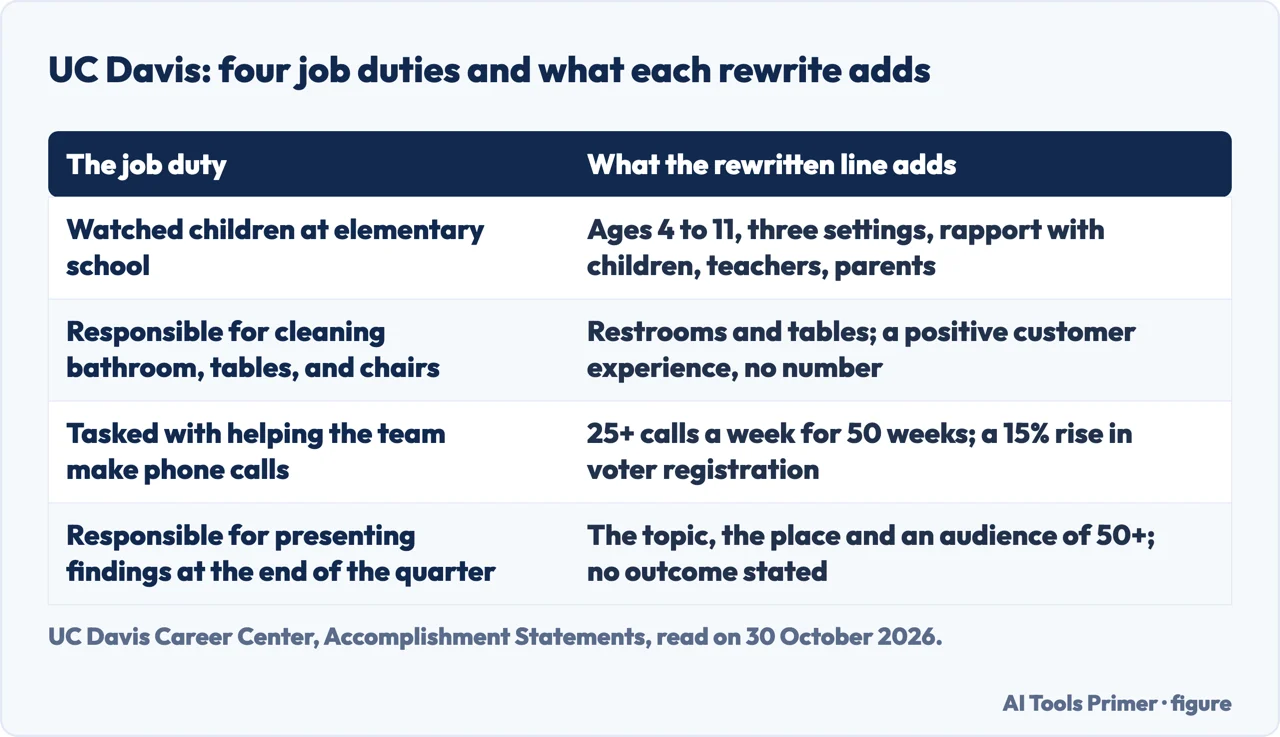
UC Davis shows four pairs, each a job duty beside the accomplishment statement written from it. “Watched children at elementary school” becomes a line that names the ages, 4 to 11, and three settings, recess, lunch and the after-school program, and ends on rapport with children, teachers and parents. The cleaning duty becomes a line about maintaining clean facilities for customers that ends on a positive customer service experience, with no figure in it. The phone-call duty becomes 25+ calls a week for 50 weeks about local propositions and voter registration, tied to a 15% increase in voter registration in the Sacramento area. The duty of presenting findings at the end of the quarter becomes a line that names the topic, the destruction of bee habitats in the Central Valley, and an audience of 50+ undergraduate, graduate and faculty attendees; it states no outcome.
Yale’s before-and-after pairs aim at results. “Selected for scholarship” becomes a line saying the person was one of 230 participants nationwide, chosen on top class rank together with community engagement work. A line about working with a student leadership committee becomes leading a 5-person leadership team that raised student participation by 100%, from 50 to 100 members, by creating a stronger social media presence. A line about contributing to a system for application submissions becomes collaborating with the IT team to develop an online submission and tracking system that reduced cost by 10%. Yale’s notes beside them are to choose verbs such as led, created and developed; to quantify, because bullets before revision mostly describe activities, not outcomes; and to contextualize, which it defines as giving a “baseline for comparison” to make it easier for recruiters to understand the accomplishment.
Not every line has a result to report, and Yale also shows skill bullets. “Worked with fellow interns” to put on a conference becomes facilitating collaboration among a 5-person intern team, dividing tasks by expertise, developing a feasible timeline and keeping the team on task and within budget. A line about looking at the branding and marketing strategies of a company becomes compiling an overview of the competitive landscape through expert interviews and online research. Yale says to pitch transferable skills, such as research, analysis, teamwork, communication and leadership, and to be specific.
UMass Global grades one line in three steps. “Hosted networking events” is what it calls mildly effective. A stronger version adds that the events increased membership and promoted community awareness. The strongest gives numbers: 15 events, an attendance of more than 2,000 community members, and a 30% membership increase. Read as a ladder, the line moves from a duty to an effect to a measured effect.
Five pages, five names for the line
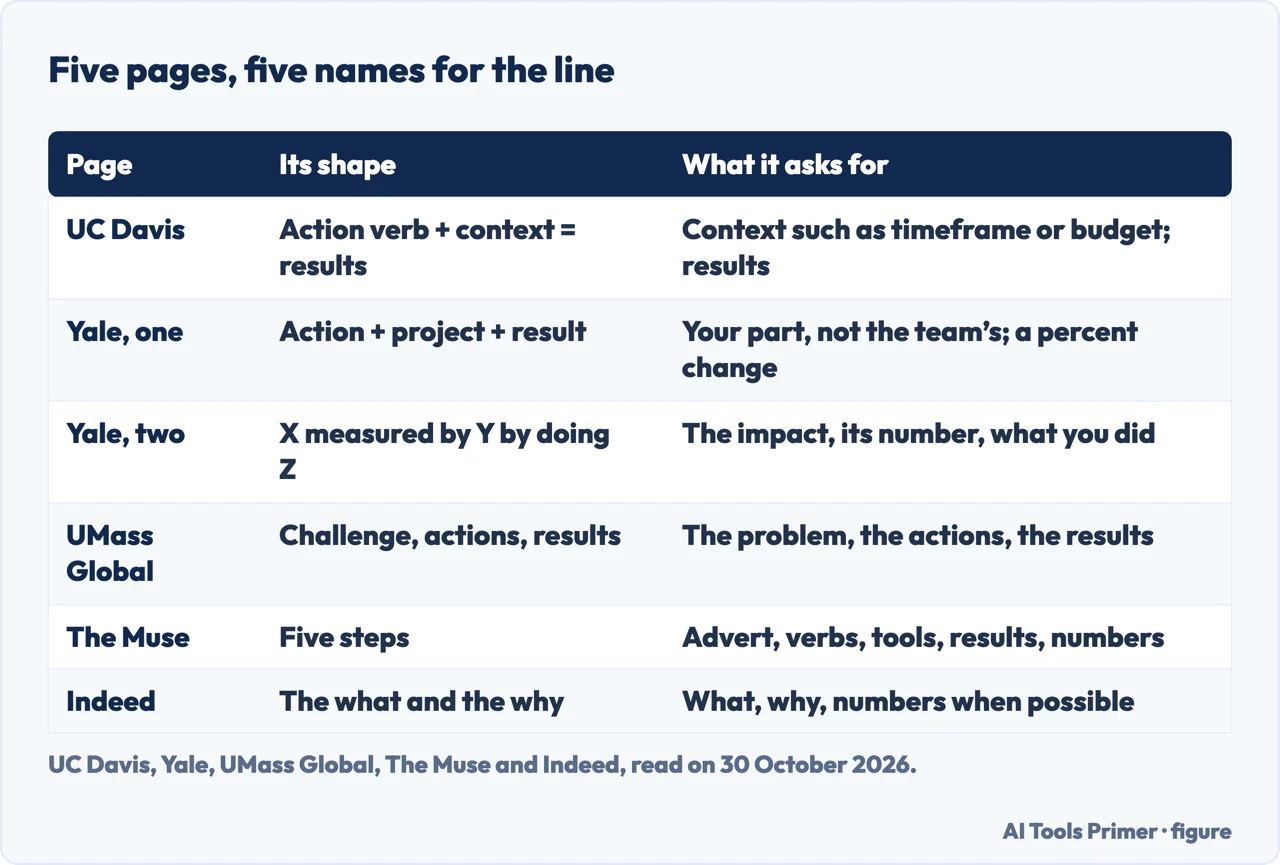
UC Davis gives the formula “ACTION VERB + CONTEXT = RESULTS”. Its context can be a timeframe, the number of people, the size of a budget or caseload, the type of issues or population, or research topics. Its results are the positive or intended outcome, quantified whenever possible, and it points to job descriptions and its own verb list for ideas.
Yale gives two formats. The first is “Action + Project + Result”: group related tasks into a project or activity, choose a verb for what you did and what your contribution was, with the warning “(NOT your TEAM!)”, and quantify the result as a percentage improvement or increase, mentioning a publication or patent if the work led to one. The second, written as “Accomplished [X] as measured by [Y] by doing [Z]”, is built from three parts: lead with the impact, measure it with a number, then say specifically what you did. The same pattern appears on this site’s page on what to put on a resume, where it comes from a US federal government help page.
UMass Global uses “Challenge-Actions-Results”, which it abbreviates to CAR: the existing problem, need or situation; what you did about it; and the outcomes you produced. It adds four guidelines: focus less on duties and more on accomplishments, start with action verbs, use quantitative measurements when you can, and keep to skills relevant to the job you want.
The Muse gives five steps rather than a formula. Choose accomplishments by reading the job description; use strong action verbs and vary the first word of each line; name the skills and tools, in the posting’s phrasing, with Salesforce as its example; include the result, so a reader is not left asking “So what?”; and add numbers. Indeed suggests considering two things in an experience bullet, the what and the why, meaning what you did and why you did it, and says to include numbers when possible.
Set side by side, the pieces line up: a verb for what was done, the thing it was done to or within, and what came of it. That is our reading, not a statement taken from the pages. The pages we read do not say which of the formulas to choose, or that one works better than another.
Finding the facts you did not write down
Three of the pages list questions meant to jog the memory. UC Davis lists seven: what problems you solved, whether you saved the company money, how you stood out among coworkers, whether you consistently exceeded goals, how your individual efforts contributed to larger goals, what you did above and beyond the normal job duties, and whether you or your team were recognized with awards. Yale’s list begins “Have I ever” and runs through improving something, achieving more with fewer resources, reducing costs, saving time, increasing recruitment numbers, designing a new process, solving a pressing problem, leading a team and presenting complex information clearly. It adds what you are most proud of, what people you worked with would say about your contribution, and what the tangible evidence is. UMass Global’s seven include awards, recognition or a promotion, a new system or procedure, a problem you identified and resolved that others did not see, a team effort with a specific result, reduced cost or increased revenue, and improved communication between groups.
The Muse starts from the goals of the job. If you were responsible for a social media account, were you meant to schedule a certain number of posts or grow the follower count? It says that meeting one or more such goals is an accomplishment and that exceeding them counts too. To add numbers it lists time frames and frequencies; the number of times something was done or work products handled; the number of employees, clients or other stakeholders managed, coordinated or helped; and percentage growth or the percentage of goals and KPIs reached. If the exact figure is unknown or varied, it says to give a range (from three to six employees), an approximation marked with a tilde, or a minimum (over 50 clients).
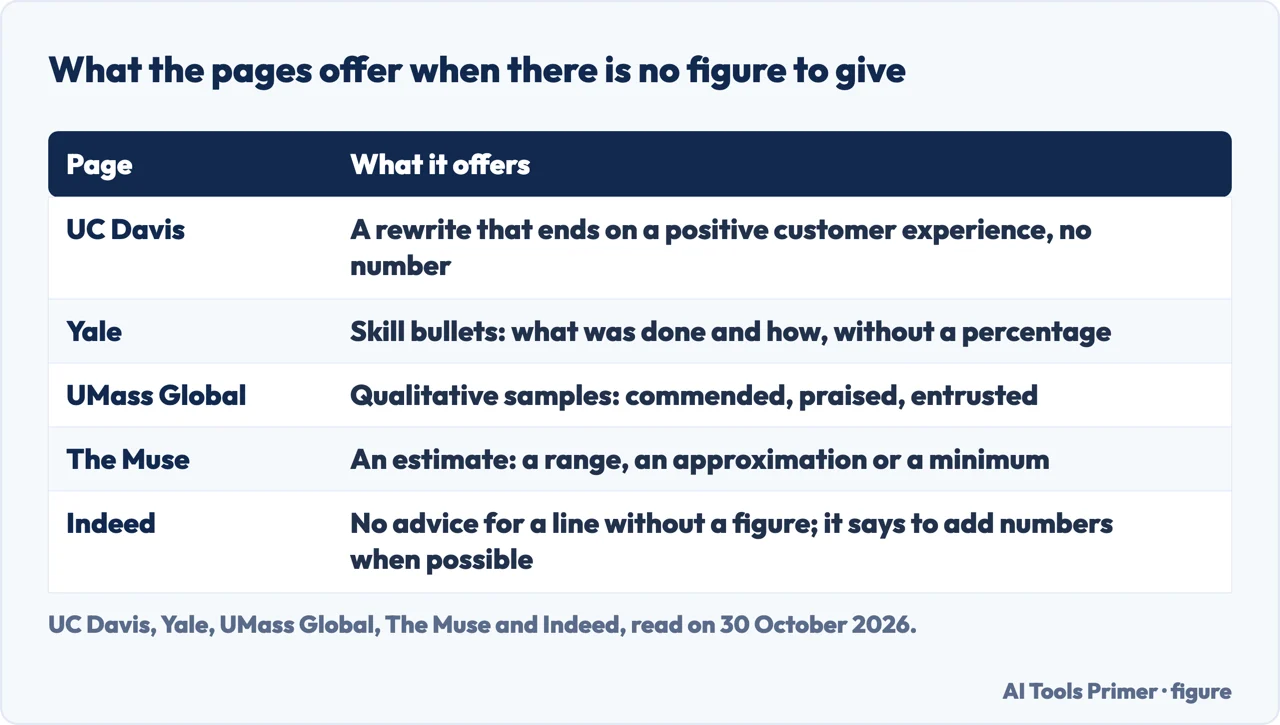
When no figure is available, the pages part ways. UC Davis keeps a rewrite that ends on a positive customer service experience. Yale’s skill bullets describe the work, not a percentage. UMass Global lists qualitative samples beside the quantitative ones: a line about organizing a database to track business contacts and being “commended for attention to detail”, and a line that opens “Praised for the ability” to solve difficult problems independently and efficiently. It credits the examples to Katy Curameng, director of career planning and development at UMass Global.
Where they go, and what to leave out
The Muse says the vast majority of your achievements will be in the experience section, under past jobs, and that they can also appear in the resume summary, the education section (especially early in a career), volunteer and activities sections, an awards section and a projects section. Indeed names the summary, skills, professional experience and a dedicated accomplishments section as the most common places. It describes the dedicated section as helpful for achievements outside the workplace, with samples such as raising money for cancer research through community efforts, creating annual events in the community and hiking the full length of the Appalachian Trail in 2018. For a more senior career it suggests a “Career Highlights” section at the top.
Indeed groups its samples by field: a business line about a quality assurance program that decreased rework by 40%, a marketing and sales line that took a website’s bounce rate from 62% to 34%, and an education line about a Career & College Day that introduced 800 students and parents to 60 universities, colleges and companies. The Muse says it has more than 70 examples, grouped by role. An administrative one negotiates a catering vendor contract and saves the company $10K annually; another reorganizes a digital filing system using PandaDoc, making the office 100% paperless and digitizing more than 1,000 clients’ records. For an entry-level line it draws on activities instead: managing communications for a club of 50+ members and increasing average meeting attendance by 25%.
Indeed lists five things to leave off. First, old or irrelevant achievements, such as childhood or high school accomplishments that do not apply to the role; a recent graduate can use academic awards and leadership positions, while someone several years into a career should focus on professional ones. Second, personal or alienating topics, such as political or religious accomplishments. Third, exaggeration: you may be asked for details, and employers might ask references or former employers to verify them, so false or inflated claims may hurt your chances or even lose a job offer. Fourth, sensitive information: some details may be privileged or proprietary, so Indeed says to check with current and past companies about what must stay private and, if unsure, to keep the accomplishment general. Fifth, a dedicated section when there is no space: if the resume is long and hard to read, Indeed says to work the accomplishments into the education, experience and skills sections instead, and adds that it is best to keep a resume to “one page in most cases”.
Indeed says there is no specific number of accomplishments to include and that the goal is quality rather than quantity. It also says personal achievements, such as volunteer contributions or personal projects, can serve as evidence of work ethic and motivation, though it is often more appropriate to keep the list career-related.
What the pages leave open
Whose work it is. Yale says to choose a verb for what you did and what your contribution was, not your team’s. UC Davis’s memory list asks how your individual efforts contributed to larger company or organization goals, and in the same list asks whether you or your team were recognized with awards. Yale’s own rewrites show how the two fit: they name the team inside the line (“Led a 5-person leadership team”, “Collaborated with the IT team”, “5-person intern team”), and the verb carries the writer’s own part. The pages do not state this as a rule; it is our reading of Yale’s samples.
Whether a number is required. Yale says to quantify the result. The Muse and UC Davis say to quantify whenever possible, and one of UC Davis’s four rewrites has no figure. UMass Global puts qualitative samples beside quantitative ones, and Indeed says to include numbers when possible. Counting the figures in UC Davis’s rewrites, most (ages 4 to 11, 25+ constituents a week, 50 weeks, 50+ attendees) describe the context and only one, the 15% rise in voter registration, describes a result. That count is ours; UC Davis does not make the point.
What the pages do not say. The pages we read do not say which formula to use, and they do not measure whether lines with numbers lead to more interviews. They do not explain how applicant tracking software treats numbers or say how many words or lines a bullet should have. For the sections around these lines, see what to put on a resume; for the interview version of the same evidence, see the STAR method. This page stays on one job, turning a duty into a result.
What we did not use. We tested nothing against a real application. We read five pages and no others; a Reddit thread, a page from resumetemplates.com and one from grahamjobs.com were not opened. UC Davis’s page was behind a Cloudflare check that stopped a plain download, so we read it through a browser; it shows a last update of 30 December 2024.
Where to start
Four ways in.
- “What does a rewrite look like?”
- Rewrites, line by line — rewrites
- “Which formula do I use?”
- Five pages, five names for the line — formulas
- “I have no numbers.”
- Finding the facts you did not write down — numbers
- “Where does it go?”
- Where they go, and what to leave out — where
On the page
Duties rewritten as results.
In the room
Five formulas, where they differ.
Questions people also ask
What should I put for accomplishments on a resume?
Yale says to describe and quantify achievements, results and successes from internships, student organizations, volunteering, military experience or study. UC Davis points to problems solved, money saved, goals consistently exceeded and awards. Indeed adds educational and personal milestones, with a GPA of 3.5 or higher and academic honors as an education example.
What are your top 5 accomplishments?
Indeed says there is no specific number of accomplishments to include and to favor quality over quantity, and it suggests a Career Highlights section on a more senior resume. To pick, Indeed says to highlight the most relevant and impressive ones, and The Muse starts from the job description and chooses those that best show the matching skills.
Can you give me 10 examples of life accomplishments?
The pages we read do not give a list of ten. Indeed’s samples for a dedicated accomplishments section include raising money for cancer research through community efforts, creating annual events in the community and hiking the full length of the Appalachian Trail in 2018.
What to write in top 3 achievements?
The pages we read do not describe a top-three format. For choosing, The Muse says to pick the accomplishments that best show the skills in the job description, and Indeed says to favor the most relevant and impressive. Indeed’s Career Highlights sample includes a new training program that resulted in a 25% increase in customer satisfaction.
Not covered here. We tested no resume line against a hiring outcome. The statements come from pages by UC Davis, Yale, UMass Global, The Muse and Indeed, all read on 30 October 2026.
The search volume and difficulty behind this page come from a Semrush reading of 29 August 2026, older than the 60 days the site normally allows; that reading expired on 28 October 2026 and is used here with the owner’s authorization, so the figures should be read again.
Sources
- UC Davis Career Center — Accomplishment Statements — careercenter.ucdavis.edu, read 30 October 2026.
- Yale Office of Career Strategy — Writing Impactful Resume Bullets — ocs.yale.edu, read 30 October 2026.
- UMass Global — Accomplishment Statement Examples to Help Make Your Resume Stand Out — www.umassglobal.edu, read 30 October 2026.
- The Muse — Forget Job Duties—Add Accomplishments to Your Resume to Land the Job — www.themuse.com, read 30 October 2026.
- Indeed — Listing Accomplishments on Your Resume (With Examples) — www.indeed.com, read 30 October 2026.
Written by Alberto Gulotta
Founder and editor of AI Tools Primer, writing from Palermo, Italy. Thirty-five years of taking computers apart, starting with a Commodore 64 — the long version is on the about page.
Something wrong on this page? Write to aitoolsprimer@gmail.com and it gets fixed.
Written on 30 October 2026.
Independence and limits
No affiliate links and no paid placements anywhere on this site. Nobody pays to appear here, and no company has seen this page before you did.
This is general information, not professional advice. Where a page touches money, health, safety or the law, it names its source and the date it was read — and your situation may still differ. See the privacy page and the cookie policy.