
Work · guide
Doctors note for work: what your employer can ask for
By Alberto Gulotta · Updated · 11 min read
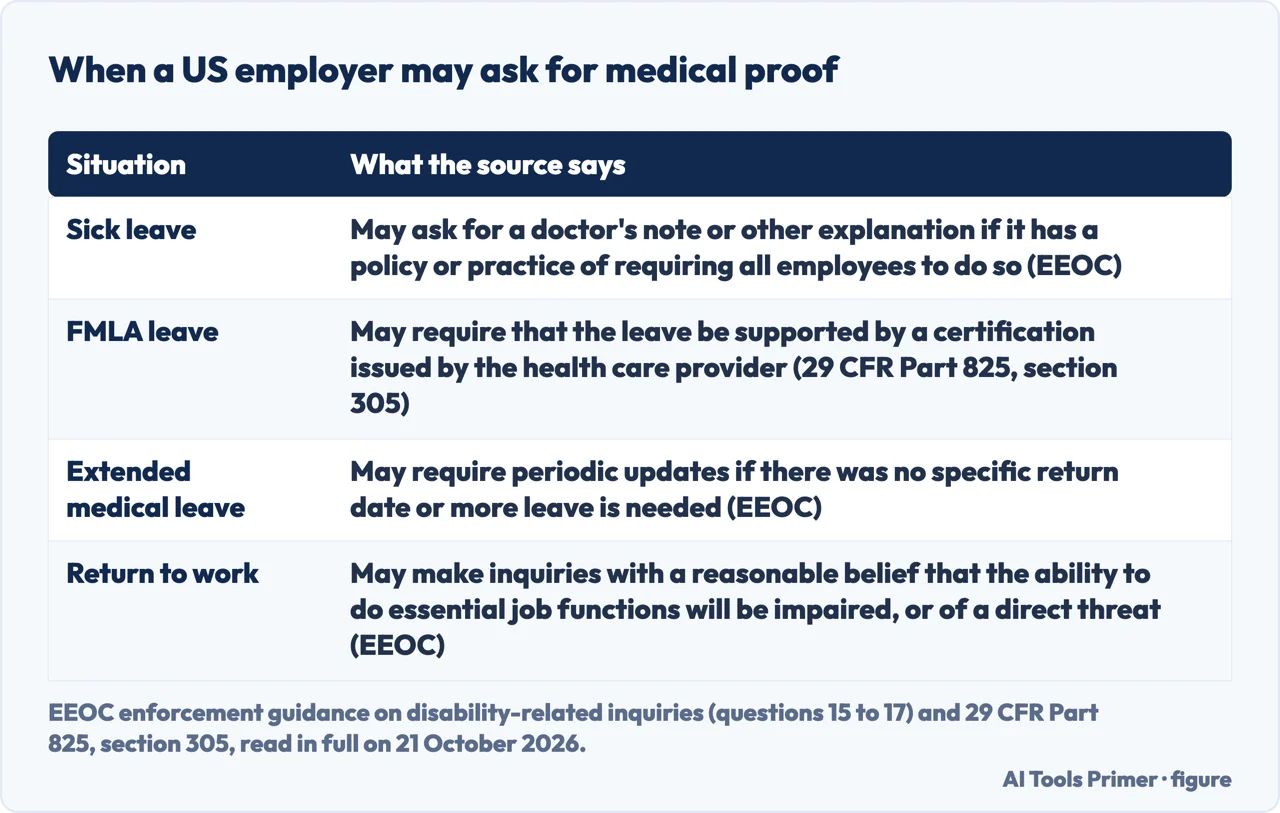
Doctors note for work: in the United States, what your employer can ask for depends on the kind of leave. For ordinary sick leave the EEOC says an employer may ask for a note if it has a policy that applies to everyone; for FMLA leave the federal regulation lets it require a certification from your health care provider.
| Situation | What the source says |
|---|---|
| Sick leave | An employer may ask for a doctor’s note or other explanation, as long as it has a policy or practice of requiring all employees to do so (EEOC) |
| FMLA leave | An employer may require that the leave be supported by a certification issued by the health care provider (29 CFR Part 825, section 305) |
| Extended medical leave | An employer may require periodic updates if there was no specific return date, or if more leave is needed (EEOC) |
| Return to work | An employer may make disability-related inquiries or require an examination only with a reasonable belief, and only within a limited scope (EEOC) |
Ordinary sick leave: the employer’s policy decides
What the EEOC says. The US Equal Employment Opportunity Commission’s guidance on medical questions asked of employees puts the question directly: “May an employer request an employee to provide a doctor’s note or other explanation to substantiate his/her use of sick leave?” Its answer begins “Yes. An employer is entitled to know why an employee is requesting sick leave.” It then says the employer may ask for a note or other explanation “as long as it has a policy or practice of requiring all employees, with and without disabilities, to do so.”
What that does and does not settle. The passage turns on a policy that applies to everyone. It names no number of days and no format for the note. Our reading is that the length of absence after which a note is needed, and what it has to show, come from your employer’s policy, which this page has not seen: the staff handbook or HR is where to check.
How much weight the source carries. The document is dated July 2000, before the ADA Amendments Act of 2008, and says that its contents “do not have the force and effect of law”. It explains how the EEOC reads the Americans with Disabilities Act. It is not a state law: this page has read no state’s rules, and some states may add their own.
FMLA leave: the certification and its clock
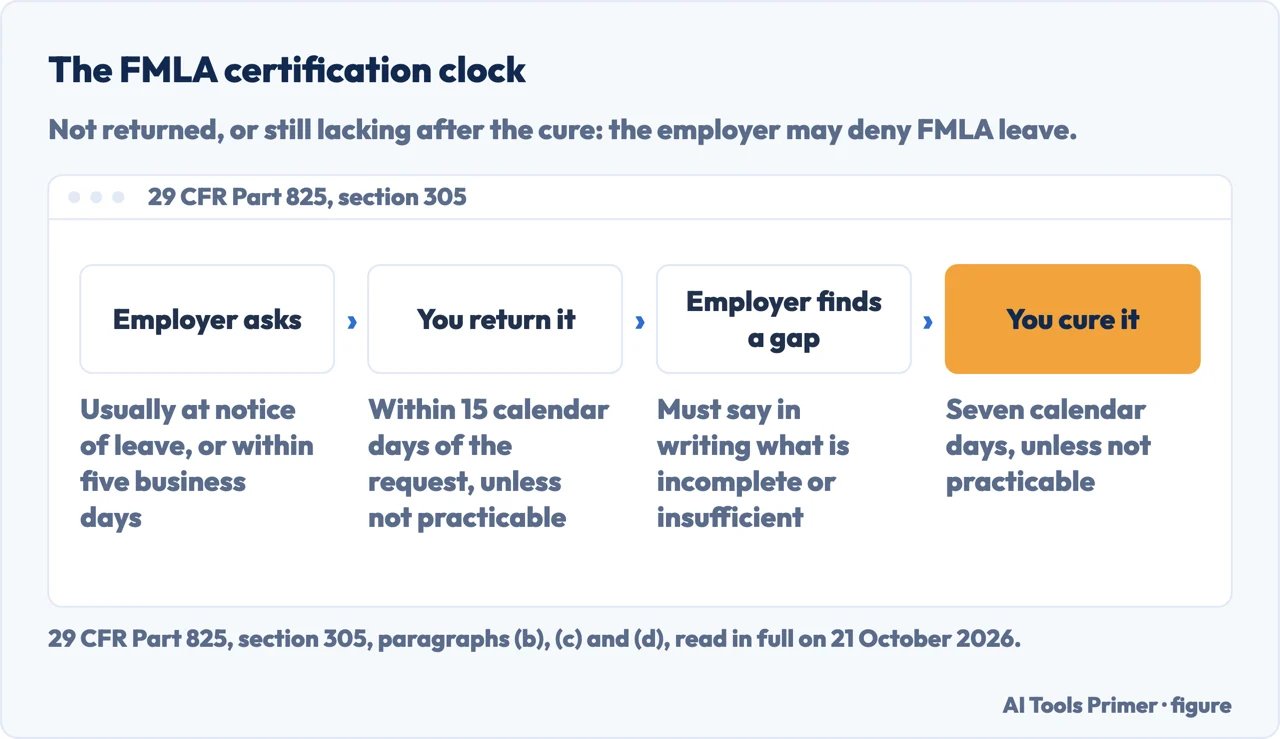
The rule. The federal regulation on the Family and Medical Leave Act says an employer may require that leave for your own serious health condition be supported by a certification issued by your health care provider. It says the employer should usually ask at the time you give notice of the need for leave or within five business days after, and that you must provide it “within 15 calendar days after the employer’s request”, unless that is not practicable despite your diligent, good faith efforts, or the employer gives you longer.
If it is not right. The regulation calls a certification incomplete if entries are blank, and insufficient if the information is “vague, ambiguous, or non-responsive”. In either case the employer must say in writing what is missing and give you seven calendar days to fix it. If it is still wrong, or never returned, the employer may deny the leave under the FMLA.
What this page leaves out. Who is covered by the FMLA, and what counts as a serious health condition, are not covered here: we did not read those parts of the regulation.
What a certification may contain
For FMLA leave, the regulation lists what a health care provider’s certification may set out. It is the closest thing in the sources to a description of what such a note says:
- the provider’s name, address, telephone and fax number, and type of practice;
- the approximate date the condition began, and its probable duration;
- appropriate medical facts, which may include symptoms, diagnosis, hospitalisation, doctor visits, medication or referrals;
- for an employee’s own condition, information sufficient to show that the employee cannot perform the essential functions of the job, and the nature of any other work restrictions.
The regulation also says the information on the form must relate only to the serious health condition for which the current need for leave exists. The Department of Labor has two optional forms, WH-380E and WH-380F, and an employer may use another form with the same basic information; no information may be required beyond what the regulation specifies. You cannot be required to sign an authorisation letting the employer talk to your provider, though you may choose to. For an ordinary sick note, the sources we read give no such list: the contents are a matter for the employer’s policy.
Can my employer call my doctor?
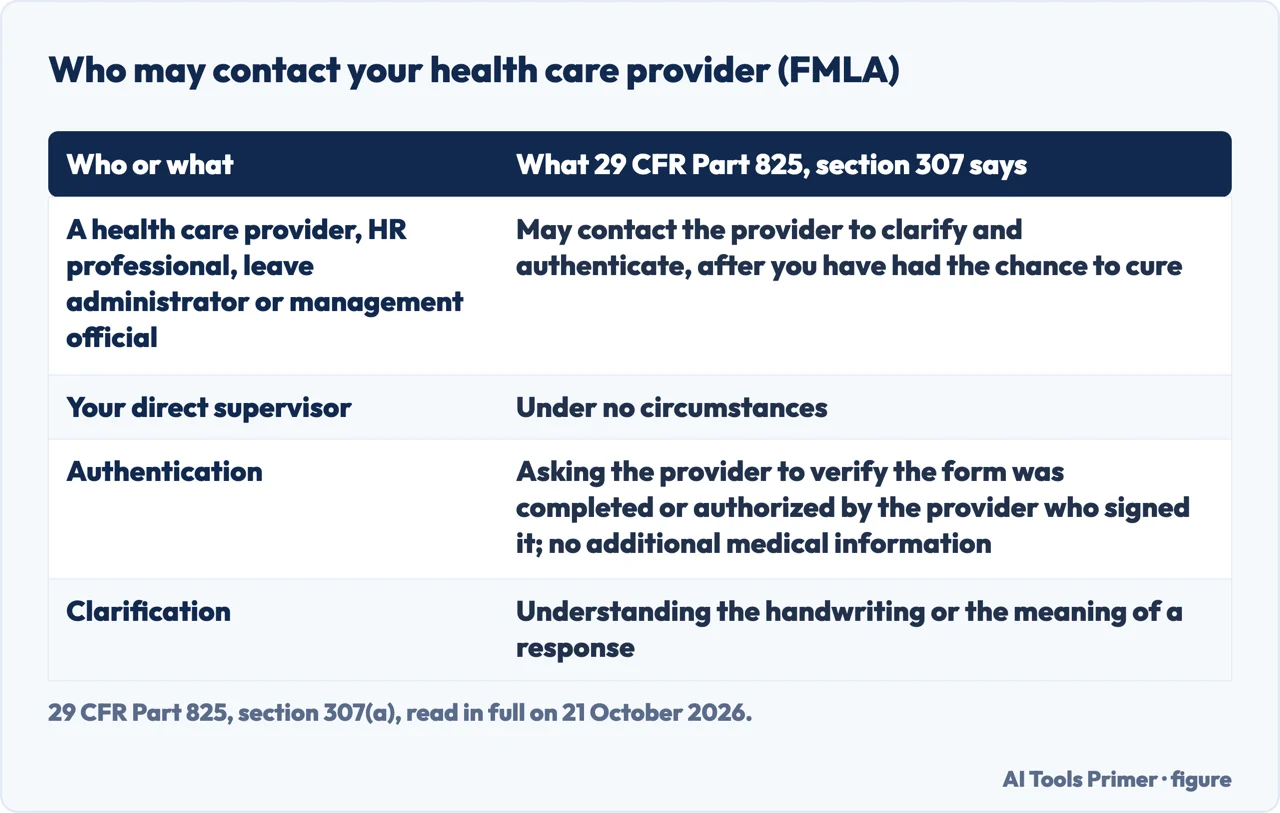
Under the FMLA, within limits. If you give a complete and sufficient certification signed by your provider, the regulation says the employer “may not request additional information from the health care provider”. It may contact the provider only to clarify and authenticate the certification, and only after giving you the chance to fix any gaps. The contact must come from a health care provider, a human resources professional, a leave administrator or a management official. The regulation says “Under no circumstances” may the employee’s direct supervisor make that contact.
What authentication means. The regulation defines it as giving the provider a copy of the certification and asking for confirmation that the form was completed or authorised by the provider who signed it. No additional medical information may be requested. So the answer to whether employers verify notes is: under the FMLA the rule lets them check that a provider signed. How often any employer does is not in the sources, and neither is whether they check an ordinary sick note.
A second opinion. An employer with reason to doubt a certification may require a second opinion at its own expense, and during that time you are provisionally entitled to the benefits of the Act.
Updates while you are off, and coming back
Updates. The EEOC says that if the request for leave gave no exact or fairly specific return date, or you need more leave than first granted, the employer may require periodic updates on your condition and likely return date. If it granted a fixed period and you have not asked for more, it cannot require updates.
Coming back. The employer may make disability-related inquiries or require an examination only if it has a reasonable belief that your ability to perform essential job functions will be impaired by a medical condition, or that you will pose a direct threat. Even then the inquiry must be limited to what is needed to assess your ability to work. The EEOC’s example is a data entry clerk who broke a leg skiing, was off for four weeks and came back on crutches: it says the employer may not require an examination, but generally may ask how she is doing and express concern about her injury.
Where the note comes from
Many websites sell a note online, and many others offer templates. Neither source above says whether a note from an online service meets an employer’s requirement, so we cannot say it does or does not: that is a question for your employer’s policy or HR, ideally before you pay for one. We did not test any service and name none.
What the FMLA text does say is that the certification is issued by your health care provider, and that the employer may ask the provider to confirm that they signed it. Our reading is that a note written by someone other than the signer is what that check is for. We would not alter one. For general guidance on other letters you may need at work, see letter templates and how to quit a job.
Where to start
Four ways in.
- “Can they ask me for one?”
- The policy rule — ask
- “How long do I have?”
- The FMLA clock — fmla clock
- “What should it say?”
- What a certification contains — contents
- “Can they call my doctor?”
- Who may contact — who contacts
Other things you may need to write at work
The letters and notices that go in your employment file, each with its own rule.
Questions people also ask
Can my employer ask for a doctor’s note?
For ordinary sick leave the EEOC says yes: an employer may ask for a doctor’s note or other explanation, as long as it has a policy or practice of requiring all employees, with and without disabilities, to do so. For FMLA leave the regulation lets the employer require a certification from the health care provider.
How long do I have to give my employer a doctor’s note?
For FMLA leave, the regulation says within 15 calendar days after the employer’s request, unless that is not practicable despite your diligent, good faith efforts or the employer gives you longer. The EEOC passage on ordinary sick leave names no deadline.
Do employers actually verify doctor’s notes?
Under the FMLA the regulation lets an employer have a health care provider, HR professional, leave administrator or management official contact your provider to authenticate and clarify a certification, after you have had the chance to fix any gaps. How often any employer does so, and whether they check an ordinary sick note, is not in the sources we read.
Can I get a doctor’s note without seeing the doctor?
Neither the EEOC guidance nor the FMLA regulation addresses it. The FMLA describes a certification issued by your health care provider, so check your employer’s policy before relying on any other route.
Not covered here. It does not give legal advice or cover state law: the sources are federal, and your state or employer may add rules.
It does not cover who qualifies for the FMLA, what counts as a serious health condition, or workers’ compensation.
It does not recommend any service that sells notes, and it tested none.
Sources
- US Equal Employment Opportunity Commission — Enforcement Guidance on Disability-Related Inquiries and Medical Examinations of Employees under the ADA (issued July 2000; questions 15, 16 and 17) — www.eeoc.gov, read 21 October 2026.
- Legal Information Institute, Cornell Law School — 29 CFR Part 825, section 305 Certification, general rule — www.law.cornell.edu, read 21 October 2026.
- Legal Information Institute, Cornell Law School — 29 CFR Part 825, section 306 Content of medical certification for leave taken because of an employee’s own serious health condition or the serious health condition of a family member — www.law.cornell.edu, read 21 October 2026.
- Legal Information Institute, Cornell Law School — 29 CFR Part 825, section 307 Authentication and clarification of medical certification; second and third opinions — www.law.cornell.edu, read 21 October 2026.
Written by Alberto Gulotta
Founder and editor of AI Tools Primer, writing from Palermo, Italy. Thirty-five years of taking computers apart, starting with a Commodore 64 — the long version is on the about page.
Something wrong on this page? Write to aitoolsprimer@gmail.com and it gets fixed.
Written on 21 October 2026.
Independence and limits
No affiliate links and no paid placements anywhere on this site. Nobody pays to appear here, and no company has seen this page before you did.
This is general information, not professional advice. Where a page touches money, health, safety or the law, it names its source and the date it was read — and your situation may still differ. See the privacy page and the cookie policy.