Work · guide
Cover letter templates: the structure and the openings
By Alberto Gulotta · Updated · 17 min read
Cover letter templates fix the font and the margins, not what goes in each paragraph. Career services from US universities to the UK’s National Careers Service agree on a structure — heading, opening, one to three middle paragraphs, a close — and on which openings now read the same however many templates a candidate tried.
| Fact | Source |
|---|---|
| A cover letter has four essential parts: heading, introduction, argument, closing | Purdue OWL |
| “Dear Sir or Madam” with “Yours faithfully” is a UK fallback, not a US one | UK National Careers Service; MIT UPOP |
| Word, Google Docs and Pages each open a template gallery from File > New | Microsoft, Google, Apple |
| In one freelance-market study, 17% of cover letters had AI assistance; the callback signal fell 51%, the offer signal 79% | arXiv preprint (not peer-reviewed) |
| A vendor survey found 46% of job seekers admit using ChatGPT for a resume or cover letter; separate vendor surveys found 58%–88% of hiring managers say they can spot AI use, with unresolved sample or date mismatches inside their own text | ResumeBuilder.com (cited by SHRM), Resume Genius, Insight Global |
The structure career services agree on
Purdue OWL’s cover letter workshop states that “a cover letter has four essential parts: heading, introduction, argument, and closing”, with “Dear Hiring Professionals” as the fallback when no name turns up. Its argument section treats the résumé as material to expand on, not repeat — an instruction restated below.
Yale OCS gives “three to four paragraphs”: an opening ending with “a short statement highlighting 2-3 related skills”, a middle that must “not simply restate your resume”, and a closing. Columbia CCE frames the whole document as “a one-page business letter where you convey why you are interested in the position and why you would be an excellent candidate for it”. Berkeley adds one more: open with “a compelling paragraph that tells a story” and show knowledge of both the position and the company.
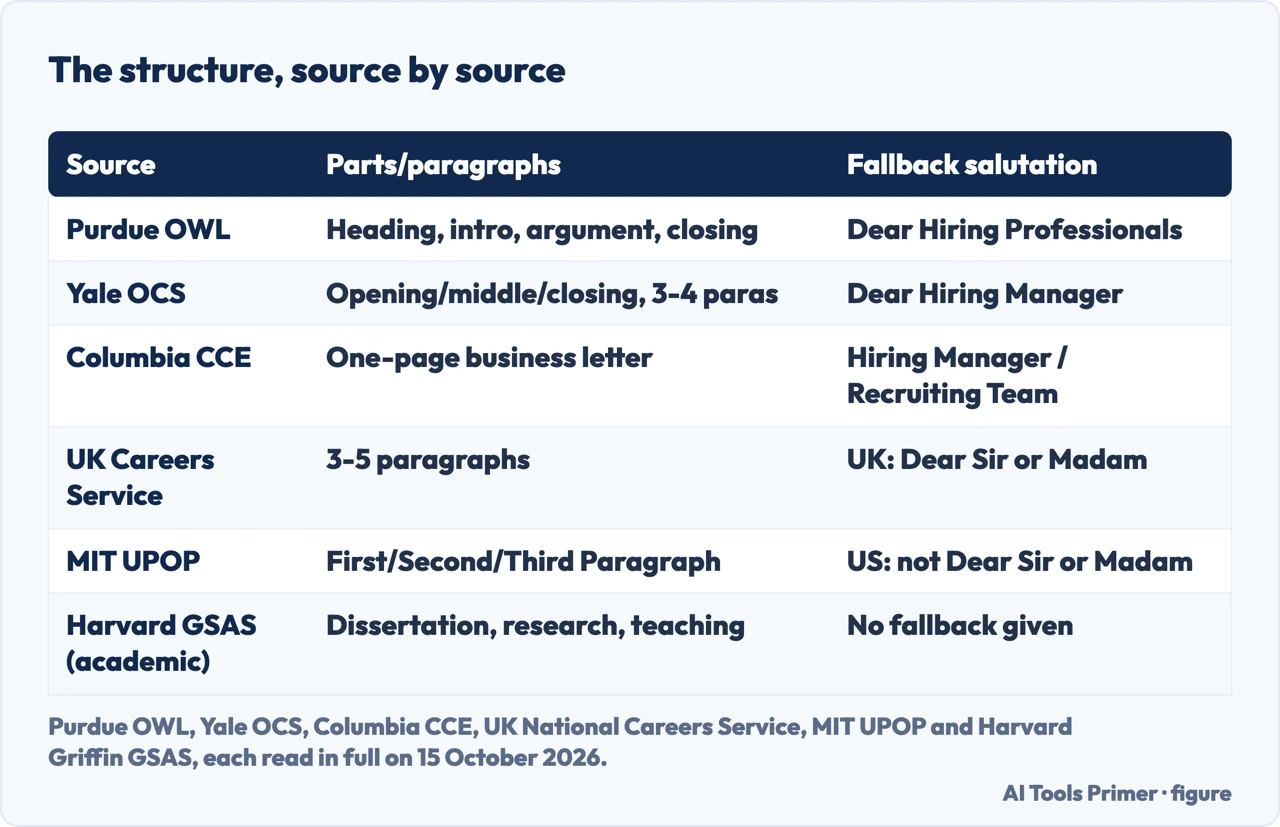
The UK’s National Careers Service describes the same shape at a different length: “a short letter, usually 3 to 5 paragraphs long”, written fresh for every application. MIT CAPD teaches US undergraduates to “tailor to the position and the company”; MIT UPOP labels the paragraphs directly as First, Second and Third Paragraph, the first introducing the applicant by degree programme and graduation year, and states the purpose in the opening sentence.
Harvard Griffin GSAS teaches the same skeleton for a narrower readership only: doctoral students and postdocs, with middle paragraphs on “your dissertation/current research”, future research plans and teaching experience — not a private-sector job. One layout note, not a fourth structure: Purdue OWL separately names block “the most common layout of a business letter”, with modified block and semi-block as variants.
Where the free templates already are
All three of the programs already installed on most machines open a free template gallery the same way: from a File menu. In Word, Microsoft’s own instructions are to go to the File tab and “select New”, then “select Blank document, or double-click a template image or type the kind of document into the Search for online templates box and press Enter”, reachable afterwards “from a computer, tablet, or phone via OneDrive”. In Google Docs, the instruction is one line: “Click File > New > From a template.” That page, read in full on 15 October 2026, never names a letter or cover-letter example among its categories, so this page does not claim Google’s gallery has one.
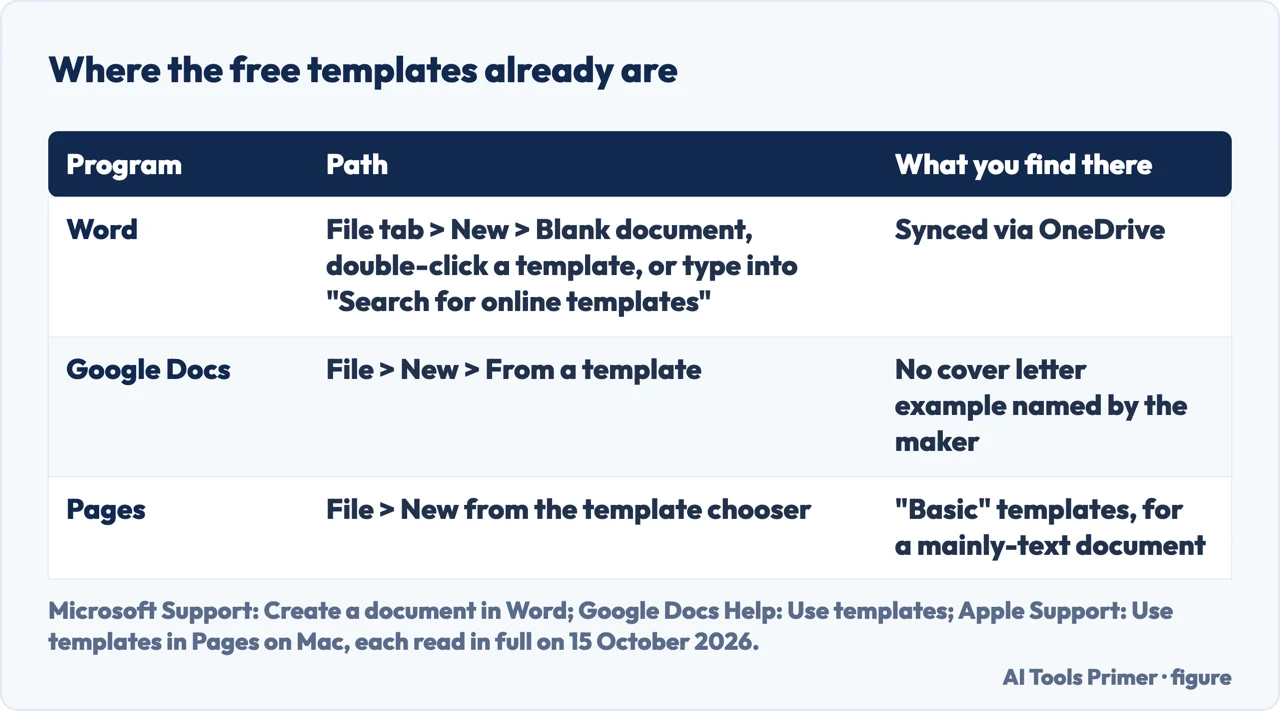
Apple’s Pages follows the same pattern — “Click the New Document button in the dialog, or choose File > New”, then double-click a template — and for mostly-text documents recommends “one of the Basic templates” rather than a graphics-heavy design. None of the three pages names a cover-letter template specifically: the gallery supplies the blank page, and the structure above supplies what goes on it.
What the template galleries actually sell
A separate set of sites sell the design, not the words. Canva’s letters page files job cover letters and thank-you letters in one general letter library. Template.net’s own FAQ describes “an AI-powered tool that generates structured letter documents from prompts in 3 to 10 seconds”, listing Cover Letter as one of roughly twenty letter categories on the same page. Adobe Express promotes creating letters “in minutes from your browser”, with no cover-letter category of its own.
Microsoft’s separate, browser-based gallery at word.cloud.microsoft promises “a wide range of letter templates and letterhead examples to customize, download, and print for free in Microsoft Word”, including a job-facing letter of interest category. TheGoodocs holds 74 templates under Letters, where Cover letters appears only once, filed separately under its own Contracts menu. None of these five is cited above as a structure source — named only for what they sell.
Openings career services say to avoid
MIT CAPD’s Dos and Don’ts list is the most direct of the career-services guides read for this page: “Don’t start with ‘To Whom It May Concern.’ It’s impersonal. Use ‘Dear Hiring Manager,’ or the person’s name. Don’t submit a generic cover letter.” The same office calls repeating the résumé “probably the biggest mistake” it sees — the same warning Yale and Columbia give above about the middle paragraphs.
The fallback salutation itself splits by country when no name can be found. Yale suggests addressing it to the hiring manager; Columbia offers the same route, or “Dear Recruiting Team”. The UK’s National Careers Service recommends the opposite convention for British applicants, already set out in the table above: Dear Sir or Madam, closing with Yours faithfully. MIT UPOP, writing for US undergraduates, states the reverse: “Do not address your letter to ‘Dear Sir or Madam.’” Whichever opening a candidate chooses, the claims it makes usually resurface at interview, the subject of preparing for an interview that is being scored.
Using AI to help — without losing your voice
Columbia’s Center for Career Education is the only one of the career-service guides read for this page that gives AI assistance its own section. Its position is that the tools can help a candidate identify relevant experiences and qualifications worth emphasising, refine a draft, and tailor the letter to a specific role or employer, but that the result should not replace the candidate’s own material: “it should still reflect your own experiences, perspective, and voice.” A stated position, not a measured outcome — the measured numbers are next.
What the data says about AI-written openings
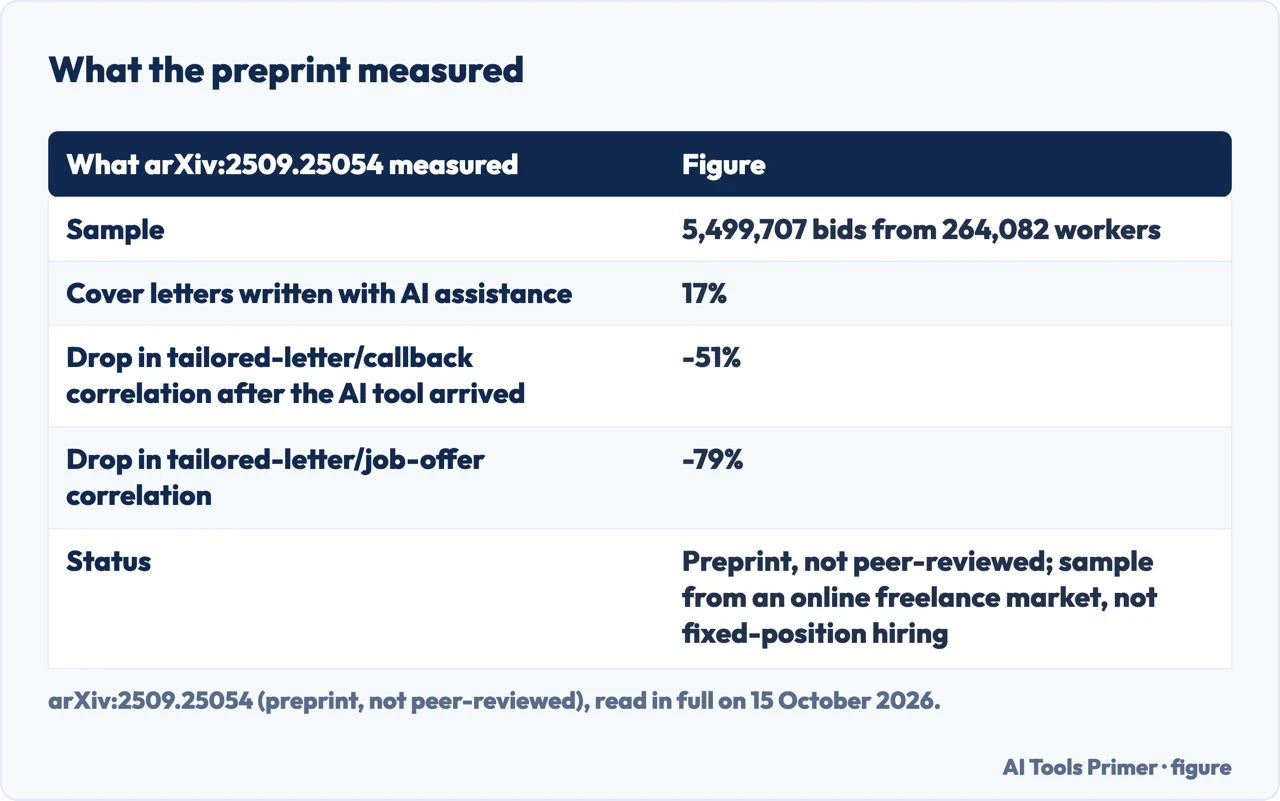
The one study that measures rather than asks is a preprint, not peer-reviewed: Signaling in the Age of AI: Evidence from Cover Letters (arXiv:2509.25054), analysing 5,499,707 job bids from 264,082 workers on an online freelance market in 2023. It found 17% of cover letters had AI assistance; after the tool arrived, the correlation between a letter’s wording matching the job and getting a callback fell 51%, and with receiving an offer, 79%. The authors’ own conclusion is that widespread AI-assisted writing diminishes the informational value of a cover letter as a hiring signal, pushing employers to weigh alternative signals, such as past work experience, more heavily instead. The sample is freelance work, not fixed-position hiring, and the authors note that in other markets, such as those for first-time job seekers, alternative signals may be weaker or absent.
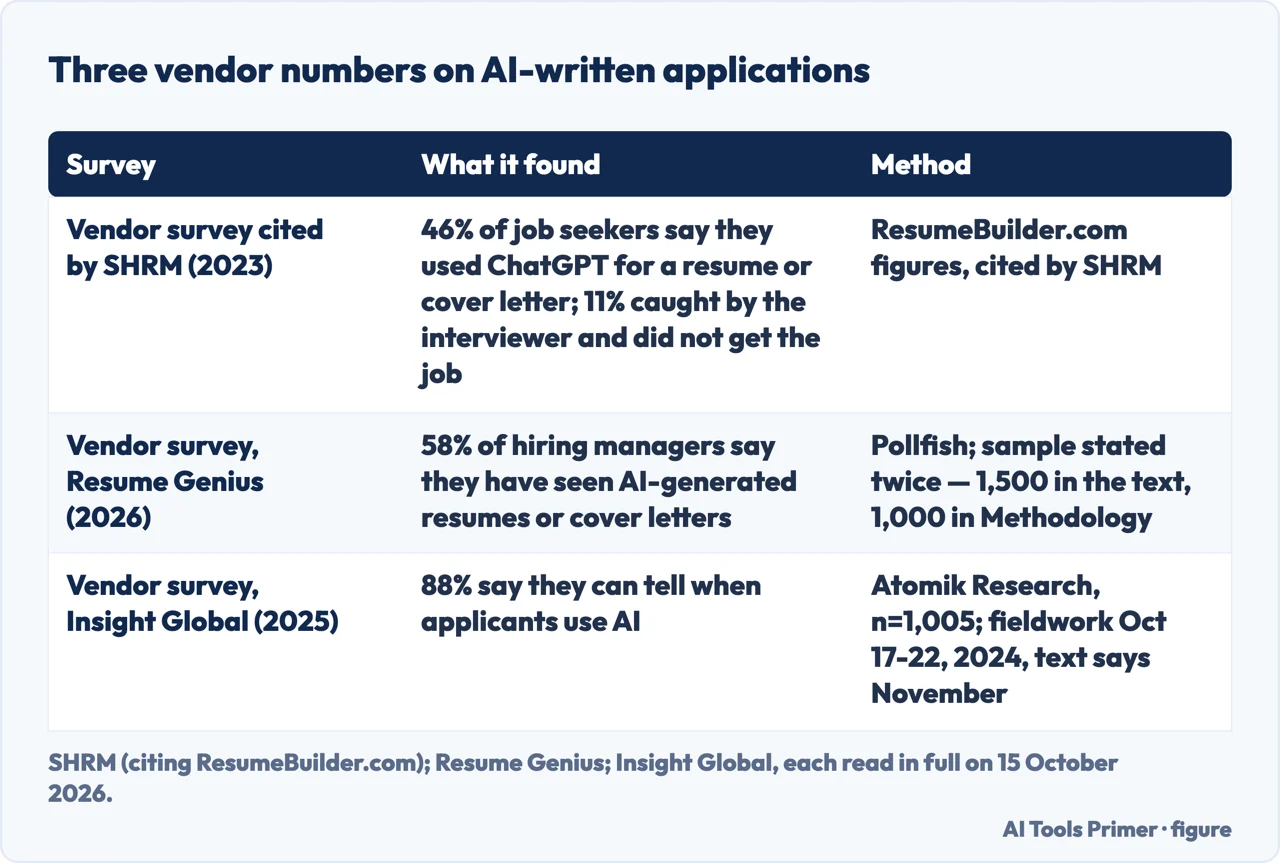
Three other reports measure perception, not outcomes. SHRM’s 2023 article cites a ResumeBuilder.com survey — a vendor’s data, not SHRM’s own — in which 46% of over 1,000 job seekers said they used ChatGPT for a résumé or letter, and 11% both had the interviewer discover it and failed to get the job. Resume Genius, which sells a competing builder, reports “58% of hiring managers have encountered AI-generated resumes or cover letters”, though its own Methodology section states a sample of 1,000 against 1,500 in the article’s opening, unresolved. Insight Global, a staffing vendor, reports “88% of those surveyed say they can tell when candidates are using AI”, from an Atomik Research survey of 1,005 hiring managers whose Methodology section dates fieldwork to 17–22 October 2024, though the article’s body says November 2024. None of the three tests whether that self-reported recognition is actually accurate.
Where to start
Six quick ways in.
- “What parts does a cover letter actually need?”
- The structure, source by source — the structure career services agree on
- “Where’s the free template in Word or Docs?”
- The exact menu path — where the free templates already are
- “What is Canva or Template.net actually selling?”
- Named for what they sell — what the template galleries actually sell
- “Which openings should I avoid?”
- What the career offices say — openings career services say to avoid
- “Can I use AI to help write it?”
- One office’s own position — using ai to help without losing your voice
- “Can recruiters really tell?”
- The numbers, with their caveats — what the data says about ai written openings
The rest of the cover letter
The letter itself, start to finish.
The rest of the application
The résumé it travels with, and what follows it.
Questions people also ask
Where can I find free cover letter templates?
Word, Google Docs and Pages each open one from File > New — though Google’s help page (read 15 October 2026) never names a letter example, and Pages offers a Basic, word-processing template. All three are already installed.
Where are the letter templates in Microsoft Word?
On the File tab, select New, then either pick Blank document or double-click a template image, or type what you need into the Search for online templates box. Word also keeps documents in OneDrive so the same file opens on another device.
Can I get a cover letter template as a PDF?
None of Word’s, Google Docs’ or Pages’ own help pages name a letter template to export as a PDF. What does exist as a PDF is a full guide: MIT’s UPOP Cover Letter Guide, downloadable with a complete sample letter already written out.
Is there a simple cover letter template?
The simplest version several career offices teach isn’t a design — it’s three or four short paragraphs: Yale’s framework runs opening, middle, closing across three to four paragraphs; Columbia calls the whole thing a one-page business letter. Simple here means short, not plain-looking.
What’s the difference between a cover letter template and a cover letter structure?
A template is a file — fonts, margins, maybe a colour band — opened from Word, Google Docs or Pages. A structure is the order of the content inside it: Purdue OWL’s four parts stay the same whichever template holds them.
Not covered here. It does not cover the alphabet letters people cut, sew or colour for craft projects, even though that activity shares the same search phrase, nor Purdue OWL’s block, modified block and semi-block layouts as a subject of their own, since those describe business-letter formatting in general, not the cover letter; and it does not rank the template galleries above one another, named only for what their own pages say they sell. Harvard Griffin GSAS’s structure appears only for the scope it states — doctoral students and postdocs. What belongs elsewhere — whether a cover letter is worth writing at all, including for US federal jobs where USAJOBS lists one as an optional document with no structure guidance of its own, how to write the letter itself, an internship cover letter with nothing on the CV yet, an ATS friendly resume template, what to put on a resume, and the thank-you email that usually follows — sits in the cards above. What holds instead is simple: every structure and salutation above is a career service’s own wording, every AI number is dated and labelled by who measured it — preprint, SHRM, or vendor survey — and nothing here ranks the template galleries.
Sources
- Purdue OWL (Purdue University) — Cover Letter Workshop: Formatting and Organization: the four-part structure (heading, introduction, argument, closing) and the “Dear Hiring Professionals” fallback. Applies to: a generic cover letter structure, no country stated — owl.purdue.edu, read 15 October 2026.
- Purdue OWL (Purdue University) — Writing the Basic Business Letter: the Block, Modified Block and Semi-Block layouts, used here only as a formatting note. Applies to: business letters in general, not the cover letter specifically — owl.purdue.edu, read 15 October 2026.
- Yale Office of Career Strategy (OCS) — Cover Letters & Correspondence: the three-part, three-to-four-paragraph framework and the “Dear Hiring Manager” fallback. Applies to: Yale students and alumni — ocs.yale.edu, read 15 October 2026.
- UC Berkeley Career Engagement — Cover Letters: the narrative-opening and knowledge-of-employer recommendations. Applies to: general structure and advice — career.berkeley.edu, read 15 October 2026.
- Columbia University Center for Career Education (CCE) — Cover Letters: the one-page-business-letter framing, the salutation fallbacks, and its own section on using AI. Applies to: cover letter structure and AI guidance — www.careereducation.columbia.edu, read 15 October 2026.
- National Careers Service (UK government) — How to write a cover letter (covering letter): the 3-to-5-paragraph length and the “Dear Sir or Madam”/“Yours faithfully” fallback. Applies to: the United Kingdom — nationalcareers.service.gov.uk, read 15 October 2026.
- MIT Career Advising & Professional Development (CAPD) — Career toolkit: Writing a cover letter: the Dos/Don’ts list and the warning against repeating the résumé. Applies to: structure and openings to avoid — capd.mit.edu, read 15 October 2026.
- MIT Undergraduate Practical Opportunities Program (UPOP) — Cover Letter Guide (PDF): the First/Second/Third Paragraph structure and the explicit US instruction against “Dear Sir or Madam”. Applies to: MIT undergraduates, United States convention — upop.mit.edu, read 15 October 2026.
- Harvard Kenneth C. Griffin Graduate School of Arts and Sciences, Mignone Center for Career Success — CVs and Cover Letters (PDF): the dissertation/research/teaching paragraph structure. Applies to: academic cover letters for doctoral students and postdocs, not general job applications — cdn-careerservices.fas.harvard.edu, read 15 October 2026.
- USAJOBS Help Center (U.S. Office of Personnel Management) — What documents do I need to provide when I apply?: the cover letter as an optional document with no structure guidance of its own. Applies to: US federal employment — usajobshelp.opm.gov, read 15 October 2026.
- Microsoft Support — Create a document in Word: the File > New steps and the OneDrive access. Applies to: Word for Microsoft 365, Word 2024, Word 2021 — support.microsoft.com, read 15 October 2026.
- Google (Google Docs Editors Help) — Use templates: the File > New > From a template path, and the listed categories that never name a letter. Applies to: Google Docs — support.google.com, read 15 October 2026.
- Apple Support — Use templates in Pages on Mac: the File > New path and the Basic-template recommendation for text-heavy documents. Applies to: Pages on Mac — support.apple.com, read 15 October 2026.
- Independent preprint, not peer-reviewed (Yale Department of Economics, Cowles Foundation) — Signaling in the Age of AI: Evidence from Cover Letters (arXiv:2509.25054): the sample, the 17% AI-assistance share, and the drop in two hiring-signal correlations. Applies to: an online freelance market in 2023, not fixed-position hiring — arxiv.org, read 15 October 2026.
- SHRM (Society for Human Resource Management) — Are Job Seekers Cheating When They Use ChatGPT to Craft Resumes and Cover Letters?: cites a ResumeBuilder.com survey, not SHRM’s own data. Applies to: US HR professionals’ perceptions, 2023 — www.shrm.org, read 15 October 2026.
- Resume Genius, which sells a competing resume and cover-letter builder — AI’s Impact on Hiring in 2026: the 58% figure and its own internal 1,000-vs-1,500 sample discrepancy. Applies to: US hiring managers, Pollfish survey — resumegenius.com, read 15 October 2026.
- Insight Global, a staffing and AI-services vendor — 2025 AI In Hiring Report: the 88% figure and its own internal date discrepancy between the Methodology section and the article body. Applies to: US hiring managers at companies with 100+ employees, Atomik Research survey — insightglobal.com, read 15 October 2026.
- Canva, a design gallery — Free, printable, customizable letter templates: the general letter library in which job cover letters sit beside thank-you letters. Applies to: what the gallery sells, read as a search result — www.canva.com, read 15 October 2026.
- Template.net, a template marketplace — Free Letter Templates, Editable and Printable: its FAQ on the AI letter generator and the Cover Letter category. Applies to: what the gallery sells, read as a search result — www.template.net, read 15 October 2026.
- Adobe Express, a design gallery — Free Letter Templates: Design a Letter Online: the browser-based gallery, with no cover-letter category of its own. Applies to: what the gallery sells, read as a search result — www.adobe.com, read 15 October 2026.
- Microsoft, the Word template gallery — Letterhead and letter templates: the free gallery and its letter of interest category. Applies to: what the gallery sells, read as a search result — word.cloud.microsoft, read 15 October 2026.
- TheGoodocs, a template gallery — Free Letter Templates for Google Docs and Word: 74 templates under Letters, with cover letters filed under Contracts. Applies to: what the gallery sells, read as a search result — thegoodocs.com, read 15 October 2026.
Written by Alberto Gulotta
Founder and editor of AI Tools Primer, writing from Palermo, Italy. Thirty-five years of taking computers apart, starting with a Commodore 64 — the long version is on the about page.
Something wrong on this page? Write to aitoolsprimer@gmail.com and it gets fixed.
Written on 15 October 2026.
Independence and limits
No affiliate links and no paid placements anywhere on this site. Nobody pays to appear here, and no company has seen this page before you did.
This is general information, not professional advice. Where a page touches money, health, safety or the law, it names its source and the date it was read — and your situation may still differ. See the privacy page and the cookie policy.