Audio · guide
What a music generator makes, and who owns the song
By Alberto Gulotta · Updated · 16 min read
A music generator turns a typed description or a photo into a track, and the pages differ on what follows. Google describes 30-second tracks, Suno says free songs are for personal, non-commercial use, and the U.S. Copyright Office does not count the mere provision of prompts as enough for copyright.
| Question | Answer | Where it comes from |
|---|---|---|
| What goes in? | A typed description, a photo or an image, depending on the service | Google, Artlist, Suno |
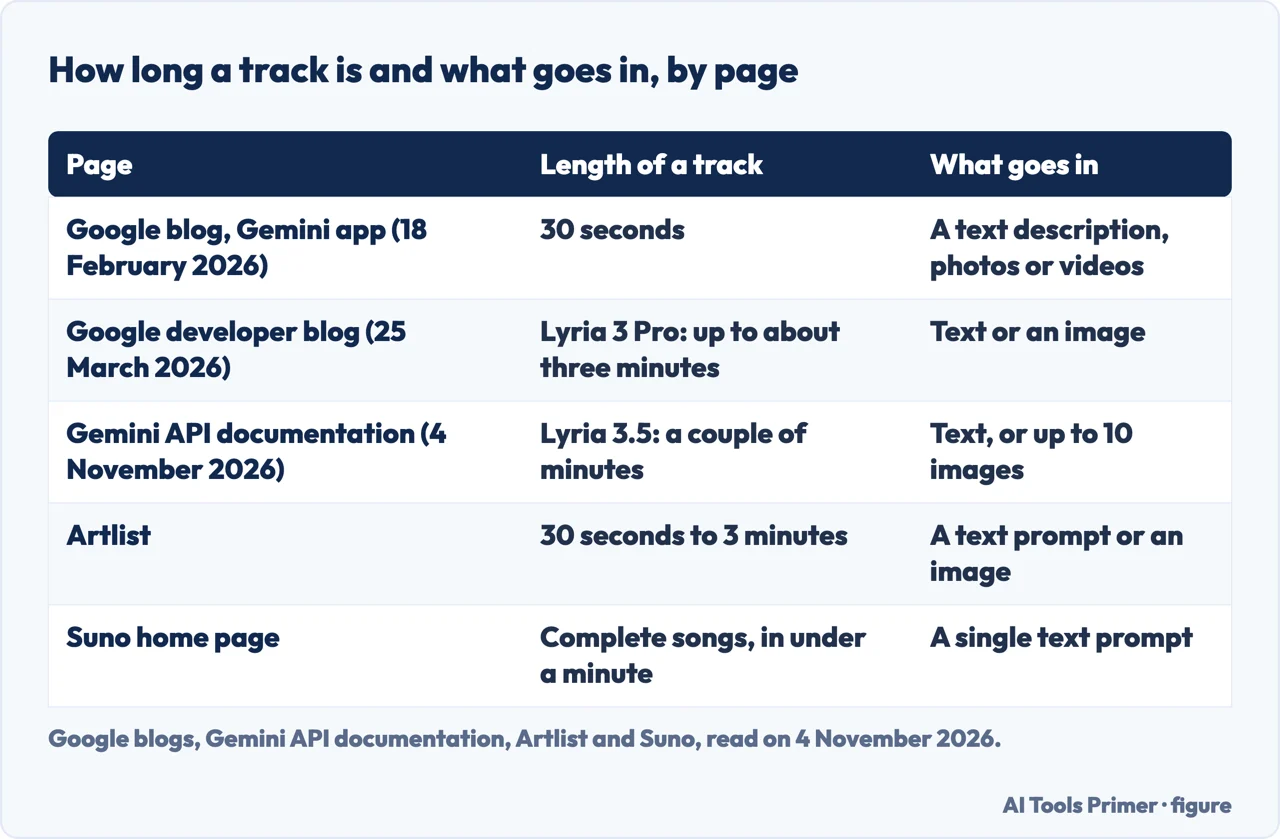
| How long is a track? | Google says 30 seconds in the Gemini app; Artlist says 30 seconds to 3 minutes | Google, Artlist |
| Can a free song be sold? | Suno says songs on its free plan are for non-commercial use and cannot be monetized | Suno Help Center |
| Does owning a song mean copyright? | Suno says the material may still not be eligible for copyright protection | Suno Help Center |
| What does the U.S. Copyright Office say? | Protection needs a human author who determined enough expressive elements | U.S. Copyright Office |
What a music generator does, as three companies describe it
Google’s blog post of 18 February 2026 says the Gemini app can now make music with a model called Lyria 3. You describe an idea or upload a photo, and Gemini makes a 30-second track with custom cover art. The post lists three ways Lyria 3 improves on earlier Google audio models: lyrics are written for you from your prompt, you get more control over style, vocals and tempo, and the tracks can be more realistic and musically complex. It also says the goal of the tracks “isn’t to create a musical masterpiece”, but to give people a fun way to express themselves.
Artlist describes a text-to-music and image-to-music tool built on Lyria 3 and Lyria 3 Pro, which composes an instrumental or vocal track from 30 seconds to 3 minutes. Its FAQ separates two terms. A music generator, it says, creates instrumentals or background music, while a song generator can also include vocals and song structure, and it adds that the two terms are somewhat interchangeable. Suno’s home page draws a line too: it says most AI music generators produce short instrumental loops, and that Suno builds complete songs, with vocals, lyrics and production, from a single text prompt in under a minute.
For developers, Google gives two pages that do not use the same names. The post of 25 March 2026 lists Lyria 3 Pro, for tracks up to about three minutes, and Lyria 3 Clip, for 30-second clips. The Gemini API documentation we read on 4 November lists Lyria 3.5, for songs of a couple of minutes whose length you can influence in the prompt, and Lyria 3 Clip. It describes 44.1 kHz stereo audio made from text or from up to 10 images, with vocals, timed lyrics and instrumental arrangements. The pages we read do not say how the two sets of names relate.
What the services say people make with it
These are the companies’ own examples, not findings of ours. Google’s Gemini post gives prompts for a track about a mother’s home-cooked plantains and for photos of a dog on a hike, and says creators can use Lyria 3 in YouTube’s Dream Track to improve the quality of each unique Shorts soundtrack, whether a lyrical verse or a backing track. The developer post describes two of its demo apps built in Google AI Studio. One analyses an uploaded video and has Lyria compose a matching instrumental as background music; the other wakes you with a new song each morning that covers the weather, the time and your calendar.
Artlist names three groups. Filmmakers and video creators can compose music for trailers, films, ads and scenes; songwriters and musicians can turn ideas, lyrics and moods into produced songs; podcasters and audiobook creators can score intros, outros and story segments. Mureka, on its page, says fitness channels need energetic tracks while cooking channels prefer warm background music, and says you can reach individual stems for mixing in a digital audio workstation. Suno’s home page says millions of people use AI to make music for fun, for content and for professional projects.
Output formats differ by service. Mureka lists MP3, WAV and MP4 downloads. Google’s documentation says Lyria 3.5 makes MP3 by default and can return WAV on request. Two of the related searches, from audio and with vocals, have an answer in the pages we read. Mureka says its Pro plan accepts reference audio uploads and lets any voice, humming included, be the singer, while its Basic plan excludes audio uploads as references and voice cloning; Suno’s home page says its Voices feature lets you record a few seconds of your own voice and hear it sing anything you write. The pages we read do not compare the quality of one service with another, and this page does not rank them.
Free plan or paid plan: the same question, answered differently
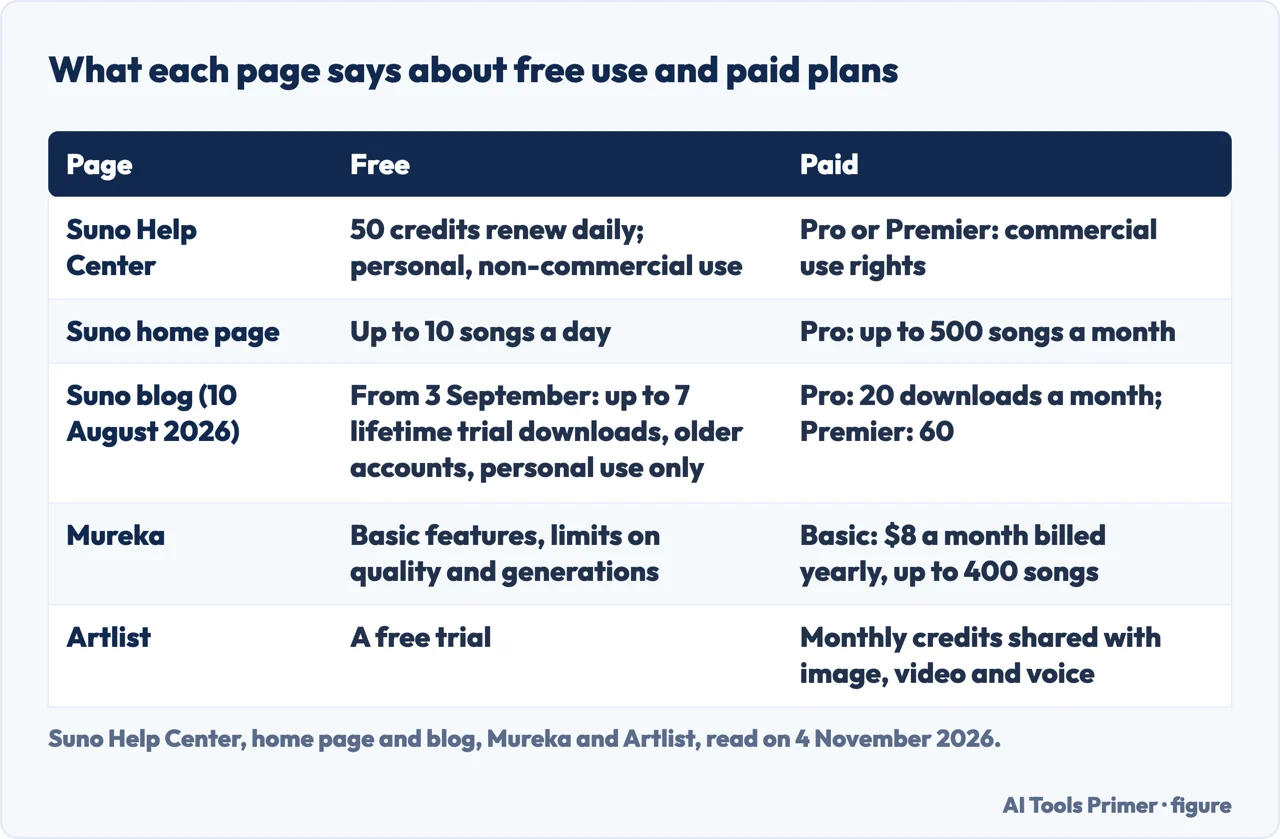
Suno’s Help Center says songs made on the free plan are only for “personal, non-commercial use” and cannot be monetized, though they can be shared with a link to your Suno page. On the free plan you create with 50 credits that renew daily, keep tracks link-only or publish them to your Suno page, and may use a song in a personal project that earns nothing. Suno’s home page counts differently: it says free users can create up to 10 songs a day, and that the Pro plan gives 500 songs a month with commercial use rights and the Premier plan 2,000. The pages we read do not say how a credit relates to a song.
A third Suno page, a blog post of 10 August 2026 signed Team Suno, changes the picture again. It says that from 3 September free accounts that joined before that date get up to 7 trial downloads for life, while free accounts that join later may only occasionally receive trial downloads, Pro accounts 20 downloads a month and Premier accounts 60, with extra downloads for sale and no limit for Premier subscribers who use Suno Studio. It says trial downloads are for personal use only, while songs downloaded on a paid plan carry commercial rights. The Help Center articles we read on 4 November still talk about daily credits and do not mention download limits, and the pages we read do not say whether the limits are in force today.
Subscribing late does not help older songs, according to Suno. Its Help Center says a Pro or Premier subscription does not give a retroactive commercial licence, by default, to songs made on the free plan; Suno may offer one in certain cases, which it does not guarantee. Songs made while subscribed stay yours after you cancel. It gives the starting price of its plans as $10 a month, with a discount for annual subscribers.
Mureka and Artlist show their own shapes. Mureka lists a Basic plan at $8 a month billed annually at $96, with up to 400 songs a month and commercial licensing, and a Pro plan at $24 a month billed annually at $288, with up to 1,600 songs, stems and voice cloning. Artlist says its monthly credits are shared across its image, video, voice and music tools, and are deducted by model and track length. Google says AI Plus, Pro and Ultra subscribers get higher limits in the Gemini app. Prices and limits change, so these are the figures on the day we read the pages.
Who owns the song, and who can copyright it
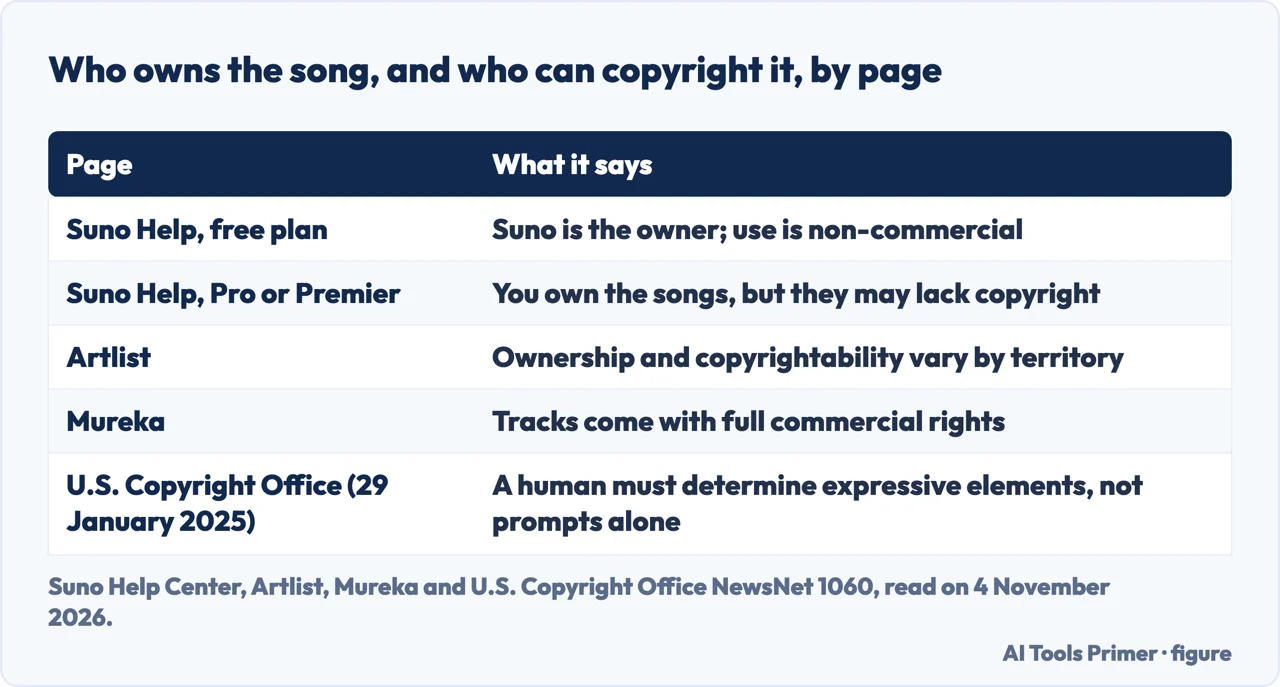
Suno’s Help Center draws a line between ownership and copyright. On its Basic (free) plan, it says, Suno is the owner of the songs and you may use them for non-commercial purposes; on Pro or Premier you own them. In both cases, it adds, the material may not be eligible for copyright protection. For the United States, the article says copyright laws protect material created by a human, that music made entirely with AI would not qualify, and that writing the prompt does not constitute the creation of the song.
The same article says that if you wrote the lyrics yourself, you own them, that most copyright offices will register lyrics on their own, and that you may be able to use them to register the whole song. It says some regions or registrars may recognise you as the writer with Suno as an instrument, and then the song will likely be eligible. Because copyrights are complex and vary by region, it suggests asking your local copyright office before you apply.
Artlist words it differently. It says laws on copyrightability and ownership of AI-generated content “vary by territory”, that where the law permits you keep the rights to the music you make, and that Artlist does not claim ownership. Mureka’s page says every track comes with full commercial rights and can be used on Spotify and social platforms “without copyright concerns”. The vendor pages we read do not set their commercial-rights wording beside the Copyright Office’s statement.
That statement is the news release of 29 January 2025 for Part 2 of the Office’s report on copyright and artificial intelligence. It says the outputs of generative AI can be protected only where a human author has determined sufficient expressive elements, which can include a human-authored work that is perceptible in the output or creative arrangements or modifications by a person, “but not the mere provision of prompts”. It also says that using AI to help in making a work, or including AI-generated material in a larger human work, does not bar copyright, and that the case has not been made for changing the law.
Where the output is limited
Length is the first limit, and it depends on the model. In the Gemini app the tracks are 30 seconds; through the developer tools Google describes clips of 30 seconds and songs of up to about three minutes, or a couple of minutes in the documentation we read. That documentation says music generation is a single-turn process, so refining a track through several prompts is not supported in the current version of Lyria 3.5.
Google also describes how it handles identity and rights. Every track made in the Gemini app carries SynthID, a watermark it calls imperceptible, and Gemini can check an uploaded audio file for it. The developer documentation says the mark is “imperceptible to the human ear”. If a prompt names an artist, the Gemini app blog says Gemini takes it as broad inspiration and aims for a similar style or mood, and filters check outputs against existing content; the developer documentation is stricter and says prompts that request specific artist voices or the generation of copyrighted lyrics are blocked by its safety filters. Google says its approach “might not be foolproof”, so you can report content that may violate your rights or someone else’s. Use of the Gemini feature is for users 18 and over, in eight languages.
Models also change. Suno’s blog post of 10 August 2026 says a new generation of models is coming and that, when they launch, all prior models will be retired, while every existing song stays in your library, playable and shareable. Suno’s home page names v6 as its newest model in one place and describes the Pro plan as including v5.5 in another; the pages we read do not explain the difference.
What the pages say to check before you publish
Suno’s distribution article says songs made while subscribed to Pro or Premier carry commercial use rights, so you can send them to Spotify and Apple Music through a distributor of your choice and use them in content posted to YouTube or TikTok, without crediting Suno. It adds a warning: you must be the exclusive rights holder of 100 percent of the material, so you should not try to monetise a song that uses someone else’s lyrics, which it says can get a YouTube channel shut down or future releases blacklisted by distributors. The copyright article adds that some distributors exclude songs that are not eligible for copyright protection, and suggests comparing several and reading their terms.
Google says that anyone using its products must follow its Terms of Service and its generative AI prohibited use policy, which bar violations of others’ intellectual property and privacy rights. Artlist says it allows commercial use as long as you comply with the prohibited uses in its Terms of Use. Suno’s post of 10 August 2026 says new Terms of Service, which it says clarify the rights users have in their content, were due on 3 September. We did not read any service’s full terms, so the lines above are summaries of help pages and blog posts, read on 4 November 2026.
What we did not use
We tested no music generator and made no song. On 4 November 2026 we opened four product pages (Suno, Mureka, MusicGPT and Artlist) and used the facts the companies state about themselves. The MusicGPT page was mostly menus and a cookie notice, so we cite nothing from it. We did not open the Google Play listing, AISongCreator, ToMusic, AISong or Brev. The Google AI box was read only at its start. We read the Copyright Office news release and its overview page, not the full report, and we read no full terms of service. The pages we read do not say how many people use these services or how much generated music is published, and they do not mention the court cases between record companies and generators.
Where to start
Four ways in.
- “What does it actually make?”
- What a music generator does, as three companies describe it — what
- “Is there a free one?”
- Free plan or paid plan — plans
- “Who owns the song?”
- Who owns the song, and who can copyright it — owner
- “Can I publish it?”
- What the pages say to check before you publish — check
Voices and consent
Generated voices and the rules that come with them.
Songs, files and copyright
Taking songs apart and keeping them.
Questions people also ask
Is there a free AI music generator?
Suno’s Help Center says its free plan gives 50 credits that renew daily, for personal, non-commercial use only; its home page says up to 10 songs a day. Artlist says its generator can be tried as part of a free trial. Mureka’s page says free users get basic features with limits.
Is there an AI music generator from Google?
Google’s blog says Lyria 3 is in beta in the Gemini app, making 30-second tracks from text or photos for users 18 and over. For developers, its documentation describes Lyria 3.5 and Lyria 3 Clip through the Gemini API, and its March post says the new music experience in AI Studio uses a paid API key.
Can an AI music generator make a song from my lyrics?
Google says Lyria 3 writes lyrics from your prompt, and its documentation mentions timed lyrics. Artlist says songwriters can turn lyrics into produced songs. Suno’s Help Center says that if you wrote the lyrics, you own them and many offices register them on their own.
Can I sell music made with an AI music generator?
Suno says songs from Pro or Premier carry commercial use rights and free-plan songs do not. Artlist and Mureka say commercial use is allowed. The U.S. Copyright Office says protection needs a human author who determined enough expressive elements, not the mere provision of prompts.
Not covered here. We tested no music generator. The statements come from Suno, Google, Artlist, Mureka and the U.S. Copyright Office, all read on 4 November 2026.
The search volume and difficulty behind this page come from a Semrush Keyword Overview reading of 29 August 2026, older than the 60 days the site normally allows.
Sources
- Suno Help Center — What rights do I have with the free plan? — help.suno.com, read 4 November 2026.
- Suno Help Center — Do I have the copyrights to songs I made? — help.suno.com, read 4 November 2026.
- Suno Help Center — Can I distribute my songs to Spotify, etc? — help.suno.com, read 4 November 2026.
- Suno Help Center — If I subscribe, do I get rights for the songs I made before subscribing? — help.suno.com, read 4 November 2026.
- Suno blog — An update to our downloads policy and Terms of Service (10 August 2026) — suno.com, read 4 November 2026.
- Suno — AI Music Generator (home page) — suno.com, read 4 November 2026.
- Google blog — A new way to express yourself: Gemini can now create music (18 February 2026) — blog.google, read 4 November 2026.
- Google developers blog — Build with Lyria 3 (25 March 2026) — blog.google, read 4 November 2026.
- Gemini API documentation — Generate music with Lyria 3.5 — ai.google.dev, read 4 November 2026.
- Artlist — AI Music Generator — artlist.io, read 4 November 2026.
- Mureka — AI Music Generator — www.mureka.ai, read 4 November 2026.
- U.S. Copyright Office — NewsNet Issue 1060, Part 2 of the AI report (29 January 2025) — www.copyright.gov, read 4 November 2026.
- U.S. Copyright Office — Copyright and Artificial Intelligence — www.copyright.gov, read 4 November 2026.
Written by Alberto Gulotta
Founder and editor of AI Tools Primer, writing from Palermo, Italy. Thirty-five years of taking computers apart, starting with a Commodore 64 — the long version is on the about page.
Something wrong on this page? Write to aitoolsprimer@gmail.com and it gets fixed.
Written on 4 November 2026.
Independence and limits
No affiliate links and no paid placements anywhere on this site. Nobody pays to appear here, and no company has seen this page before you did.
This is general information, not professional advice. Where a page touches money, health, safety or the law, it names its source and the date it was read — and your situation may still differ. See the privacy page and the cookie policy.