Audio · guide
Voice cloning from your own recording: audio, consent, storage
By Alberto Gulotta · Updated · 15 min read
Voice cloning starts with a recording of your own voice, and the pages we read give different lengths: ElevenLabs asks for at least one minute, while a Google summary said ten to sixty seconds. ElevenLabs and Resemble also keep what they make by different rules, and both address consent before a clone is made.
| Question | Answer | Where it comes from |
|---|---|---|
| How much audio for an instant clone? | The guide says at least 1 minute and not more than 3; its FAQ allows 10 seconds in all; Google’s AI summary said 10 to 60 seconds | ElevenLabs, Google |
| What does the clone copy? | Speed, inflections, accent, tone, breathing, noise and mouth clicks | ElevenLabs |
| Can the clone be downloaded? | No: it stays in the account and can be used through an API key | ElevenLabs |
| How long is it kept? | ElevenLabs: voice data it generates, no longer than 3 years after your last interaction. Resemble: recordings and models while the account is active, then 30 days after closing or a deletion request; its policy also says biometric identifiers are destroyed no later than 3 years after collection | ElevenLabs, Resemble |
| Is consent asked? | ElevenLabs asks you to confirm it; Resemble may require a spoken statement | ElevenLabs, Resemble |
What it takes to make an instant clone
ElevenLabs’ guide to an Instant Voice Clone is four steps. In the dashboard you select the Voices section, click the plus icon and choose Instant Voice Clone; you upload or record audio; you name and label the voice, confirm that you have the right and consent to clone it, and click Save voice; and the clone then sits under My Voices, where Use voice starts it. Above the steps the guide sends anyone unsure about what is permitted to its Terms of Service and its AI Safety information.
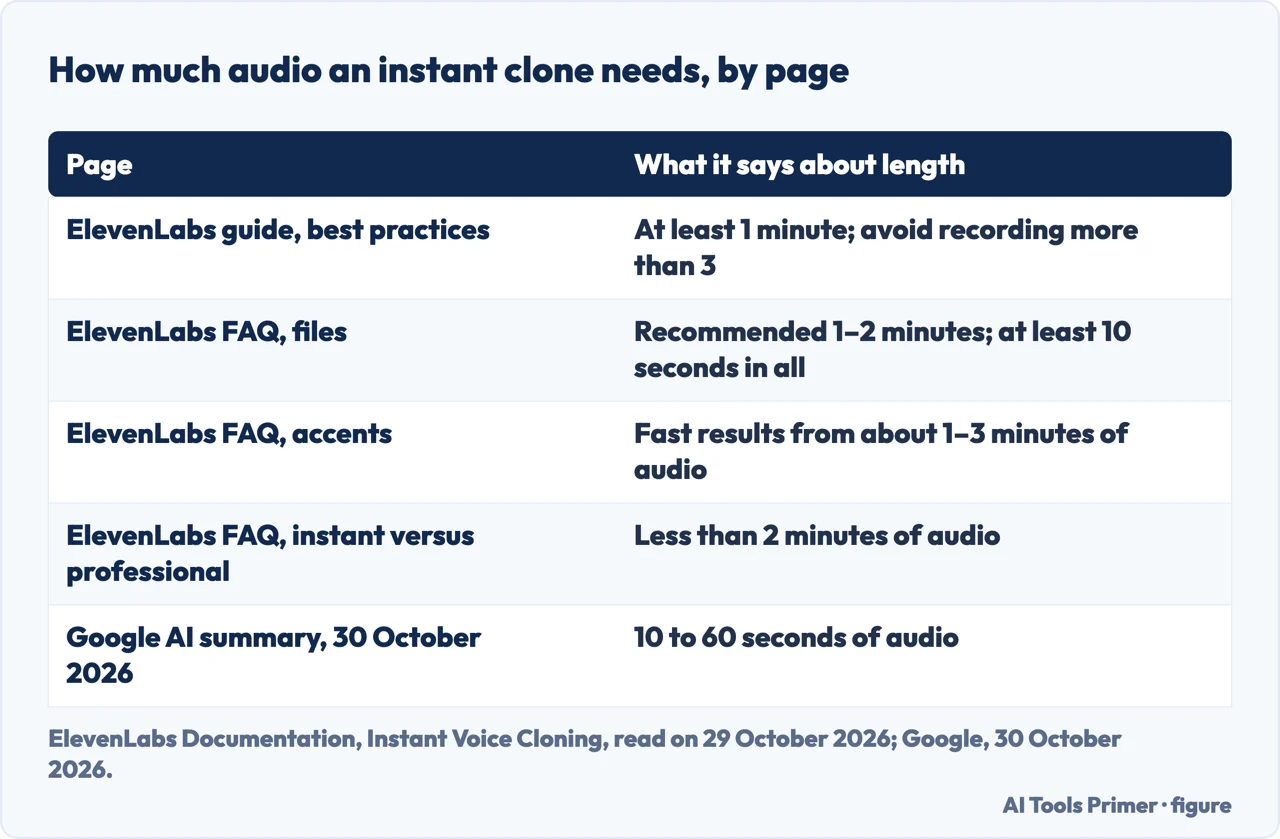
On length the guide is specific. Its best-practices section says to record at least 1 minute of audio and to avoid recording more than 3, because more yields little improvement and can in some cases make the clone worse. It adds that how the audio was recorded matters more than the total runtime, and that the number of samples does not matter, only their combined length. What it recommends is about 1 to 2 minutes of clear audio with no reverb, artifacts or background noise. When it talks about quality it says it means how the audio was captured, not the codec, and it advises MP3 at 128 kbps and above.
The FAQ on the same page gives other numbers for the same job. It recommends 1 to 2 minutes of good audio for an instant clone, and sets a technical minimum: each file must be at least 5 seconds long and all the samples together at least 10 seconds. It says users have got excellent results from samples of only 30 seconds and worse ones from 10 minutes, and that more than 2 or 3 minutes brings little improvement. Another answer says fast results come from about 1 to 3 minutes. Google’s AI summary of 30 October 2026 said 10 to 60 seconds. The figure below puts the five side by side.
The format advice differs too. The guide says MP3 at 128 kbps and above; the FAQ strongly recommends MP3 at 192 kbps or higher, and says uncompressed formats such as WAV “usually do not improve clone quality” and can cause problems with the upload. Resemble’s terms of service go another way: they describe the audio files it takes as .wav, or another format it asks for. For loudness the guide gives a target of between -23 dB and -18 dB RMS with a true peak of -3 dB.
What the clone copies, and what it cannot change
The guide says the AI attempts to mimic everything it hears in the audio: the speed of the person talking, the inflections, the accent, the tonality, the breathing pattern and strength, and also noise and mouth clicks. It says even noise and artefacts that can confuse the model are factored in. So a slow, monotone recording is what the clone will imitate, and a quick, emotional one is what it will try to reproduce. The guide asks for the same tone and the same performance across every sample, and for consistent audio quality even when only one sample is used. Audio with wide swings in pitch and volume, it says, gives less predictable results.
The FAQ is firm about what happens afterwards: you cannot change the accent or tone of a clone after it is created. To improve the result you change the audio samples, and it says small changes to the samples can make a large difference. If an instant clone does not capture the voice or accent well, the same answer suggests trying a professional clone.
Two more answers matter if the clone is going to be used somewhere else. On export, ElevenLabs says you cannot download or export voice clones as standalone files and that they stay in your account; with your API key, third-party services can call the ElevenLabs API and generate speech with the voices in the account. To recreate a clone later it says to keep the original audio samples, and that each clone will sound slightly different even from the same audio. On language, you can clone your voice in any language supported by Flash v2.5 and Multilingual v2. Cloning a voice speaking a language the model does not support may capture the tone but will not make it speak that language, and ElevenLabs says it does not recommend that.
Instant or professional
ElevenLabs offers two cloning options and its FAQ explains the difference in one answer. An instant clone is made quickly from less than 2 minutes of audio. A professional clone is a dedicated model trained on a large set of voice data, which ElevenLabs describes as virtually indistinguishable from the original voice. Because it has to be fine-tuned, the answer says there is a wait: usually 3 to 6 hours, with an email when the clone is ready. A separate answer, about an error message shown when a professional clone is used too early, says the process will usually take between 3 and 6 hours but can take up to 24.
The audio asked for differs by a wide margin. The FAQ recommends 30 to 180 minutes of good audio for a professional clone, and another answer says 30 minutes to about 3 hours. Google’s AI summary of 30 October 2026 said professional cloning takes from 30 minutes up to several hours of audio. The pages we read do not say what either kind costs or which plan is needed for it, and the guide does not compare the two on anything but length and time.
The FAQ points to the professional option when an instant clone does not capture the voice or accent. Both options share one constraint that the next section explains: ElevenLabs lists both as not eligible for Zero Retention Mode, because the clone has to be stored to generate speech.
What the service keeps
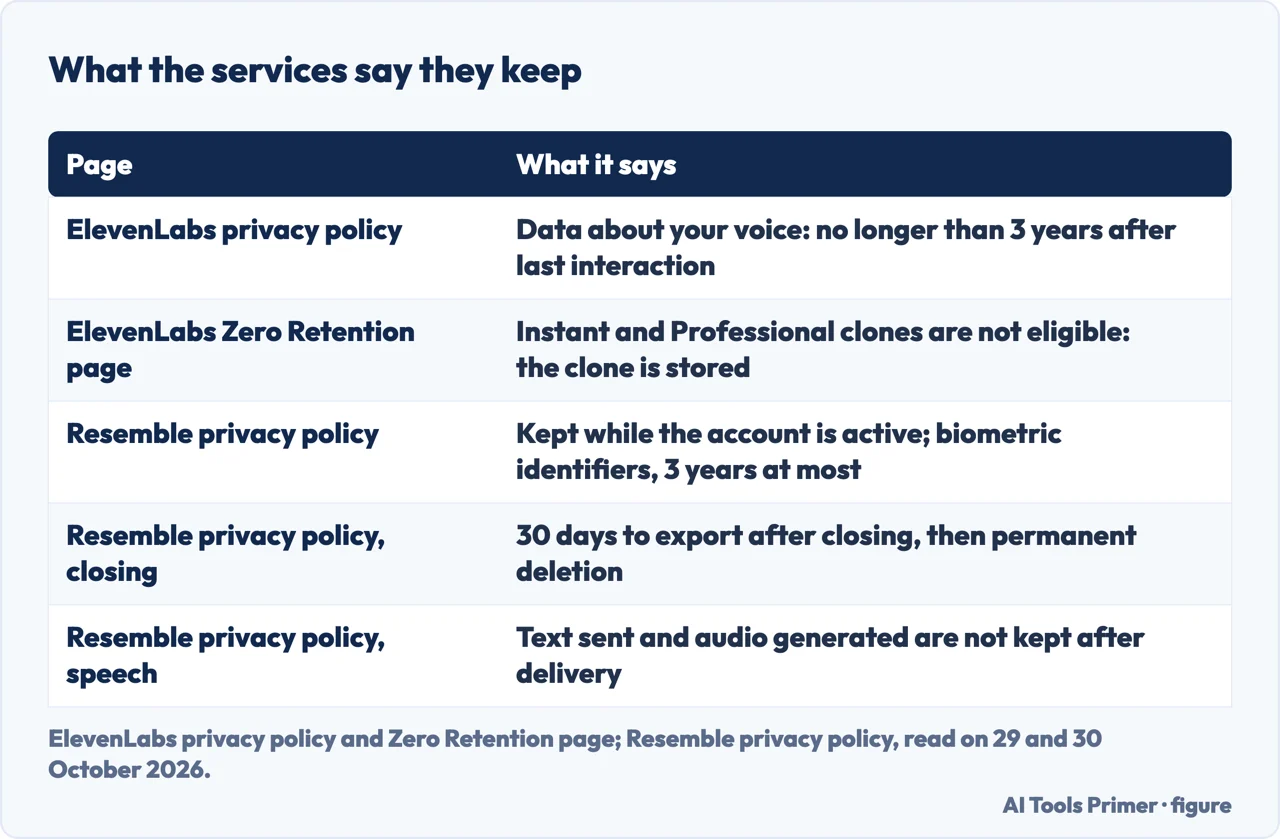
ElevenLabs’ privacy policy says its voice data can be a recording or live narration of your voice, or of someone else’s voice you ask it to use, and that from it the service creates a synthetic copy it calls a voice model. On how long it keeps what it generates, the policy says it will not keep data it generates about your voice for longer than 3 years after your last interaction with the company, unless the law requires or allows otherwise. Elsewhere it says it generally keeps personal information as long as necessary to provide the services or as the law requires or permits, and then securely deletes or de-identifies it. The policy says you can delete your account from your account settings, and it describes an opt-out from the use of your personal information for training in the Data use menu of your account.
The ElevenLabs page on Zero Retention Mode adds a limit. By default the company retains data in line with its privacy policy; Zero Retention Mode is an option for select enterprise customers. The page’s table of products lists both Instant Voice Cloning and Professional Voice Cloning as not eligible, and gives as the reason that a clone has to be stored to generate speech.
Resemble’s privacy policy is organised differently. It says it processes voice recordings and the resulting model to deliver the service and for no other purpose, and that it does not use customer voice data to train general-purpose models. Recordings and models are retained while the account is active; after termination, expiry or a deletion request there is a 30-day grace period for export, and then permanent deletion. The text sent for speech synthesis and the audio generated from it, it says, are not retained after delivery. The same policy says biometric identifiers are destroyed when their purpose has been met and no later than three years after they were collected, and it treats voice recordings and voice models as biometric identifiers and sensitive personal information. ElevenLabs words it as a possibility: where it uses voice data to check that it belongs to you, it says it may be handling biometric or sensitive data under some laws.
The two rules are not the same rule. ElevenLabs counts from your last interaction and speaks of data it generates about your voice; Resemble counts from the life of the account and speaks of recordings and models, although its separate rule for biometric identifiers, which it says include voice recordings and voice models, sets a limit of no later than three years after collection; the policy does not say how the two rules fit together. The ElevenLabs guide to instant cloning does not mention how long a clone or its samples are kept, and the privacy policy sentence about data it generates about your voice does not say whether it covers the clone or the uploaded samples.
Consent, age and misuse
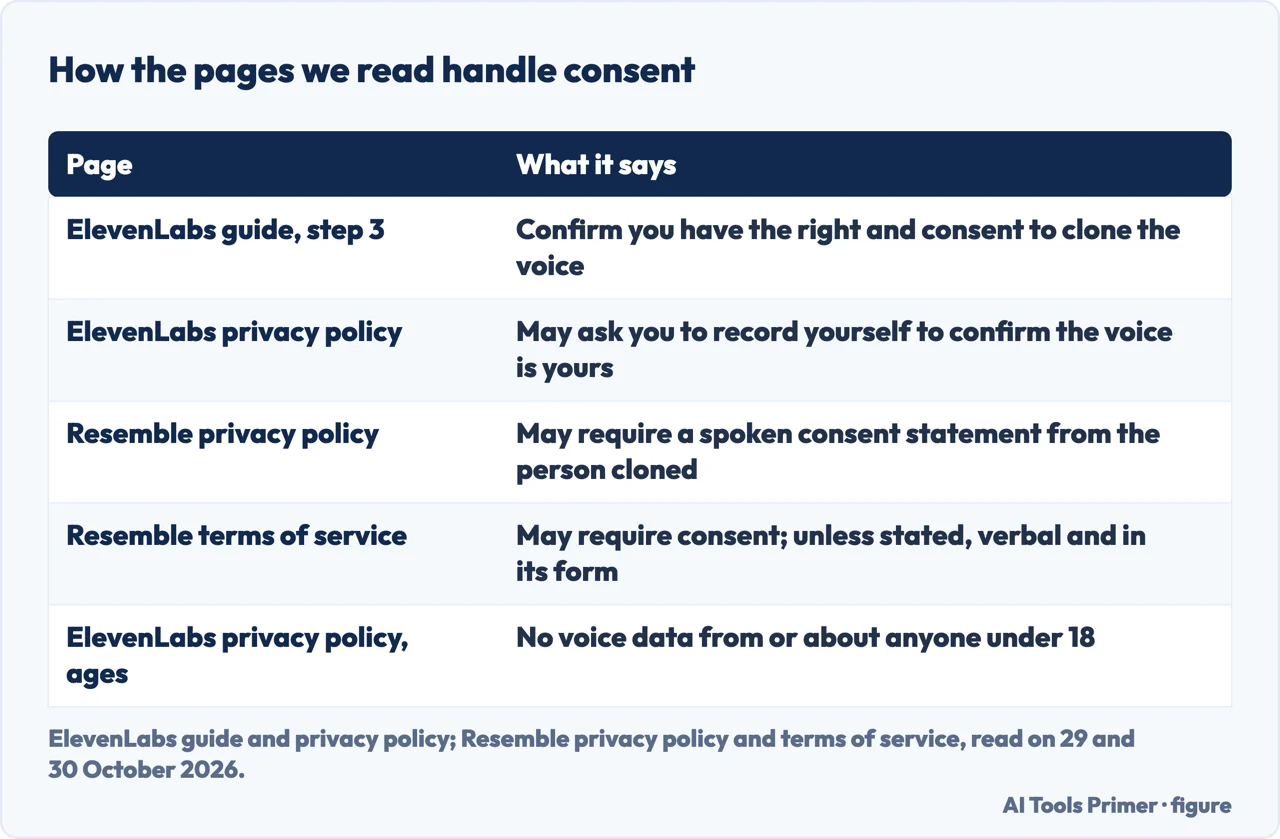
The two services ask for consent in different ways. In ElevenLabs’ flow it is a confirmation at step 3 that you have the right and consent to clone the voice. Its privacy policy adds that for services such as voice cloning it may ask you to record yourself, so that it can confirm the voice you uploaded is yours. Resemble says that before a voice model is created it may require the person whose voice is being cloned to record a spoken consent statement, which it analyses to confirm that it is authentic and matches a required script. Its terms say it may require consent from the individual or third party whose voice is cloned, that unless stated otherwise the consent must be verbal and captured in the form it specifies, and that whoever uploads content warrants having the rights, consents and permissions to do so.
Age is a separate rule. ElevenLabs’ privacy policy says all users are strictly prohibited from providing voice data from or about anyone under the age of 18. On misuse, its FAQ says it works only with clients who follow its Terms of Service and Prohibited Use Policy, that all audio generated by its models can be instantly traced back to the user responsible, and that clear regulation is yet to be introduced.
The FTC writes from the other side. Its November 2023 post says voice cloning systems are generally built on large training sets of real voices and that many are commercially available or open source. It names the risks as fraudulent extortion scams against families and small businesses, and voice artists whose voices could be appropriated. It says it is prepared to act under the FTC Act and the Telemarketing Sales Rule and is considering a proposed Impersonation Rule. Its April 2024 announcement of the Voice Cloning Challenge winners lists four: AI Detect, which uses algorithms to tell genuine and synthetic voices apart; DeFake, which adds distortions to voice samples that the ear cannot hear but that make them harder to clone; OriginStory, which authenticates the human origin of a recording as it is made; and Pindrop’s detection, which checks incoming audio in two-second chunks. DeFake’s description notes that voice samples for cloning are generally collected from social media and other platforms. The FTC says the results of the challenge show that there is no single solution to this problem.
For the scam side, our guide to voice scams covers the call that sounds like a relative. For consent when a real person’s voice is used in narration, see our voice generator guide.
What it is for, and what the pages leave out
The FTC’s post gives one use plainly. It says voice cloning offers people who may have lost their voices to accident or illness the chance to speak as themselves again, and it recalls that speech synthesis is decades old: Stephen Hawking used the robotic CallText 5010 synthesiser after he lost his voice in 1985.
The pages we read do not say what cloning costs, and they do not say which plan includes it. The FTC pages we read do not compare services or say which one is safe. We cloned no voice and tested no service; the statements here come from the vendors’ own documents and policies and from the FTC. The sources we read are silent on narrating with your own clone; for disclosure labels and consent when a cloned voice reads a script, see our voice generator guide.
Google’s AI summary is quoted above as it appeared on 30 October 2026, and only its opening was read.
Where to start
Four ways in.
- “How much audio do I need?”
- What it takes to make an instant clone — audio
- “Will it copy my accent?”
- What the clone copies, and what it cannot change — copy
- “What does the service keep?”
- ElevenLabs and Resemble, side by side — kept
- “Whose voice can I clone?”
- Consent, age and misuse — consent
Voices and consent
Generated voices, calls that imitate a relative, and recording a call.
Your own recordings
What to do with a recording once you have it.
Questions people also ask
How much audio do you need to clone your voice?
ElevenLabs’ guide says at least 1 minute and not more than 3. Its FAQ sets a technical minimum of 10 seconds in all, and Google’s AI summary of 30 October 2026 said 10 to 60 seconds.
Can you download a cloned voice?
ElevenLabs says you cannot download or export voice clones as standalone files. They stay in your account, and third-party services can use them through your API key.
How long does a service keep a cloned voice?
ElevenLabs says it will not keep data it generates about your voice longer than 3 years after your last interaction, unless the law allows otherwise. Resemble keeps recordings and models while the account is active, then 30 days after closing or a deletion request; biometric identifiers go no later than three years after collection.
Do you need consent to clone a voice?
ElevenLabs asks you to confirm that you have the right and consent to clone the voice. Resemble says it may require a spoken consent statement from the person cloned.
Not covered here. We cloned no voice and tested no service. The statements come from ElevenLabs (the Instant Voice Cloning guide, the privacy policy and the Zero Retention Mode page), Resemble (privacy policy and terms of service) and two FTC pages, read on 29 and 30 October 2026.
The search volume and difficulty behind this page come from a Semrush reading of 29 August 2026, older than the 60 days the site normally allows.
Sources
- ElevenLabs Documentation — Instant Voice Cloning — elevenlabs.io, read 29 October 2026.
- ElevenLabs — Privacy Policy — elevenlabs.io, read 30 October 2026.
- ElevenLabs Documentation — Zero Retention Mode — elevenlabs.io, read 30 October 2026.
- Resemble AI — Privacy Policy — www.resemble.ai, read 30 October 2026.
- Resemble AI — Terms of Service — www.resemble.ai, read 30 October 2026.
- FTC — Preventing the Harms of AI-enabled Voice Cloning — www.ftc.gov, read 30 October 2026.
- FTC — FTC Announces Winners of Voice Cloning Challenge — www.ftc.gov, read 30 October 2026.
Written by Alberto Gulotta
Founder and editor of AI Tools Primer, writing from Palermo, Italy. Thirty-five years of taking computers apart, starting with a Commodore 64 — the long version is on the about page.
Something wrong on this page? Write to aitoolsprimer@gmail.com and it gets fixed.
Written on 30 October 2026.
Independence and limits
No affiliate links and no paid placements anywhere on this site. Nobody pays to appear here, and no company has seen this page before you did.
This is general information, not professional advice. Where a page touches money, health, safety or the law, it names its source and the date it was read — and your situation may still differ. See the privacy page and the cookie policy.