
Footprint · guide
Cyberbullying help: what to keep and who to tell
By Alberto Gulotta · Updated · 18 min read
Cyberbullying help, in the pages we read, begins with a few steps: keep a record, report to the platform where it happened, and, for StopBullying.gov and Kids Help Phone, block the person. Then the pages split by country: 911 and 988 in the United States, Kids Help Phone in Canada, Childline and the NSPCC in the United Kingdom.
| Question | Answer | Where it comes from |
|---|---|---|
| Should I reply? | StopBullying.gov says not to respond to or forward the messages; Kids Help Phone says to avoid responding right away | StopBullying.gov, Kids Help Phone |
| What do I keep? | Dates, times and descriptions, with screenshots, emails and text messages; CCRI adds the URL, time and date on each screenshot | StopBullying.gov, CCRI |
| Who do I tell first? | The Cyberbullying Research Center puts reporting to the app, social media site, gaming network or service provider involved first; StopBullying.gov says to use the evidence to report to service providers and social media sites | Cyberbullying Research Center, StopBullying.gov |
| When is it a matter for the police? | StopBullying.gov lists threats of violence, sexually explicit messages or photos, photos taken where privacy is expected, stalking and hate crimes | StopBullying.gov |
| What is the emergency number? | In the United States, 911 for a crime or immediate risk and 988 for someone feeling hopeless or thinking of suicide; the pages we read give no lines for other countries | StopBullying.gov |
First, what the pages say to do and not to do
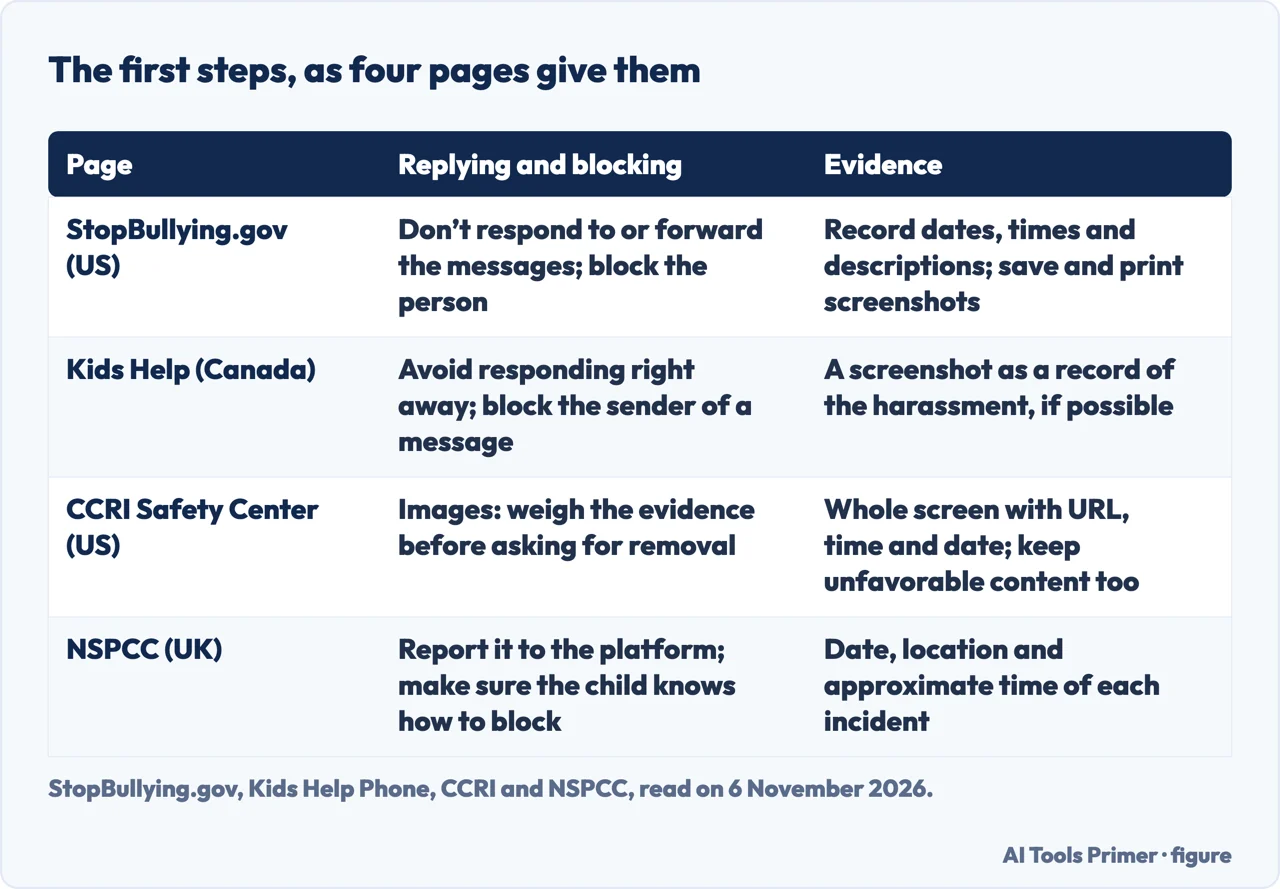
StopBullying.gov, which describes itself as a federal government website managed by the US Department of Health and Human Services, lists three steps to take immediately in its page on reporting cyberbullying, reviewed on 11 December 2024. The first is not to respond to or forward the messages. The second is to keep evidence. The third is to block the person who is cyberbullying. Kids Help Phone, a Canadian service, updated its page on 11 March 2026. It says it can help to take a breath and avoid responding right away, to take a screenshot as a record of the harassment “if possible”, and to block the person who sent a harassing message on a phone or social media.
The two pages do not word the first step the same way. StopBullying.gov says not to respond. Kids Help Phone says to avoid responding right away, and later adds that, if the person feels it is safe, they can message the one cyberbullying privately, say why they are upset and ask for it to stop. Kids Help Phone says people who cyberbully are often motivated by the belief that others will approve or find it funny, and that telling them the behaviour is not OK might motivate them to stop. We report the difference without choosing between them.
The pages written for parents add a different first step. HealthyChildren.org, from the American Academy of Pediatrics (updated 28 January 2022, written by Megan Moreno, MD), says not to threaten to take away a child’s device or cut their time online, because the child may see it as punishment and be less willing to say so about bullying in the future. It points to studies showing that having just one person listen and support a child who has been bullied helps the child handle the situation in a healthy way, and it suggests saving a screenshot of any online evidence. The NSPCC, in the United Kingdom, says to report anyone bullying a child to the platform where it happened.
The pages also describe what they mean. Kids Help Phone says cyberbullying is a type of bullying that uses technology to intimidate, hurt or humiliate someone, and lists cruel or threatening messages, embarrassing photos or videos, websites made to make fun of someone, fake accounts, rumours, harassment in video games and secretly recording someone and sharing it. The NSPCC lists threatening or abusive texts, trolling, exclusion from online games, abusive polls, fake accounts and pressure to send sexual images. For how it differs from bullying in person, Kids Help Phone says it can happen at any time, spread quickly, reach a larger audience and be easier to hide behind technology, and that content is hard to remove for good once it is shared. HealthyChildren.org cites a report from the National Academies concluding that cyberbullying and bullying are more alike than different.
What to keep as evidence
StopBullying.gov says to record the dates, times and descriptions of instances of cyberbullying and to save and print screenshots, emails and text messages. It says to use this evidence to report to web and cell phone service providers and to social media sites. The NSPCC, writing for parents who go to a school, says to bring any evidence, which online might include text messages and screenshots, and to keep a record with as much information as possible: the date, location and approximate time of each incident, and any contact with the school.
The most detailed list on the pages we read is from the Cyber Civil Rights Initiative (CCRI), a United States organisation whose Safety Center says it is primarily intended for adult victims and survivors of image-based sexual abuse. Its step called “Document, Document, Document” says the record matters for anyone who wants a restraining order, who wants to file a complaint with the police or who works with an attorney. It says to take screenshots that capture the entire screen, including the URL, time and date, to download a whole video to a secure drive and to keep printouts as well as the digital copy. It warns that failing to preserve everything, including content the person believes is unfavorable to them, may lead to sanctions or adverse findings by a court. If someone has been hacked, CCRI says the evidence may be better on a thumb drive than on the hard drive, and for someone who lives with an abuser, in a locked, private place.
CCRI also describes a hold letter, a request to a site to keep data. It says intermediaries may not keep data for very long, with some keeping it for only a month or two and others longer, while finding the right attorney or detective may take a while. Its warning on timing is this: if images are removed before legal professionals collect digital forensic data, crucial evidence could be destroyed, so it asks the reader to think about this before asking a site to take images down. That is advice about intimate images. StopBullying.gov lists blocking among its immediate steps, and the pages we read do not say how the two fit together. Kids Help Phone adds only that content is hard to remove permanently once shared.
Who to tell, and when
The platform. StopBullying.gov says cyberbullying often violates the terms of service of online platforms, and links to how to report on YouTube, TikTok, Snapchat, Instagram, Facebook, Discord, X, Twitch, Xbox Party Chat, PlayStation Party Chat and Tumblr. The Cyberbullying Research Center puts reporting first: it calls it crucial to report to the specific app, social media site, gaming network, internet service provider or cell phone service provider involved. Kids Help Phone says to report content on social media as inappropriate and ask for it to be taken down, and points to NeedHelpNow.ca for removing photos and videos. For a video, the NSPCC says social networks are more likely to take it down if the child in it, or their parents, make the report, and that if the identity of other children in the video is known, it is worth thinking about telling the school or the local police. Our page on getting a post taken down on Facebook covers one platform’s menus, and the one on fake profiles covers another case.
The police. StopBullying.gov says cyberbullying involving these activities is considered a crime and should be reported to law enforcement: threats of violence; child pornography or sending sexually explicit messages or photos; taking a photo or video of someone in a place where privacy is expected; stalking and hate crimes. It adds that some states consider other forms of cyberbullying criminal and tells the reader to consult their state’s laws and law enforcement. HealthyChildren.org names a narrower case: if the bullying involves threats of physical harm, a parent can consider reporting to the police. The NSPCC says racial, sexual, transphobic and homophobic bullying, and bullying someone because of a disability, are also hate crimes. Kids Help Phone says that anyone physically threatened, or who feels their safety is in danger, can contact the emergency or community services nearest them right away. Our page on doxxing covers the case where addresses and phone numbers are being published.
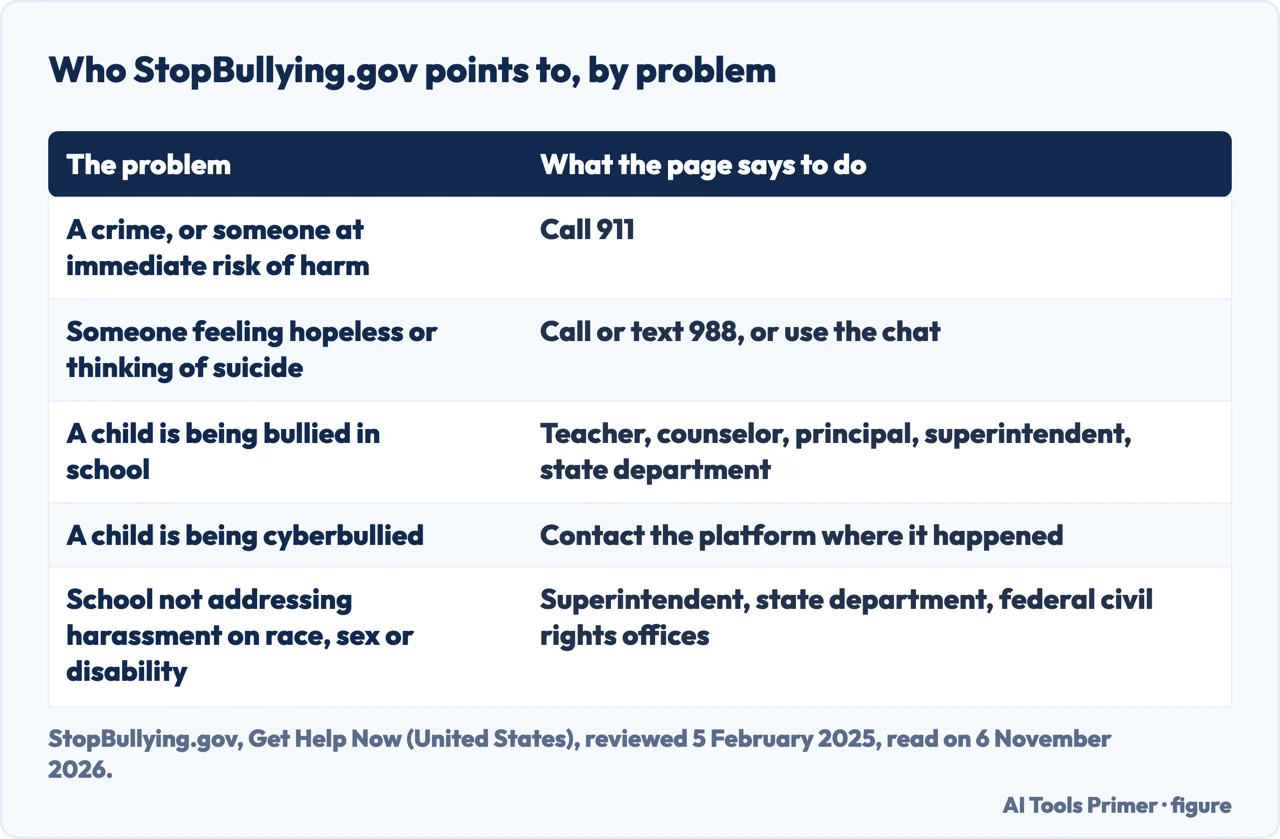
The school. StopBullying.gov says cyberbullying can create a disruptive environment at school and is often related to in-person bullying, and that in many states schools are required to address it in their anti-bullying policy. It adds that some state laws also cover behaviour away from the campus that creates a hostile school environment, and says to check with the state or local education agency. Its Get Help Now page lists, for a child bullied in school, the teacher, the school counselor, the principal, the school superintendent and the State Department of Education. For a school not adequately addressing harassment based on race, color, national origin, sex, disability or religion, it adds the US Department of Education Office for Civil Rights and the US Department of Justice Civil Rights Division. In the United Kingdom, the NSPCC says the first person to contact is the class teacher, form tutor, head of year or house tutor, and suggests asking for the school’s anti-bullying policy, behaviour policy and complaints procedure. If that does not resolve it, it names a letter of complaint to the headteacher, then the chair of governors, then the local education authority or the Department for Education, depending on the type of school.
Help lines, by country
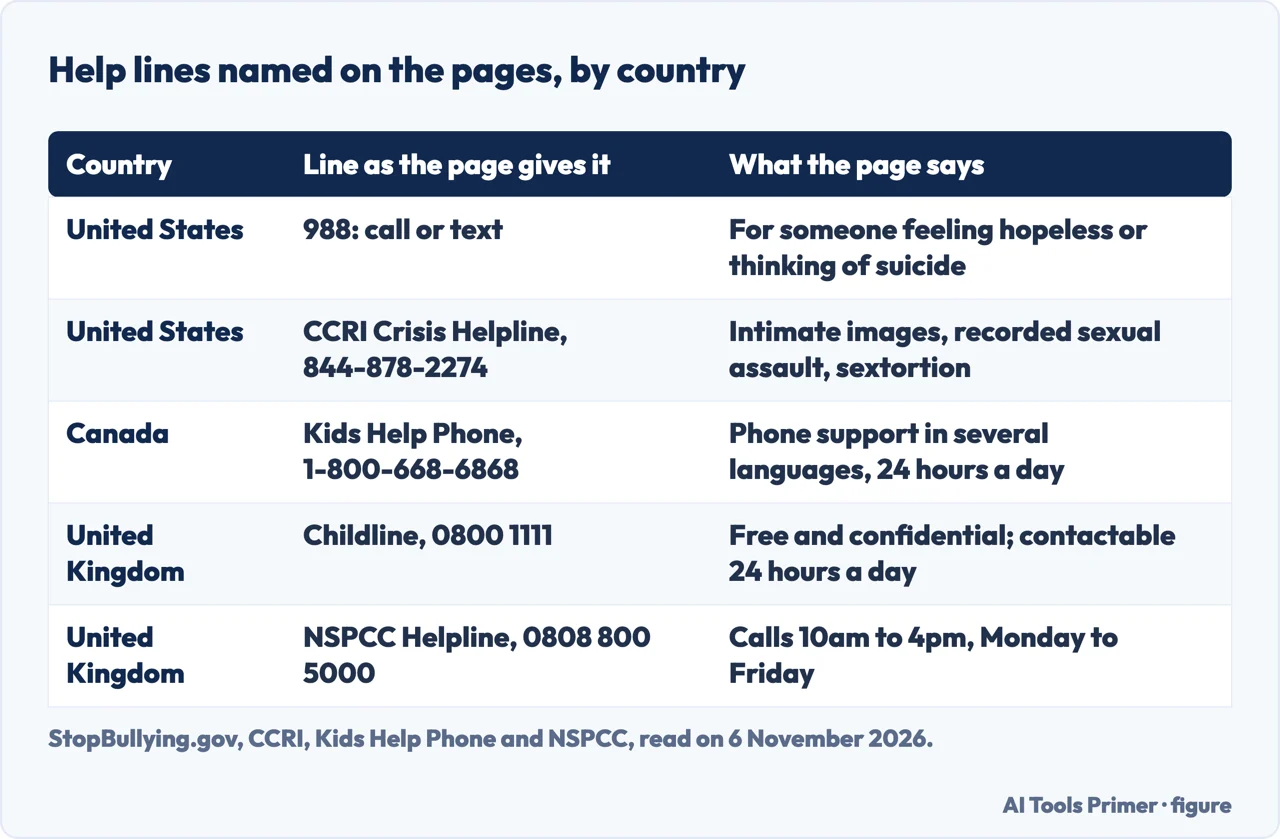
Every line below is given as the page that names it gives it, and the country comes first because the pages tie each line to one country.
United States. StopBullying.gov’s Get Help Now page, reviewed on 5 February 2025, says to call 911 for a crime or when someone is at immediate risk of harm. For someone feeling hopeless or helpless or thinking of suicide it says to call or text 988, or to chat with the Suicide and Crisis Lifeline. It gives Spanish speakers a route (call 988 and press 2, or text AYUDA to 988) and a route for people who are Deaf or hard of hearing (a relay service, or dial 711 and then 988). It says free and confidential support is available 24 hours a day, 7 days a week. For someone acting differently than normal, it points to a local counselor or other mental health services. For intimate images, the CCRI Crisis Helpline is 844-878-2274 for victims of nonconsensual intimate images, recorded sexual assault or sextortion who live in the United States; CCRI says its representatives can give information, support, referrals and non-legal advice, around the clock, with interpretation in most languages. The Cyberbullying Research Center also lists the Games and Online Harassment Hotline, which it describes as text-based emotional support in the US, from 6pm to 10pm Eastern. We did not check that listing at the hotline’s own site.
Canada. Kids Help Phone says to call 1-800-668-6868 or text CONNECT to short code 686868 to reach a trained volunteer crisis responder, and describes phone support in several languages 24 hours a day. For people who identify as Indigenous, it says to message FIRST NATIONS, INUIT or METIS to the same short code to ask for a First Nations, Inuk or Métis crisis responder, if one is available. When we read the page, it said its Peer-to-Peer Community was unavailable. The page says a chat with a professional counsellor runs from 7 p.m. to midnight ET, and a separate Live Chat window says it is available from midnight until 7:00 a.m. (no time zone given); we repeat neither as a rule.
United Kingdom. The NSPCC says Childline can be contacted 24 hours a day and that calls to 0800 1111 are free and confidential; children can also contact it online. For the parents and carers its pages are written for, the NSPCC Helpline is 0808 800 5000, open 10am to 4pm, Monday to Friday, with email contact 11am to 4pm, seven days a week.
Everywhere else. The pages we read do not give lines for other countries, and we have not read pages for them. CCRI says that callers who live outside the United States should look at the International Resources section of its site. The Cyberbullying Research Center also lists Access Now’s Digital Security Helpline for civil society groups, journalists and activists, Online SOS for journalists, and TallPoppy for reputation services; we did not check those either.
Intimate images, and anyone under 18
Where a sexual image is involved, the pages we read point to different places for adults and for people under 18. CCRI says its own information is primarily intended for adults, and that in the United States the National Center for Missing and Exploited Children (NCMEC) is the best source of assistance for minors. Its first step asks whether the person is physically safe and, if they fear for their or their family’s physical safety, says to contact law enforcement right away. It defines image-based sexual abuse as an umbrella term, describes sexually explicit digital forgeries, often called deepfakes, and defines sextortion as the threat to distribute real or synthetic intimate material unless the person complies with demands, such as paying money or sending more images. Our page on sextortion goes through the scam version.
In the United Kingdom, the NSPCC says that a young person under 18 whose sexual image or video has been shared online can use Report Remove, a tool from Childline and the Internet Watch Foundation, to see whether it can be taken down, and that Childline gives support through the process. CCRI describes a separate route for images the person took themselves: it says that someone who took the photos or video themselves owns the copyright, which it says gives the authority to demand removal as a copyright infringement. The pages we read do not say how fast a site acts on such a request.
What the pages do not say, and what we did not use
The pages we read do not say what the police do after a report, or whether a particular act is a crime where the reader lives; StopBullying.gov sends the reader to state laws and local law enforcement. They do not say whether a report to a platform leads to removal or how long it takes. Only CCRI gives a figure for how long data is kept, and only for some intermediaries. They do not give help lines for countries other than the United States, Canada and the United Kingdom. This page is not legal or medical advice, and it is not a substitute for the services it names.
We did not open the pages of the National Children’s Alliance, the Kids Mental Health Foundation or the Megan Meier Foundation that Google listed, or the university checklist in PDF form. The Google AI box was read only at its start and is not a source here. The Cyberbullying Research Center also lists four third-party tools for use on social platforms; we did not assess them and do not recommend them. Its page carries no date we could read.
Where to start
Five ways in.
- “What do I do first?”
- First, what the pages say to do and not to do — first
- “What should I keep?”
- What to keep as evidence — evidence
- “Who do I tell?”
- Who to tell, and when — tell
- “Is there a number to call?”
- Help lines, by country — lines
- “It is an intimate image.”
- Intimate images, and anyone under 18 — images
Getting it taken down
When the harm is already public.
Profiles, posts and threats
When an account, a post or a threat is involved.
Questions people also ask
What can you do to cyberbullying?
StopBullying.gov lists three immediate steps: do not respond to or forward the messages, keep a record of dates, times and descriptions with screenshots, and block the person. It then points to reporting to the platform, to the police if a crime is involved, and to the school. Kids Help Phone adds choosing a support the person trusts.
What can we do to help someone who is being cyberbullied?
HealthyChildren.org suggests talking with the child, not threatening to take away a device, saving a screenshot and reporting to the school. The NSPCC says to bring evidence to the class teacher and to report to the platform. Kids Help Phone suggests choosing a support the person trusts.
What are some ways to stop cyberbullying?
The pages we read do not promise a way to make it stop. They give reporting to the platform, which StopBullying.gov says it often violates the terms of, telling the school, and calling the police if a crime is involved. Kids Help Phone adds that, if it is safe, a private message asking the person to stop might help.
Can police do anything about cyberbullying?
StopBullying.gov says threats of violence, sexually explicit messages or photos, photos taken where privacy is expected, stalking and hate crimes should be reported to law enforcement, and that some states treat other forms as criminal. HealthyChildren.org says to consider it for threats of physical harm. The pages we read do not say what the police do next.
Not covered here. Each statement on this page is traced to the sources listed below, and the quotations were matched word for word against them. The statements come from two StopBullying.gov pages, the Cyberbullying Research Center, Kids Help Phone, HealthyChildren.org, two CCRI pages and two NSPCC pages, all read on 6 November 2026.
The search volume and difficulty behind this page come from an Ubersuggest reading of 5 November 2026, within the 60 days the site normally allows; the difficulty is Ubersuggest’s own figure, not Semrush’s.
Sources
- StopBullying.gov — Report Cyberbullying (reviewed 11 December 2024) — www.stopbullying.gov, read 6 November 2026.
- StopBullying.gov — Get Help Now (reviewed 5 February 2025) — www.stopbullying.gov, read 6 November 2026.
- Cyberbullying Research Center — Get Help — cyberbullying.org, read 6 November 2026.
- Kids Help Phone — Cyberbullying: what it is and ways to address it (Canada, updated 11 March 2026) — kidshelpphone.ca, read 6 November 2026.
- HealthyChildren.org (American Academy of Pediatrics) — Cyberbullying: how to help prevent it (updated 28 January 2022) — www.healthychildren.org, read 6 November 2026.
- Cyber Civil Rights Initiative — CCRI Safety Center — cybercivilrights.org, read 6 November 2026.
- Cyber Civil Rights Initiative — CCRI Crisis Helpline — cybercivilrights.org, read 6 November 2026.
- NSPCC — Bullying and cyberbullying (United Kingdom) — www.nspcc.org.uk, read 6 November 2026.
- NSPCC — Dealing with bullying (United Kingdom) — www.nspcc.org.uk, read 6 November 2026.
Written by Alberto Gulotta
Founder and editor of AI Tools Primer, writing from Palermo, Italy. Thirty-five years of taking computers apart, starting with a Commodore 64 — the long version is on the about page.
Something wrong on this page? Write to aitoolsprimer@gmail.com and it gets fixed.
Written on 6 November 2026.
Independence and limits
No affiliate links and no paid placements anywhere on this site. Nobody pays to appear here, and no company has seen this page before you did.
This is general information, not professional advice. Where a page touches money, health, safety or the law, it names its source and the date it was read — and your situation may still differ. See the privacy page and the cookie policy.