
Images · guide
Face swap apps: your photo, the law and the app stores
By Alberto Gulotta · Updated · 16 min read
A face swap app turns your photo into numbers, and what happens next depends on its own words: Reface says it removes the original within 48 hours, FaceApp says 24 to 48, and a 2021 Reface notice allows three years for biometric data. The FTC, Apple and Google rules concern intimate images; Meta’s page concerns labels on AI content.
| Question | Answer | Where it comes from |
|---|---|---|
| What does the app do with my photo? | Reface says it turns the face into numbers called embeddings, then an encoder and a decoder build the new face | Reface |
| How long is the original kept? | Reface says 48 hours on a page marked with a 2024 copyright and 24 hours in a 2021 post; FaceApp says 24 to 48 hours after the last edit | Reface, FaceApp |
| Is there a federal law? | The FTC enforces the TAKE IT DOWN Act from 19 May 2026: intimate images shared without consent, digital forgeries included, come down within 48 hours of a valid request | FTC |
| Do the app stores have rules? | Apple and Google Play both restrict apps over intimate images made without consent; Meta labels AI content instead | Apple, Google, Meta |
| Do those rules say face swap? | The pages we read do not use the words | FTC, Apple, Google, Meta |
What the app does with your photo
Reface, a face swap app, explains its method on a page called How it works, marked with a 2024 copyright. When you upload a photo, it says, the photo is transformed into numerical codes it calls face embeddings, numbers that represent facial features and are unique for every face. The face then goes through an encoder that turns it into a representation vector, and a matching decoder processes that vector and creates a new face. When you ask for a swap, the model generates the swapped images. In a 2021 post on its blog, Reface describes the same numbers as 512 values that it says are not biometry. A Reface privacy notice of the same year, covered in the next section, has a separate passage on biometric data, but it does not mention embeddings.
The same page describes a second product, AI Avatars, which builds personalized digital avatars from a user’s photos. For that product Reface says the generated result and the trained model are stored for 31 days, so that the next avatar pack takes less time to produce. The page adds that if you ask for another swap within 48 hours, the app reuses the photo and the embeddings it already holds, and that after 48 hours the mobile app reloads the photo and processes it again.
FaceApp turns up in the same searches, so we read its pages too. Its policy describes photo and video editing, and the pages we read do not use the words face swap. We use it here only as a second example of how an editing app describes what happens to a picture in the cloud. Its FAQ says the photos you see in the app are stored only on your device, and that a photo you edit is cached on Google Cloud Platform and Amazon Web Services servers, encrypted with a key stored on the device. Photos that are not edited with its filters are not uploaded, it adds.
What the apps say they keep, and for how long
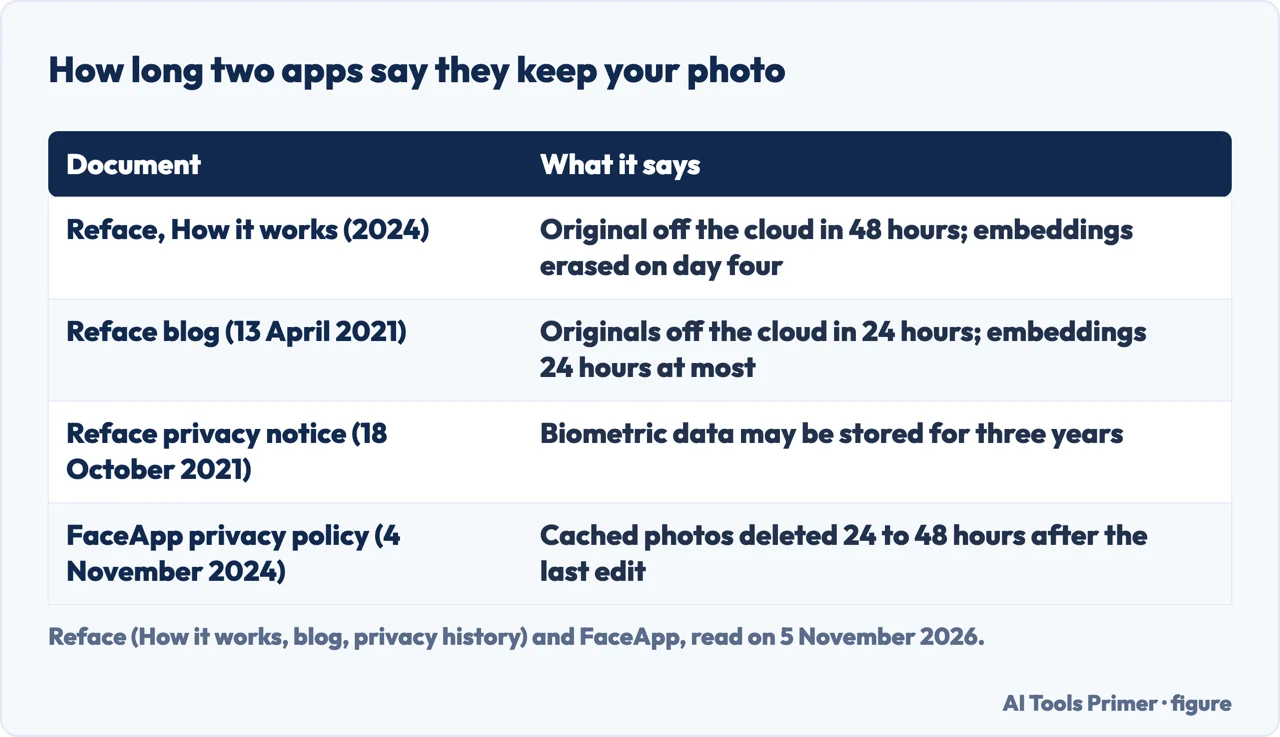
The numbers differ from document to document, and the documents differ in date. Reface’s How it works page says the original photo is removed from its cloud within 48 hours, plus a brief period for server operations. It says the embeddings are no longer available for reuse after 48 hours and are completely erased from the database on the fourth day. Its blog post of 13 April 2021 says the company deletes the data within a maximum of 24 hours, usually keeping it for two, that it shares no photos with third parties and that it will not use a photo for facial recognition. The post puts the originals’ deletion from the cloud at 24 hours as well. That is a 24-hour figure in 2021 and a 48-hour figure on the page that carries a 2024 copyright. We do not know which one describes the app today.
A third Reface document says more. The privacy notice last amended on 18 October 2021, which we read in the company’s privacy history, says that subject to your separate opt-in consent Reface may collect biometric data, including your facial geometry and your voice print, and that you may opt out at any time by contacting the company. The same notice says Reface may store biometric data for three years, and that it may share personal information, except biometric data, with advertising partners. The 2021 blog post calls the embeddings not biometry; the notice of the same year has a section on biometric data. We did not read the notice that is in force today, which the company publishes at a separate address, so we cannot say whether those passages still stand.
FaceApp’s policy, updated on 4 November 2024, says only the photos and videos you select go to the cloud, and that they may remain there for a maximum of 24 to 48 hours after they were last edited. It also says it does not sell personal information and cannot disclose the cached photos because it does not store the encryption keys. To erase earlier, the policy points to a Request cloud data removal button in the Support section of the app’s settings, and the FAQ gives a path of Settings, Privacy & Legal, Delete Cloud Photo Cache. A window of 24 to 48 hours and a window of 48 hours look alike, but FaceApp counts from the last edit and Reface’s page counts from when the embeddings were extracted.
What the federal law says
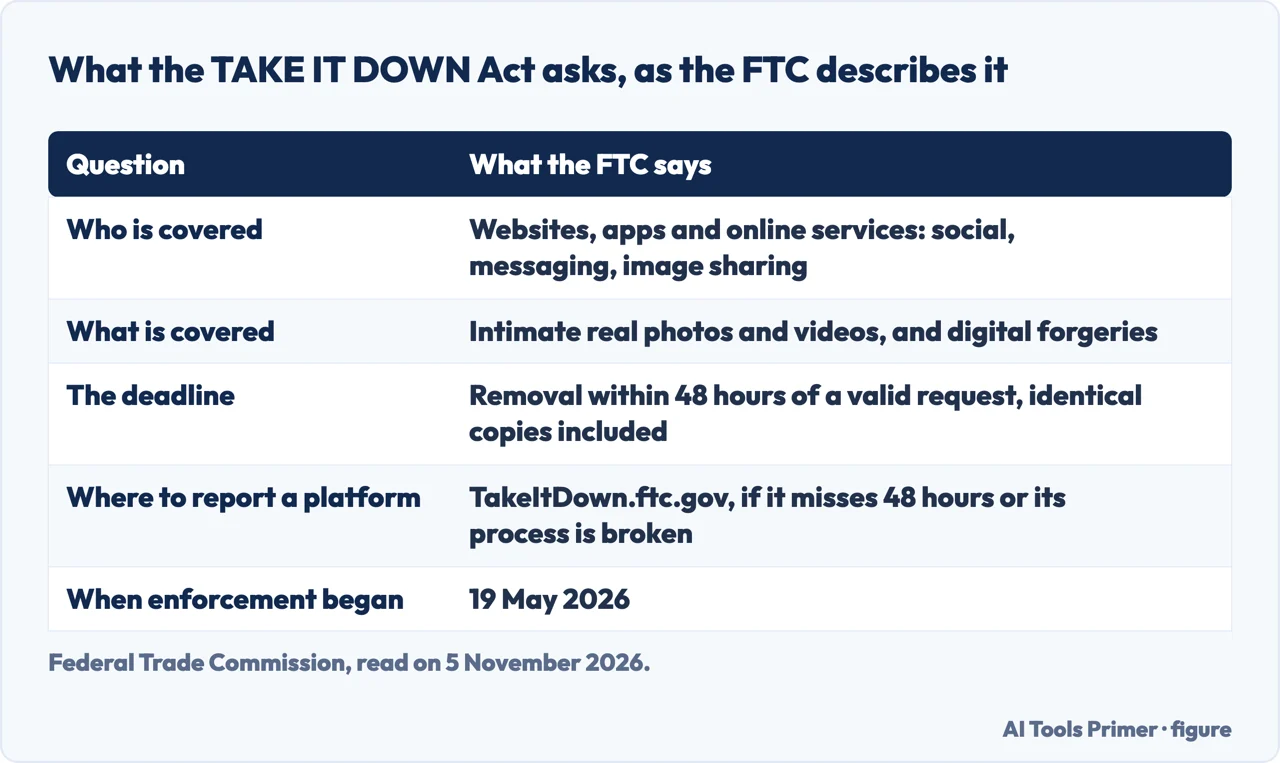
The FTC says President Trump signed the TAKE IT DOWN Act on 19 May 2025 and that the agency began enforcing Section 3 on 19 May 2026. That section requires covered platforms to provide a process for people to ask for the removal of intimate photos or videos shared without their consent. When a platform receives a valid request, the FTC says, it must remove the content and any known identical copies within 48 hours. The FTC describes covered platforms as websites, apps and online services such as social media, messaging, image or video sharing and gaming, and says the protections are not limited to people who hold an account on the platform.
The Act reaches beyond real photographs. The FTC says it covers digital forgeries, which it describes as images of people created or altered with software, an app or artificial intelligence. The FTC describes this in terms of intimate images shared without consent. The pages we read do not say whether a swap that is not intimate needs the consent of the person whose face appears, and they do not mention face swap apps by name. We also did not read the text of the law or the laws of individual states, so this page says nothing about them. The FTC says platforms that violate the law may face enforcement action and civil penalties for each violation; the amount changes, so we leave it out.
For someone who is the victim, the FTC’s consumer alert of 19 May 2026 says that only platforms can remove intimate photos and videos shared without consent, and that the FTC’s job is to check that they comply. You can tell the FTC about a platform that does not remove an image within 48 hours of your request, or whose removal process you cannot find or that is broken. The alert adds that sharing an intimate image of a minor, or of you without your consent, is a crime, and says to report the person to local law enforcement and to the FBI at tips.fbi.gov. In its guide for businesses the FTC suggests hashing to stop removed images from reappearing, and names StopNCII.org for adults and the National Center for Missing and Exploited Children’s Take It Down service for minors. Our page on blackmail with intimate images covers the first hours in more detail.
What the app stores and platforms require
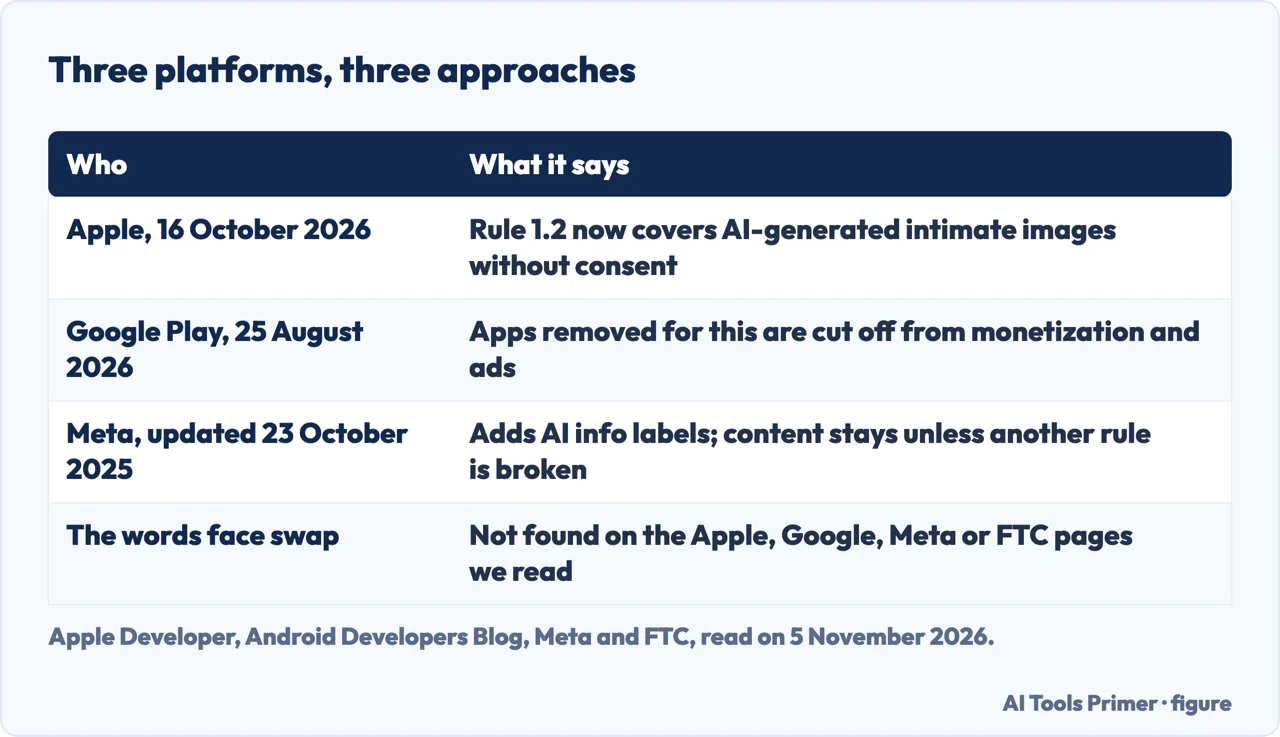
Apple’s App Review Guidelines, rule 1.2, apply to apps that let users create, generate, upload or share content, and the text names social media, user-generated content platforms and AI content creation apps. It lists nonconsensual intimate imagery among the risks, and says such apps must filter objectionable material, provide a way to report offensive content with timely responses, let you block abusive users and publish contact information. In a notice dated 16 October 2026 Apple says rule 1.2 now explicitly covers nonconsensual intimate imagery, including imagery generated with AI tools, as content apps must proactively prevent and remove. Developers who fail to do so, or who do not fix violations after notice, risk removal from the App Store. The same notice also clarifies rule 2.5.19, which concerns apps that misrepresent what they do during review and then change after approval.
Google’s Android Developers Blog, in a post of 25 August 2026, says Google Play’s policies prohibit the facilitation, creation or distribution of non-consensual sexual content. Apps suspended or removed for trying to generate or monetize such content are blocked from monetization and advertising across Google’s platforms. The post asks developers to keep documentation of the safety tests they ran, with special attention to requests such as undressing prompts and deepfake generation, and says an app that advertises nudifying capabilities falls under the Play App Promotion policy even if it does not have them.
Meta takes a different route. Its page on labeling AI content, first published on 5 April 2024 and updated on 23 October 2025, says it adds AI info labels when it detects industry standard indicators or when people disclose that content is AI-generated. For content that was only modified by AI tools, the label moved into the post’s menu. If digitally created or altered media carries a particularly high risk of materially deceiving the public on a matter of importance, Meta says it may add a more prominent label. The content stays online unless it breaks another rule, and the page names voter interference, bullying and harassment and violence and incitement. So Apple writes a rule for apps, Google ties enforcement to money and advertising, and Meta labels. The pages we read do not use the words face swap.
What the documents do not put side by side
Face swap apps are mostly compared in app store listings, product pages and ranked lists written by the vendors, which sort apps by features and price. We did not open those pages, because the question here is what the apps and the rule-makers say in their own pages.
Put the documents we did read next to each other and the gaps are visible. The apps give time limits for their copies of a photo. The FTC, Apple, Google and Meta pages describe intimate images, AI-generated content and labels. The two sets of pages do not meet: the pages we read from the rule-makers do not name face swap apps, and the pages from the apps do not say whether the person in a photo has to agree to the swap. One part of the gap is narrower than it looks: Reface’s 2021 post does answer the worry about fakes made without permission, saying it moderates content, reviews rights-violation reports, lets users report content inside the app, and is imprinting a hidden watermark in its videos while it trains a network to recognise them, with a detection tool it describes as still in progress. That is a gap in what we read, not a finding about what the law requires.
Before you tap download
The pages we read do not tell you which app to choose, and we tested no app. What they do give is a list of things a policy can state, which you can look for in an app’s terms. How long the original photo stays on the company’s servers, and from when the clock starts: Reface gives 48 hours from extraction, FaceApp 24 to 48 hours from the last edit. Whether the company calls face data biometric, and for how long it may keep it: the Reface notice of 2021 says three years. Whether there is a way to delete earlier: FaceApp names a button and a menu path. Whether the company lists a way to reach it: Apple’s rule 1.2 requires published contact information from apps that carry user content.
Reface’s 2021 blog post adds a short list of its own for any app: pay attention to details, search for the app and check its developers before installing, do not give an app permissions that feel wrong to you, and keep your phone’s operating system updated. It also says not to download suspicious apps from uncertified stores. For anyone whose image has been used without consent, the steps are in the section on the federal law above, and our page on metadata in photos explains what else travels inside a picture file when you share it.
What we did not use
We did not read Reface’s current privacy notice or its terms of use, so we say nothing about who owns a swapped picture. Google Play and YouTube help pages were handed to us as a CAPTCHA, so nothing here concerns YouTube’s rules. Google showed no People also ask box for the key face swap app, so the four questions below come from the neighbouring search, are face swap apps safe, read the same day.
Where to start
Five ways in.
- “What happens to my photo?”
- What the app does with your photo — works
- “How long do they keep it?”
- What the apps say they keep — keep
- “Is it legal?”
- What the federal law says — law
- “What do the app stores require?”
- What the app stores and platforms require — stores
- “Which app is best?”
- Before you tap download — before
How the pictures are made
Generators, free limits and AI editing.
Faces and private images
What a picture carries, and what to do when one is misused.
Questions people also ask
Is Faceswap legit?
The pages we read do not rate any app as legit, and we tested none. What they give is each company’s own statement: Reface says it removes originals within 48 hours, FaceApp keeps cached photos 24 to 48 hours after the last edit.
Is Faceswap AI legal?
The FTC says the TAKE IT DOWN Act covers intimate images, real or digital forgeries made with software, an app or AI, shared without consent, with removal within 48 hours. The pages we read do not say whether a swap that is not intimate needs consent.
Is the FaceApp safe to use?
We cannot call it safe or unsafe. Its policy of 4 November 2024 says only the photos you select go to the cloud, encrypted with a key kept on your device, for 24 to 48 hours after the last edit, and it names a button to delete sooner.
What’s the best app for face swapping?
The pages we read do not rank apps. They let you compare what each states: Reface gives 48 hours for the original and a 2021 notice with three years for biometric data; FaceApp gives 24 to 48 hours and a delete button.
Not covered here. We tested no face swap app. The statements come from the FTC, Apple, the Android Developers Blog, Meta, Reface and FaceApp, all read on 5 November 2026; the dates of each document are given where it is used.
The search volume and difficulty behind this page come from an Ubersuggest reading (US, 5 November 2026), whose SEO difficulty is not Semrush’s KD; a Semrush check is still to be made.
Sources
- FTC — Complying With the TAKE IT DOWN Act — www.ftc.gov, read 5 November 2026.
- FTC — TAKE IT DOWN Act enforcement starts now (19 May 2026) — www.ftc.gov, read 5 November 2026.
- FTC Consumer Advice — What will the FTC’s enforcement of the TAKE IT DOWN Act mean for you — consumer.ftc.gov, read 5 November 2026.
- Apple Developer — App Review Guidelines — developer.apple.com, read 5 November 2026.
- Apple Developer — Strengthening App Review Guidelines against nonconsensual intimate imagery (16 October 2026) — developer.apple.com, read 5 November 2026.
- Android Developers Blog — Ensuring Safety in the Generative AI Ecosystem (25 August 2026) — developer.android.com, read 5 November 2026.
- Meta — Our approach to labeling AI-generated content and manipulated media — about.fb.com, read 5 November 2026.
- Reface — How Reface works — reface.ai, read 5 November 2026.
- Reface — Security checklist blog post (13 April 2021) — reface.ai, read 5 November 2026.
- Reface — Privacy policy history (notice amended 18 October 2021) — reface.ai, read 5 November 2026.
- FaceApp — Privacy Policy (4 November 2024) — www.faceapp.com, read 5 November 2026.
- FaceApp — Does FaceApp keep your photos? — www.faceapp.com, read 5 November 2026.
Written by Alberto Gulotta
Founder and editor of AI Tools Primer, writing from Palermo, Italy. Thirty-five years of taking computers apart, starting with a Commodore 64 — the long version is on the about page.
Something wrong on this page? Write to aitoolsprimer@gmail.com and it gets fixed.
Written on 5 November 2026.
Independence and limits
No affiliate links and no paid placements anywhere on this site. Nobody pays to appear here, and no company has seen this page before you did.
This is general information, not professional advice. Where a page touches money, health, safety or the law, it names its source and the date it was read — and your situation may still differ. See the privacy page and the cookie policy.