
Scams · guide
Gift card scam: how it works and what to do after paying
By Alberto Gulotta · Updated · 17 min read
A gift card scam asks you to pay with a gift card and read out the number and PIN on the back. The FTC says only scammers will ask for that. The pages we read differ on what to do after paying: who to call, whether the money can come back, and what to check on cards in the store.
| Question | Answer | Where it comes from |
|---|---|---|
| What is the rule? | A gift card is for a gift, not for a payment: the FTC says only scammers ask you to buy one and read out the numbers | FTC, AARP |
| Why do scammers ask for cards? | AARP says they work like cash; Norton adds that they are hard to trace and not refundable once used | AARP, Norton |
| What if I already paid? | Tell the card company at once and keep a copy of the card and the receipt; the pages differ on who else to call | FTC, AARP, Google, Norton |
| Can I get the money back? | The FTC says it is worth asking; Norton says a refund is not guaranteed; Google says it cannot issue a new card | FTC, Norton, Google |
| Can a card be emptied before I buy it? | AARP says criminals note the numbers on store racks and reseal the cards | AARP, Norton |
The one rule the pages share
The FTC page opens with its rule: only scammers will tell you to buy a gift card, such as a Google Play or Apple card, and give them the numbers off the back of the card. It adds that a real business or government agency will never tell you to buy a gift card to pay them. Its advice on buying puts the same thing shortly: “Gift cards are for gifts.” AARP says it in its own words: only use gift cards for gifts, and never give gift card information to a stranger. Google Play Help puts the rule in terms of its own cards, which it says can only be used to make purchases on Google Play, and tells you never to share the code on the back.
The pages also say why a card is the thing scammers ask for. AARP says the cards work like cash and quotes Melanie McGovern, of the International Association of Better Business Bureaus: “Once the money is gone, it’s gone.” LifeLock by Norton, a company that sells identity protection, lists five reasons: the cards are widely available, need no personal information, are difficult to trace, give the scammer access to the funds within minutes of the code and PIN arriving, and cannot be refunded once redeemed.
AARP and Norton each turn the rule into a test. AARP quotes Jennifer Pitt, of Javelin Strategy & Research, who suggests offering a different way to pay when someone asks for a gift card, such as a credit card that can easily be tracked or refunded, and says that a refusal means a scam. Norton says that someone who will accept only gift cards and not the usual payment methods is “almost certainly” trying to scam you.
How the request goes, in three tactics
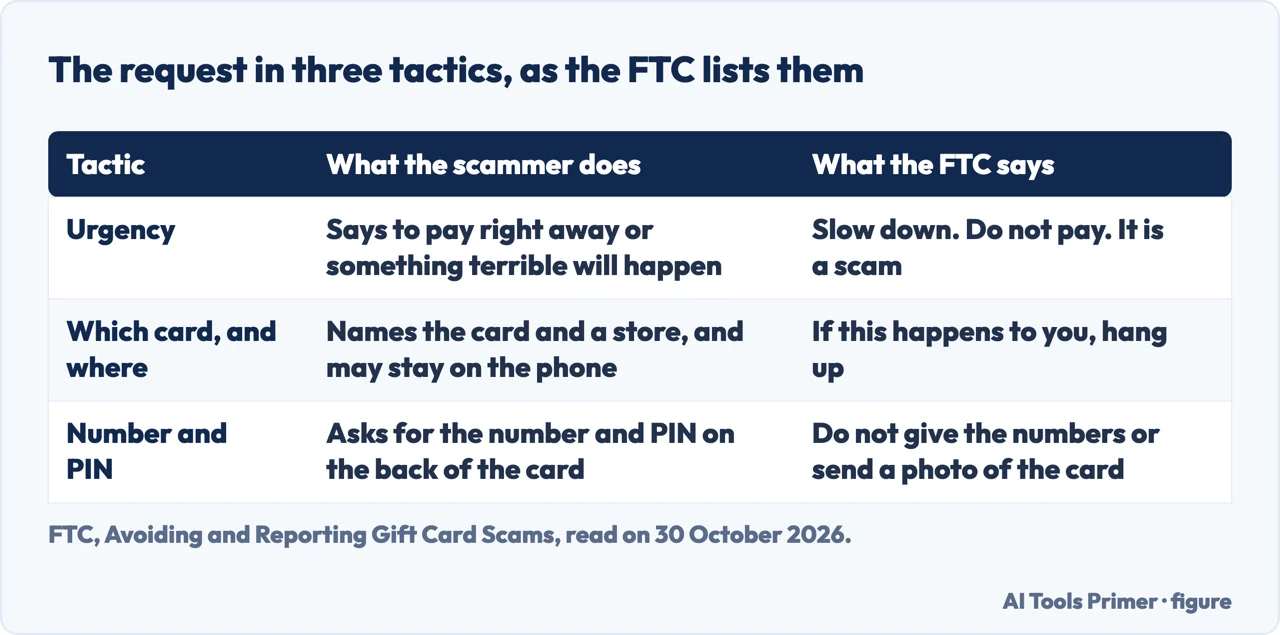
The FTC says gift card scams start with a call, text, email or social media message, and that scammers will say almost anything to get you to buy cards such as Google Play, Apple or Amazon and hand over the card number and PIN. It then names three tactics. The first is urgency: the scammer says to pay right away or something terrible will happen, and does not want you to have time to think or to talk to someone you trust. The FTC’s answer is to slow down and not pay.
The second tactic is telling you which card to buy and where. The FTC says the scammer might name an eBay, Google Play, Target or Apple card, might send you to a particular store, often Walmart, Target, CVS or Walgreens, and sometimes says to buy cards at several stores “so cashiers won’t get suspicious.” AARP repeats that line, attributing it to the FTC. The scammer may also stay on the phone while you go to the store and load money onto the card, and the FTC’s instruction for that case is to hang up. The third tactic is asking for the number and PIN. The FTC says these two let the scammer take the money you loaded even if you still have the card itself, so it says not to give them out and not to send a photo of the card.
Norton lists four signs of its own: urgency, a call or message out of the blue, a refusal of other payment methods, and a request for cards from a specific retailer. It suggests the named store may make the request seem more legitimate and may be meant to avoid stores that limit the value of a card. AARP says criminals tend to favor cards from major retailers such as Apple, Target, eBay, Walmart and Amazon, and that the scammer asks you to read out the serial number and the PIN on the back.
The stories the request arrives in
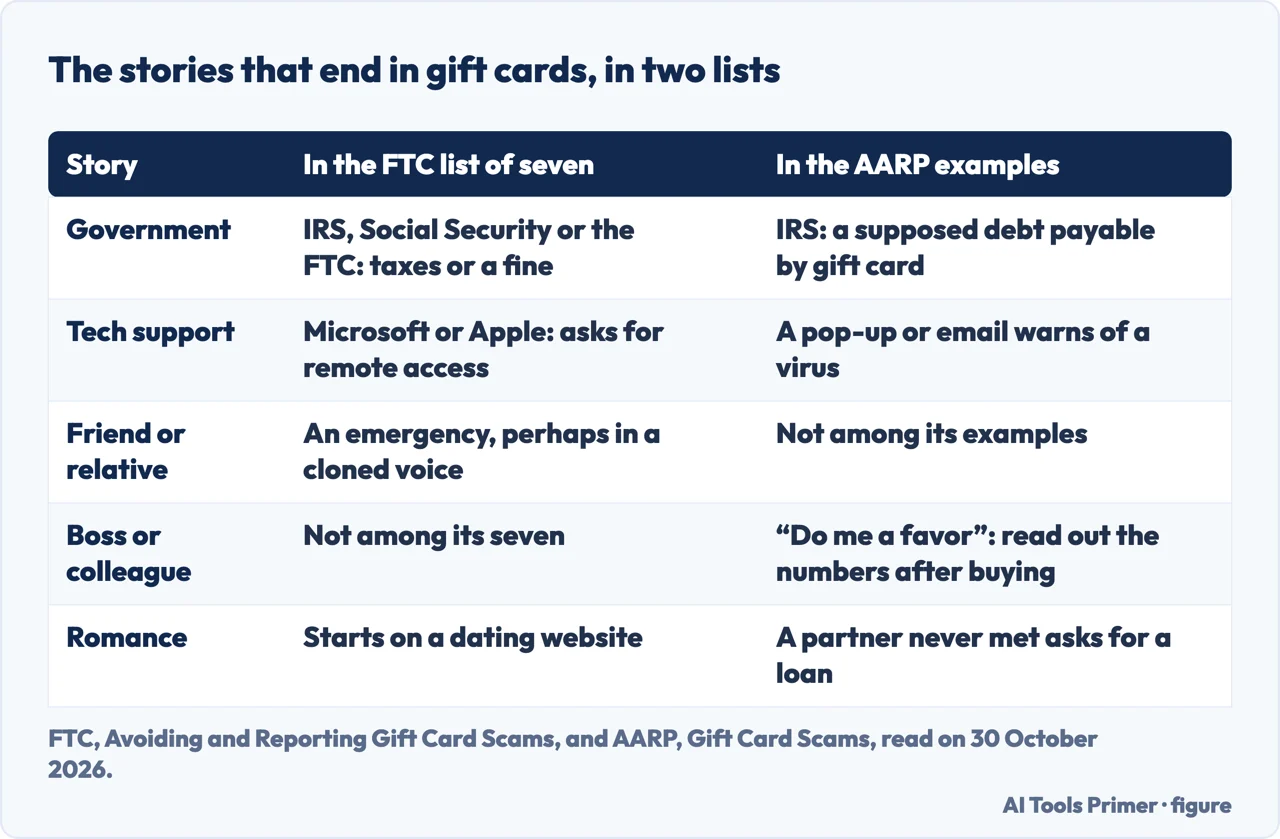
The FTC lists seven. Scammers say they are from the government, such as the IRS, the Social Security Administration or the FTC, and that you owe taxes or a fine; the FTC says government agencies never demand payment by gift card. They say they are from tech support at Microsoft or Apple and ask for remote access. They say they are a friend or family member in an emergency, in a voice that may be cloned, and ask you not to tell anyone. They say you have won a prize but must first pay fees with a card. They say they are from your utility company and threaten to cut off service. They chat you up on a dating website. Or they send a check for much more than you expected and ask you to deposit it and give them the difference on a gift card, which the FTC says will turn out to be a fake check.
AARP’s list overlaps and adds two. It names government impostors, tech support scams that begin with a pop-up or an email, and romance and lottery scams. The two additions are the “do me a favor” request, in which a boss or colleague asks you to buy cards and read out the numbers afterward with a promise to reimburse you later, and online shopping scams, where a seller or a fake shopping website asks for payment in cards and vanishes once it has the number and PIN. Google Play Help gives two examples of its own: a caller from a government agency such as the IRS who says you owe taxes, bail money or a debt, and a supposed family member, attorney or other representative who may discourage you from contacting the relative to check.
Norton adds an overpayment scam, in which a supposed buyer on an online marketplace sends too much money and asks you to return the extra in gift cards. It says the original payment is later reversed or bounces, leaving the seller without the money and without the value of the cards. Our pages on voice scams, romance scams and Microsoft security alert scams cover three of these stories in their own right.
If you already paid: four pages, four lists
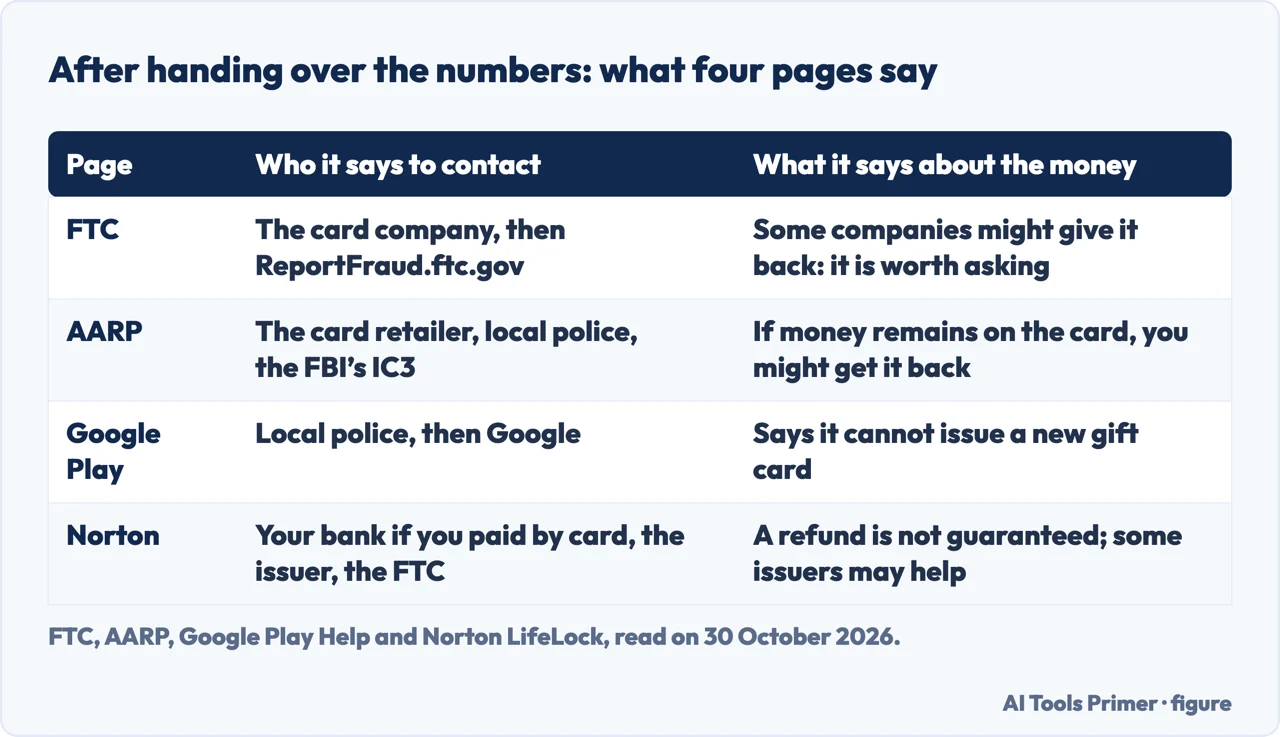
The FTC and AARP start with the company that issued the card, Google Play Help starts with the local police and Norton with the bank if you paid by card, so the order differs. The FTC says to use the card and the store receipt, report the scam to the gift card company right away, and report it however long ago it happened. Next comes asking for your money back, and here the FTC is encouraging without promising: some companies are helping stop gift card scams and might give the money back, and it says asking is worth it. It then tells you to report to ReportFraud.ftc.gov. Its list of how to contact the companies covers Amazon, American Express, Apple and iTunes, Best Buy, eBay, Google Play, MoneyPak, ReloadIt, Sephora, Steam, Target, Vanilla, Visa and Walmart, with a phone number, a form or a chat for each. For Apple and Google Play it says that if the money is still on the card, the company can put a freeze on it. If your card is not on the list, it says to look for contact details on the card itself and, failing that, to report to the FTC.
AARP also starts with the retailer that issued the card, and says that if money remains on it you might be able to get it back. It then adds local law enforcement and the FBI’s Internet Crime Complaint Center, and its own free Fraud Watch Network Helpline. Google Play Help starts with the local police and then Google, with a form for people without a Google Account, and notes that the person who reports must be the person affected. It is also the plainest about money: its cards cannot be resold, exchanged or transferred for value, so it says it will not be able to issue a new card, and they are not redeemable for cash, not reloadable and non-refundable unless required by law.
Norton is the only page we read that tells you to ask your bank whether it can reverse the charge. If you bought the card with a debit or credit card, it says to contact the bank, report the fraud and ask whether the charge can be reversed. It then lists the card issuer, noting that a refund is not guaranteed but some issuers may help, and a report to the FTC, with local police if you gave the scammer personal information. Because scammers may try again, it says to be careful with unknown calls, emails and texts and to consider a fraud alert on your credit report or a credit freeze. Before paying, its advice is to hang up on a caller who demands gift cards and contact the organization directly using a number you trust. The pages we read do not give a deadline after which a refund is no longer possible, and they do not say how many people get their money back. If personal details went along with the card numbers, our page on identity theft gives the steps in order.
The other trick: a card emptied before you buy it
AARP separates two crimes. The first is the one above, where the card is the payment. The second is tampering: criminals take gift cards from store racks, record the account numbers and PINs, reseal the cards and put them back, and the customer who buys one finds the value drained. AARP gives a case from Texas, where the Texas Financial Crimes Intelligence Center arrested four people suspected of draining cards at Walgreens, Dollar Tree and other stores in Texas and Arkansas, and says investigators found “hundreds of tampered gift cards” from a single day of activity. Norton describes a variation, a fake barcode stuck over the real one so that the funds go to the scammer’s account when the cashier scans it.
The pages ask for different checks at the rack. The FTC says to make sure the protective stickers are on the card and the PIN on the back is not showing, to pick a different card if something looks wrong, and to show the tampered card to a cashier or manager. AARP adds checking that the funds are there before leaving the store and making sure each card is scanned at the register, and passes on the signs listed by the Retail Industry Leaders Association: cuts, tears, unusual marks, loose stickers or extra layers on the packaging. Norton lists damaged packaging, scratched or exposed PINs and barcodes that look thicker than usual, and says there is no foolproof way to tell. Only Norton suggests choosing cards from the back or the middle of the rack, which it says are less likely to have been tampered with.
On where to buy, AARP says to buy directly from the business that issued the card and quotes Pitt on not buying from a company that says it specializes in digital gift cards. The FTC says to stick to stores you know and to avoid online auction sites, because the cards may be fake or stolen. Both keep the receipt: the FTC says to photograph the card and the receipt, because the numbers help you file a report. AARP also says six states passed AARP-backed protections this year, covering packaging and display, warnings at the checkout, training for employees and stronger penalties. The pages we read do not say how many of the reports come from tampered cards and how many from payments a scammer demanded.
The figures, and why they are not added together
Two pages give a total, for different years. AARP says that at least $233 million was stolen through gift card-related scams in 2025, according to the FTC, and adds that the real losses are probably higher because many victims do not report. Norton says Americans reported losing $212 million to gift card fraud in 2024. The pages we read do not say whether the two totals were counted the same way, so we have not added them or compared them. Norton also says that 34% of U.S. adults have been targeted by a scam involving a gift card payment, citing one study that its page does not name. The FTC page gives no figures, and its date line reads July 2023. Norton, which sells identity protection, adds that total reported losses to this type of fraud “don’t seem to be slowing down”; the pages we read do not say how that was measured.
What we did not use
We did not use a Wall Street Journal article on gift card scammers, which is behind a paywall, or a Reddit thread. Norton sells identity protection, so we used its page only for what it says about the scams and the steps afterward, and we left out the anecdote it tells about one victim. AARP says the “About Gift Card Scams” section at the top of its page was created with the assistance of generative AI and reviewed by an editor; from that section we use only the sentence that the cards work like cash and the McGovern quote, and we took the figures, the examples and the steps from the body text. We left the phone numbers on the FTC’s list for the FTC to give, because that page carries a date of July 2023.
Where to start
Four ways in.
- “Why is a gift card the thing they ask for?”
- The one rule the pages share — rule
- “How does the request go?”
- How the request goes, in three tactics — script
- “I already paid.”
- If you already paid: four pages, four lists — paid
- “Can a card be emptied in the store?”
- The other trick: a card emptied before you buy it — rack
When the payment is the point
Three stories that end with money sent to a stranger.
The call and the number
The call, the number on the screen and whether to ring back.
Questions people also ask
How does the gift card scammer work?
The FTC says it starts with a call, text, email or social media message and uses three tactics: urgency, naming the card and the store, and asking for the card number and PIN. The scammer may stay on the phone while you load the card, and the FTC says to hang up if that happens.
How to identify a gift card scam?
The FTC says only scammers will tell you to buy a gift card and give them the numbers off the back. Norton lists urgency, an unsolicited call or message, a refusal of other payment methods and a request for cards from a specific retailer. AARP says to offer a credit card and treat a refusal as a scam.
Why is gift card payment a scam?
AARP says the cards work like cash, so once the money is gone it is gone. Norton adds that they need no personal information, are difficult to trace, give the scammer quick access to the funds and are not refundable once redeemed. The FTC says gift cards are for gifts, not for payments.
Can someone steal your info from a gift card?
Norton answers this directly: if you buy from a legitimate retailer and share nothing personal with the scammer, it is unlikely they could steal your data directly, but a link to “register” the card could install malware or phish you. The card’s own number and PIN can be taken: AARP says criminals record them from cards on store racks.
Not covered here. We bought no card and called no number. The statements come from pages of the FTC (dated July 2023), AARP (updated 19 October 2026), Google Play Help and LifeLock by Norton (27 November 2025), all read on 30 October 2026.
The search volume and difficulty behind this page come from a Semrush reading of 29 August 2026, older than the 60 days the site normally allows.
Sources
- Federal Trade Commission — Avoiding and Reporting Gift Card Scams (date line July 2023) — consumer.ftc.gov, read 30 October 2026.
- AARP — Gift Card Scams: How to Avoid Them and Protect Yourself (updated 19 October 2026) — www.aarp.org, read 30 October 2026.
- Google Play Help — What to do if you’re a victim of a Google Play gift card scam — support.google.com, read 30 October 2026.
- LifeLock by Norton — 11 gift card scams and how they work (27 November 2025) — lifelock.norton.com, read 30 October 2026.
Written by Alberto Gulotta
Founder and editor of AI Tools Primer, writing from Palermo, Italy. Thirty-five years of taking computers apart, starting with a Commodore 64 — the long version is on the about page.
Something wrong on this page? Write to aitoolsprimer@gmail.com and it gets fixed.
Written on 30 October 2026.
Independence and limits
No affiliate links and no paid placements anywhere on this site. Nobody pays to appear here, and no company has seen this page before you did.
This is general information, not professional advice. Where a page touches money, health, safety or the law, it names its source and the date it was read — and your situation may still differ. See the privacy page and the cookie policy.