
Temp mail · guide
Free trials: what stops the charge, by the FTC and Hulu
By Alberto Gulotta · Updated · 16 min read
Free trials usually ask for a credit card number, the FTC says, so the company can charge you if you do not cancel before the trial ends. The shortest route is to mark the end date and cancel before it: Hulu says the charge then starts automatically. The CFPB covers stopping payments at the bank.
| Question | Answer | Where it comes from |
|---|---|---|
| Why is a card asked for? | So the company can charge you if you do not cancel before the trial ends | FTC |
| Where do I cancel a Hulu trial? | On the Account page, under Your Account, then Cancel; a confirmation email follows | Hulu Help Center |
| What if I cannot cancel? | The FTC says to call the credit card company and ask it to stop the payments | FTC |
| Can I stop a payment at the bank? | The CFPB says yes, by telling the company and then the bank that you revoked permission | CFPB |
| Does a paused virtual card cancel the trial? | Privacy.com says no: you still follow the company’s cancellation instructions | Privacy.com, a seller |
Why the card number is asked for
The FTC’s consumer advice page puts it in one sentence: for a free trial you usually have to give your credit card number, so that the company can charge you if you do not cancel before the trial ends. It adds that dishonest businesses make cancelling hard and keep charging, even when you no longer want the product or the subscription. The trial is free only up to a date, and the card is how the date turns into a charge. The same page also warns that an automatic renewal can cost more than the last payment, for example when you started on a promotional rate, and advises reading the renewal notice to confirm the amount.
The page has a name for the arrangement. A negative option, it says, is when you are billed automatically for something because you did not say not to bill you, and it is common with free trials and subscriptions. In its words, the business takes your silence as permission to charge you. Its example is a month-long trial of a box of products, followed by automatic monthly shipments until you cancel.
Hulu’s Help Center, in a page dated 15 June 2026, shows the same thing from the seller’s side. Once the free trial ends, it says, you are charged automatically at the current monthly rate of the plan you chose when you signed up, and the subscription renews until you cancel. The FTC page also says that before a business gets your credit card information it has to tell you how to cancel, and that businesses must make cancelling simple. It says this is the law. The FTC announced in March 2026 that it is reviewing its negative option rule, which the last section of this page describes.
What the FTC says to check before you sign up
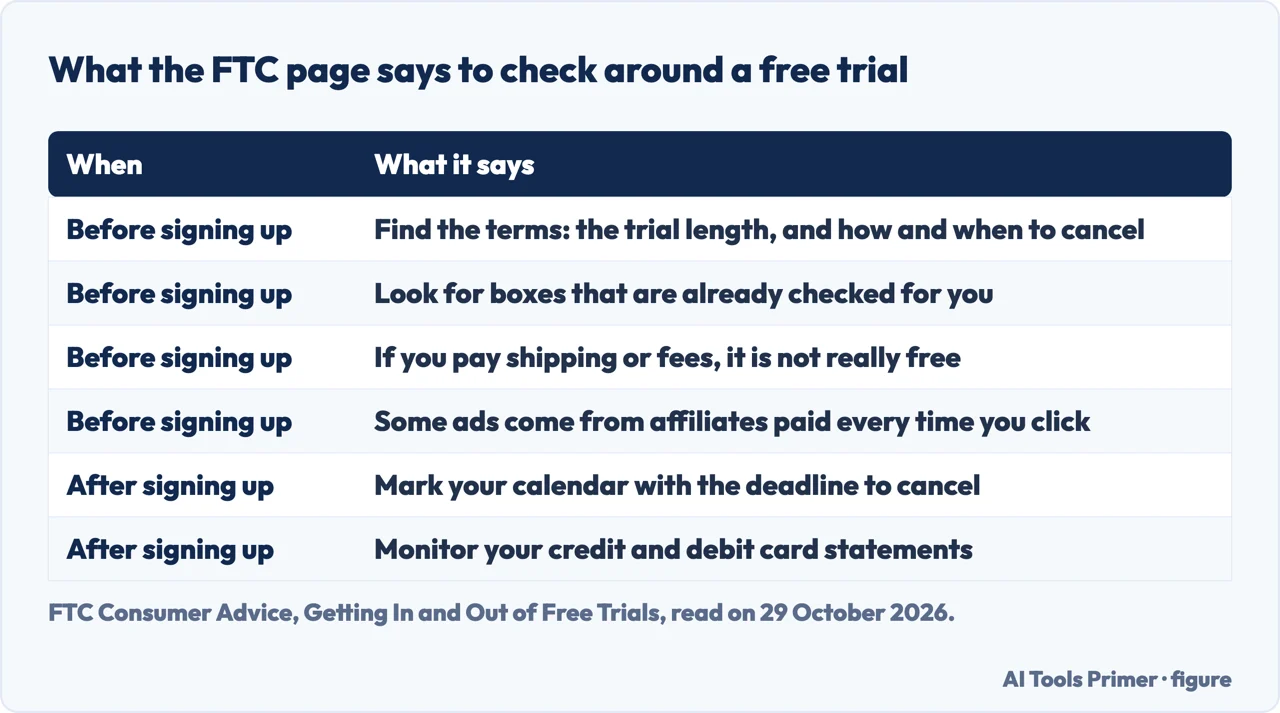
The FTC lists several checks to make before you hand over a card. First, find the terms and conditions of the offer. They should tell you exactly what you are agreeing to, including the length of the trial and how and when to cancel if you do not want to be charged afterwards. If you cannot find that information, or do not understand it, the page says it might be a sign the company will make returns and cancellations difficult, and its advice is not to sign up. It adds that some return and cancellation policies on free trials are so strict that cancelling can be almost impossible. Elsewhere the page gives two rules of thumb: if it is not clear whether the business will keep charging you unless you tell it to stop, assume it will, and if it is not clear how to cancel, walk away. It also asks whether you can skip or change shipments instead of cancelling and whether you have a limited time to respond, and says the company must be clear about these things up front.
Second, look for boxes that are already checked. The page says a checkmark you did not add might give the company permission to keep charging you after the trial, to sign you up for more products you must pay for, or to share your information with others, and it advises unchecking a box you do not agree with.
Third, the word free. The FTC says that if you have to pay shipping or fees to get a “free” trial, it is not really free, and that you may later see higher charges than expected, or charges for products you did not order. Its summary is short: Free means free. A company that says you must pay to get something free is, in the page’s words, at best dishonest and at worst a scammer.
Fourth, the ad itself. The page says companies hire affiliate marketers, who are paid every time you click on their ad, to create many of the ads you see online for free trials, and that some of those ads carry exaggerated claims or misleading information. It suggests researching the company: search its name with the words “scam” or “complaint”, and compare reviews from a wide variety of sources. Our page on cancelling a subscription on an iPhone covers the cancel button for one platform, and it cites the same FTC guide.
The calendar and the cancel button
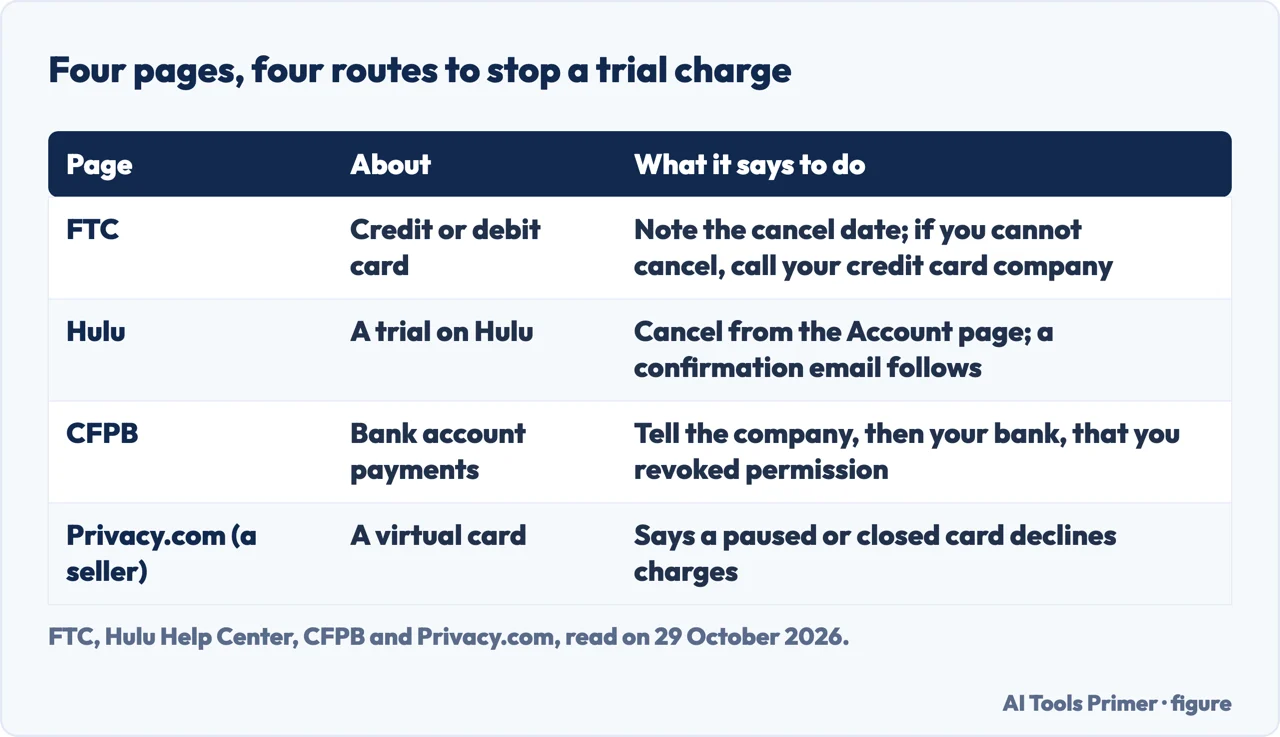
After you sign up, the FTC says to mark your calendar, because the trial has a time limit and once the deadline passes you might be on the hook for more products or services and more payments. It also says to monitor your credit and debit card statements, so you know right away if you are charged for something you did not order. If you cannot cancel, it says to call your credit card company and ask it to stop the payments. The page does not say how many days before the end to cancel.
Hulu’s page gives the steps for its own trials. Trials are available on select services, and Hulu names Hulu + Live TV, Disney+ and ESPN, for new and eligible returning subscribers who have not subscribed to Hulu in the past 12 months. How long a trial lasts depends on the subscription, and Hulu says you can view the end date on your Account page. To cancel during the trial, go to the Account page on a computer or mobile browser, select Cancel under the Your Account section and follow the on-screen instructions. Hulu says you will then receive a confirmation email.
Two cautions on the same Hulu page. Changing your subscription while on a free trial may result in a charge. And if one trial ends before another, or a trial ends before your next regular billing date, Hulu says that in some circumstances you will see a prorated charge, after which your monthly total reflects the plan and add-ons you signed up for. The page describes only Hulu, so these details belong to Hulu’s trials and are not rules for other services. For the equivalent steps elsewhere, see cancelling Xbox Game Pass, cancelling CapCut and cancelling ChatGPT.
What a virtual card limit or pause does, and who says so
Privacy.com is a company that sells virtual cards, so we use its blog post only for what it says about its own product. The post is dated 25 September 2025, and it says its content was sourced in January 2024, so what follows may have changed. It says a virtual card linked to a real funding source masks your actual financial information with temporary card numbers at checkout. It describes two card types, a single-use card that closes after the first transaction and a merchant-locked card that locks to the first merchant you use it at, which it presents as the fit for recurring payments such as subscriptions.
On stopping a subscription, the post makes two claims. Pausing or closing the card is described as handy when you stop a subscription, but with a condition attached: you still have to follow the company’s cancellation instructions, and Privacy will decline all charge attempts on the card. A spending limit, it says, means the merchant cannot charge more than your preset limit, because Privacy blocks all transactions that exceed it. It lists price hikes and double billing as the overcharges a limit can head off. Its Personal plan is free for domestic transactions with 12 virtual cards a month, and it gives Pro at $10 a month and Premium at $25 a month for up to 60 cards a month. Those are the seller’s prices as the post states them, read on 29 October 2026 and not checked on the Privacy.com pricing page.
Now the gap. The FTC, CFPB and Hulu pages we read do not mention virtual cards, so they do not say whether a limit or a pause stops a trial charge, and the Hulu page does not say whether Hulu accepts them. The Hulu page does not mention prepaid cards either. The three kinds of advice also fit three kinds of payment. The FTC speaks of credit and debit cards and of disputing a charge, the CFPB of automatic payments from a bank account, and Privacy.com of pausing a virtual card. Where they meet is a single point: Hulu says an uncancelled trial turns into a charge, the FTC says to cancel on time, and Privacy.com says a paused card does not replace cancelling.
If the charge lands anyway
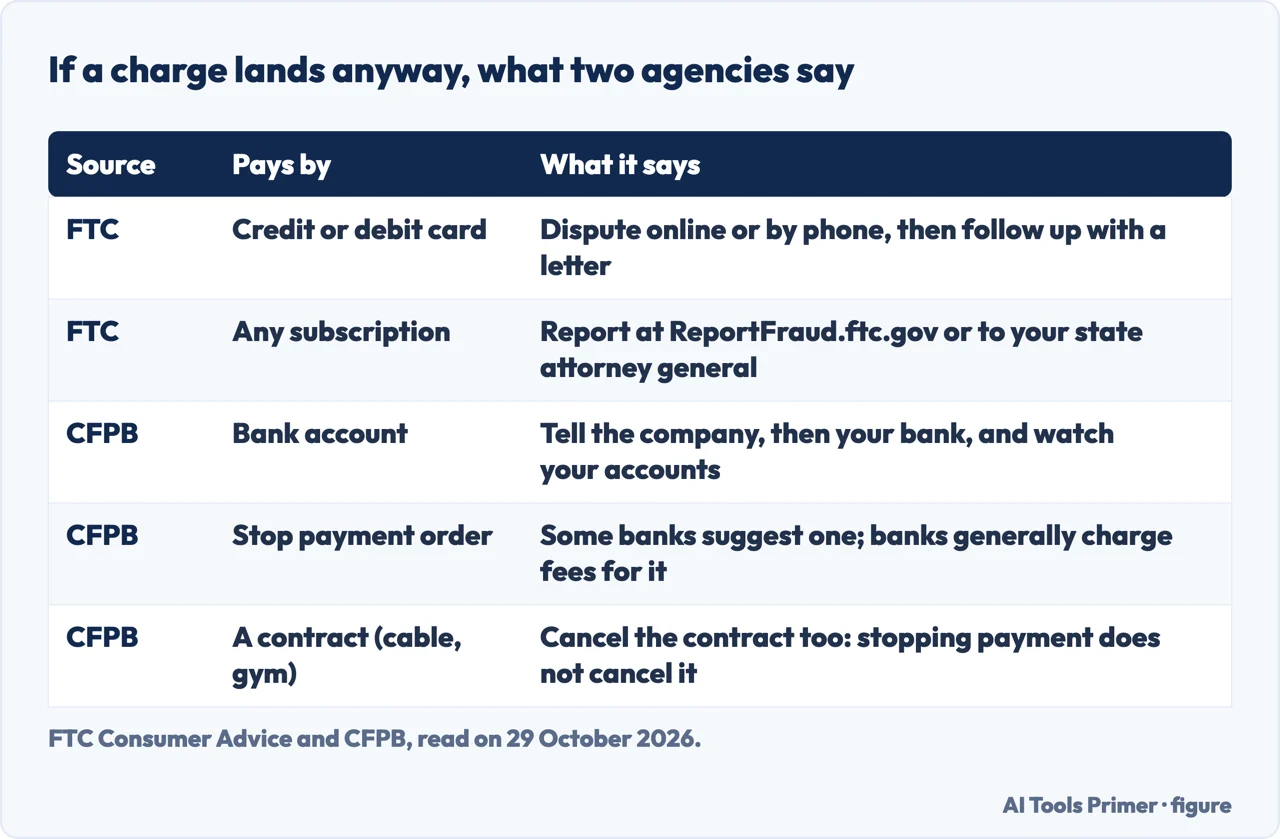
The FTC’s steps for stopping a subscription start with the company: look it up, follow its cancellation instructions if it has them, and keep a copy of your request along with notes of any conversations. Then watch your bank or credit card statements for charges after you cancelled. If the company charged extra or will not stop charging after you told it to cancel, the FTC says to file a dispute, also called a chargeback, with your credit or debit card company. You can do that online by logging in to your card account, or by phone using the number on the back of the card. The page then says to follow up in writing to the address for billing disputes, suggests certified mail with a return receipt so you have proof of what the creditor got, and says to keep your letters, notes and emails.
The CFPB page, reviewed on 28 August 2026, is about automatic payments from a bank account, and it says you have the right to stop them even if you allowed them earlier. Its steps run in order. Call the company and say you are taking away permission, then follow up with a letter or email. Next, call your bank or credit union and say you revoked authorization, and follow up in writing there too. After you have contacted both, it says, further payments initiated by that company would be errors, and you can contact your bank for a refund.
The CFPB adds details the FTC page lacks. Some banks or credit unions might recommend a stop payment order, and banks and credit unions generally charge fees for them. It advises keeping close track of your requests and their dates. It says federal law gives you the right to dispute unauthorized transfers from your account and get your money back, as long as you tell your bank in time. And one line matters for any ongoing service: cancelling an automatic payment does not cancel what you owe. To end an ongoing service you must cancel the contract with the company as well as tell it to stop the automatic payments.
For the report itself, the FTC page says that if you have problems cancelling a subscription, or were charged for one you did not agree to, you can report it at ReportFraud.ftc.gov or to your state attorney general.
What the rules are now
On 11 March 2026 the FTC announced that it is seeking public comment on an advance notice of proposed rulemaking about its Negative Option Rule, which covers prenotification negative option plans. The notice asks the public to weigh in on the current rule, on whether amendments are needed and on alternatives for dealing with deceptive or unfair negative option practices. Among the options it names are retaining the current rule, adopting provisions of the “vacated 2024 Rule” or other provisions, and alternatives to regulation such as educating consumers and businesses.
The announcement says that once the notice is published in the Federal Register, consumers can submit comments electronically for 30 days. The announcement we read does not say which court vacated the 2024 rule or when, so we do not either. We also read no later FTC statement on the outcome of the comment period. What the consumer page says about cancelling therefore sits beside a rule under review, and we cannot say which parts of that advice the review will touch.
One note from this site, not from the sources. The temporary-address pages in our temp mail section hold that an address meant to be thrown away is the wrong one for anything you may need to get back. Hulu says it sends a confirmation email when you cancel a trial, and the pages we read do not say what happens if that address no longer exists.
What we did not use
We tested no trial, no card and no cancellation. The four questions at the foot of this page are our own wording, not taken from a source. Privacy.com mentions Amazon Prime refunds, but we did not read an Amazon page, so we leave that out. The pages we read do not say how many days before the end of a trial to cancel, and they do not say what happens to an account after a declined charge. The CFPB page was read on 29 October 2026 through a browser, because a plain request was refused.
Where to start
Four ways in.
- “How do I cancel before I am charged?”
- The calendar and the cancel button — calendar
- “Can I use a virtual card?”
- What a virtual card limit or pause does — limit
- “What if I forgot?”
- If the charge lands anyway — anyway
- “Is a trial really free?”
- What the FTC says to check before you sign up — before
Where each service puts the cancel button
A phone, a console and a video app, each with its own route.
Accounts and the inbox behind them
A chatbot plan and a public inbox.
Questions people also ask
How do you cancel a free trial before you are charged?
The FTC says to know the terms, mark the deadline on your calendar and cancel before the trial ends. For Hulu, the Help Center says to go to the Account page, select Cancel under Your Account and follow the instructions; a confirmation email follows.
Can you use a virtual card for a free trial?
Privacy.com, a seller of virtual cards, describes using them for subscriptions and says a paused card declines charges, though you still follow the company’s cancellation instructions. The FTC, CFPB and Hulu pages we read do not mention virtual cards.
What happens if you forget to cancel a free trial?
Hulu says you are charged the current monthly rate of your plan once the trial ends, and it renews until you cancel. The FTC says that if you cannot cancel, call your credit card company and ask it to stop payments. The pages we read do not say whether a forgotten trial’s charge counts as unauthorized or will be refunded.
How do you stop a charge after a free trial?
The FTC says to follow the company’s cancellation steps, then dispute the charge with your card company online or by phone. The CFPB says that for a bank account you tell the company and then the bank that you revoked permission.
Not covered here. We tested no trial, card or cancellation. The statements come from the FTC consumer advice page and its March 2026 announcement, the Hulu Help Center, the CFPB and a Privacy.com blog post, all read on 29 October 2026.
The search volume and difficulty behind this page come from a Semrush reading of 29 August 2026, older than the 60 days the site normally allows.
Sources
- FTC Consumer Advice — Getting In and Out of Free Trials, Auto-Renewals, and Negative Option Subscriptions — consumer.ftc.gov, read 29 October 2026.
- FTC — FTC Seeks Public Comment in Response to Advance Notice of Proposed Rulemaking Regarding Negative Option Marketing Practices — www.ftc.gov, read 29 October 2026.
- Hulu Help Center — Free trials on Hulu — help.hulu.com, read 29 October 2026.
- CFPB — How do I stop automatic payments from my bank account? — www.consumerfinance.gov, read 29 October 2026.
- Privacy.com — End the Cycle: How To Cancel Amazon Prime Free Trial — www.privacy.com, read 29 October 2026.
Written by Alberto Gulotta
Founder and editor of AI Tools Primer, writing from Palermo, Italy. Thirty-five years of taking computers apart, starting with a Commodore 64 — the long version is on the about page.
Something wrong on this page? Write to aitoolsprimer@gmail.com and it gets fixed.
Written on 29 October 2026.
Independence and limits
No affiliate links and no paid placements anywhere on this site. Nobody pays to appear here, and no company has seen this page before you did.
This is general information, not professional advice. Where a page touches money, health, safety or the law, it names its source and the date it was read — and your situation may still differ. See the privacy page and the cookie policy.