Study · guide
How to cite ChatGPT in APA and MLA, and what changed in 2025
By Alberto Gulotta · Updated · 18 min read
How to cite ChatGPT depends on the year of the guidance. The older APA and MLA posts on the subject are the 2023 versions, and each says an update was published in 2025. APA now names the company as author; MLA starts with the prompt.
| Question | Answer | Where it comes from |
|---|---|---|
| Which pages are current? | APA’s post of 9 September 2025 and the MLA Style Center’s post of 13 August 2025; the 2023 posts say an update followed | APA Style Blog, MLA Style Center |
| Who is the author in APA? | The company that developed the tool, such as OpenAI | APA Style Blog |
| Who is the author in MLA? | The MLA Style Center does not recommend treating the AI tool as an author | MLA Style Center |
| What about the version? | APA no longer advises a version number by default and asks for the model name if available; MLA puts the model in the Version element | APA Style Blog, MLA Style Center |
| Where does the prompt go? | APA keeps it out of the reference; MLA says the title of the source may include it, if it is not already in the text | APA Style Blog, MLA Style Center |
| Do I have to cite it? | APA says it will usually be necessary to disclose and cite AI used when writing a paper; your instructor’s policy decides what is allowed | APA Style Blog |
The 2023 posts have newer versions
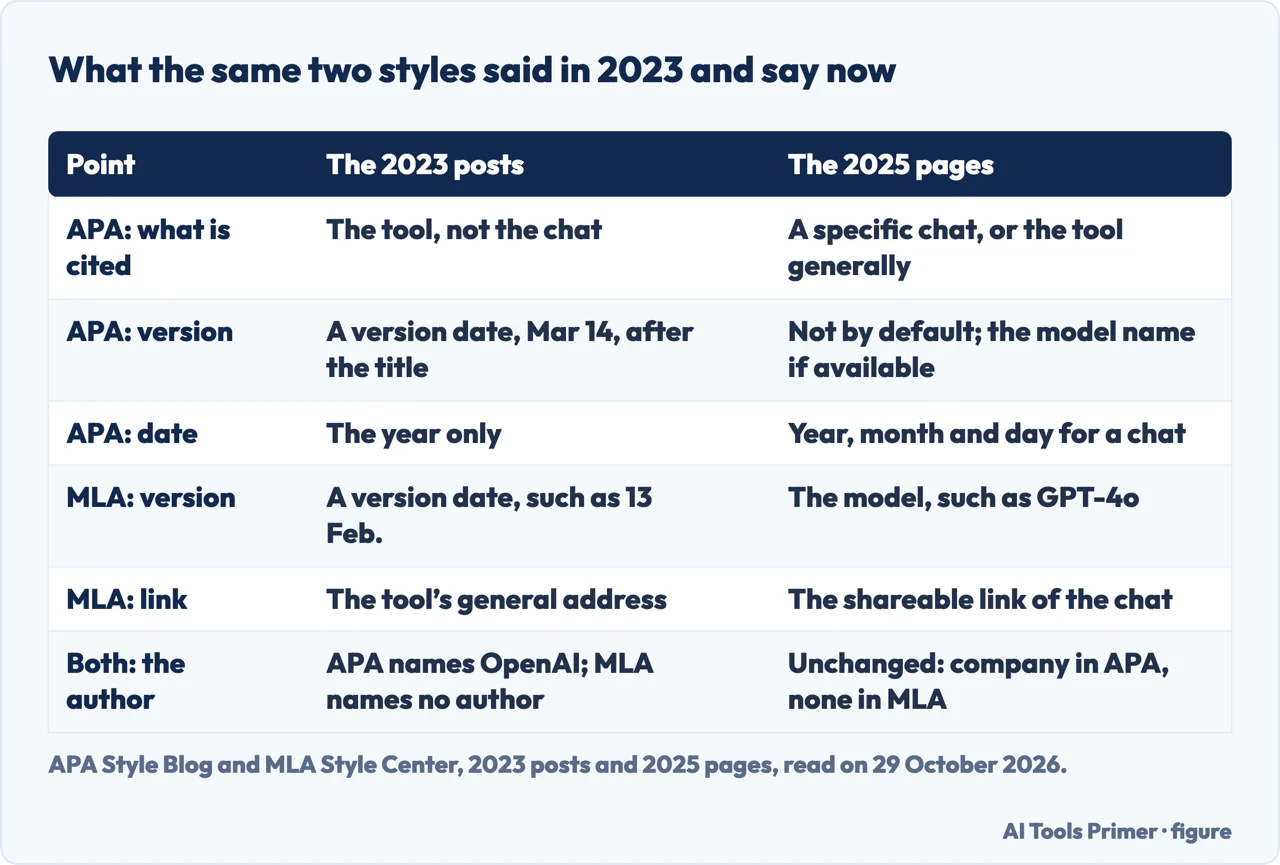
The APA Style Blog has a post titled How to cite ChatGPT, and the MLA Style Center has a post on citing generative AI. Both date from 2023, and both say so at the top. APA’s note says updated guidance for citing generative AI tools was published in September 2025 and that the post is kept for archival purposes only. The MLA Style Center’s note says it published an updated and revised version in August 2025 and sends readers there for its most up-to-date guidance. We read the two newer pages, whose addresses we took from the links on the older ones: the APA Style post of 9 September 2025, which is Part 1 of its advice and covers reference formats, and the MLA Style Center post published on 13 August 2025.
Each newer page explains what moved. In 2023 APA recommended citing only the tool and not the chat, because at the time it was not possible to retrieve and share specific chats. The 2025 post says most AI chat tools, ChatGPT included, now have a sharing option that typically gives a unique URL and a title for each chat. The MLA Style Center’s 2023 post had a note saying ChatGPT did not have a built-in feature to create a unique URL to the conversation, and it named a Chrome extension as an outside tool that could generate one. Its 2025 post says tools like ChatGPT and DALL-E let you share a link by clicking Share link at the top of the chat.
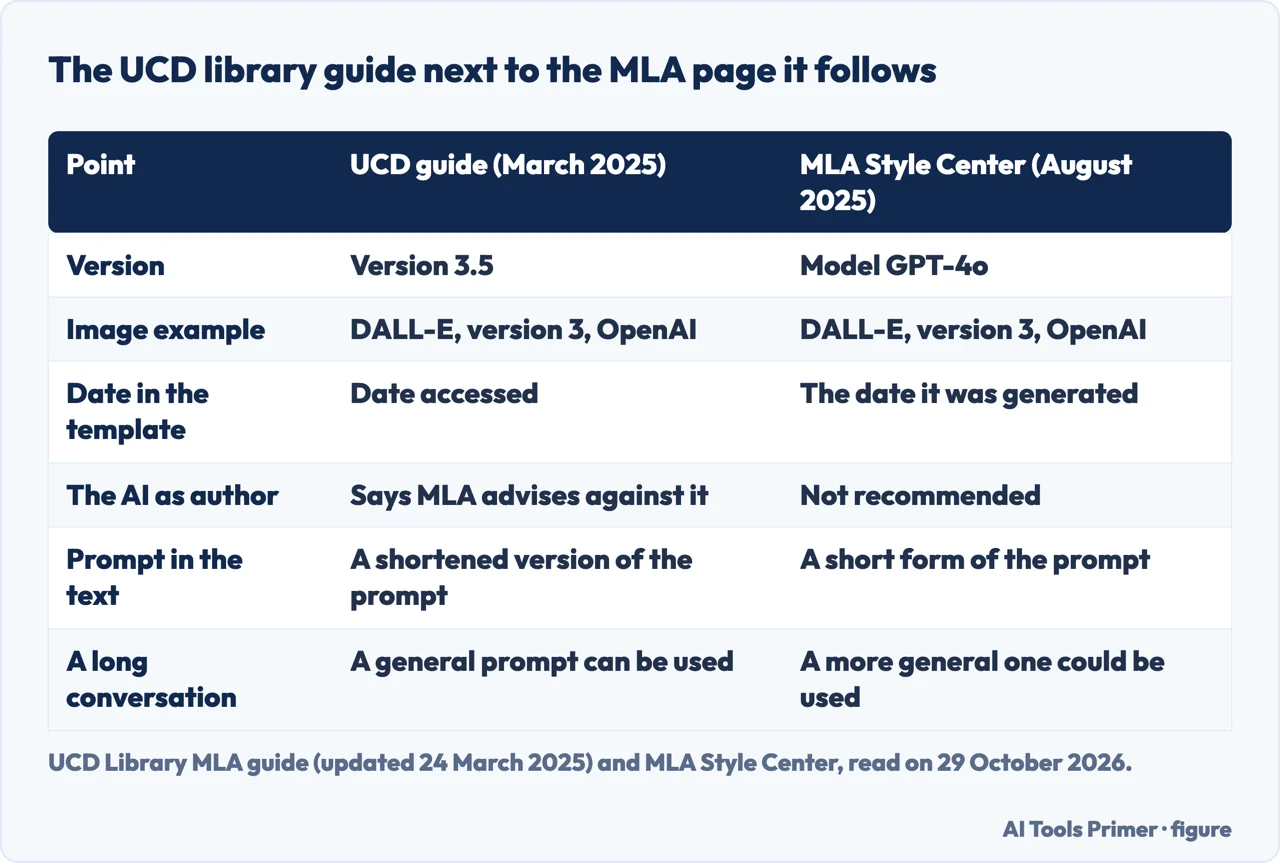
A university library guide shows the older shape. The UCD Library page on citing generative AI in MLA style says it was updated on 24 March 2025, and its ChatGPT example gives version 3.5, the form of the 2023 MLA post, whose examples used a ChatGPT version that carried a version date. The MLA Style Center’s 2025 post asks for the model name or number, such as GPT-4o, in the Version element. The pages we read do not say what to do with a reference list already written under the 2023 rules.
When a citation is needed at all
APA’s 2025 post says that if you used AI when writing your paper, it will usually be necessary to disclose the use and cite the chat or the tool. Its reason is transparency: readers should be able to understand, evaluate and potentially replicate your work. The post points out that APA Style does not require citations to common software such as Microsoft Office and Adobe products, and says AI is treated differently because it is an emerging technology that should be noted. It encourages authors to err on the side of thoroughness and transparency. It also says that submitting AI-generated work as though you did it yourself is still not a good idea and would be academic misconduct for students, and that what is allowed and how it is disclosed depend on instructor, departmental and publisher policies.
The MLA Style Center’s 2023 post lists three things you should do. Cite a generative AI tool whenever you paraphrase, quote or incorporate content it created, whether text, image or data. Acknowledge functional uses, such as editing your prose or translating words, in a note, in your text or in another suitable place. And take care to vet the secondary sources the tool cites. The 2025 post says its guidance has largely remained the same, and for uses that go beyond citation it points to a separate post on acknowledging AI, which we did not read.
The UCD Library guide adds a condition at the start: its advice applies only when your module coordinator or School allows AI tools in an assignment, and an AI tool used in an assignment must be acknowledged. It says that using AI to find sources does not need to be cited, because you cite the source itself, while paraphrasing or quoting ideas or sentences formulated with generative AI does need a citation. The guide credits the MLA Style Center for this; the MLA posts we read make a related point, that you cite the source the AI led you to and not the AI itself.
APA also lists cases where the tool, rather than each chat, is the thing to cite. For editing or refining your own writing, the in-text citation plus a general reference to the tool is enough, and APA does not ask for every draft to be on display. For translating a source to understand it, you cite the original source and not the AI. For tables and figures made with AI, the use goes in the table or figure note.
APA: the company is the author, and you choose a chat or the tool
APA’s 2025 post gives two forms. For a specific chat it follows the usual author, date, title, source order:
AI Company Name. (year, month day). Title of chat [Description, such as Generative AI chat]. Tool Name/Model. URL of the chat
The post says to include a reference and an in-text citation for a specific chat foremost when it helps readers. Its ChatGPT example reads: OpenAI. (2025, August 21). High school grammar concepts [Generative AI chat]. ChatGPT. https://chatgpt.com/share/68a77b60-0ee4-800c-9acc-cd3fd573c311 That is the company as author, the day of the chat, the chat title in italics, the bracketed description, the tool name and the link to the shared chat. In the text the form is (OpenAI, 2025), or OpenAI (2025) when the company is part of the sentence.
- Author. The company responsible for developing the tool. APA says AI itself cannot be an author because it is not a living, conscious human who can give consent and take on the responsibilities of authorship.
- Date. The year, month and day on which the chat occurred or concluded.
- Title. The title of the chat in italic sentence case, followed by a bracketed description you can adapt. Because users can edit the title of a chat in most AI tools, APA suggests editing it into something descriptive before you create the reference.
- Source. The name of the tool, either general (ChatGPT, Gemini) or the model (ChatGPT-5, Gemini 2.5 Flash), then the URL of the chat.
One caution about the link: APA says that anyone with a shared URL can continue the chat, but in the tools it tested the continued conversation did not seem to be saved for anyone except the person who continued it, so other readers see only the original conversation.
For the tool in general, APA uses its software template:
AI Company Name. (year). Tool Name/Model [Description; e.g., Large language model]. URL of the tool
APA says to cite the tool generally when citing a specific chat would be unhelpful, unethical or otherwise inappropriate, or when you want to point to the tool without citing specific information from it. Its example is OpenAI, 2025, ChatGPT in italics, [Large language model] and the tool’s address. The date is the year the tool was most recently updated, and APA says to ask the AI if you are unsure; if the tool shows no date, it says to use the copyright date of the website or app. The description Large language model is usually correct for chat tools, though others are possible. The source is only the URL, because author and publisher are the same and APA names that company once. For the Method section, APA’s sample sentence says the writer used ChatGPT, cited as OpenAI 2025, to edit the paper and give feedback on clarity and flow.
Prompts stay out of the reference. APA gives four reasons: a prompt does not fit author, date, title or source; it does not help readers retrieve the work; it is hard to report fully in one reference when a writer refines it several times; and it would likely be too long. The reference is for the chat, not the prompts. You should document prompts for your own records and, where it helps readers, describe them in the text or put them in an appendix or supplemental material, a decision APA says to make with your editor or instructor.
On versions, APA no longer advises a version number in every AI reference by default. It asks for the model name if it is available, and says using only the name of the tool is also acceptable. It states that ChatGPT no longer specifies version numbers, so a ChatGPT reference uses ChatGPT or ChatGPT-5. If an AI does show a version, APA says it goes in parentheses, not italics, after the tool name or model.
MLA: the prompt does the work of the title
The MLA Style Center’s 2025 post does not recommend treating the AI tool as an author, and says this follows policies developed by publishers, including Cambridge University Press, the partner publisher of the MLA’s journal PMLA. It then fills the usual core elements:
- Title of source. Describe what the AI tool generated, which may include information about the prompt if you have not given it in the text.
- Title of container. The name of the tool, such as ChatGPT.
- Version. The model or model version, named as specifically as possible; the post’s examples use the GPT-4o model of ChatGPT.
- Publisher. The company that made the tool.
- Date. The date the content was generated.
- Location. The stable, shareable URL for the generated content. If the tool does not provide one, the general URL of the tool.
The post’s first example paraphrases a ChatGPT answer about the theme of nature in Mansfield Park. The works-cited entry reads: “Describe the theme of nature in Jane Austen’s Mansfield Park” prompt. ChatGPT, model GPT-4o, OpenAI, 23 Sept. 2024, chatgpt.com/share/66f1b0a0-d704-8000-be9a-85f53c850607. It opens with the prompt in quotation marks and the word prompt, then the tool, the model, the company, the date generated and the link of the shared chat. In the text, a short form of the prompt goes in parentheses; the example uses the first three words. The post adds that a more general prompt could be used in the entry, since you are describing something that mimics a conversation which may have had several prompts along the way.
For an AI-generated image, the post says to write a caption following section 1.7 of the MLA Handbook: a description of the prompt, then the tool, the model name or version and the date created. Its DALL-E example gives version 3, OpenAI and a date of 23 Sept. 2024, and the same information can go into a works-cited entry instead. For a poem or other creative text the choice depends on whether you gave it a title: if you asked for a free verse poem titled “The Oak Tree”, that title opens the entry, and if the work has no title, part or all of its first line goes into the title element.
The last example concerns sources the AI itself cites. The 2025 post uses a Copilot answer, now the name for what had been Bing AI, and says that to cite a highlighted claim you click through to the cited source, here a Britannica page, and use that as the source you cite. Its reason is that AI tools can hallucinate, or make up, sources or incorrectly summarize the content they do reference, so it recommends consulting and citing the sources the AI links to instead of the AI response.
Side by side: where APA and MLA part ways
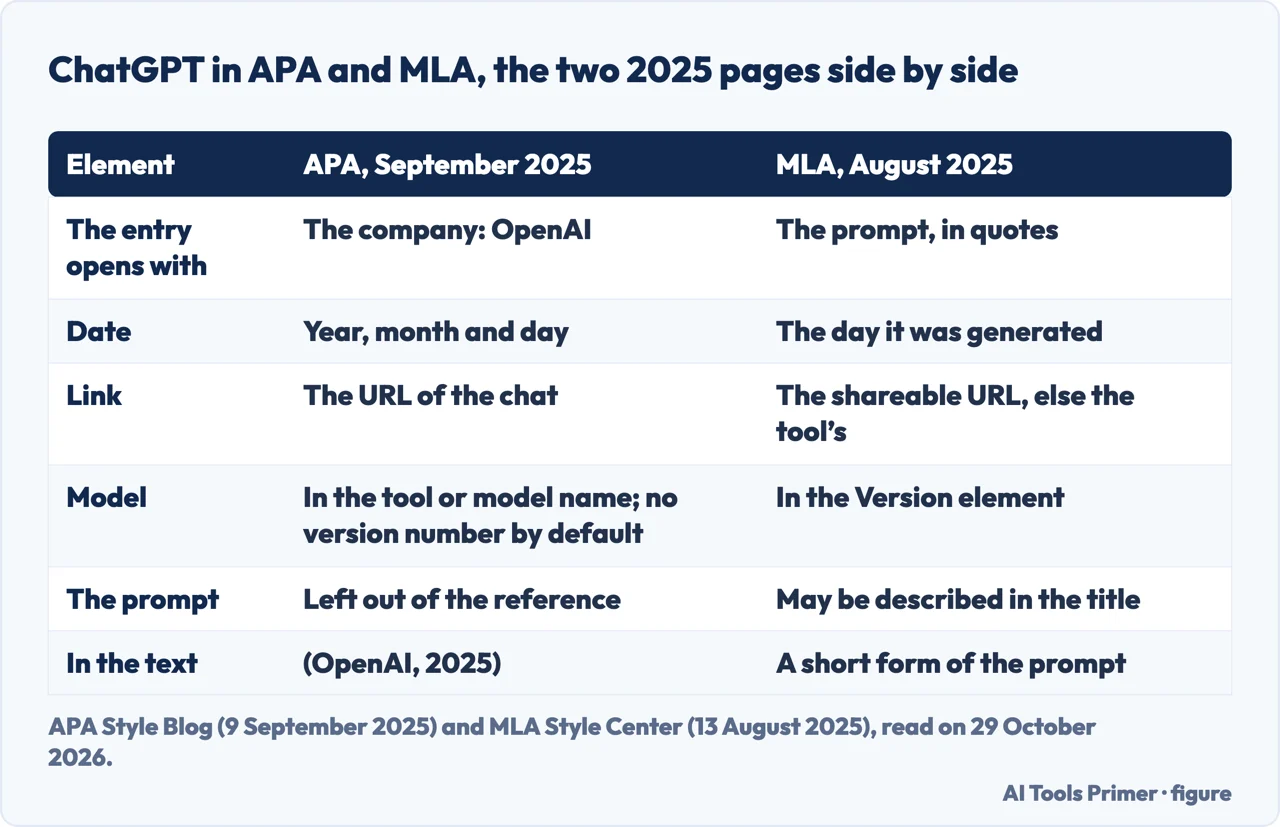
The MLA Style Center prefers the shared link of the chat, and APA’s form for a specific chat ends with the chat URL. APA names the company that built the tool as author, while the MLA Style Center does not recommend treating the tool as an author and its first example begins with the prompt. The differences are in the table above and come down to a few choices. APA dates the chat to the day and MLA gives the day the content was generated. APA leaves the prompt out of the reference and describes it in the paper if useful, while the MLA Style Center says the title of the source may include information about the prompt if you have not given it in the text. APA asks for the tool or model name in the source element, while MLA gives the model its own element, Version.
For a tool cited in general, the two diverge less in form than in fallback: APA gives the URL of the product, and MLA falls back to the tool’s general URL when a stable shareable link is not available. If your instructor names another style, this page cannot tell you how it works: the Chicago Manual of Style page Google listed returned a sign-in page when we opened it, so we have nothing to report on it. Our own pages cover APA, MLA and Chicago in general.
What the AI tells you about its own sources
All three kinds of page warn about the references an AI produces. In its 2023 post, the APA writer asked ChatGPT for a list of sources to support what it had said about the two halves of the brain. It returned five references; four could be found online. The fifth did not seem to be a real article: the digital object identifier it gave belonged to a different article, and the writer could not find any article with the authors, date, title and source details ChatGPT gave. APA’s suggestion was that authors using such tools for research consider this scrutiny of the primary sources a standard process, and that if the sources are real, accurate and relevant, it may be better to read the originals.
The UCD Library guide says generative AI often provides citations and sources that do not exist or are inaccurate, and that the user must check all such references. The MLA Style Center’s 2025 post makes the same point in its advice to cite the source the AI links to, and not the AI response. Related, APA’s 2025 post says to keep your prompts for your own records, the way a researcher keeps a data set, and to share them with readers only where that helps.
What we did not read
We tested no share link and cited nothing with ChatGPT ourselves. We read the APA and MLA posts and their 2025 updates. We did not open the five library guides and FAQs on the list, from Purdue, CMCC, ERAU, SNHU and Bemidji. The Chicago page returned a sign-in page. The APA 2025 post links to more posts, on AI as a search engine and on whether AI is allowed in APA Style, and the MLA 2025 post links to posts on acknowledging AI and on Google’s AI Overviews; we did not open those posts. The Google AI box was read only in part and is not used as a source here. The UCD guide is a university library page, so we treat it as a secondary source that follows the MLA Style Center.
Where to start
Four ways in.
- Is it necessary to cite ChatGPT?
- When a citation is needed at all — when
- How do I cite AI in APA format?
- APA: the company is the author — apa
- How do I cite ChatGPT in MLA format?
- MLA: the prompt does the work of the title — mla
- “Which page is the current one?”
- The 2023 posts have newer versions — versions
The styles themselves
What APA, MLA and Chicago ask for, apart from AI.
Other sources to cite
A video, a website and the list at the end.
Questions people also ask
Is it necessary to cite ChatGPT?
APA says that if you used AI when writing your paper, it will usually be necessary to disclose the use and cite the chat or the tool. The MLA Style Center’s 2023 post says to cite a generative AI tool whenever you paraphrase, quote or incorporate content it created. APA adds that instructor policies matter.
How do I cite AI in APA format?
For a specific chat, APA gives the company as author, then the year, month and day, the chat title in italics with a bracketed description, the tool or model name and the chat URL. For the tool in general it gives the company, the year, the tool name in italics with [Large language model] and the tool’s URL.
How do I cite ChatGPT in MLA format?
The MLA Style Center does not recommend treating the tool as an author. The entry describes what was generated, often with the prompt, then names the tool as container, the model in the Version element, the company as publisher, the date generated and the shareable URL.
Does ChatGPT reference correctly?
Not always, according to the pages we read. APA’s 2023 post describes one list of five references from ChatGPT in which the fifth did not seem to be a real article, and the MLA Style Center says AI tools can make up sources or summarize them incorrectly. The UCD guide says to check every reference.
Not covered here. We tested no share link and cited nothing with ChatGPT ourselves. The statements come from two APA Style Blog posts, two MLA Style Center posts and a UCD Library guide, all read on 29 October 2026.
The search volume and difficulty behind this page come from a Semrush reading of 29 August 2026, older than the 60 days the site normally allows.
Sources
- APA Style Blog — Citing generative AI in APA Style: Part 1, Reference formats (9 September 2025) — apastyle.apa.org, read 29 October 2026.
- APA Style Blog — How to cite ChatGPT (2023, kept for archival purposes) — apastyle.apa.org, read 29 October 2026.
- MLA Style Center — How do I cite generative AI in MLA style? (Updated and Revised, 13 August 2025) — style.mla.org, read 29 October 2026.
- MLA Style Center — How do I cite generative AI in MLA style? (17 March 2023) — style.mla.org, read 29 October 2026.
- UCD Library — MLA Style Guide: Generative AI — libguides.ucd.ie, read 29 October 2026.
Written by Alberto Gulotta
Founder and editor of AI Tools Primer, writing from Palermo, Italy. Thirty-five years of taking computers apart, starting with a Commodore 64 — the long version is on the about page.
Something wrong on this page? Write to aitoolsprimer@gmail.com and it gets fixed.
Written on 29 October 2026.
Independence and limits
No affiliate links and no paid placements anywhere on this site. Nobody pays to appear here, and no company has seen this page before you did.
This is general information, not professional advice. Where a page touches money, health, safety or the law, it names its source and the date it was read — and your situation may still differ. See the privacy page and the cookie policy.