
Study · guide
Handwriting vs typing: the EEG study, the notes and the tablet
By Alberto Gulotta · Updated · 16 min read
Handwriting vs typing is argued in headlines and settled in fewer places than they suggest. A 2024 EEG study of 36 students found more brain connectivity when writing by hand, while a 2021 replication on lecture notes found small, nonsignificant differences. A 2025 review, a neurologist's note and Apple's tablet pages add the rest.
| Question | Answer | Where it comes from |
|---|---|---|
| Does writing by hand show more brain connectivity? | In one EEG study of 36 students, yes, for single words written in cursive on a screen against one-finger typing | Frontiers in Psychology |
| Does it raise quiz scores on lecture notes? | A 2021 replication found small, nonsignificant differences; a 2026 summary still calls the 2014 study a landmark | APS Observer, Edutopia |
| Is a stylus the same as paper? | A 2025 review says a stylus reduces tactile resistance and asks studies to say which they used | Review in Life (PMC) |
| What does a neurologist say? | Replication studies have produced mixed results, and typing can be the only option when handwriting is painful | Henry Ford Health |
| Which is faster? | Edutopia reports a keyboard about 55 percent faster in a 2011 study | Edutopia |
The EEG study behind the headlines
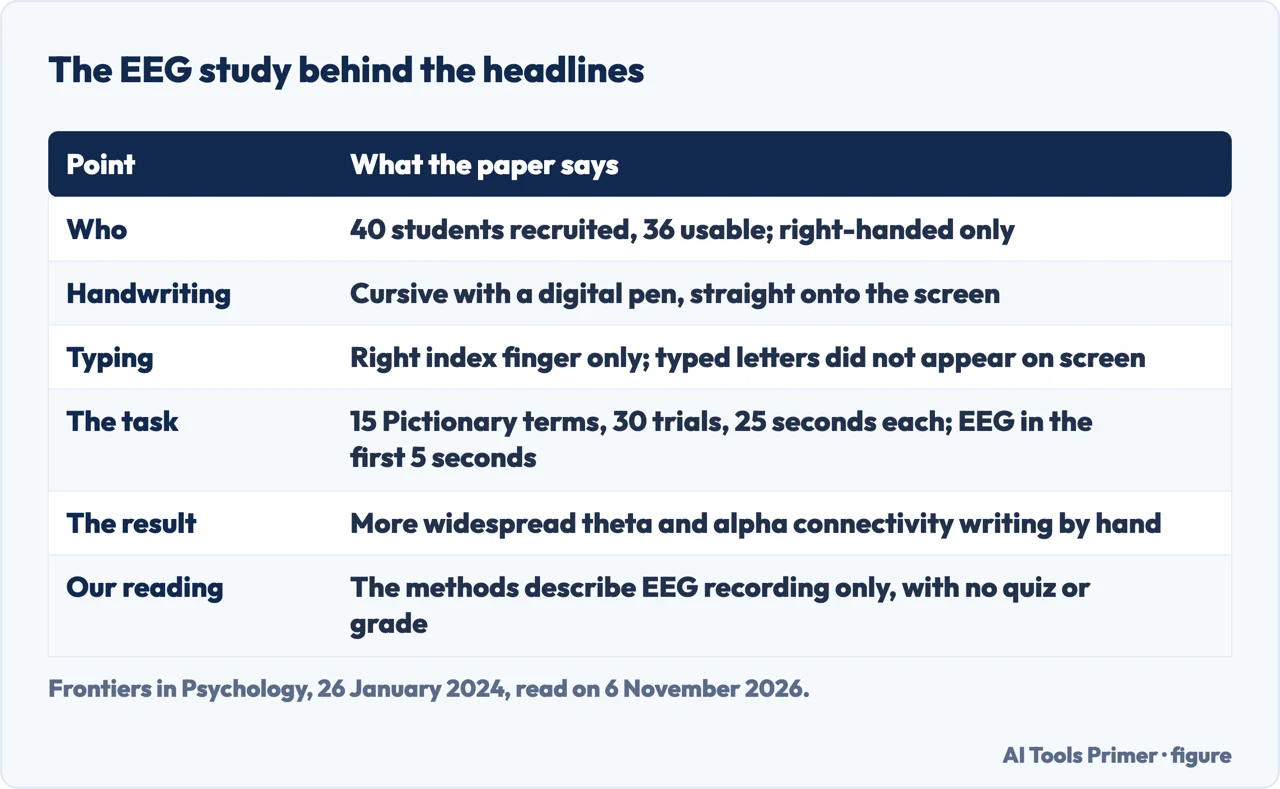
The study most pages point to is by Ruud van der Weel and Audrey van der Meer at the Norwegian University of Science and Technology, published in Frontiers in Psychology on 26 January 2024. Forty university students in their early twenties took part and EEG data from 36 of them were good enough to use. Only right-handed students were included, and the brain activity was recorded with 256 sensors. Each student saw a list of 15 terms taken from the game Pictionary, and each term appeared twice, once to write and once to type, for 30 trials in all.
The two conditions were narrower than the words “handwriting” and “typing” suggest. By hand meant writing in cursive with a digital pen directly on a touchscreen. Typing meant pressing the keys with the right index finger only, and the typed letters did not appear on the screen. Each trial lasted 25 seconds and the EEG was recorded only during the first 5 seconds. The result: connectivity in the theta band (3.5 to 7.5 Hz) and the alpha band (8 to 12.5 Hz) was more widespread when writing by hand, in the parietal and central regions. The paper counts 32 significant clusters for handwriting, which it says represent 16 connections, and it reports that the typing condition did not show the same pattern.
The authors link this to learning by citing earlier work on brain activity, and they write that the findings can be taken as evidence that handwriting promotes learning. The methods we read describe the EEG recording only, with no quiz or grade, so what the connectivity means for a student’s results is a step the paper takes from the literature, not from a test. The sample is small, the task is single words, and the typing condition used one finger. Those three points are our reading of the methods, not limits the authors list. The authors themselves recommend that children learn handwriting at school and also learn a keyboard, depending on the task, and they say that knowing when to use which matters, whether for lecture notes or longer essays. The page for the study also mentions a published commentary on the article, which we did not read.
NPR’s report of 11 May 2024, by Jonathan Lambert, describes the same study: motor and visual areas synchronise with areas involved in memory when students write by hand, and not when they type. The report quotes Marieke Longcamp of Aix-Marseille Université, who calls handwriting probably one of the most complex motor skills the brain is capable of.
What a review of 30 imaging studies adds
A 2025 review by Giuseppe Marano and colleagues, published in the journal Life and indexed in PubMed Central, set out to compare the brain activity behind the two. Its PubMed search on 5 December 2024 gave 41 records, 22 more came from reading the reference lists of earlier reviews, and of the 63 articles in total 30 were eligible. The authors left out studies of children and adolescents, as well as reviews and meta-analyses. Their conclusion is that handwriting activates a broader network of brain regions for motor, sensory and cognitive processing, while typing engages fewer circuits.
The same review is careful about how far that goes. It says the differences are not always pronounced, and that results vary with the experimental design, the people studied and the imaging method. As one example it sets a study of Japanese participants, in which kanji handwriting and kana typing activated different regions, beside a study of English speakers. For us the useful point is that the review does not treat “handwriting” as one thing. It asks that studies say whether it means pen on paper or a stylus on a screen, and the next sections come back to that.
Lecture notes: the 2014 study and the 2021 replication
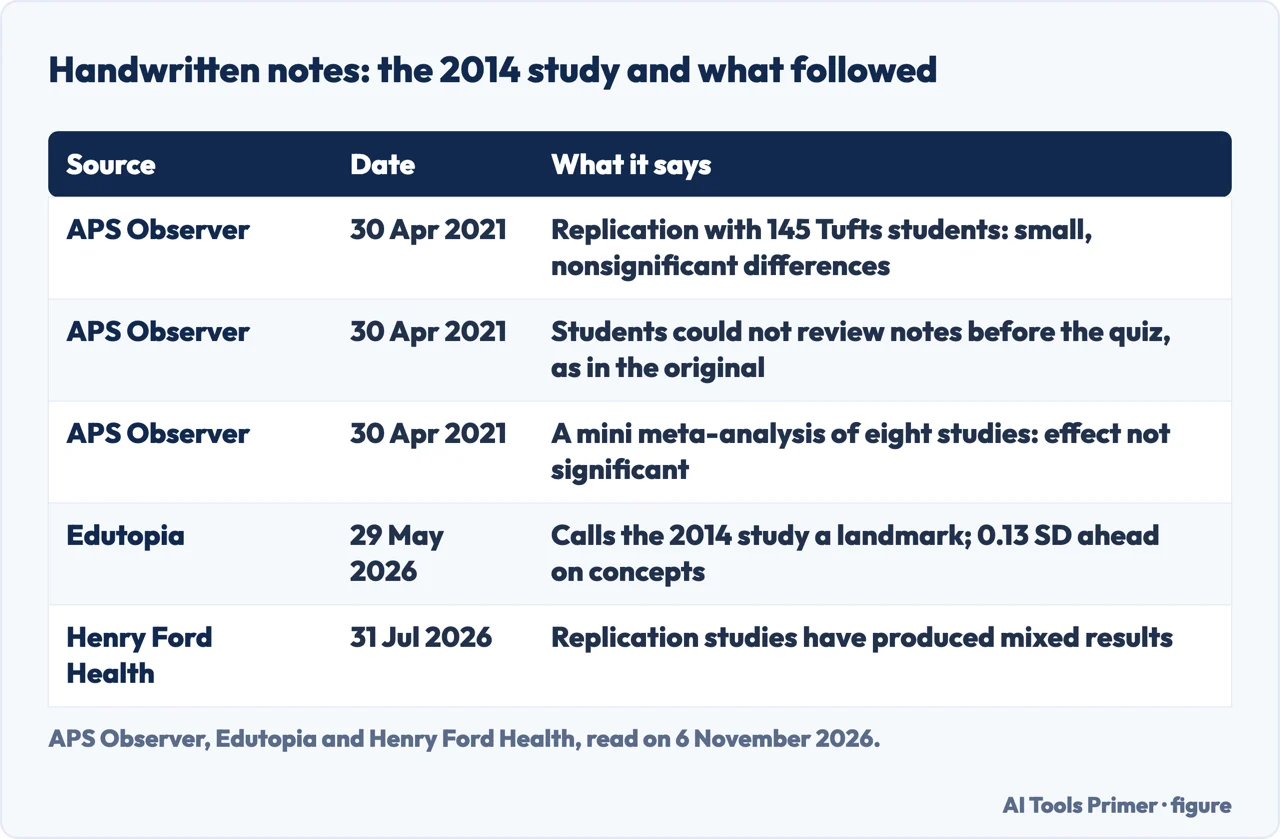
The claim most students have heard is about notes. Two of the pages we read describe the 2014 study by Pam Mueller and Daniel Oppenheimer, in which students took notes by hand or on a laptop. We did not read the 2014 paper itself. The Association for Psychological Science says the original involved 67 undergraduates at Princeton. Edutopia, in a piece published on 29 May 2026, calls it a landmark study and says that on conceptual questions the students who wrote by hand scored 0.13 standard deviations above average, which it describes as beating out 55 percent of other students. Edutopia adds that a 2024 meta-analysis reinforced the result and reports that analysis as covering 24 studies and roughly 3,000 students, with about 40 percent of the handwriters earning As and Bs against 30 percent of the typers. Those are second-hand figures: we did not read the meta-analysis.
The APS Observer of 30 April 2021 reports a direct replication by Heather Urry and colleagues, in Psychological Science. They had 145 undergraduates at Tufts watch a recorded lecture, take notes by hand or by typing, and sit a quiz straight away. The Observer reports that they found only small differences in quiz performance by note-taking medium, and that the differences were not statistically significant. As in the original, typed notes had more words and more word-for-word overlap with the lecture, more words went with a better score and more overlap with a worse one. Unlike the original, the replication found no relationship between the medium and the conceptual questions. On factual recall the APS says neither study found a significant relationship with the medium. A mini meta-analysis of eight related studies also gave an effect that was not statistically significant.
The replication has its own limits, and its authors name them. The students could not review their notes before the quiz, as in the original, so the result does not say what happens when people study from their notes afterwards. Edutopia describes the original differently: it says handwriters who were allowed to study their notes scored 0.29 standard deviations above average on factual questions, a figure we could not check at the source. They also point out that more words or less overlap could stand in for motivation, conscientiousness or interest, which would also lead a student to write more in their own words. Baibing Chen, a neurologist at Henry Ford Health, writing on 31 July 2026, says some research shows better conceptual performance after handwritten notes, but that replication studies have produced mixed results, so the advantage may not be as clear-cut as once thought. Put side by side, the three pages differ: Edutopia presents the advantage as solid, the replication found little to separate the two, and Henry Ford Health calls it mixed.
Children and letters
The pages that stress handwriting most are often about children. NPR reports that tracing letters, as opposed to typing them, leads to better and longer-lasting recognition of letters, and quotes Sophia Vinci-Booher of Vanderbilt University on how forming a letter by hand asks the fingers and the eyes to work together. It adds, in a parenthesis, that so far the evidence suggests it is writing by hand that matters, not whether the writing is print or cursive.
Edutopia gives figures from studies we did not read, so they stay its figures. It reports a 2025 study of kindergarten-age children in Spain in which those who learned letters by hand named letters with 92 percent accuracy against 76 percent for those who typed, and named whole words 72 percent of the time against 38 percent. It also reports a 2019 study of fifth and ninth graders who listened to short stories while writing them into a paper notebook, a touchscreen tablet or a laptop and were asked a week later to recall the details: among the ninth graders 26 percent of the details were recalled after handwriting, 22 percent after a touchscreen and 19 percent after a laptop, and the younger children also did better by hand, with gains of about 10 percent. These findings are about children. The review above left children out on purpose, and the EEG study was of young adults, so these figures should not be read across to an adult taking notes.
A stylus on a tablet is not the same as paper
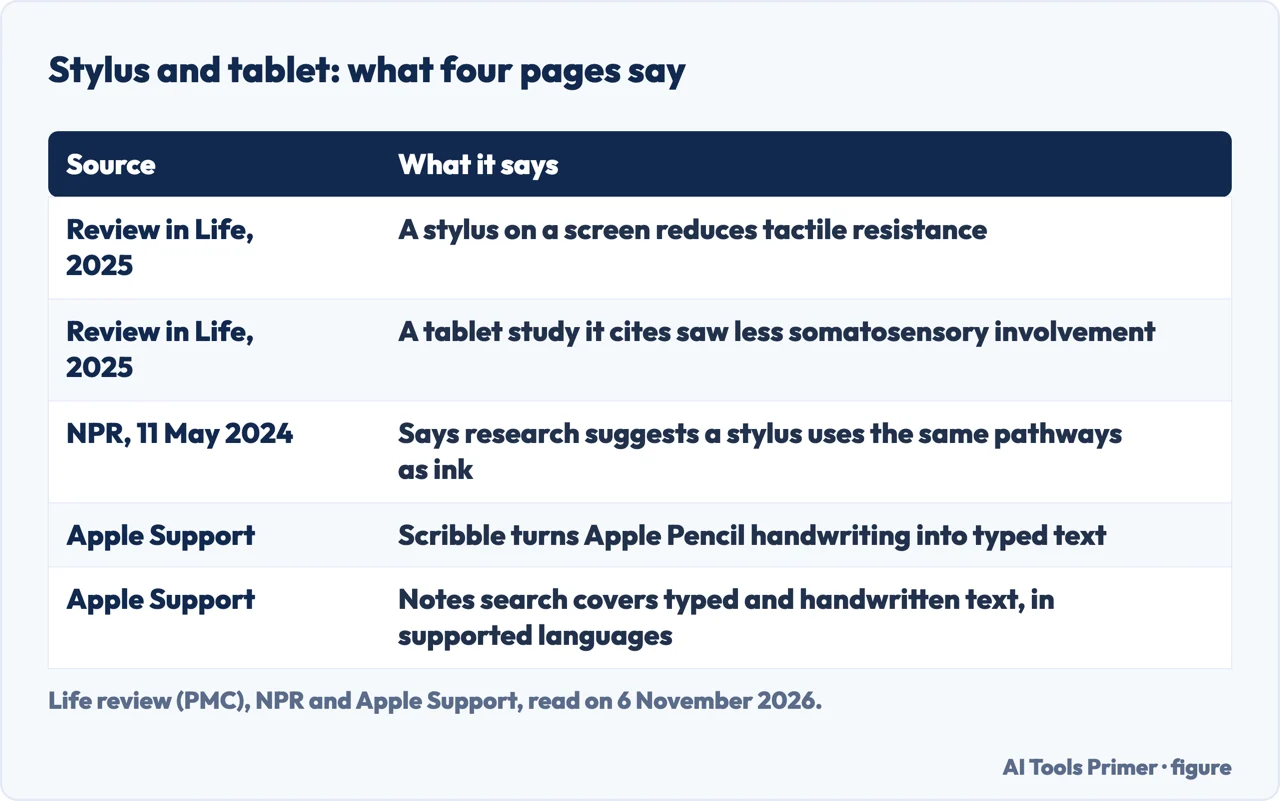
The review in Life describes pen-and-paper handwriting as engaging fine motor skills and the feedback from the physical resistance of the writing surface. A stylus on a touchscreen, it says, changes that by reducing tactile resistance and bringing in different haptic feedback. It cites a tablet study, which it spells Karimpour, that found cortical activation during handwriting was more widespread than in studies using pen and paper, but with less involvement of the somatosensory cortex, and the review suggests that physical contact with paper may be a key factor. It also mentions a study finding that, once people are used to it, handwriting with a digital pen and tablet can increase the ability to learn compared with typing on a keyboard. Its own recommendation is that studies state whether handwriting means paper or a stylus.
NPR gives the opposite impression in one sentence. It quotes Ramesh Balasubramaniam of the University of California, Merced saying that digital tools do not have to be dropped, and reports that research suggests scribbling with a stylus on a screen activates the same brain pathways as ink on paper. The article does not say which research. The EEG study used a digital pen on a screen, so it does not settle paper against stylus either.
What a tablet does well is described in Apple’s iPad User Guide. In Notes you write with Apple Pencil on supported models, or with a finger. The Scribble tool transcribes handwriting to typed text as you write, Smart Selection selects handwriting with the gestures used for typed text and lets you paste it as typed text, and the handwriting can be refined in real time to be more legible while keeping your own style. Search covers typed and handwritten text, objects in images and text in scanned documents, in supported languages; in a locked note only the title appears in results. Apple says these features depend on the model and language. A blog we read, Effectiviology, lists the practical gains of digital notes as being easier to edit, search and back up. For turning a scanned page into text, our page on scanned pages and OCR is a different question from this one.
Choosing by task
The pages we read stop short of a ranking, and several point to the job as the thing that decides. The EEG authors recommend learning both and picking by task. NPR’s report says writing by hand forces adults to slow down, and quotes van der Meer saying that for a long essay a keyboard is much more practical. Henry Ford Health says typing can be the only option for people who find handwriting painful or very difficult, and says both have advantages for specific groups.
- Lecture notes. The disputed case, as the notes section shows. Our pages on taking notes and on notes from a textbook cover how to write them, whichever tool you use.
- Long writing. NPR quotes van der Meer calling a keyboard much more practical for a long essay. Edutopia reports a 2011 study of nearly 1,000 middle and high school students in which typing was about 55 percent faster.
- Keeping and finding notes. Apple says handwriting in Notes can be searched and transcribed to typed text, in supported languages and on supported models.
- Revising from notes. The replication did not test it, so the page cannot say. See how to study effectively and making cards from notes for what to do with them.
What we did not use
We did not open the original 2014 paper, the 2024 meta-analysis that Edutopia cites, or the studies behind its figures on children, so those appear only as Edutopia reports them. We did not read the commentary published on the EEG article, the Oxford Learning page, the Reddit thread that Google listed, or the box of AI-written text above the results. Effectiviology is a blog and we used it only for its practical list. The pages we read do not mention handwriting quality or intelligence, so this page does not answer that question, and they do not report a long-term test of adults taking notes on a tablet against paper.
Where to start
Four ways in.
- “What did the brain study find?”
- The EEG study behind the headlines — brain
- “Do handwritten notes score higher?”
- Lecture notes: the 2014 study and the 2021 replication — notes
- “Is a tablet the same as paper?”
- A stylus on a tablet is not the same as paper — tablet
- “Which should I use?”
- Choosing by task — choose
Notes that last
Taking notes, keeping them and turning them into cards.
Using the notes
Study methods, review dates and text from a scan.
Questions people also ask
Is handwriting actually better than typing?
It depends on what is measured. One EEG study of 36 students found more brain connectivity writing by hand, a 2021 replication on lecture notes found small, nonsignificant differences, and a neurologist at Henry Ford Health calls the replications mixed.
Do you prefer handwriting or typing?
The pages we read do not settle it by taste. The EEG authors recommend learning both and choosing by task, NPR calls a keyboard more practical for a long essay, and Henry Ford Health says typing may be the only option when handwriting is painful.
Is bad handwriting linked to higher IQ?
The pages we read do not mention handwriting quality or intelligence, so this page does not answer the question.
How many WPM is handwriting?
Edutopia reports a 2011 study in which a keyboard was about 55 percent faster than writing by hand, and gives 4.5 for students writing by hand and 7 for typing, in words per minute, against 174 for a teacher speaking. These are its figures, which we did not check at the source.
Not covered here. The statements come from a Frontiers in Psychology article, a review in Life, NPR, Henry Ford Health, Edutopia, the APS Observer and two Apple Support pages, all read on 6 November 2026.
The search measure behind this page is an Ubersuggest reading of 5 November 2026, with the difficulty score of that tool and not the Semrush figure, which is still to be checked.
Sources
- Frontiers in Psychology — Handwriting but not typewriting leads to widespread brain connectivity (van der Weel and van der Meer) — www.frontiersin.org, read 6 November 2026.
- Life (PubMed Central) — The Neuroscience Behind Writing: Handwriting vs. Typing, Who Wins the Battle? — pmc.ncbi.nlm.nih.gov, read 6 November 2026.
- NPR — Why writing by hand beats typing for thinking and learning — www.npr.org, read 6 November 2026.
- Henry Ford Health — How Handwriting And Typing Compare For Brain Health Benefits — www.henryford.com, read 6 November 2026.
- Edutopia — Why Writing by Hand Beats Typing (in 6 Charts) — www.edutopia.org, read 6 November 2026.
- Association for Psychological Science — Don’t Ditch the Laptop Just Yet: Replication Finds No Immediate Advantage to Writing Notes by Hand — www.psychologicalscience.org, read 6 November 2026.
- Apple Support — Add drawings and handwriting in Notes on iPad — support.apple.com, read 6 November 2026.
- Apple Support — Search through your notes on iPad — support.apple.com, read 6 November 2026.
- Effectiviology — How to Choose the Best Method to Take Notes — effectiviology.com, read 6 November 2026.
Written by Alberto Gulotta
Founder and editor of AI Tools Primer, writing from Palermo, Italy. Thirty-five years of taking computers apart, starting with a Commodore 64 — the long version is on the about page.
Something wrong on this page? Write to aitoolsprimer@gmail.com and it gets fixed.
Written on 6 November 2026.
Independence and limits
No affiliate links and no paid placements anywhere on this site. Nobody pays to appear here, and no company has seen this page before you did.
This is general information, not professional advice. Where a page touches money, health, safety or the law, it names its source and the date it was read — and your situation may still differ. See the privacy page and the cookie policy.