
Study · guide
Spaced practice: what five study pages and the Anki manual say
By Alberto Gulotta · Updated · 22 min read
Spaced practice spreads study over several sessions with rests between them, instead of one long block. University pages give different calendars, from 1 to 2 hours every other day to a review one day after each class, and the Anki manual shows software setting the dates, with a default desired retention of 90%.
| Question | Answer | Where it comes from |
|---|---|---|
| What is it? | Learning spread over several sessions with rests between them, as against one session | Indiana CITL, Duke ARC |
| How far apart? | The pages differ: 1 to 2 hours every other day, a review one day after each class, or a gap that depends on the retention wanted | UC San Diego, Learning Scientists, Arizona |
| What goes in a session? | The same material again, recalled rather than reread | Duke ARC, Learning Scientists |
| Why not cram? | Three problems: it takes more time, it is forgotten quickly and it replaces sleep | Learning Scientists |
| What does Anki add? | The program sets the next review date after each answer; the default desired retention is 90% | Anki manual |
What spaced practice is, and what it is not
Indiana University’s teaching centre (CITL) defines spaced, or distributed, practice as learning that takes place over time with rest periods between practice sessions. Its page sets that against massed, or blocked, practice: learning that happens in a single session without a rest period, such as studying the same material over and over, redoing the same quiz repeatedly or rereading the same text several times. The page adds that we often call this cramming.
Duke’s Academic Resource Center words it as a schedule. Its page describes distributed practice, or spacing, as creating a schedule of study sessions of short duration, used to practice the same material and not new material, and it contrasts that with massed practice or cramming, which means fewer study sessions of longer length. The psychology department at UC San Diego uses the same two names and describes spaced practice as distributing exam preparation over multiple sessions, each shorter than a cramming session. Having several sessions, its page says, lets you “divide and conquer” by focusing on a subset of the materials in each one.
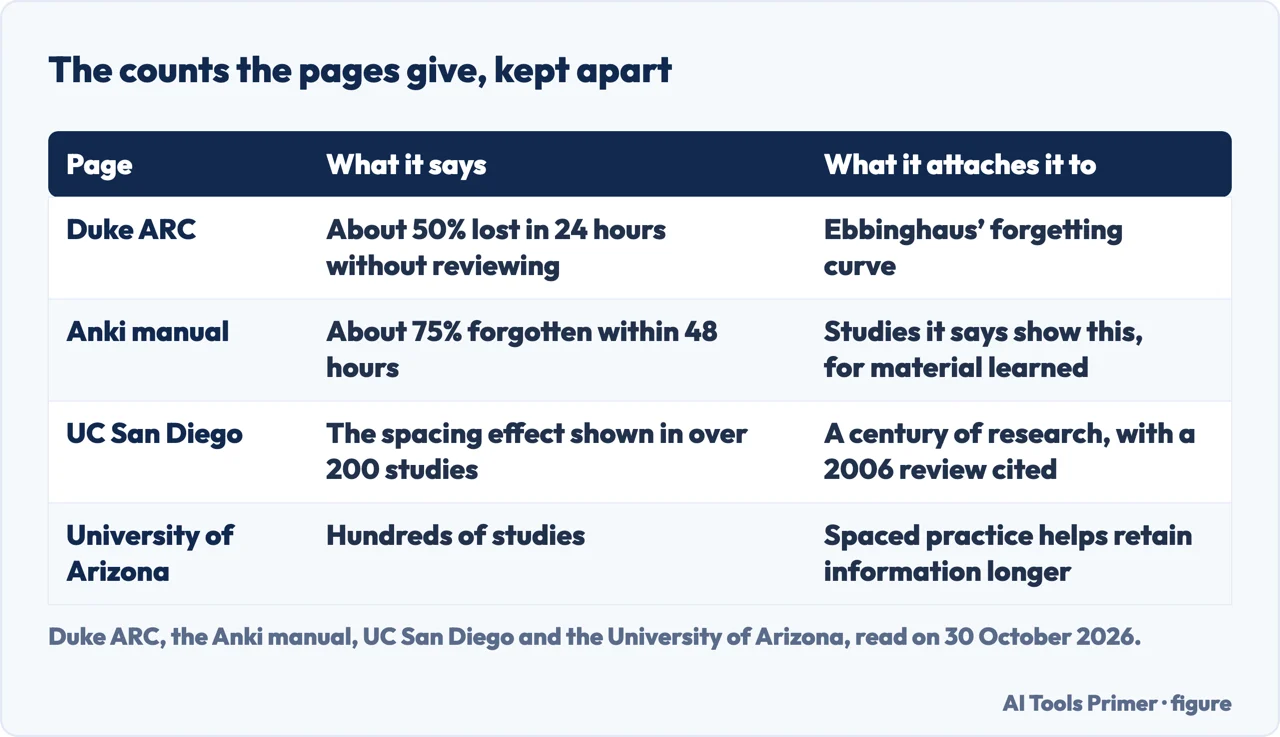
On how much evidence there is, the pages use different counts. UC San Diego says the spacing effect has been demonstrated in over 200 research studies from over a century of research, and it cites a 2006 review of distributed practice in verbal recall tasks. It also says that multiple practice sessions over time generally result in better long-term memory than a single session of equivalent duration or an equivalent number of repetitions. The University of Arizona says that hundreds of studies have shown spaced practice, which it also calls distributed learning or spaced repetition, to help students retain information for longer periods than massed sessions do. We did not open the studies behind either count, so both are the pages’ own summaries.
A word about names. Wikipedia’s article on spaced learning describes a different method: highly condensed content repeated three times, with two 10-minute breaks filled with distractor activities such as physical activity. The article opens with a note not to confuse it with the spacing effect, and it is not the calendar of days and weeks that the study centres describe. The same article says that spaced retrieval practice, for example taking a practice test every month, is more effective than massed practice.
A calendar you can follow, and where the pages differ
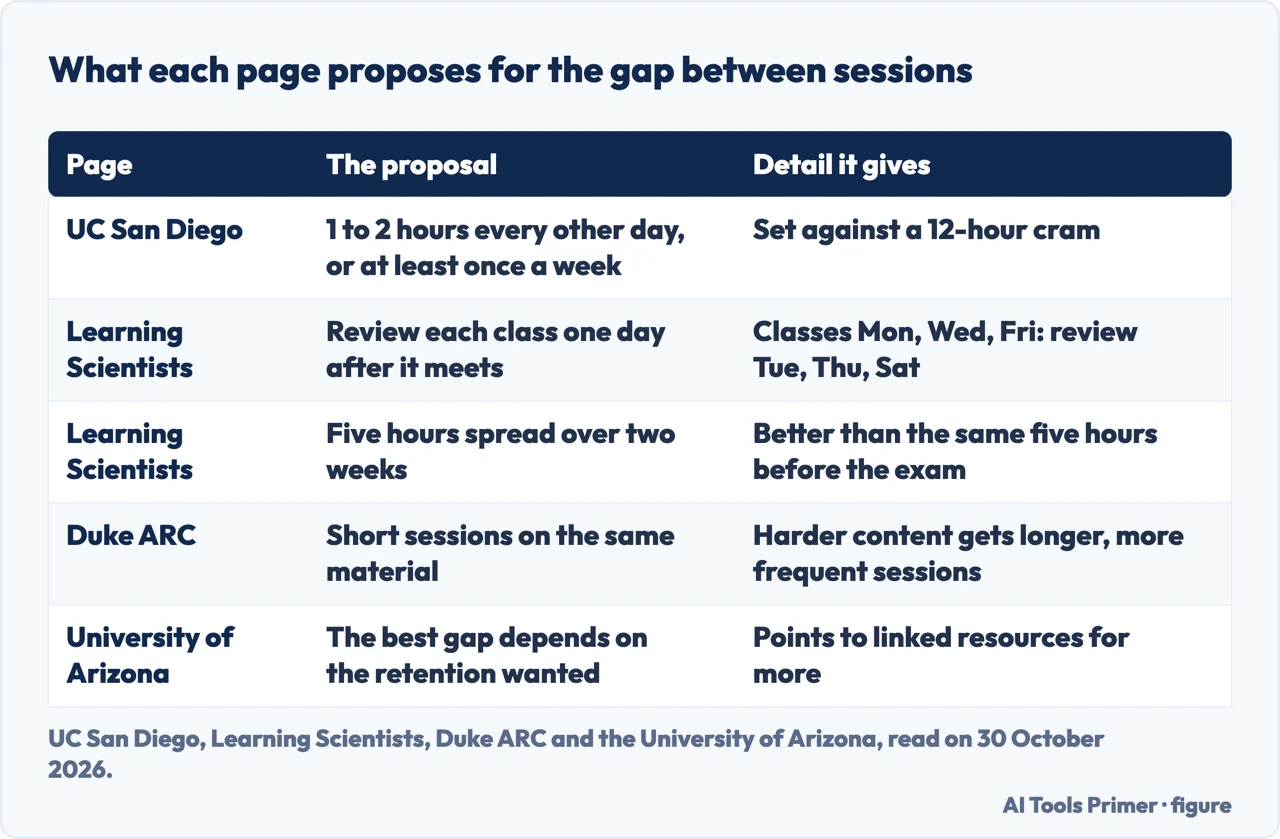
The proposals below are what each page gives, in its own terms. They are not one plan: the pages differ on how often to sit down and on what goes into each session.
UC San Diego starts from the course syllabus, which it says typically lists the topics and the date of each quiz or exam. From it you build a calendar in which exam preparation begins several weeks in advance and continues regularly until the exam date, with an hour or two at regular intervals, such as every other day or every Monday and Friday. The page also says to go over course materials more than once: what you learned in week 1 can be revisited in weeks 3 and 4. Its example split of time is 75% on new materials and 25% on old materials. The page introduces the split with the words “for example”, so we read it as an illustration and not as a rule.
The Learning Scientists post starts earlier and asks for more frequent contact. It says to begin planning at the start of the semester or even before, and to set aside a bit of time every day just for studying, even if the exams are months away. Its rule for reviewing is a delay of one day: review each class, but not immediately after it, for instance on Tuesday, Thursday and Saturday for classes that meet on Monday, Wednesday and Friday. It asks for small spaces, for example a few days, between study sessions, and a little at a time so that it adds up.
Duke gives four steps. Put the sessions on a calendar, at least a few days in advance. Keep the intervals small and frequent. Give harder content longer and more frequent sessions, and familiar content fewer but still adequate ones. Make adjustments as you go without letting interruptions disturb the schedule.
Where the pages differ is worth stating. UC San Diego’s example is every other day or at least once a week, and the Learning Scientists ask for something every day with reviews a day after each class. Duke asks for small, frequent intervals, and the text we read does not turn that into a number of days. On content, Duke says the sessions practice the same material and not new material, while UC San Diego says to focus on both new and old materials. The University of Arizona says the optimal timing between study sessions varies with the desired retention period, and it points to linked resources for more instead of giving a number on its page. The pages we read do not give one rule for the distance between sessions.
To make that concrete, here is the arithmetic of two of those rules on a real calendar. It is our illustration, not a schedule from any of the pages. If a course starts on Monday 2 November 2026, UC San Diego’s pattern of revisiting week 1 in weeks 3 and 4 points to the weeks that begin on Monday 16 November and Monday 23 November. With the Learning Scientists’ rule, classes on Monday 2, Wednesday 4 and Friday 6 November are reviewed on Tuesday 3, Thursday 5 and Saturday 7 November. For building a whole exam period around dates, see our page on study planning.
Why the gap does the work
Why would the same hours work better when they are split up? The pages give related answers, and they do not use the same words.
Indiana’s answer is about memory. Cramming, it says, is a less effective way to acquire and retain information in the long term because the brain needs time to move information from short-term, or working, memory to long-term memory. It reports that researchers found “drastic declines” in the performance of students who used massed practice compared with those who spaced their practice, citing a 2007 paper, and it says distributed practice requires students to encode and then retrieve the information over time, which helps long-term learning.
Two pages put part of the work on forgetting itself. The University of Arizona says that after learning something new, learners should give the mind time to forget, so that in the next session the brain has to struggle to recall what was learned, and that spaced practice should be combined with retrieval practice. The Learning Scientists post says you may forget some information from day to day and that this is a good thing, because a little forgetting is needed to benefit from spacing. Duke lists, among the conditions under which spacing is most beneficial, pushing yourself to recall something you barely know yet. Duke also says memory has a limited capacity and that the brain needs a break after going over material for an extensive period.
The Learning Scientists post gives the plainest comparison: five hours spread out over two weeks is better than the same five hours right before the exam. It lists three problems with cramming. First, it takes more time: if the same learning comes from 5 hours in 1-hour increments, a single 5-hour cram needs more time to reach the same level. Second, what is crammed is forgotten soon after the test, and the post says that future learning depends on previous learning, in science, math or a foreign language. Third, cramming inevitably replaces sleep. The post is not against studying close to the exam: you can still study up until the exam, it says, as long as that is not the only time.
UC San Diego describes the habit that cramming grows out of. In the weeks before an exam, it says, students often spend very little time preparing, and only when 2 or 3 days are left do they cram, citing a 1999 study. It adds that repeating information over and over in one sitting is often wasted effort, because the benefits are usually lost even a few days later, citing a 2007 paper.
Two figures on forgetting, kept apart. Duke’s page says that, according to Ebbinghaus’ forgetting curve, without reviewing people lose about 50% of what they learned in 24 hours, and that reviewing what you covered the day before interrupts the process. The Anki manual says that studies show we forget about 75% of material learned within a 48-hour period. The two pages attach their figures to different things, a curve in one and unnamed studies in the other, and to different time spans, so we do not combine them or use one to check the other. The table shows them side by side with the study counts from the first section.
When the calendar is done for you: Anki
A calendar like those asks you to track which material is due and when. The Anki manual describes software that does that bookkeeping. Wikipedia describes Anki as a free and open-source flashcard program that uses techniques such as active recall testing and spaced repetition. The manual’s background page names the same two ideas: active recall, where you try to remember actively rather than read passively, and spaced repetition, where, it says, you only study cards when you are about to forget them and the easier the card, the longer the intervals between reviews become.
The manual gives a short history. It says the spacing effect was reported in 1885 by Hermann Ebbinghaus, and that proposals to use it, under the name spaced repetition, date from the 1930s. In 1972, it says, Sebastian Leitner popularized a version with paper flashcards sorted into boxes: a card moves to a different box after each successful or unsuccessful review, which shows at a glance roughly how well a card is known and when it should be reviewed. The manual calls this a rough approach, since it cannot give an exact date for the next review and does not work very well with material of varying difficulty.
The next step in the manual is SuperMemo, a commercial flashcard program. The manual says SuperMemo pioneered a system that keeps track of the ideal time to review and optimizes itself from the user’s performance: each answer tells the program how well you remembered, and the program uses that to decide when to show the question again. Its example is a question you see for the first time today, then 3 days later, 15 days later and 45 days later. The manual also says SuperMemo is often criticized as buggy and difficult to navigate, runs only on Windows and is proprietary. That comparison is written in Anki’s own manual, so it is one side’s account; we did not read SuperMemo’s own pages.
Anki’s scheduler, the manual says, is based on an older version of the SuperMemo algorithm called SM-2, and a new algorithm called FSRS has recently been integrated as an alternative. Wikipedia dates SM-2 to the late 1980s, for SuperMemo, and notes that SuperMemo grades answers from 0 to 5 while Anki offers at most four grades: again, hard, good and easy. The clients differ in price. The manual says there are free clients on many platforms, and Wikipedia lists AnkiMobile for iPhone, iPod Touch and iPad as paid, AnkiWeb as free to use online and AnkiDroid for Android as free of charge. The pages we read do not give the price of AnkiMobile.
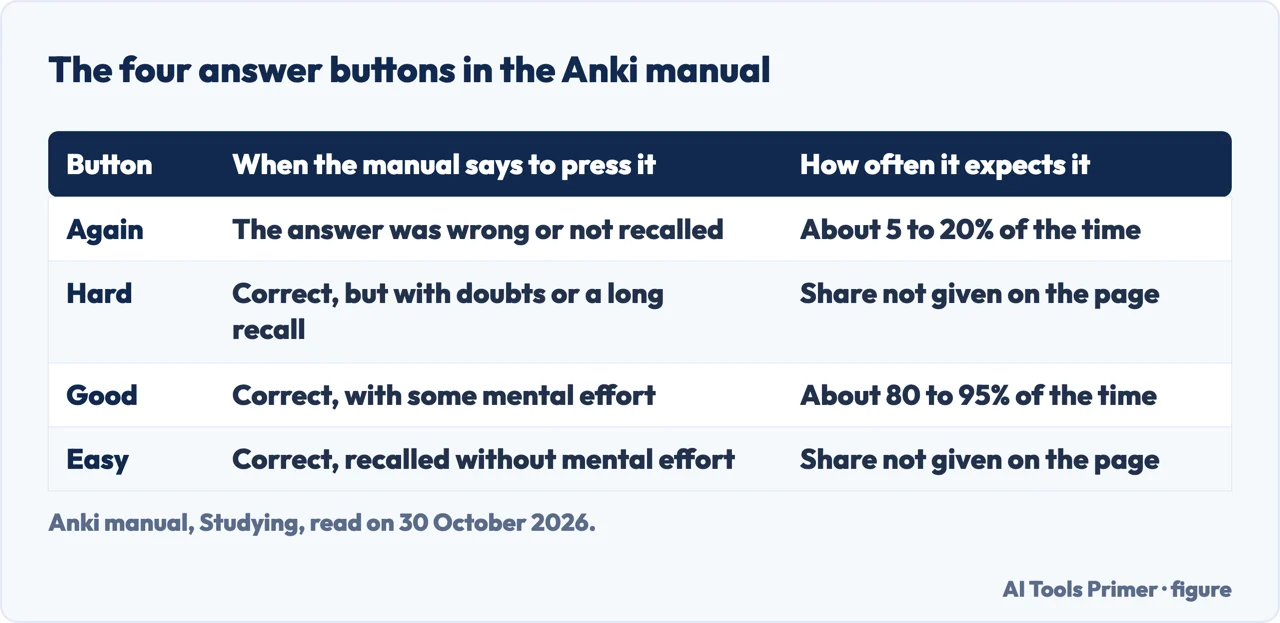
In daily use the scheduler works through four buttons. The studying page of the manual says to press Again when your answer is wrong or you could not recall it, and to be strict: if it counts as a fail in a real-life context outside Anki, it counts as a fail in Anki. It expects Again about 5 to 20% of the time. Hard is for a correct answer that you had doubts about or that took a long time to recall. Good is for a correct answer that took some mental effort; the manual expects it about 80 to 95% of the time when Anki is used properly. Easy is for a correct answer recalled without mental effort. If four buttons are too many, the manual says you can use only Again and Good. It also says that if you cannot answer within about 10 seconds, it is probably better to move on and show the answer than to keep struggling.
The Anki manual asks you to answer before you see the back of the card, and the Learning Scientists and Arizona pages ask for retrieval practice during the spaced sessions. Our page on how to study effectively covers retrieval and spacing at the level of the university pages, and practice questions covers writing the questions.
Setting Anki up: FSRS and desired retention
The manual’s deck options page describes FSRS, the Free Spaced Repetition Scheduler, as an alternative to Anki’s legacy SM-2 algorithm. Wikipedia says FSRS was integrated into Anki as an optional feature in version 23.10, and gives that version’s release date as 31 October 2023. The manual’s FAQ says FSRS is based on the “Three Component Model of Memory” and names three variables. Retrievability is the probability that you can recall something at a given moment. Stability is the time, in days, for retrievability to fall from 100% to 90%, so a stability of 365 means a year before the chance of recalling a card drops to 90%. Difficulty is how hard it is to raise stability after a review. Wikipedia calls the model DSR, for difficulty, stability and retrievability.
Two claims about FSRS come with different support. The FAQ says users have to do fewer reviews with FSRS than with Anki’s default algorithm to reach the same retention level. Wikipedia says the default FSRS parameters are based on about 727 million reviews from 10 thousand users and are more accurate than SM-2 according to benchmarks, and it cites a GitHub benchmark. We did not open that benchmark and ran nothing ourselves, so these are the manual’s and Wikipedia’s statements. The FAQ also says SuperMemo’s latest algorithm is proprietary and requires licensing, which is why Anki can only use freely available algorithms such as FSRS, and that preliminary tests seem to indicate FSRS is roughly on par with SM-17.
The deck options page gives a short guide. First check that all your Anki clients support FSRS: it names Anki 23.10, AnkiMobile 23.10 and AnkiWeb, and AnkiDroid from version 2.17, and it says a client that does not support FSRS will make things work incorrectly. FSRS can only be enabled globally, not for some presets and not for others. Keep the learning and relearning steps shorter than one day: steps such as 10m or 30m are good, and 23h is not recommended. Click Optimize under the FSRS parameters field; a message that the parameters currently appear to be optimal is fine. Then choose a desired retention.
The manual calls desired retention the most important setting in FSRS: the proportion of cards recalled successfully when they are due. The default is 90%, which it says offers a good balance of retention and workload. Higher retention gives shorter intervals and more reviews per day. Above 90% the workload increases very quickly and above 97% it can be overwhelming, so the manual recommends keeping it lower than 97%. At lower values you do significantly fewer reviews but forget more cards. The manual says the exact shape of the workload graph is different for everyone, and it offers Help Me Decide, marked Experimental, which simulates your workload at different levels of retention so that you can ask how many reviews you can realistically do per day.
The words are close but the things differ. Arizona’s retention period is how long you want to keep the information, and Anki’s desired retention is the share of cards recalled when they come due. We make no claim that one maps onto the other.
One habit matters, according to the manual. FSRS can adapt to almost any habit except pressing Hard instead of Again when you forget. Hard tells FSRS you recalled correctly, with hesitation, so if you press it after failing to recall, all intervals will be “unreasonably high”. The FAQ says using only Again and Good works fine, and that in some cases FSRS may even be more accurate that way.
On parameters, the manual says not to change them manually or copy them from someone else, and that optimizing once a month is sufficient. The FAQ gives a second rule, to optimize every time the number of reviews doubles, after 100, then 200, then 400, and calls the monthly rule simpler. It says that since Anki 24.06.3 the optimizer can be used with any number of reviews, where earlier versions needed 1000. The manual’s optional health check lists a low number of reviews, fewer than a few hundred, as one reason FSRS may not perform well, because it needs data to learn from.
The FAQ also answers a worry about first intervals. FSRS tends to give longer first intervals than SM-2, with a first Good of 3 to 5 days and a first Easy of over a week, but for mature cards it is more conservative. To shorten intervals, raise the desired retention, which shortens all of them. It says FSRS works equally well whether you learn 5 or 50 new cards a day, so it does not name an optimal number of new cards per day.
Finally, the manual covers whether to reschedule cards when you enable FSRS or change the desired retention. The default is not to: future reviews use the new scheduling, with no immediate change to your workload. Rescheduling often makes a large number of cards due at once, so the manual does not recommend it when first switching from SM-2, and if you still want it, it recommends creating a backup first.
What the pages do not settle
- The gap. UC San Diego, the Learning Scientists, Duke and Arizona each give a different frame, and the pages we read do not give one rule for the distance between sessions. The Anki manual is the page we read that says how a distance is computed: from the desired retention, with 90% as the starting value.
- The study centres and Anki. The text of the five study pages we read does not mention Anki. The link between the calendars and the program is ours, made by reading both.
- FSRS against SM-2. The manual and Wikipedia both say FSRS is more efficient or more accurate. Wikipedia’s support is a benchmark on GitHub that we did not open, and the FAQ’s own test remark is a comparison with SuperMemo’s SM-17, not with SM-2.
- The forgetting figures. Duke gives about 50% in 24 hours and the Anki manual about 75% in 48 hours. We keep them apart because the pages attach them to different things.
- Time per day. The manual says higher retention means more reviews per day, and the pages we read do not give a number of minutes.
- ADHD. The text of the pages we read on spacing and on Anki does not discuss it, so we do not answer that question. Duke’s site lists a neurodiversity and ADHD support page in its menu, which we did not open.
For the techniques that sit next to spacing, see how to study effectively, practice questions and study planning.
Where to start
Four ways in.
- “How far apart should sessions be?”
- A calendar you can follow, and where the pages differ — calendar
- “Why not just cram?”
- Why the gap does the work — gap
- “Can software set the dates?”
- When the calendar is done for you: Anki — repetition
- “What do I set in Anki?”
- Setting Anki up: FSRS and desired retention — settings
Planning and practice
The dates, the questions and the study techniques around spacing.
Notes and sources
What to write down while you study, and where to keep it.
Questions people also ask
What is the meaning of spaced practice?
Indiana’s teaching centre defines it as learning that takes place over time with rest periods between practice sessions. Duke describes a schedule of short study sessions used to practice the same material, set against fewer, longer sessions.
What is an example of spaced practice?
UC San Diego gives 1 to 2 hours every other day, or at least once a week, rather than a 12-hour marathon. The Learning Scientists give five hours spread over two weeks, and a review one day after each class: Tuesday, Thursday and Saturday for classes on Monday, Wednesday and Friday.
Is spaced repetition good for ADHD?
The text of the pages we read on spacing and on Anki does not discuss ADHD, so we do not answer. Duke’s site lists a neurodiversity and ADHD support page in its menu, which we did not open.
What is Spaced Practice in Education?
The University of Arizona says spaced practice should be built into in-class activities, assessments and homework, with cumulative quizzes and exams. Indiana lists low-stakes practice assessments, scaffolded assignments with intermediate due dates and in-class recall activities.
Not covered here. We tested no schedule and no deck. The statements come from pages of UC San Diego, the Learning Scientists, Duke University, the University of Arizona and Indiana University, from the Anki manual and FAQs, and from two Wikipedia articles, all read on 30 October 2026.
The search volume and difficulty behind this page come from a Semrush reading of 29 August 2026, older than the 60 days the site normally allows.
Sources
- UC San Diego Psychology — Spaced Practice — psychology.ucsd.edu, read 30 October 2026.
- The Learning Scientists — Learn How to Study Using... Spaced Practice — www.learningscientists.org, read 30 October 2026.
- Duke Academic Resource Center — Spaced Practice — arc.duke.edu, read 30 October 2026.
- University of Arizona Academic Affairs — L2L Strategy - Spaced Practice — academicaffairs.arizona.edu, read 30 October 2026.
- Indiana University CITL — Spaced Practice — citl.indiana.edu, read 30 October 2026.
- Anki Manual — Background — docs.ankiweb.net, read 30 October 2026.
- Anki Manual — Studying — docs.ankiweb.net, read 30 October 2026.
- Anki Manual — Deck Options — docs.ankiweb.net, read 30 October 2026.
- Anki FAQs — What spaced repetition algorithm does Anki use? — docs.ankiweb.net, read 30 October 2026.
- Anki FAQs — Frequently asked questions about FSRS — docs.ankiweb.net, read 30 October 2026.
- Wikipedia — Anki — en.wikipedia.org, read 30 October 2026.
- Wikipedia — Spaced learning — en.wikipedia.org, read 30 October 2026.
Written by Alberto Gulotta
Founder and editor of AI Tools Primer, writing from Palermo, Italy. Thirty-five years of taking computers apart, starting with a Commodore 64 — the long version is on the about page.
Something wrong on this page? Write to aitoolsprimer@gmail.com and it gets fixed.
Written on 30 October 2026.
Independence and limits
No affiliate links and no paid placements anywhere on this site. Nobody pays to appear here, and no company has seen this page before you did.
This is general information, not professional advice. Where a page touches money, health, safety or the law, it names its source and the date it was read — and your situation may still differ. See the privacy page and the cookie policy.