
Study · guide
How to study for finals effectively: four pages, one calendar
By Alberto Gulotta · Updated · 14 min read
How to study for finals effectively starts with a calendar. Four university pages we read, from Bowdoin, UNC, Front Range and Cincinnati, plan on a schedule: three start from dates and work backwards from the exam, and UNC plans one week at a time. They rank differently and differ on weeks to plan and how long a session lasts.
| Question | Answer | Where it comes from |
|---|---|---|
| What goes on the calendar first? | Every exam, paper, project and deadline, then sessions worked backwards from them | Bowdoin, Cincinnati |
| How far ahead should it start? | Bowdoin names the final two weeks; Front Range says finals week should be closer to a month | Bowdoin, Front Range |
| Which exam gets the most time? | The one with the most material and the hardest, adjusted for goals and current grade | Front Range |
| What is studied last, or skimmed? | Material that might be on the final; supplemental readings when hours run short | Bowdoin, UNC |
| How long is a session? | 25 to 90 minutes on one page, 30 or 45 on another | Bowdoin, UNC |
Start with the dates, not the topics
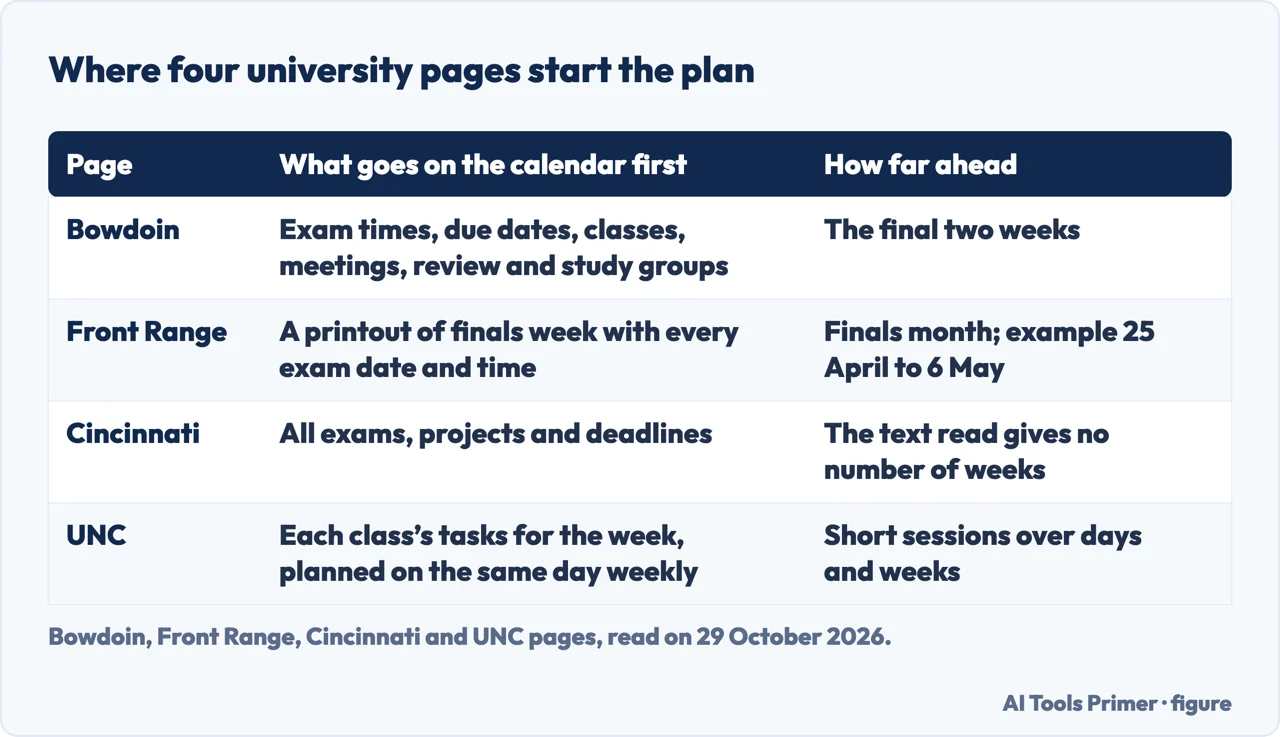
Bowdoin, Front Range and Cincinnati each begin the plan from dates. Bowdoin’s Baldwin Center says to put all finals in one plan, meaning exams, papers and projects together, because that shows how much work you are facing, how early you should start and where you have to set priorities. To build it you need a calendar, printed or electronic, coloured markers if it is on paper, each class syllabus and all the course material. The page lists what goes in before any studying: exam times, due dates for papers, projects and take-home exams, class times, meetings with professors or others, review sessions and study group sessions. Review sessions get a note of their own, because you might get information on exam format and key concepts to focus on there. Only after that scaffolding does Bowdoin add study and writing sessions, and it places them by working backwards from the final due date.
Cincinnati’s page gives the same order in shorter steps. List everything, meaning exams, projects and deadlines. Work backward by asking how many days you have to prepare for each subject. Divide big topics into smaller chunks, assign times, take short pauses every hour, colour-code by class and schedule sleep. Front Range’s blog post, dated 23 April 2021, starts with a printout of the week that shows every exam date and time, and says finals week should end up closer to “finals month”: you pay attention in class so you know what will be tested and can prepare well before the few days prior to each exam.
The pages do not agree on how long that runway is. Bowdoin writes about the final two weeks of the semester. Front Range says finals month and then gives an example that runs from 25 April to 6 May. The Cincinnati and UNC pages we read do not give a number of weeks for finals. UNC plans in a smaller unit: on the same day each week, for example Sunday night or Saturday morning, you write down what you want to complete for each class, count the hours you have, and check whether the list fits. Before bed each night, it says, make the plan for the next day.
Rank the exams, then rank what is inside each
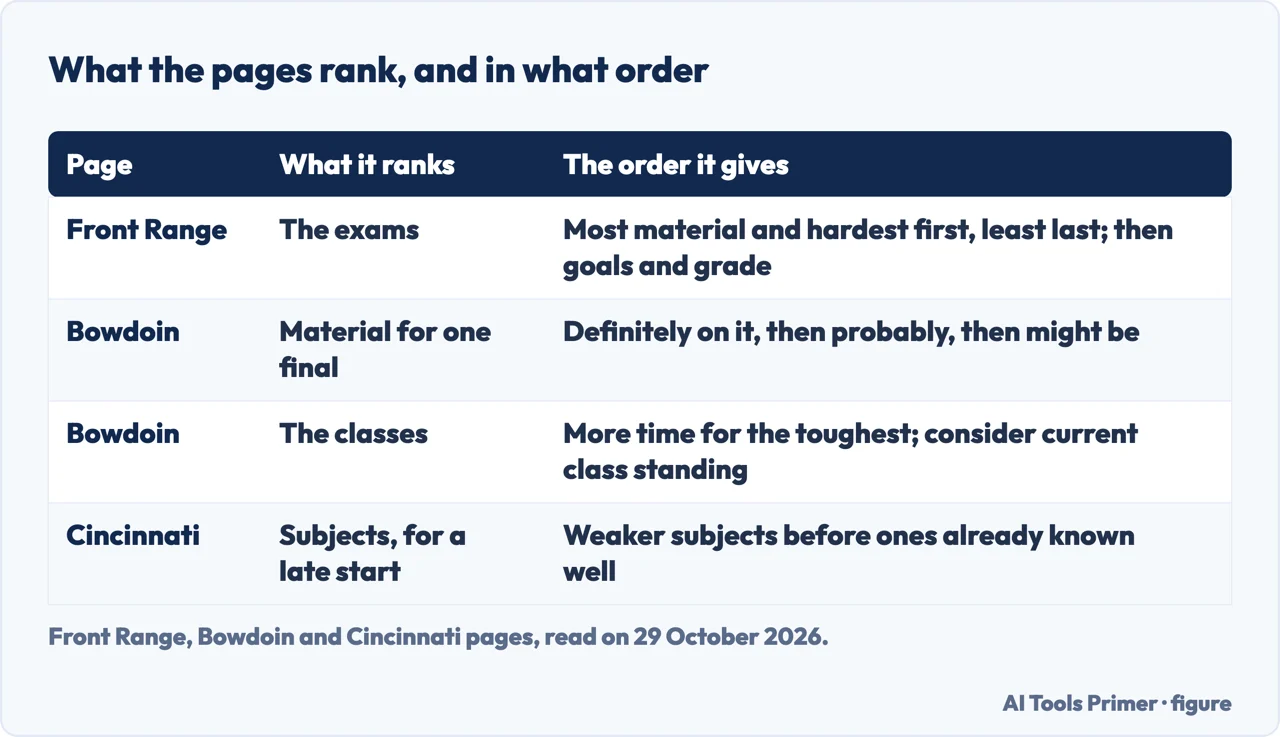
Two pages rank things, and they rank different things. Front Range ranks the exams. It says some instructors give a final that is just another test, others make it cumulative, and that if you are unsure you should check the syllabus or talk to the teacher. Then it says to list what each final covers and put the exams in order from the most material covered, and the most challenging, to the least. The order is then adapted to three things: your goals for each class, the scope and difficulty of the final, and your grade in each class going into finals.
Its three examples show how the adjustment works. A math final may be one of the most in depth, but if you are comfortable with the material and have a strong A, it might go lower on the priority list. A science final worth 20 per cent of the grade, after two weak exams, where the final can replace those grades, is one to spend extra time on. An English final may be the one you feel most prepared for, but with a chance to raise a B to an A, Front Range says you definitely do not want to blow this one off.
Bowdoin ranks the material inside a final, in three steps: study what is definitely on the final, then what is probably on it, then what might be on it. It also asks whether one final is harder than the others and says to give the toughest classes more time, which leaves more time to ask the professor questions, and to consider your current standing in each class. Cincinnati’s list for people who did not start early is a third ranking: put weaker subjects ahead of the ones you already know well, look through study guides, past quizzes and assignments for repeat patterns, make condensed sheets or flashcards, and focus on big-picture concepts rather than memorizing every detail.
The pages differ on the strong subject. Front Range says a strong A might move down the list, though it warns against ignoring a B that could become an A; Cincinnati, in its list for people who did not start early, says weaker subjects go before ones you know well. The pages we read do not say how to combine the three rankings into one order.
What the pages put last, or skim
The pages we read do not tell you to leave a subject out, and they do not use the words abandon or give up. What they offer is an order, and the last items in that order are the natural place to stop if time runs short; the pages themselves say so only for UNC’s readings. The clearest case is in UNC’s weekly plan. If your list takes more hours than you have, UNC says you will likely need to “triage your readings”, and it calls completing all of them a luxury. The decision rests on what is covered in class: read and take notes on everything from the source the class uses most, which may be the textbook or the reading that addresses the day’s topic, and skim the supplemental readings. That advice is about readings, not about whole courses or exams.
Bowdoin’s order puts material that “might be on the final” last. That is the third step of a sequence, after the material that is definitely and probably on the final. Cincinnati’s last-minute list, described above, is another order of this kind. Cincinnati also says that rereading a textbook is not the same as studying, and lists active recall, spaced repetition, practice problems and teaching the idea to someone else as the alternatives. Our page on how to study effectively covers those techniques.
Front Range puts an order on the clock, too. Its advice is not to save the most important studying for after midnight and to do the highest priority work earlier. The pages give an order of attention; the one place they say to skim is UNC’s supplemental readings.
Cut the days into sessions
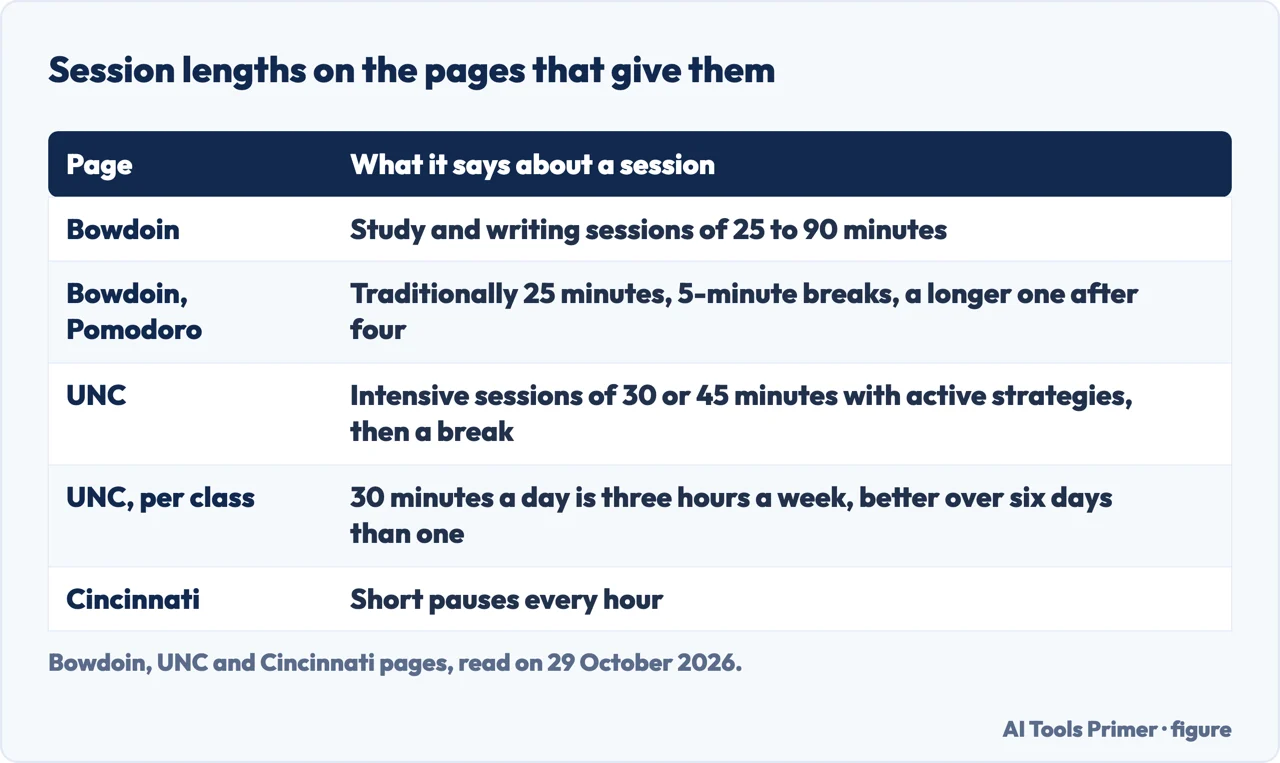
Bowdoin gives study and writing sessions a length of 25 to 90 minutes. For an exam, it says to go through the relevant course material and split it into chunks that fit one session, by topic, book chapter, lecture, problem set or vocabulary set. For a paper or project it says to set milestones such as research, outline, first draft, revision and final paper. Its page on large projects adds two rules: start from the due date, or ideally even two days before it, and overestimate by one third how long each task will take, so that there is built-in buffer time. If a step might take longer than 90 minutes, it says to break it down further.
UNC takes a different angle on length. It calls spacing study out over several short periods across days and weeks one of the most impactful strategies, and says to work a short time on each class every day. Its examples are a few math problems a day instead of all of them the hour before class, and 15 to 20 minutes of actively studying history notes. For intensive sessions it names 30 or 45 minutes with active strategies such as self-testing, followed by a break, and says that planning hours on end of self-testing is likely to cause distraction. It also warns about lighter weeks: 30 minutes per class each day adds up to three hours a week, and UNC says spreading that over six days is more effective than cramming it into one three-hour session.
Cincinnati suggests short pauses every hour. Bowdoin names the pomodoro technique for breaks, which it describes as intervals traditionally 25 minutes long with 5-minute breaks and a longer break after four. It also suggests switching subjects, for example physics in the morning, computer science in the afternoon and English in the evening, and scheduling personal recap sessions to repeat material you have already studied. The pages do not say which session length is the right one: Bowdoin’s range and UNC’s 30 or 45 minutes are two different answers to how long a session lasts; Cincinnati gives only a short pause every hour, not a session length.
One dated countdown, from Front Range
Only one of the four pages puts dates on a plan. Front Range’s example is a cumulative chemistry final that covers six chapters, worked backward from the exam:
- 6 May: final exam.
- 4 to 5 May: review all.
- 1 to 3 May: chapters 5 and 6.
- 28 to 30 April: chapters 3 and 4.
- 25 to 27 April: chapters 1 and 2.
The same post then says plans work best when they are detailed. It suggests a Google sheet that lists, for each class, everything to do each day, because there might be days when you take one final and study for another. Its sample day, 10 May, has four lines: calculus, review the study guide; calculus, address difficult problems from chapter 3; communication, a final look at the study guide and notes; and the communication final at 4:00. We have not built a day-by-day schedule of our own beyond what the pages give.
Three more things sit inside the countdown on the pages. Front Range says to set a reasonable, consistent bedtime and to take breaks, even short ones. Bowdoin says to get about 8 hours of sleep a night in the weeks before finals and, whenever possible, not to cram, because studies show, it says, that cramming can lead to higher stress and reduced success. Cincinnati says all-nighters feel productive but real learning happens when you are rested. Bowdoin also suggests scheduling meals, exercise and self-rewards in the plan.
After the first exam, and what the pages do not say
Bowdoin’s advice does not stop at the calendar. It says to review previous exams and learn from mistakes and test-taking errors, and links an Error Analysis sheet for past exams. The questions it asks are how you studied, whether you prepared effectively and whether you misread the questions. For practice it names exams provided by your professor, questions at the end of a book chapter, or an exam you make yourself from old ones, and it says to think like a professor: notice what the professor focused on in class, homework and quizzes, and predict questions from lecture notes, problem sets and the headings of readings. Our page on taking good notes covers what those notes should hold.
Several things are left unsaid. The four pages we read do not put a two-week calendar in one place that shows what to study each day and what is left out; the closest are Front Range’s chemistry countdown and Bowdoin’s three-step order. The text we read gives no total of hours to study per day in the last two weeks. It does not say how many days are enough for one exam, which is the question behind is 2 days enough. And the number rules that people ask about, 1/3,5/7 and 3/2:1, do not appear on the four pages we read.
What we did not use
We read four university pages for this plan; pages from test-preparation companies, tutoring services and forums were not used. Front Range’s post is dated 23 April 2021, and the Cincinnati address contains 2025/10; the Bowdoin and UNC pages show no date in the text we read, so every statement above is dated by the day we read it.
Where to start
Four ways in.
- “Where do I start?”
- Start with the dates, not the topics — dates
- “Which exam comes first?”
- Rank the exams, then rank what is inside each — rank
- “How long is a session?”
- Cut the days into sessions — sessions
- “Show me dates.”
- One dated countdown, from Front Range — countdown
Studying and notes
The techniques, the notes and the list at the end.
Papers and citations
The written work that sits on the same calendar as the exams.
Questions people also ask
What is the 1/3,5/7 rule in study?
The four pages we read do not mention it. The numbers they give are Bowdoin’s sessions of 25 to 90 minutes, UNC’s 30 or 45 minutes and Cincinnati’s pause every hour.
What is the 3/2:1 rule in studying?
The pages we read do not mention it either. The nearest numbers are Bowdoin’s overestimate by one third for each task and UNC’s 30 minutes per class each day.
Is 2 days enough to study for finals?
The pages we read do not say how many days are enough. Front Range’s chemistry example runs from 25 April to 6 May for six chapters, and Cincinnati has a last-minute list for people who did not start early.
How early should I study for finals?
Bowdoin writes about the final two weeks and says the earlier you start the better. Front Range says finals week should be closer to finals month. UNC spreads short sessions over days and weeks.
Not covered here. We tested no schedule on a real exam period. The statements come from pages of Bowdoin College, the University of North Carolina at Chapel Hill, Front Range Community College and the University of Cincinnati, all read on 29 October 2026.
The search volume and difficulty behind this page come from a Semrush reading of 29 August 2026, older than the 60 days the site normally allows.
Sources
- Bowdoin College, Baldwin Center — Preparing for Finals — www.bowdoin.edu, read 29 October 2026.
- The Learning Center, UNC Chapel Hill — Studying 101: Study Smarter Not Harder — learningcenter.unc.edu, read 29 October 2026.
- Front Range Community College blog — Six Tips for Developing a Finals Study Plan — blog.frontrange.edu, read 29 October 2026.
- University of Cincinnati — How to study for finals in college (and high school) — uc.edu, read 29 October 2026.
Written by Alberto Gulotta
Founder and editor of AI Tools Primer, writing from Palermo, Italy. Thirty-five years of taking computers apart, starting with a Commodore 64 — the long version is on the about page.
Something wrong on this page? Write to aitoolsprimer@gmail.com and it gets fixed.
Written on 29 October 2026.
Independence and limits
No affiliate links and no paid placements anywhere on this site. Nobody pays to appear here, and no company has seen this page before you did.
This is general information, not professional advice. Where a page touches money, health, safety or the law, it names its source and the date it was read — and your situation may still differ. See the privacy page and the cookie policy.