Study · guide
Practice questions: what eight university and research sources say
By Alberto Gulotta · Updated · 17 min read
Practice questions are questions you answer from memory before you check anything. Pages from Duke, Penn, ASU, Barnard, Michigan and others, read on 30 October 2026, agree on the idea and differ on how to write the questions, where to find them, how to check them and what the studies show.
| Question | Answer | Where it comes from |
|---|---|---|
| What counts as one? | Any attempt to recall and then check: practice tests, flashcards, teaching someone, covering the notes | Duke, Frontiers |
| How do I write my own? | One question at each of three levels per key point, or open questions such as a definition or a process | ASU, Barnard |
| Where do ready-made ones come from? | The professor’s course site, the end of the chapter, a library guide, the professor or TA | Penn |
| When do I check the answer? | After trying from memory; Duke and ASU say check right away, Penn says retrieve before looking at the answer | Duke, ASU, Penn |
| Which is better, my questions or ready-made ones? | The pages we read do not compare them | Our reading |
Why answering a question beats rereading
NYIT’s CFE Weekly Teaching Notes, in a note written for instructors and credited to a Brigham Young University teaching center, says rereading is one of the most common study methods among college students and that it can feel productive. It says rereading creates a feeling of familiarity that is often mistaken for knowing the material, a bias it calls “The Illusion of Knowing.” The better method, it says, is what cognitive scientists call retrieval practice, which it describes as a fancy term for an activity such as self-quizzing. Duke’s Academic Resource Center defines retrieval practice as the active process of trying to recall concepts and big ideas, even before you completely know the material, and sets it against glancing over notes or passively underlining.
A practice question is the most direct form of that. Penn’s Weingarten Center, in a two-part series, says professors tell its staff that in STEM courses practice questions are one of the most effective strategies for learning the material. It gives two uses. They can show whether you understand the lectures, and they can show gaps: if you keep getting a topic wrong that you feel you understand, that is a sign to go back to the material, and if you keep getting it right, that shows solid understanding. The page adds that the best way to prepare for a test of solving or answering questions is to practice what the exam will ask, and compares skipping that to training for a marathon by walking a few times beforehand.
Frontiers in Education carries the numbers. Its 2021 meta-analysis of the ten learning techniques that Dunlosky and colleagues reviewed in 2013 covers 242 studies and 1,619 effects. Practice testing came out at an average effect size of 0.74, second of the ten behind distributed practice at 0.85, and well above re-reading at 0.47; the overall average was 0.56. The paper defines practice testing as any activity where the student practices retrieval, reproduces the information in some form and checks it against an accepted correct answer, and it lists completing questions from textbooks or previous exams and self-generated flashcards among the examples students can do alone. It adds that the effect is strong whatever the form of the test, even when the practice format does not match the final test.
Our page on how to study effectively sets out Duke’s self-quizzing steps and the case for spacing, so we do not repeat it here. This page is about the questions themselves.
Writing your own: three levels, two open forms
ASU’s University College gives a study guide in three steps: find out what the test will cover and in what format, write the questions, then test yourself. For the first step it says to ask which lectures and readings the test covers, how much comes from lectures and how much from readings, and whether the format is multiple choice, essays or short answer. If past tests exist, it says to look at whether their questions are factual, conceptual or analytical.
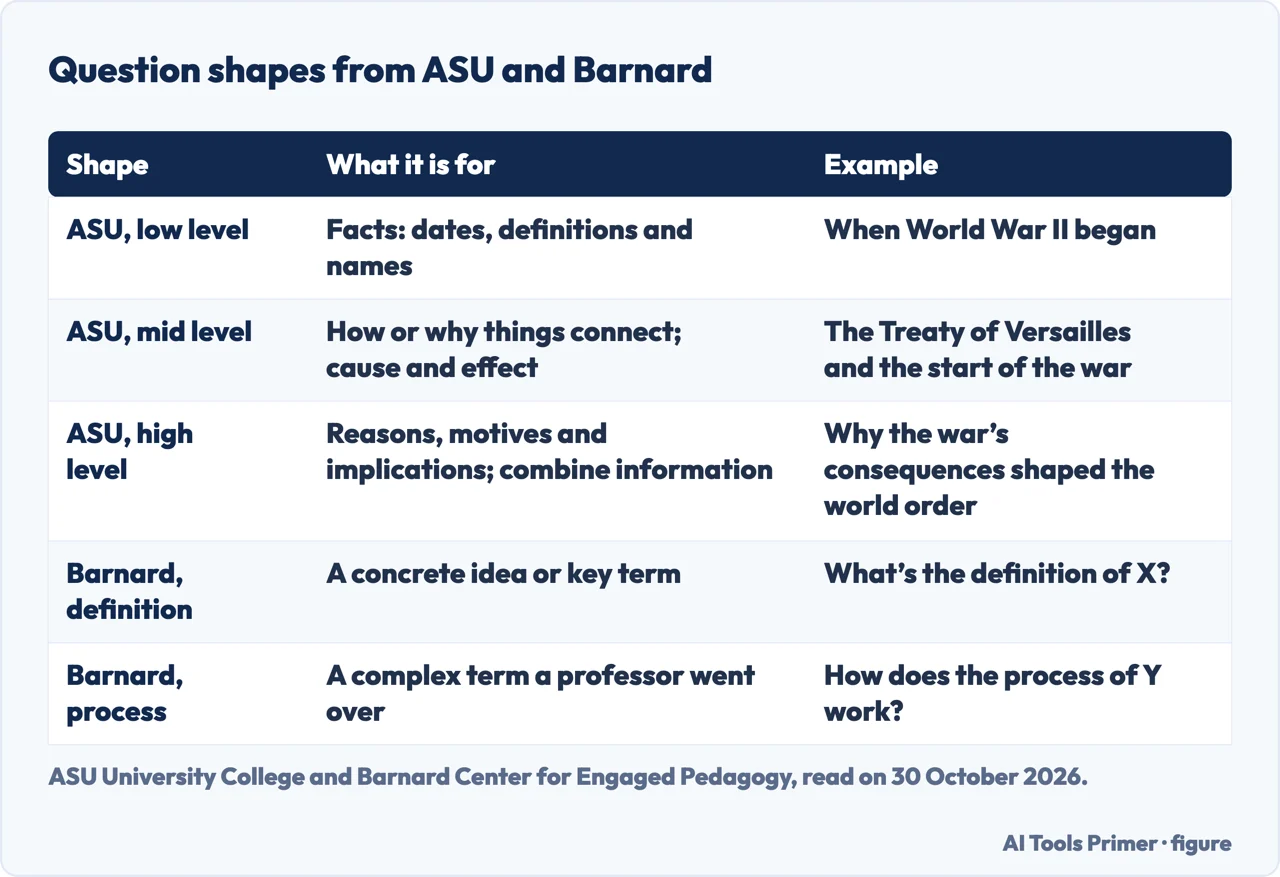
For the second step it says to go through your notes and readings and write questions at three levels. A low-level question asks for a specific fact such as a date, a definition or a name, and the answer can be found directly in your materials. A mid-level question asks how or why things are connected, a cause and effect, or how one event influenced another. A high-level question asks for reasons, motives or implications, may combine several pieces of information, and challenges you to form an argument or think about long-term effects. All of ASU’s examples are about World War II, from the year it began to the consequences that shaped the modern world order. Its suggested action is to pick one lecture topic and, for each key point, write one question at each level.
Barnard’s Center for Engaged Pedagogy, in its note-taking guide published in 2021 and updated in 2024, suggests digital flashcards (Quizlet or Anki) and also open questions. For a concrete idea or key term it suggests asking “What’s the definition of X?” or what other terms and processes are related to it, and for a complex term a professor went over, “How does the process of Y work?” The guide says to try to answer from memory first and then look back at the notes, or to have a friend ask the questions. For humanities courses it suggests writing your own exam questions from the instructor’s seat and then answering them.
The University of Michigan’s LSA study-skills site turns the same idea into a prompt: pretend you are teaching the class and write your own test questions. It asks what key information you would test, how you would answer, and how many of your questions end up on the tests, and says a strategic preparer sees more of them appear on each later exam. It also says to anticipate questions during regular review of lecture notes, and that textbook headings and highlighted or italic material give clues. For essay exams it says to write a thesis statement, collect supporting details, outline, and try a complete answer without memorizing it, so you are ready for variations in how the question is worded.
The pages differ on what counts as a question. Duke and NYIT include flashcards and explaining a topic to someone else. Duke lists a self-made practice test, flashcards with Anki and Quizlet as examples, teaching a study partner, and a zero-preparation method called copy-cover-check, in which you cover the content and try to recall at least two main ideas. ASU and Barnard write out full questions (Barnard also suggests digital flashcards), and Penn’s series is about practice questions in STEM courses.
Where ready-made questions come from
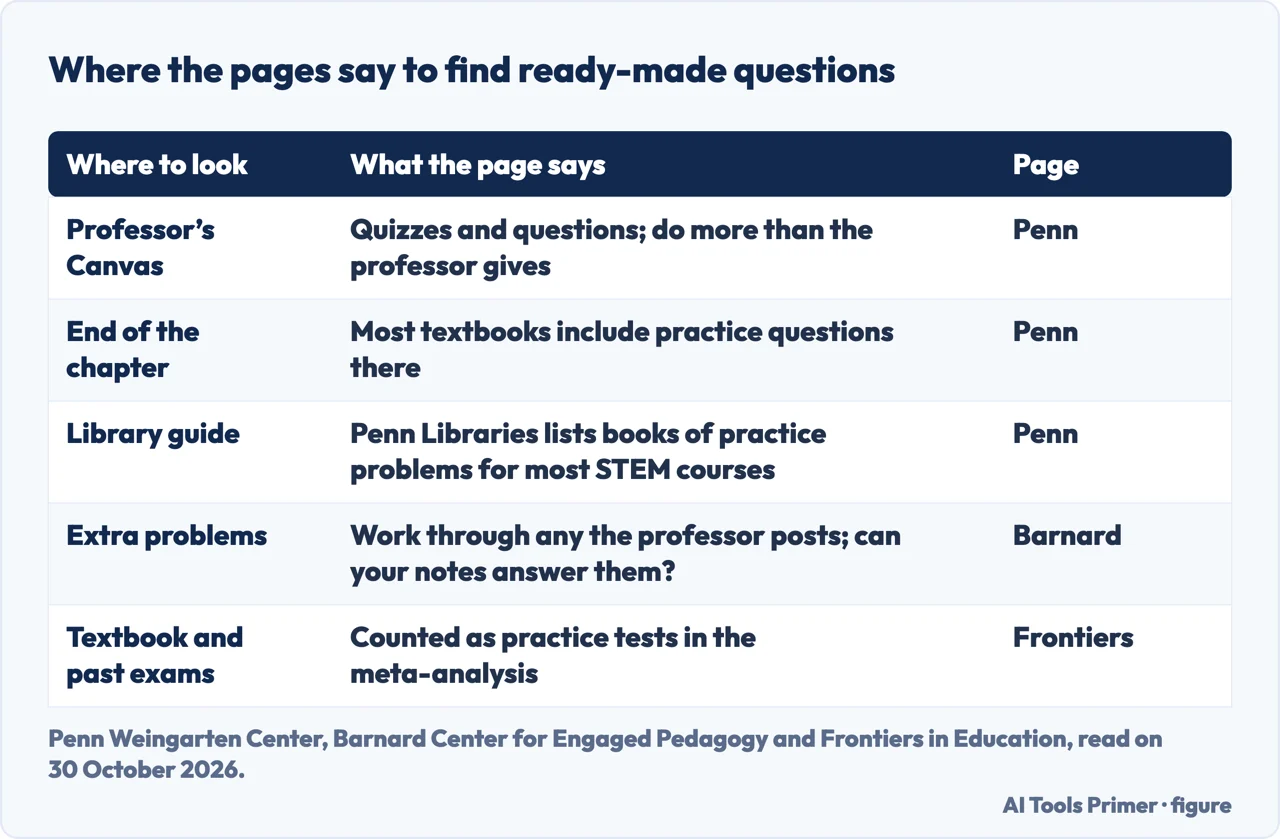
The second part of Penn’s series answers this directly. The professor may give practice quizzes and questions on the course site, but Penn says you should be doing more questions than the professor provides. Most textbooks include practice questions at the end of the chapter, and Penn Libraries has a guide with books of practice problems for most STEM courses. It also says to ask the professor or TA for resources they think are good. The first part points to the Penn Libraries guide on practice problems in maths and science for a quick tutorial on using practice exams.
NYIT, writing for instructors, lists the same sources from the other side: show students how to use the questions in the textbook, help them form study groups where they ask each other questions, and invite them to create practice tests together and then take them. Barnard says to work through any extra practice problems the professor posts, and adds that whether your notes let you answer them also helps show whether you are taking away the key points from class. Frontiers counts questions from textbooks and previous exams as practice tests.
To supplement them, Penn gives fallbacks. Look for online video explainers on a specific topic and summarize them afterwards, so you are not just listening. Request a tutor or go to a drop-in session, where having done practice questions already gives you a specific area to discuss, and tutors may show resources they have used. Work with classmates, because teaching others is a good way of reviewing. Michigan adds a way to learn from an exam that has already happened: match each test question to its source, whether readings, lectures, headings or class questions, and use that to see what to study.
Using them: order, records and checking
Penn’s first part gives a procedure. Start as early as possible, after lectures, and do questions as many times as possible before an exam. Begin with an equal number of questions per topic so you can see where the gaps are. Do not worry about the time on each question, but fix the total study time, and the page recommends an hour to two hours per lecture. Keep track of your confidence. If you are confident on a topic but the results do not match, you may be making small mistakes or overestimating your understanding; if the opposite, you may be guessing and lucky, or understanding and underestimating yourself. Then do more questions on the weaker topics without dropping the others, and try a couple of practice exams, one a week before and one a couple of days before.
The second part adds a record: group the questions by topic and note your confidence and how difficult each felt. A topic you got right but found hard and slow may need more practice for speed rather than for correctness. And once a topic improves, shift your effort, because time spent on a topic that was weak at first may be better spent on another difficult one.
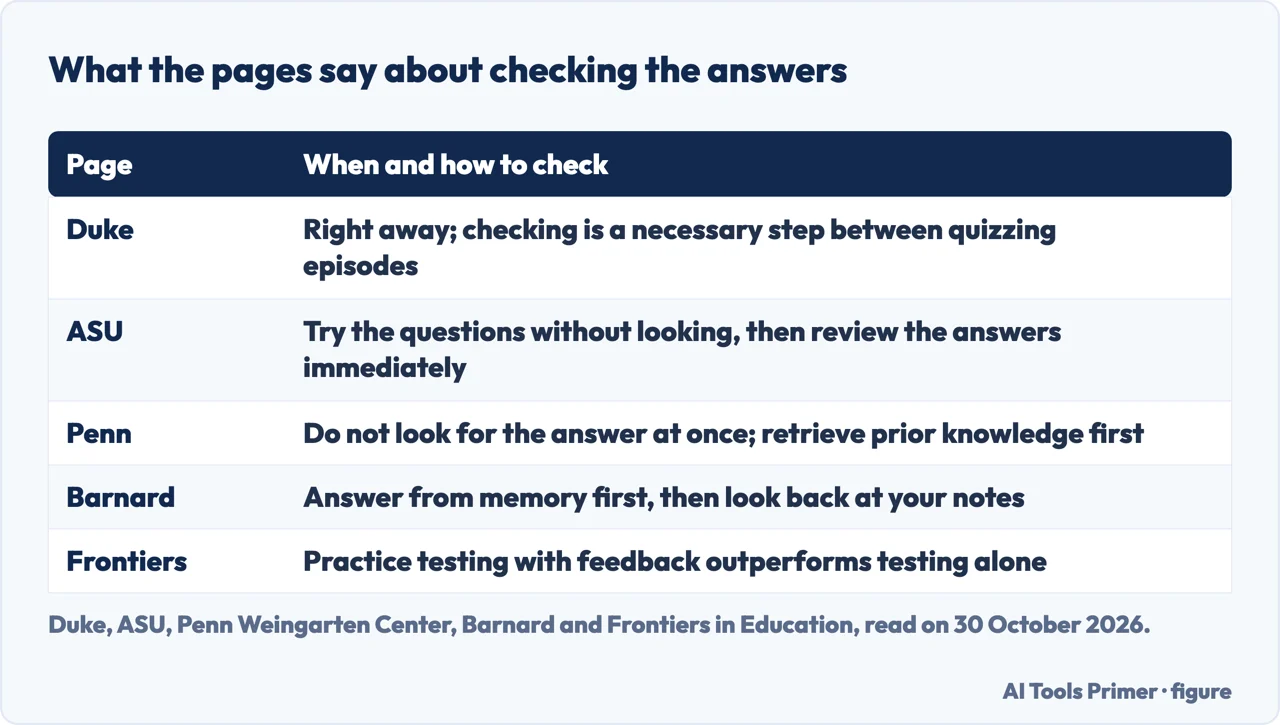
On checking, the pages agree on the order and use different words. Duke says to follow up immediately with feedback or self-checking, calls checking answers a necessary step between quizzing episodes, and says mistakes show you where to focus your time and energy. ASU says to answer without looking, say the answers out loud, review them right away, explain the ideas to someone else, and go through the whole study guide twice before the test. Penn says to avoid looking for the right answer at once and to try to retrieve prior knowledge instead. Duke also says to practice retrieval in different formats, visual, textual and graphic, and in several episodes spread across daily and weekly sessions.
Limits: what the studies measured and what they did not
A Learning Scientists post of 24 October 2019 describes an experiment by Vaughn and Kornell, and its first point is about what students choose. Students report using self-testing to gauge how much they know, not as a way to learn. In the experiment they studied 60 unrelated word pairs and then picked, for each pair, among four options with 0, 2, 4 or 6 letters of the answer shown. Six letters meant plain restudy; the other three meant retrieval with more or fewer hints. The 4-letter option was chosen most often, and 71 percent agreed it was the most fun, against 11 percent for the 6-letter option and 0 percent for the 0-letter one. When only the 0-letter and 6-letter options were offered, restudy took about 80 percent of the trials.
All three retrieval options improved a final test given two minutes later more than restudy did. The post adds a caveat: students must actually retrieve. If a word pair allowed correct guessing from the clue alone, more hints worsened the result. The setting matters too. The words were unrelated, the test came two minutes later and it was an experiment on word pairs, so the post does not say what happens with written course questions weeks before an exam.
Frontiers lists its own limits. Most studies in the meta-analysis measured surface or factual outcomes, and the paper advises caution for deeper ones. Most, 68 percent, were evaluated within a day, usually immediately. Across all ten techniques the mean effect was 0.47 for low-ability students and -0.11 for high-ability ones, but only 13 and 6 of the 242 studies covered those two groups. The paper also names feedback as a major moderator: it quotes Dunlosky and colleagues that practice testing with feedback consistently outperforms practice testing alone, and warns that practising wrong answers can turn errors into high-confidence ones. It says it is not the frequency of testing that matters but the skill in using it.
Duke suggests using Duke Copilot or Duke GPT to make practice test questions tailored to your knowledge gaps. The page does not say how to check what such a tool writes. Michigan asks how many of your questions end up on the tests, which is a count made after the exam.
Where the pages differ and what they leave out
On when to start the pages concur: Penn says early, after lectures; ASU says early and not a few days before the test; Duke says to start before you completely know the material. On how often they differ in emphasis. ASU asks for two passes through the study guide, Penn for as many times as possible, and Frontiers repeats Dunlosky and colleagues’ conclusion that more practice testing is better, but says it would be a mistake to claim there should be more testing, and that it is not the frequency of testing that matters but the skill in using it. On time, Penn says to fix the total study time and not to worry about the time on each question.
The pages also split on where the question comes from. Duke, NYIT, ASU, Barnard and Michigan describe questions written by the student, while Penn’s second part and NYIT point to questions already written. Several things are left unsaid. The pages we read do not say which of the two routes works better. They do not say how to tell that a question you wrote is too easy; Michigan’s count of how many reached the exam comes afterwards. They do not give a number of questions per topic, only Penn’s equal number for each. And Frontiers lists self-generated flashcards only as an example of practice testing, so the pages we read do not show that self-written questions give the same effect as the tests in the studies.
If the questions are the plan, the calendar comes next: how to study for finals effectively covers the dates and session lengths, and taking good notes covers the material the questions are written from.
What we did not use
We did not test any of these methods ourselves. We did not read commercial practice-test and quiz sites: ProProfs, TestPrep-Online, ACT, Criteria, Test Prep Review, SHL and Pocket Prep. We read the Study Guide Zone page of exam questions and did not use it. The Duke page is dated 22 August 2025, the NYIT note 3 April 2024 and the Barnard guide was last updated on 29 July 2024; the Learning Scientists post and the Michigan page carry their dates in their addresses, 24 October 2019 and 1 September 2022.
Where to start
Four ways in.
- “How do I write them?”
- Writing your own: three levels, two open forms — write
- “Where do I find some?”
- Where ready-made questions come from — find
- “How do I use them?”
- Using them: order, records and checking — use
- “Do they always work?”
- Limits: what the studies measured and what they did not — limits
Studying and planning
The techniques, the calendar and the notes the questions come from.
Records and papers
What to keep while you read, and the written work after the studying.
Questions people also ask
What is a practice question?
Frontiers defines practice testing as any activity where the student practices retrieval, reproduces the information and checks it against an accepted correct answer. Duke counts practice tests, flashcards, teaching someone else and copy-cover-check.
What are some practice questions?
ASU’s examples are about World War II: what year it began, how the Treaty of Versailles contributed to the start, and why its consequences shaped the modern world order. Barnard’s are “What’s the definition of X?” and “How does the process of Y work?”
Is it practice or practise questions?
The pages we read do not discuss the spelling; all of them write "practice" (practice questions, practice testing). We did not check a dictionary or style guide, so we do not say which form is correct.
How to write practice questions?
ASU says to write one question at each of three levels, factual, conceptual and critical thinking, for each key point. Barnard suggests definition and process questions, and Michigan says to write test questions as if teaching the class.
Not covered here. We did not test these methods ourselves. The statements come from pages of Duke, NYIT, Penn, ASU, Barnard and Michigan, a Learning Scientists post and a Frontiers in Education paper, all read on 30 October 2026.
The search volume and difficulty behind this page come from a Semrush reading of 29 August 2026, older than the 60 days the site normally allows.
Sources
- Duke Academic Resource Center — Retrieval Practice — arc.duke.edu, read 30 October 2026.
- NYIT CFE Weekly Teaching Notes — Retrieval Practice: A More Effective Way to Study — nyit.edu, read 30 October 2026.
- The Learning Scientists — Making Tests (More) Fun Through Hints Increases Student Uptake Of Self-Testing — www.learningscientists.org, read 30 October 2026.
- Penn Weingarten Center — Why Use Practice Questions? — weingartencenter.universitylife.upenn.edu, read 30 October 2026.
- Penn Weingarten Center — How to Use Practice Questions — weingartencenter.universitylife.upenn.edu, read 30 October 2026.
- ASU University College — Study Guide Framework for Better Learning and Memory — universitycollege.asu.edu, read 30 October 2026.
- Barnard Center for Engaged Pedagogy — Note-Taking Guide — cep.barnard.edu, read 30 October 2026.
- University of Michigan LSA Study Skills — Final Preparation for the Exam — sites.lsa.umich.edu, read 30 October 2026.
- Frontiers in Education — A Meta-Analysis of Ten Learning Techniques — www.frontiersin.org, read 30 October 2026.
Written by Alberto Gulotta
Founder and editor of AI Tools Primer, writing from Palermo, Italy. Thirty-five years of taking computers apart, starting with a Commodore 64 — the long version is on the about page.
Something wrong on this page? Write to aitoolsprimer@gmail.com and it gets fixed.
Written on 30 October 2026.
Independence and limits
No affiliate links and no paid placements anywhere on this site. Nobody pays to appear here, and no company has seen this page before you did.
This is general information, not professional advice. Where a page touches money, health, safety or the law, it names its source and the date it was read — and your situation may still differ. See the privacy page and the cookie policy.