
Study · guide
How to take notes from a textbook: five pages compared
By Alberto Gulotta · Updated · 18 min read
How to take notes from a textbook gets different timings from five college and university pages, all asking for your own words: UNC says after a paragraph or up to a page, Cornell College says not while reading, Cornell's P2R says during ten pages, and a Bristol student says skim first.
| Question | Answer | Where it comes from |
|---|---|---|
| Should I copy the text down? | UNC says copying does not engage your brain and is not a strong strategy for learning and remembering | UNC Learning Center |
| When do I write? | UNC says after a paragraph or two, up to a page; Cornell College says after at least a paragraph, not while reading; Cornell’s P2R says during ten pages | UNC, Cornell College, Cornell Learning Strategies Center |
| How much do I read before stopping? | Ten pages in Cornell College and P2R; one section under a heading in SQ3R; a paragraph or two to a page at UNC | Cornell College, Cornell Learning Strategies Center, UNC |
| How long on a page? | Cornell College says 5 minutes a page for the average college student; a Bristol student says there is no perfect amount | Cornell College, Bristol Study Skills |
| How do I close a chunk? | A summary in your own words, then the questions you wrote in the margin, answered without the book | Cornell College |
Why not copy or highlight everything
The Learning Center at the University of North Carolina at Chapel Hill says good notes can take different forms and may vary from person to person, or even from text to text. Its handout names one key idea: it is not necessary to copy down loads of information from the text. Copying, it says, “does not engage your brain” and is not a strong strategy for learning and remembering content, and it takes a lot of time and energy. Highlighting loads of information is simpler, UNC says, but does not do much to engage the brain either. The handout lists what good notes can do: organize your ideas, keep you focused and engaged, keep a record of what you read so it is easier to locate later, help you think critically and identify main ideas, prepare you for class, and give you material for exams or assignments.
Cornell College’s Office of the Registrar starts from a different picture. It says many students pick up a textbook, read 50 pages straight through from front to back and assume the assignment is done, and that these students often struggle to take part actively in class discussion and may not do well on tests. It says there are better methods, and the page that follows describes one. It also says to keep notes in your own words rather than the book’s, which it says helps you avoid plagiarism in papers and makes you think more about the reading, which in turn helps you retain the material.
The Bristol post is written by a student, so it reports a habit, not a rule of the university. Its author says being selective about what gets written stopped the creation of lots of notes copied directly from the textbook and never read again. Sheridan College’s library guide puts the problem at the level of reading itself: it says simply reading through your texts will not be enough to retain the information and build connections between content, and that you need active reading techniques and to engage with the text as you take notes.
Look first, and how much to read
Cornell College calls the first step Preview, and compares it to reading a tourism book or looking at a map before travelling to another country. You read the section titles, or the first lines of paragraphs if there are no titles; you read the last paragraph; you glance over charts or photos; and you read any study questions or summaries at the end of the chunk. Then you stop to think about the main topic of the section, what you already know about it, and your biggest question. Cornell’s Learning Strategies Center gives two versions. Its P2R system has you read the introduction, or the first couple of paragraphs if there is none, page through the headings, glance at charts, graphs, diagrams or pictures, and read the last paragraph or two, to get an overview and a sense of how the ideas progress. Its SQ3R system, which it attributes to Francis P. Robinson, a psychologist from Ohio State University, begins with a survey of the headings and the final summary paragraph, which the page says should take no more than a minute or two. UNC’s tips include previewing the chapter by looking at the text features for clues about its main ideas.
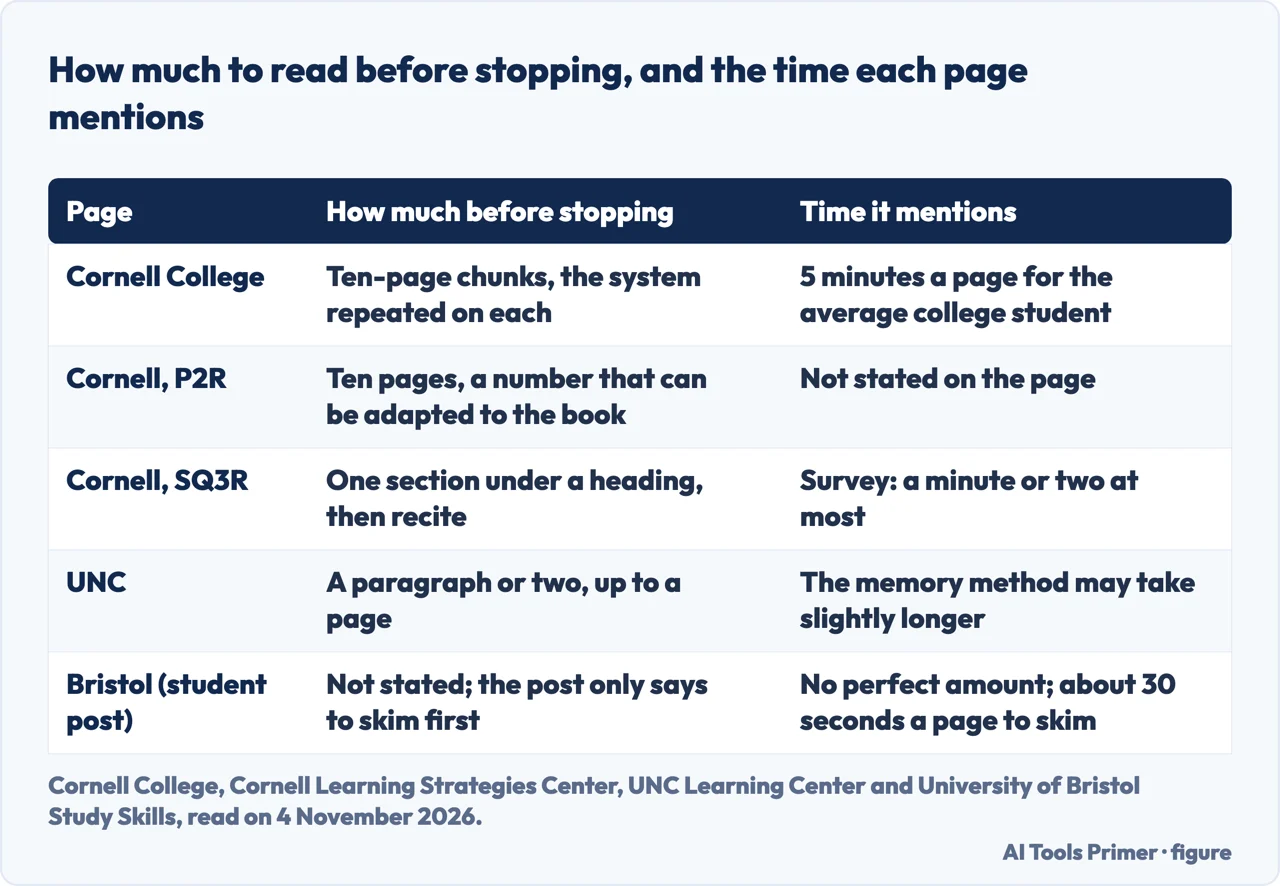
The Bristol post also puts skimming before notes and gives a reason. Its author says to learn to skim read before starting any notes, looking for key words (usually bold), diagrams and sub-headings, and says that writing and highlighting the first time through a passage is not effective because it is hard to predict whether a sentence is important. To avoid getting caught up in details, the author set a timer for around 30 seconds a page at the beginning. That is a personal practice for skimming. It is not a reading time, and it is not the same thing as the figure Cornell College gives. Cornell College says to multiply the pages you have to read by 5 minutes, which it calls the amount of time the average college student needs, and to spread that time out: for four hours of reading, it suggests an hour before class in the morning or over the lunch break instead of reading from 7 to 11 p.m. straight through.
On how much to read before stopping, the pages again differ. Cornell College divides the reading into ten-page chunks and says to finish the whole system on one chunk before moving to the next. The P2R page also marks ten pages, adding that the number can be adapted to the particular book. SQ3R works one headed section at a time. UNC’s memory method uses a paragraph or two, up to a page. The Bristol author says there is no perfect amount of time or secret formula, and that each textbook has different requirements. The pages we read do not say which unit of reading works best.
When to stop and write
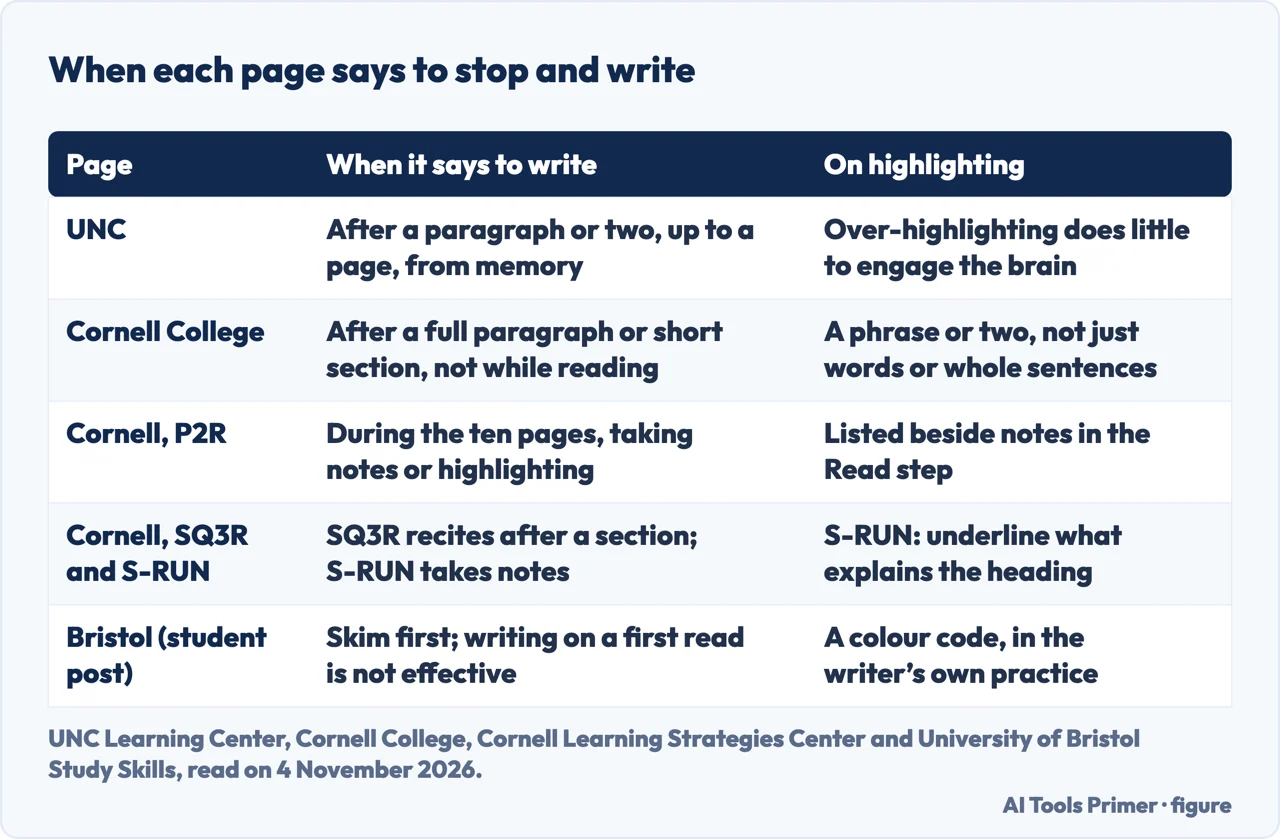
This is where the pages part company. UNC says to read a short section, likely a paragraph or two or up to a page, pause to think about what you just read, and then take notes from your memory of it. It says this helps you focus on the main points instead of getting caught up in details, and that it is fine not to remember everything: focus on the main points and go back to the text to fill in details. For digital notes it suggests a Word or Google document for each article or textbook chapter, with a summary of the key points written without looking back at the text and the details filled in afterwards. UNC adds that the method may take slightly longer and that many students say it is worth it for the gain in comprehension. A separate tip in the same handout says to wait until the end of a page to take notes, so that you can summarize in your own words rather than copy.
Cornell College also has you read a paragraph first, but what it does at the pause is different: it marks the book instead of writing from memory. It says not to take notes or highlight as you read, because that breaks up your flow and diminishes your understanding, and because you do not know whether the first sentence is worth a note until you have read the third. Read at least one complete paragraph or a short section first. Then highlight a phrase or two, not just words and not whole sentences, with dates and definitions as the exceptions. Its test is that you could re-read only the highlighted part in a month and get the gist of the paragraph. After that you write a question or two in the margin, or on a post-it if you are not writing in the book, and when the ten pages are done you try to answer them without looking at the book. If you have to look, you underline that highlighted passage to show it needs more study.
The Learning Strategies Center’s P2R is looser: mark ten pages and read them while taking notes or highlighting the important information. Its S-RUN system, adapted from Van Blerkom (2009), reads the section, underlines the material that explains the heading, and only then takes notes summarizing the main points. In SQ3R the Recite step comes after each headed section: you look away from the book and try to recite the answer to your question in your own words, and glance over the section again if you cannot. Writing is only one of the five ways the page lists for reciting, and it mentions notes themselves only in the final Review step, where you look them over. Bristol’s student says writing and highlighting the first time through a passage is not effective, and says to write margin questions as they arise but answer them after you finish reading, since the author says answering as they appear leads into a Google “rabbit-hole” and procrastination. The pages we read do not say which of these timings produces the best results.
Three ways to put it on paper
Marking the text. UNC says that if you have a print version that allows it, you simply use a pen or pencil: underline, circle or highlight key words and phrases, and annotate the margins with symbols, abbreviations or summaries in your own words. For an online text, some digital programs allow annotating, highlighting and commenting, and otherwise UNC says to grab a plain sheet of paper, label it with the text and the chapter or page number, and jot your thoughts, key words and summaries there. Cornell College says writing in the book is highly recommended and gives post-its as the substitute, and asks for a highlighter of a different color if the book is already highlighted by a previous reader. The Bristol author uses a highlighter colour code that forces each sentence to be characterised as it is read, and in library books uses a post-it for questions and index tabs in place of highlighting.
A page with two columns. UNC describes Cornell-style notes: divide a sheet into three sections, with about two inches blank at the bottom and the top portion split into a left third and a right two thirds. Notes go on the right, key words or questions on the left, and a summary of the whole page at the bottom. UNC links to a fuller explanation. Our page on taking good notes covers the five steps Cornell publishes for its system.
A map, a table or an outline. UNC suggests a graphic organizer or concept map for texts with higher-level concepts that need explanations, or with remember-level facts, dates and terms: a concept map, table, flow chart, hierarchy, timeline or Venn diagram, to separate main ideas from support. It also suggests writing your own questions from headings and keywords before you begin, then looking for the answers as you read. Sheridan’s guide points to images and Concept Mapping for readers who remember visuals, and the Bristol author, a life sciences student, finds the outline method helpful. UNC’s handout also lists two apps, EverNote and OneNote, which it says sync notes across devices; our page on note apps compared looks at that kind of tool.
Closing a chunk
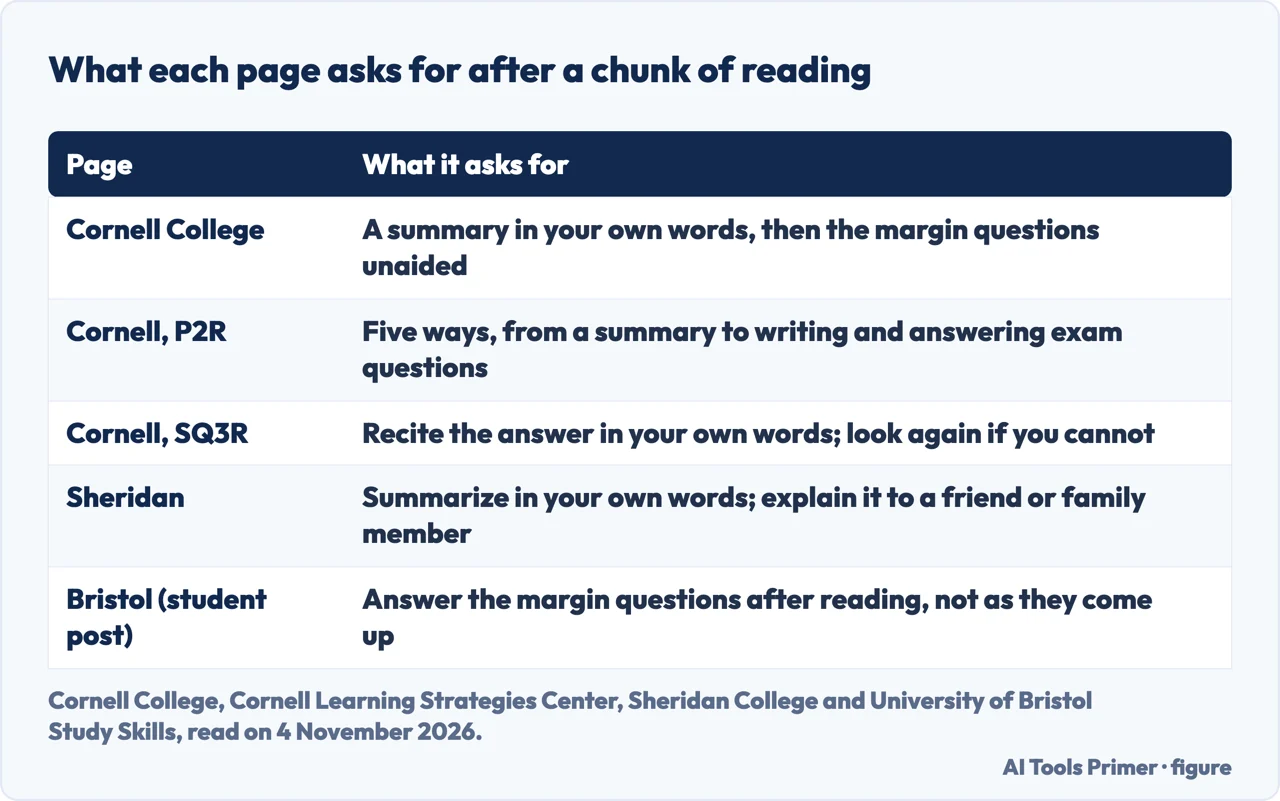
Cornell College’s Review step comes at the end of the ten pages. You think about the section as a whole, go to a clean sheet of paper or a reading journal, and write a summary in your own words, not quotes from the book. Then you make broad observations about how it connects to other things you knew or have read, or any feelings about it, go back to answer the questions in the margins, and start again with the next ten pages. Its page also treats the reading as preparation for class: on a sheet or notecard you write questions you want to ask, observations or opinions you want to share, and, if useful, page numbers and quotes to discuss. When the whole assignment is finished, it says to finish the reading journal and organize the note cards or the split sheet so you are ready for class the next day.
The Learning Strategies Center offers five ways to review after ten pages: summarize the author’s main points in your own words; write three or four sentences summarizing what you read; close the book and recite the key information under each heading; quiz yourself on the questions or problems at the end of the chapter; or write the questions you may see on the exam about the material and answer them. In SQ3R the final Review step is to look over your notes for a bird’s-eye view of the points and how they relate, then cover the notes and try to recall the main points and the subpoints under each.
Sheridan lists ten active reading tips, which it says involve thinking, questioning, writing, summarizing, reflecting and talking out loud. Several fit the end of a chunk: summarize in your own words and try explaining the topic to a friend or family member to see how well you can; link what you read to what you already know; look for themes, patterns and relationships between readings; make connections to your class notes; create your own examples of a new concept; and reflect on why the information is important. The page was last updated on 28 September 2026. Cornell College adds three tips: read out loud if something is not making sense, look up the important words you do not know, and ask the professor by email or in person, or get a tutor.
What the pages do not say
- PDFs. The pages we read do not mention PDFs. The nearest line is UNC’s advice for online texts: a plain sheet of paper labelled with the text and the chapter or page number.
- Hand or keyboard. The pages we read do not compare handwriting with typing. UNC describes a document per article or chapter for digital notes, and Cornell College says paper or notecards, depending on your preference.
- How many notes are enough. The pages we read do not say how many notes are enough, and they do not mention exam results for these methods. Cornell College gives its 5 minutes a page as the time the average college student needs, and the page does not say where the figure comes from.
- Dates and authorship. The Cornell College, Cornell Learning Strategies Center and UNC pages carry no date. Sheridan’s was updated on 28 September 2026. The Bristol post was published on 24 January 2022 and is a student’s account of a personal method.
- Pages we did not use. We did not read commercial blogs, forum threads or community questions on the same topic; the statements here rest only on the five pages in Sources. Parts of UNC’s handout point to other handouts, on annotating and highlighting, that we did not open.
Recording the source. The pages we read do not mention recording an author and page number for a citation. Two of them come close to the subject: UNC lists keeping a record of what you read so you can locate it later and a label of text and page on its sheet, and Cornell College suggests jotting page numbers and quotes for class discussion. If the notes are headed for a paper, our pages on writing a bibliography and footnotes cover what has to be recorded while you read. For what to do with the notes weeks later, see how to study effectively, spaced practice and practice questions.
Where to start
Six ways in.
- “Should I just copy the book?”
- Why not copy or highlight everything — copy
- “What do I do before the first note?”
- Look first, and how much to read — preview
- “When do I stop and write?”
- When to stop and write — when
- “What do I write on?”
- Three ways to put it on paper — paper
- “What do I do after a chapter?”
- Closing a chunk — close
- “What about PDFs?”
- What the pages do not say — said
Studying and practice
What to do with the reading once it is in your notes.
Notes and sources
What to write down while you read, and where to keep it.
Questions people also ask
Should I take notes from my textbook?
UNC says good notes keep you focused, leave a record of what you read and prepare you for class and exams, but not by copying loads of text. Sheridan says reading through texts will not be enough to retain the information. Cornell College says to read at least a paragraph before stopping to take notes.
How to take notes while reading textbook?
UNC says to read a paragraph or two, up to a page, pause, then write from memory. Cornell College says to read a paragraph, highlight a phrase or two, write a margin question, and summarize in your own words after ten pages. Cornell’s P2R takes notes or highlights during the ten pages.
How to take notes from a textbook PDF?
The pages we read do not mention PDFs. For online texts, UNC says some digital programs allow annotating, highlighting and commenting, and otherwise to use a plain sheet of paper labelled with the text and the chapter or page number.
What is the 5 finger rule for books?
The pages we read do not mention a five finger rule for books. What they cover is what to do once the book is open: preview, read in chunks, write, and review.
Not covered here. We tried none of these methods on a textbook. The statements come from pages of UNC, Cornell College, Cornell University’s Learning Strategies Center, Sheridan College and the University of Bristol, all read on 4 November 2026.
The search volume and difficulty behind this page come from a Semrush reading of 4 November 2026, within the 60 days the site normally allows.
Sources
- UNC Learning Center — Taking Notes While Reading — learningcenter.unc.edu, read 4 November 2026.
- Cornell College, Office of the Registrar — Reading a Textbook for True Understanding — www.cornellcollege.edu, read 4 November 2026.
- Cornell University Learning Strategies Center — Textbook Reading Systems — lsc.cornell.edu, read 4 November 2026.
- Sheridan College Library & Learning Services — Taking Notes from Textbooks & Course Readings — sheridancollege.libguides.com, read 4 November 2026.
- University of Bristol Study Skills — How I make notes: From a textbook — studyskills.blogs.bristol.ac.uk, read 4 November 2026.
Written by Alberto Gulotta
Founder and editor of AI Tools Primer, writing from Palermo, Italy. Thirty-five years of taking computers apart, starting with a Commodore 64 — the long version is on the about page.
Something wrong on this page? Write to aitoolsprimer@gmail.com and it gets fixed.
Written on 4 November 2026.
Independence and limits
No affiliate links and no paid placements anywhere on this site. Nobody pays to appear here, and no company has seen this page before you did.
This is general information, not professional advice. Where a page touches money, health, safety or the law, it names its source and the date it was read — and your situation may still differ. See the privacy page and the cookie policy.