
Detect · guide
AI voice detectors and the limits their own pages state
By Alberto Gulotta · Updated · 16 min read
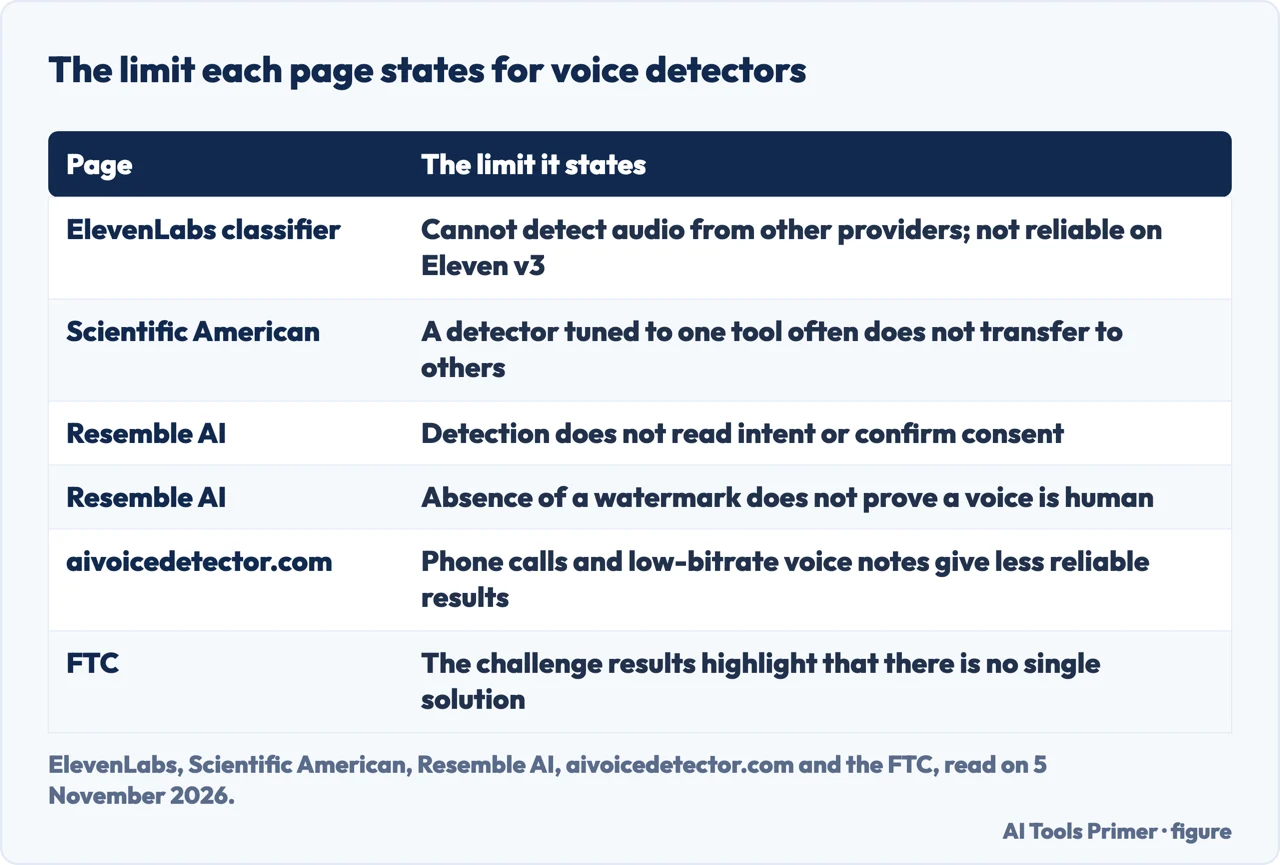
An AI voice detector returns a score, and the pages we read say what it cannot settle. Scientific American reports that listeners flagged fake voices 60 percent of the time. ElevenLabs says its classifier covers only its own audio. Resemble says a missing watermark does not prove a voice is human, and the FTC says there is no single solution.
| Question | Answer | Where it comes from |
|---|---|---|
| Can listeners tell by ear? | In one study, listeners asked to flag artificial voices did so 60 percent of the time | Scientific American |
| Does one detector cover every generator? | ElevenLabs says its classifier cannot detect audio from other providers; Scientific American reports that a tuned detector often does not carry over | ElevenLabs, Scientific American |
| What does a phone call do? | Resemble says compression and re-encoding remove detail; aivoicedetector.com says phone calls give less reliable results | Resemble AI, aivoicedetector.com |
| Does a missing watermark mean the voice is real? | Resemble says it does not, because most generators do not watermark | Resemble AI |
| What does the FTC say? | Its 2024 challenge results highlight that there is no single solution | FTC |
Why a voice is hard to judge by ear
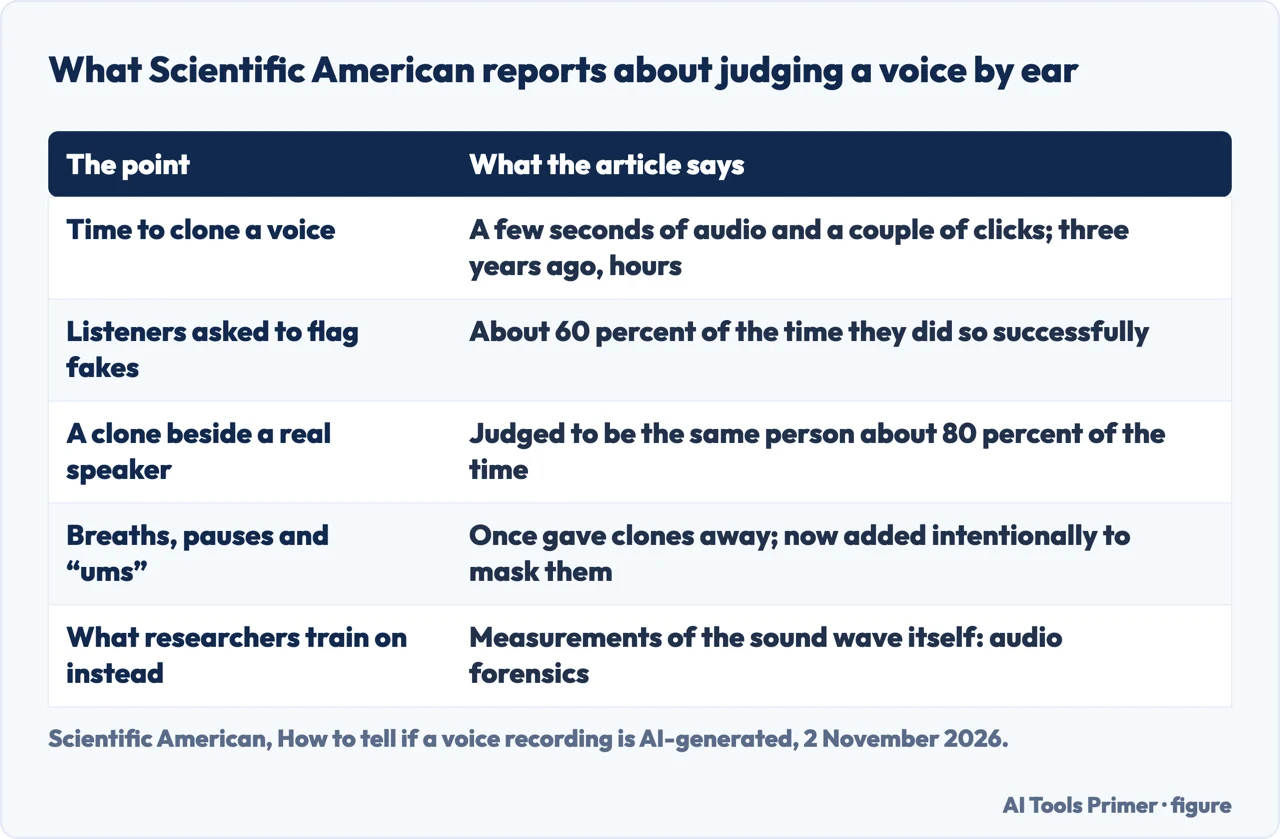
Scientific American’s article of 2 November 2026 says that three years ago cloning a voice took hours of recorded speech and a host of specialized tools, and that now it takes a few seconds of audio and a couple of clicks. The author, a science journalist with a background in acoustic analysis, cloned the author’s own voice with a free, open-source tool. Sarah Barrington, a doctoral candidate at the University of California, Berkeley who studies voice cloning, tells the magazine that some online platforms advertise a clone from as few as three seconds of someone’s voice. At most, the article adds, a cloning service might ask the user to affirm the right to copy a voice.
The same article describes a study by Barrington and colleagues. Real and cloned voices of 220 speakers were played to more than 600 listeners. About half were asked to flag the voices they thought were artificially generated, and they did so successfully 60 percent of the time. The other half heard a clone and a real speaker side by side and judged them to be the same person about 80 percent of the time.
The article also says the old tells have changed. In the past, breaths, pauses and disfluencies such as “ums” gave a cloned voice away because it was too polished. It says those inflections are now added intentionally to mask the clone. EyeSift, a company that offers a free voice detector, still lists breaths and pauses in its own checklist of things to listen for, and says synthetic narration often has no audible breaths or places them oddly. The two pages differ, and we report both without choosing. Scientific American also cites a Reuters report from September of someone posing as a lawyer, using a cloned voice, who persuaded a large Italian private bank to wire around €95 million abroad.
What a detector measures
Scientific American says researchers are training AI models to detect clones from measurements of the sound wave itself, a process called audio forensics. Zoomed in far enough on a waveform, each vibration of the vocal folds shows as a repeating bump. Tiny variations in the length of those cycles are called jitter, and variations in the height of the peaks are called shimmer. The article lists them as two of the many features a detection model can weigh together.
Resemble AI, in a blog post about live calls, splits “AI-generated voice” into three pathways: text to speech with a fixed voice, text to speech with a cloned voice, and real-time voice conversion, where a live human voice is transformed as the person speaks. It says a detector tuned for one can miss the others. For voice conversion, where the prosody, pacing and breathing are genuinely human, the page says detection models have the least public benchmark coverage. It adds that a detection result is a confidence score: it tells you whether the voice was generated or altered by AI, and it does not read intent or confirm consent.
Scientific American reports a test by its author on two dozen sentences, the author’s own and the clone’s versions of them. With a heater humming in the background, the clone’s jitter was statistically indistinguishable from the author’s, though its shimmer was steadier. In a quiet room the clone came out measurably cleaner, with less noise under the tone in all 12 sentences, even after a simulated phone call. That is one author’s test of one free tool, as the magazine tells it.
A detector that knows one maker
Scientific American says models can be tuned to detect the signatures of one cloning company’s tools, or perhaps a few, and quotes Barrington saying that this ability “often does not transfer well to other providers.” Spectral analysis, it says, can reveal quirks of particular tools, but no single measure works across all of them. Its conclusion is that no single measurement can show a recording is fake and that a suite of tools is needed.
ElevenLabs offers an AI Speech Classifier that shows how narrow a detector can be by design. The page says it is a free tool that estimates the probability that a sample was generated with ElevenLabs voice technology. It uses only the first minute of a sample, asks for no login and returns a match score; if the audio is AI-generated, it shows the closest matching voices in the ElevenLabs library. The page carries a note that the classifier does not reliably classify audio generated with the Eleven v3 model, and its answers say it cannot detect audio from other providers and is not a general-purpose detector.
Resemble AI’s page takes a different view of the same question. It says its own detection model, DETECT-World, learns structure that generative systems leave in the audio rather than memorizing fingerprints, so that one model can cover many generators, including ones it has not seen. It reports that the model was benchmarked against more than 250 generators, and that Podonos, which the page describes as a third-party benchmark, ranked it first of 18 systems at 99.47 percent accuracy. That is a vendor describing its own product. Scientific American reports that transfer is often poor; Resemble reports that its model generalizes. The pages say different things, and we leave both attributed.
Other companies publish scores of their own. aivoicedetector.com gives a probability from 0 to 100 and a four-step verdict: 86 percent and above is labelled AI Generated, 50 to 85 Likely AI, 16 to 49 Likely Human and below 16 Human. It asks for a clip of at least 3 seconds, says a Likely AI or Likely Human verdict is borderline and should be treated as one piece of evidence, and describes Likely Human as probably real but not proof. Moderation API gives a score from 0 to 1 per sentence on live calls, and says that in its tests 99.5 percent of real callers were never flagged and 94 percent of AI calls were flagged within 10 seconds, across 120 voice engines. EyeSift describes accuracy figures from vendors as reported under their own test conditions. We do not compare these figures with one another, because they come from different tests.
What a telephone does to the evidence
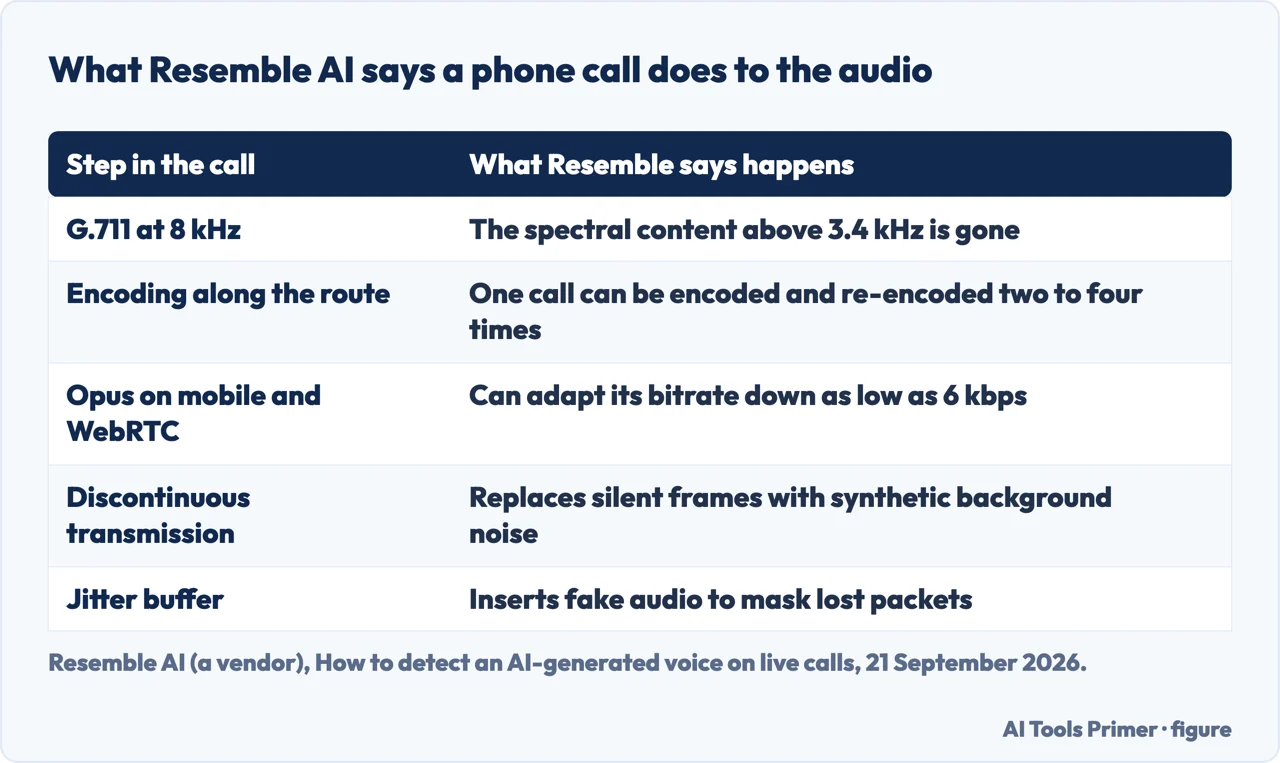
Scientific American adds, in a parenthesis, that a phone call minimizes or degrades much of a voice’s key forensic detail, making clones harder to spot. Resemble AI spells out the mechanics on its blog. Most PSTN calls use G.711, which encodes audio at 8 kHz, so the spectral content above 3.4 kHz is gone. WebRTC and mobile calls use Opus, whose bitrate adapts to the connection and sometimes drops as low as 6 kbps, and cellular networks use AMR and AMR-WB, which apply their own lossy compression. A single call can be encoded, decoded and re-encoded two to four times along the route. Discontinuous transmission replaces silent frames with synthetic background noise, which Resemble says changes the micro-silences and breathing patterns a forensic detector tries to measure, and the jitter buffer inserts fake audio to mask lost packets.
Resemble then gives figures from its own test, the Resemble AI Codec Testbench v3. G.711 a-law, G.722 and EVS held 100 percent accuracy on both real and synthetic audio; G.728 reached 91.9 percent on real audio and 97.9 percent on synthetic; iLBC reached 95.8 and 98.7. These are the vendor’s own results. For live calls the page says its detector uses a higher threshold tuned for precision, and that the trade-off is that some synthetic calls near the threshold boundary will be missed. It describes a second pattern, an analysis after the call, that aggregates many windows of the full recording and reduces false positives. The live version works on four-second windows and, the page says, returns a result in under 300 milliseconds.
EyeSift cites the ASVspoof research challenges as having found that detectors often lose accuracy on compressed or phone-transmitted audio. aivoicedetector.com says short, compressed or noisy clips, such as phone calls and low-bitrate voice notes, give less reliable results. The pages we read from aivoicedetector.com and Moderation API do not give accuracy figures for low-quality phone audio.
Watermarks, and what their absence means
Scientific American says some companies that make AI audio tools, Google among them, hide an inaudible watermark in the audio they create. The changes are too faint to hear but can be read by a detector later, and they travel with the file wherever it is shared. The article calls these watermarks powerful but not foolproof: someone might alter a recording enough to erase the mark, and on some open-source programs the watermark is optional. Barrington compares a good watermark to a locked door that can keep out 99 percent of the bad cases. The FTC’s Tech at FTC page of April 2024 agrees on the limit, saying fraudsters may be able to remove a watermark or distort audio, and that watermarks can be altered or removed.
Resemble says a watermark that is present is the strongest provenance signal available. It adds that the absence of a mark does not prove a voice is human, because most generators do not watermark. EyeSift says its own tool does not decode SynthID watermarks, and it describes a missing watermark or credential as not proof that audio is human-recorded.
Resemble also separates two questions that are easily confused. STIR/SHAKEN, it says, establishes who initiated a call at the network level, and a signed call with full attestation can still carry a synthetic voice. Detection is the layer that assesses the audio. The page adds that as of 2 August 2026 the EU AI Act requires machine-readable marking of AI-generated content, including audio. That is how Resemble’s page puts it; we did not read the regulation.
What the FTC says, and what to do with a score
The FTC’s press release of 8 April 2024 names four winning proposals in its Voice Cloning Challenge. AI Detect, from OmniSpeech, would use AI to tell genuine from synthetic voice patterns. DeFake, from Washington University in St. Louis, would add distortions to voice samples that the ear cannot hear but that make accurate cloning harder. OriginStory would authenticate the human origin of a recording at the point of creation, using sensors that measure speech acoustics and biosignals in the throat and mouth. Pindrop Security received the Recognition Award for technology that detects clones in real time, evaluating each call in two-second chunks. The release says the results highlight that there is no single solution to the problem.
The Tech at FTC page of April 2024 sorts approaches into three intervention points: upstream prevention or authentication, real-time detection or monitoring, and post-use evaluation of existing content. It says studies show a spectrum of efficacy for detection solutions, and that as cloning grows more sophisticated, current evaluation schemes may need to be adapted. It also says there is still no silver bullet to prevent the harms posed by voice cloning. The FTC pages we read do not give accuracy figures for the winners.
What the vendor pages say to do with a result is consistent in one respect: it is one input. aivoicedetector.com says a Likely Human result is probably real but not proof, and to weigh it with the context, such as who sent it and what it asks for. For a result of AI Generated it says not to act on the request and to confirm with the person through a number you already know. EyeSift says to verify money, account, identity or source requests through a separate trusted channel. Resemble says the answer tells you which question to ask next, such as blocking the call, routing it to a person or logging it. It also says detecting on a call carries the same recording-consent posture as recording it, and to consult a legal team if the call was not being recorded before. Our page on voice scams covers the call that sounds like a relative, and the one on recording a phone call covers the notices that come with recording.
Where to start
Four ways in.
- “Can I tell by listening?”
- Why a voice is hard to judge by ear — ear
- “What does a detector look at?”
- What a detector measures — measures
- “Will it catch any fake?”
- A detector that knows one maker — maker
- “What about a phone call?”
- What a telephone does to the evidence — phone
Cloned voices
The voice that is not theirs, and what the rules say about it.
Other audio, made and recorded
Audio that a model makes, and audio that people record and interview.
Questions people also ask
How can I tell if a voice is AI?
Scientific American says listeners asked to flag artificial voices succeeded 60 percent of the time, and that breaths and ums are now added on purpose. Researchers instead train models on sound-wave measurements such as jitter and shimmer, and the article says no single measurement can show a recording is fake.
How to tell if someone has an AI voice?
aivoicedetector.com says a Likely Human result is probably real but not proof, and that a result of AI Generated means not acting on the request and confirming with the person through a number you already know. Resemble says a score does not read intent or confirm consent.
How to detect if you are talking to AI?
Resemble describes a detector that works on four-second windows during a call and returns a result in under 300 milliseconds, with a higher threshold that means some synthetic calls near the boundary will be missed. Moderation API says it scores each sentence from 0 to 1 on live calls.
Can YOU Detect an AI Voice?
In the study Scientific American describes, about half of more than 600 listeners were asked to flag artificial voices and did so 60 percent of the time. The other half judged a clone and a real speaker, heard side by side, to be the same person about 80 percent of the time.
Not covered here. We tested no detector and uploaded no audio. The statements come from Scientific American, ElevenLabs, Resemble AI, the FTC, aivoicedetector.com, Moderation API and EyeSift, all read on 5 November 2026. The vendor pages are used for what they say about their own products, and their accuracy figures are the vendors’ own.
We did not open the Google Play app, Undetectable, AnyToSpeech, Diopter or the Miraheze wiki page that Google listed. The Google AI box was read only in part. The pages we read do not give an error rate measured apart from a vendor’s own test, and do not say how widely detectors are used.
The search volume and difficulty behind this page come from an Ubersuggest reading of 5 November 2026 (United States), which gives search volume and its own SEO difficulty score, not Semrush’s; a Semrush check is still to be made.
Sources
- Scientific American — How to tell if a voice recording is AI-generated — www.scientificamerican.com, read 5 November 2026.
- ElevenLabs — AI Speech Classifier — elevenlabs.io, read 5 November 2026.
- Resemble AI — How to detect an AI-generated voice on live calls — www.resemble.ai, read 5 November 2026.
- FTC — FTC Announces Winners of Voice Cloning Challenge — www.ftc.gov, read 5 November 2026.
- FTC — Approaches to Address AI-enabled Voice Cloning (Tech at FTC) — www.ftc.gov, read 5 November 2026.
- aivoicedetector.com — AI Voice Detector — aivoicedetector.com, read 5 November 2026.
- Moderation API — AI voice detector for phone calls — moderationapi.com, read 5 November 2026.
- EyeSift — Free AI Voice & Audio Detector — www.eyesift.com, read 5 November 2026.
Written by Alberto Gulotta
Founder and editor of AI Tools Primer, writing from Palermo, Italy. Thirty-five years of taking computers apart, starting with a Commodore 64 — the long version is on the about page.
Something wrong on this page? Write to aitoolsprimer@gmail.com and it gets fixed.
Written on 6 November 2026.
Independence and limits
No affiliate links and no paid placements anywhere on this site. Nobody pays to appear here, and no company has seen this page before you did.
This is general information, not professional advice. Where a page touches money, health, safety or the law, it names its source and the date it was read — and your situation may still differ. See the privacy page and the cookie policy.