
Business · guide
How to track business expenses: what the IRS and GOV.UK say
By Alberto Gulotta · Updated · 19 min read
How to track business expenses falls into three parts across the IRS, GOV.UK and SBA pages we read: an account that keeps the money apart, a record that shows who was paid and why, and a routine for checking it. They differ on the account and on how long the papers are kept, and describe the books differently.
| Question | Answer | Where it comes from |
|---|---|---|
| Which account do the expenses go through? | The IRS says a separate business checking account; GOV.UK says a personal or a business account might do | IRS, GOV.UK |
| What should the papers for one expense identify? | The payee, the amount paid, proof of payment, the date and a description showing it was a business expense | IRS |
| How often do I record and check? | The IRS says to record expenses when they occur, generally daily, and to reconcile the checking account each month | IRS |
| What is the $75 line? | In Publication 463, travel, gift and car expenses other than lodging under $75 need no receipt, but still need a written record | IRS |
| How long are the records kept? | The IRS ties it to the period of limitations; GOV.UK says at least 5 years after the 31 January deadline | IRS, GOV.UK |
Before the first receipt: the account the money goes through
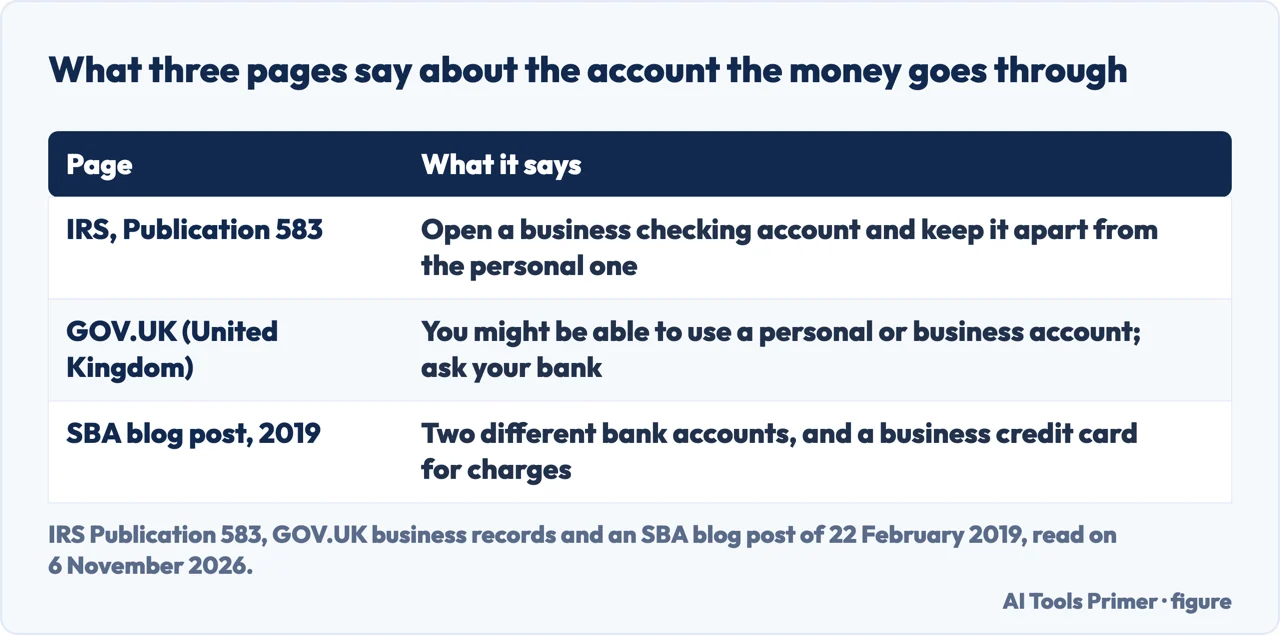
The IRS’s Publication 583, Starting a Business and Keeping Records, puts the account first. It says one of the first things to do when you start a business is open a business checking account, and to keep it separate from your personal checking account. All daily receipts go into the business account, and payments are made by check so that each one documents a business expense. The publication says to avoid writing checks payable to cash; if you must write one to pay a business expense, include the receipt for the cash payment in your records, and if you cannot get a receipt, make an adequate explanation in your records at the time of payment. It also suggests a checkbook with room to mark each deposit as business income, personal funds or a loan, and a note of the source on the deposit slip. The page was last reviewed on 30 April 2026.
GOV.UK, in its guide to business records for the self-employed (sole traders and partners in a partnership; limited companies follow different rules), gives a looser answer. It says you might be able to use a personal or a business bank account for your business, and to check with your bank which type you can use. What the page asks is that your records are accurate and that you can identify business transactions.
A blog post on the SBA’s site, published on 22 February 2019 and written by an outside contributor described there as a business credit expert, goes further than either. It says that to keep personal and business funds completely separate you must have two different bank accounts, calls a business credit card the primary tool for separating personal and business charges, and says utility accounts the business pays should be set up in the company’s name. Its stated reason concerns incorporated businesses: it says that failing to separate the finances risks forfeiting the legal protections an entity structure offers. Because the post is from 2019 and from a contributor, we use it only for what it says, not as a statement of rules.
Put side by side, the three pages give three answers to one question. The IRS says to open a separate account, GOV.UK says a personal one might do, and separately asks that you can identify business transactions, and the SBA post says two accounts for a reason that applies to incorporated businesses. The pages we read do not say which one suits a given business.
What each line of your records must show
The IRS page “What kind of records should I keep”, last reviewed on 3 August 2026, says you may choose any recordkeeping system suited to your business, as long as it clearly shows your income and expenses. The system should include a summary of your business transactions, ordinarily made in your business books, for example accounting journals and ledgers, and the books must show your gross income as well as your deductions and credits. Supporting documents are the second layer: sales slips, paid bills, invoices, receipts, deposit slips and canceled checks. The page says to keep them orderly and in a safe place, and gives one way to do it, by year and by type of income or expense.
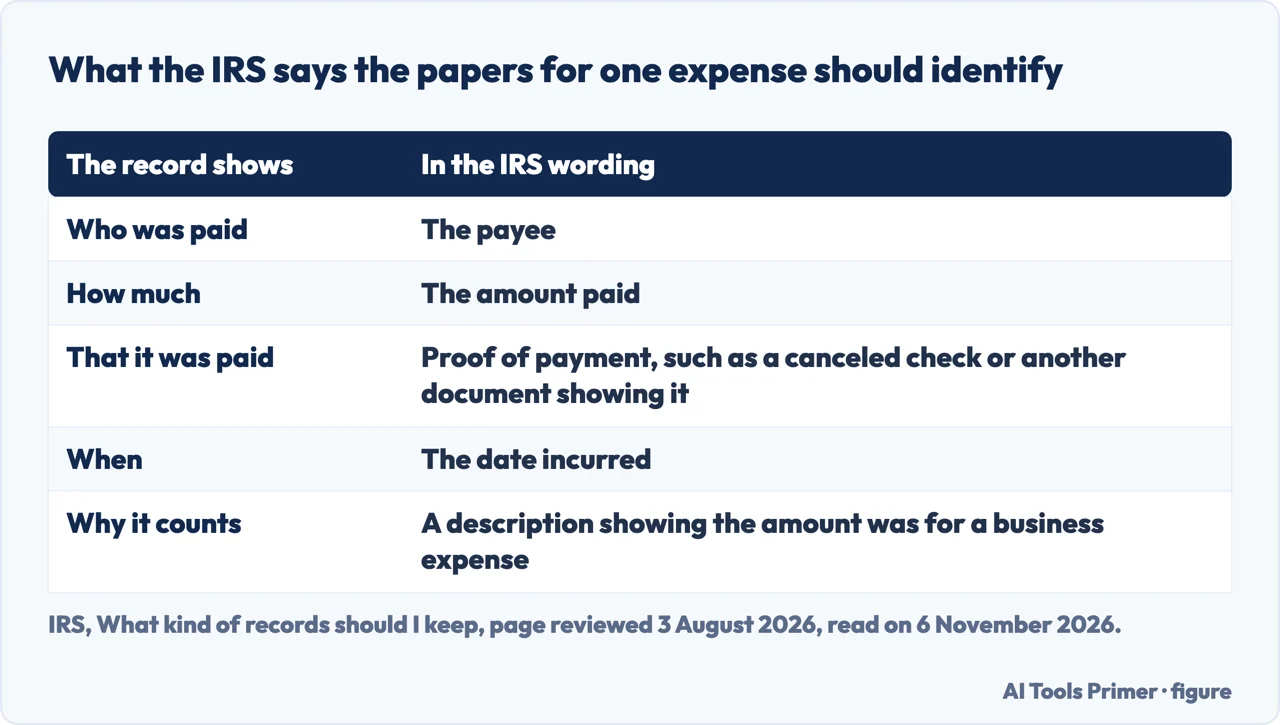
For an expense, the page names five things the supporting documents should identify: the payee, the amount paid, proof of payment, the date incurred, and a description of the item purchased or service received that shows the amount was for a business expense. The documents it lists for expenses are canceled checks or other proof of payment, cash register tape receipts, account statements, credit card receipts and statements, and invoices. It adds that a combination of supporting documents may be needed to substantiate all elements of the expense.
Publication 583 gives reasons for keeping all this. Your records can identify the source of your receipts, which you need to separate business from nonbusiness receipts. They also help with deductible expenses, because the publication says you may forget expenses when you prepare your return unless you record them when they occur. And they support the items on a return if the IRS examines it: the publication says that a complete set of records will speed up the examination. The page on records adds a list for assets, such as machinery and furniture: when and how you acquired them, the purchase price, the cost of improvements, depreciation deductions taken and the selling price if you sold them.
GOV.UK’s page on what records to keep reads as a list. For a sole trader or partner it names all sales and income, all business expenses, VAT records if you are registered for VAT, PAYE records if you employ people, and records about your personal income. Types of proof include all receipts for goods and stock, bank statements, chequebook stubs, sales invoices, till rolls and bank slips. GOV.UK gives two reasons to keep them: to work out your profit or loss for your tax return, and to show them to HMRC if asked. You do not send them in with the return.
A routine: record it, reconcile it, file it
Publication 583 says a system works better when it follows good recordkeeping practices, and its first example is to record expenses when they occur and identify the source of recorded receipts. It adds that, generally, it is best to record transactions on a daily basis. For small cash payments it describes a petty cash fund: each time you pay from the fund you make out a petty cash slip and attach it to your receipt as proof of payment.
The IRS pages put a monthly interval on one task, the bank reconciliation. The publication says you should reconcile your checking account each month. When the statement arrives, the statement, your checkbook and your books should agree; they may not if the statement includes bank charges you did not enter, or leaves out deposits made after the statement date or checks that had not yet cleared. The steps it gives are to compare the deposits on the statement with your checkbook, compare each canceled check by number and amount, prepare a bank reconciliation, and update your checkbook and journals for items shown as unrecorded, such as service charges. It gives three purposes: verifying how much money is in the account, making sure the books reflect all bank charges and the correct balance, and correcting errors.
The GOV.UK pages work to a calendar rather than a reconciliation. If you prepare accounts for your business, you choose the dates you keep records to and from, usually the same dates each year, and it may be easier to complete your tax return if they match the tax year (6 April to 5 April). If you do not prepare accounts, GOV.UK says you record your income and expenses for each tax year. The pages we read do not say how often a UK business should write entries down.
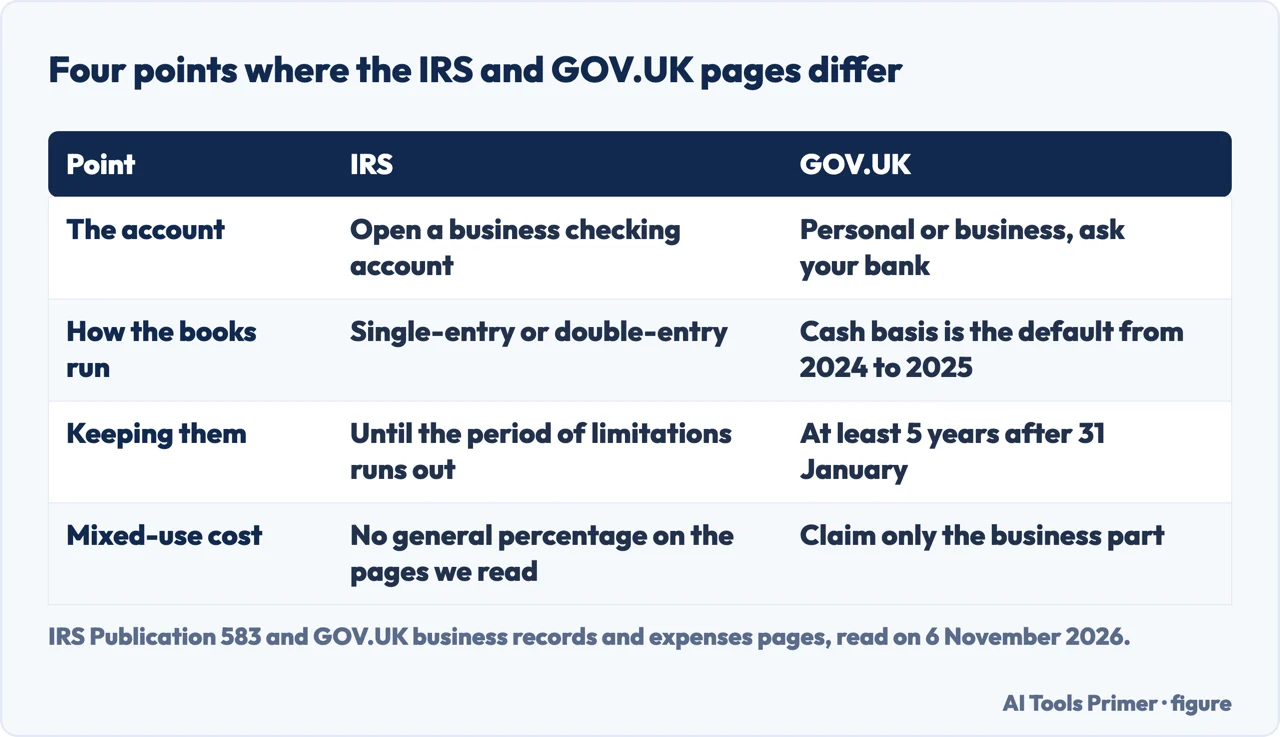
On filing, the two authorities set different clocks. The IRS ties the time to the period of limitations for each return, with periods of 3, 6 and 7 years and some cases with no limit, and says to keep employment tax records for at least 4 years. GOV.UK says to keep records for at least 5 years after the 31 January submission deadline of the relevant tax year, with its own example of a 2022 to 2023 return sent by 31 January 2024. Our page on how long to keep business records sets the periods out in full.
Receipts, logs and the $75 line
The $75 figure comes from Publication 463, Travel, Gift, and Car Expenses, in its chapter on recordkeeping, and it applies to those expenses. The chapter says you cannot deduct amounts that you approximate or estimate, and that you should keep adequate records or have sufficient evidence that will support your own statement. A written record is generally needed, though a record prepared on a computer is considered adequate. The proof goes in an account book, diary, log, statement of expense, trip sheets or a similar record, and it is backed by documentary evidence such as receipts, canceled checks or bills.
Then comes the exception. The publication says documentary evidence is not needed if any of several conditions apply: the expenses are meals or lodging accounted for to an employer under an accountable plan with a per diem allowance, the expense other than lodging is less than $75, or there is a transportation expense for which a receipt is not readily available. So the $75 line removes the need for the receipt, not for the record. The pages we read do not say whether the same figure applies to expenses outside travel, gifts and cars.
When a receipt is kept, Publication 463 says it is ordinarily adequate if it shows the amount, date, place and essential character of the expense. Its examples are a hotel receipt with the name and location, the dates and separate amounts for lodging, meals and phone calls, and a restaurant receipt with the name and location, the number of people served, and the date and amount. A canceled check together with a bill from the payee ordinarily establishes the cost, but a canceled check alone does not prove a business expense without other evidence that it was for a business purpose. You do not have to record information in your account book that duplicates a receipt, as long as your records and receipts complement each other in an orderly manner.
On timing, the publication says to record the elements of an expense at or near the time of the expense, and that a timely kept record has more value than a statement prepared later. You do not need to write down every expense on the day: a weekly log that accounts for use during the week is considered timely. Its example is a car used for visiting clients, where weekly records kept during the first week of each month show 75% business use and invoices and bills show the same rate in later weeks. For a map of where each kind of expense is covered, the IRS has a Guide to business expense resources page, reviewed on 27 June 2026, which says Publication 535 was discontinued and lists links by topic; it points to publications and does not walk through tracking steps. Our page on receipts and paperwork covers the paper side.
Mixed use and working from home, as GOV.UK counts it
GOV.UK’s expenses page for the self-employed, meaning sole traders and individuals in a business partnership, explains that you deduct allowable expenses to work out your taxable profit before paying Income Tax. Its example takes the allowable expenses away from turnover to reach the profit that is taxed. Allowable expenses do not include money taken from the business for personal use. The page lists office costs, travel costs, clothing, staff costs, things you buy to sell on, financial costs such as insurance or bank charges, business premises costs, advertising or marketing, subscriptions and training courses related to the business. It also says you cannot claim expenses if you use the £1,000 tax-free trading allowance.
For something used for both business and personal reasons, GOV.UK says you can only claim allowable expenses for the business costs. Its example is a mobile phone bill of £200 for the year, of which £130 is personal calls and £70 business calls: you can claim £70. This is the page’s answer to whether a cost can be written off in full, at least for the UK: only the business part. On the IRS side, Publication 583 says a deductible business expense must be both ordinary and necessary, and Publication 463 says you can generally deduct only 50% of the cost of business meals; the pages we read give no single percentage for all expenses.
For working from home, the page says you may be able to claim a proportion of heating, electricity, Council Tax, mortgage interest or rent, and internet and telephone use. You need a reasonable method of dividing the costs, for example by the number of rooms you use for business or the amount of time you spend working from home. Its example is a home with 4 rooms, one of them used only as an office, and an electricity bill of £1120 for the year: assuming all rooms use equal amounts, you can claim £280. If you worked only one day a week from home, it divides that by 7 and gets £40.
GOV.UK also describes simplified expenses, flat rates for vehicles, working from home and living on your business premises. The simplified expenses page says you do not have to use them, and that you keep records of your business miles, the hours you work at home and how many people live at your business premises over the year. We give no rates here, because they are the kind of figure that changes and we did not read a current table. The travel page lists what you cannot claim: non-business driving or travel costs, fines or penalty charges, and travel between home and work.
Spreadsheet, books or software
The IRS page on records does not name a format. It says some businesses choose to use electronic accounting software or some other electronic system to capture and organize their records, that the system should meet the same basic recordkeeping principles, and that all requirements that apply to hard copy books and records also apply to electronic records. The pages we read do not say which apps or spreadsheets to use, and they do not say whether a photo of a receipt is enough, so we do not claim that it is. The Stripe and Forbes guides we read do not mention the IRS or HMRC; Stripe’s covers receipts, categories and reconciliation, and Forbes’s, whose pages carry affiliate links, covers the cash and accrual methods and apps that read receipts.
Publication 583 asks you to decide between a single-entry and a double-entry bookkeeping system. It says single-entry is the simplest to maintain but may not suit everyone: it is based on the income statement and records the flow of income and expenses with a daily summary of cash receipts and monthly summaries of cash receipts and disbursements. Double-entry uses journals and ledgers, and is self-balancing because every transaction is a debit in one account and a credit in another; the publication’s example is a journal entry for a rent payment on 5 October. For software, it says you must be able to produce sufficient legible records to support the entries on your return, and that the machine-sensible records must reconcile with your books and return, with enough detail to identify the underlying source documents.
GOV.UK frames the choice as a method. From the 2024 to 2025 tax year, cash basis is the default method of accounting, and you must opt out to use traditional accounting. With cash basis you record income or expenses only when you receive money or pay a bill; its example is an invoice sent on 15 March 2024 and paid on 30 April 2024, recorded on 30 April in the 2024 to 2025 tax year. With traditional accounting you record by the date you invoiced or were billed, and GOV.UK lists extra records for it: what you are owed, what you have committed to spend but not paid, the value of stock and work in progress, year-end bank balances, what you invested in the business and what you took out for your own use. The SBA’s page on managing your business describes the same split as accrual and cash, with a sale in January and a payment in February as its example, and lists a pros and cons table for each.
For help, the SBA page says to consider a certified public accountant, a bookkeeper or an online service. Our pages on free accounting software, accounting tools compared and invoicing go through the products themselves. We did not use QuickBooks’s own expense-tracking page, which returned no text when we fetched it.
Where to start
Four ways in.
- “Which account do I use?”
- Before the first receipt: the account the money goes through — account
- “What goes on each line?”
- What each line of your records must show — record
- “Do I need every receipt?”
- Receipts, logs and the $75 line — receipts
- “Is it all deductible?”
- Mixed use and working from home, as GOV.UK counts it — mixed
Keeping the papers
How long, and in what form.
The books and the tools
Free plans, paid plans and invoices.
Questions people also ask
What is the $75 rule?
In the IRS’s Publication 463, documentary evidence is not needed for a travel, gift or car expense, other than lodging, that is less than $75. The publication still asks for a written record. The pages we read do not say whether it applies to other expenses.
What is the 50/30/20 rule for business?
The IRS, GOV.UK and SBA pages we read do not mention a 50/30/20 rule, so we cannot say what it covers or whether any authority recommends it.
How should I track business expenses?
The IRS says to keep a business checking account, record expenses when they occur, and reconcile the account each month. For each expense, keep papers that identify the payee, amount, proof of payment, date and business purpose. GOV.UK asks that records are accurate and transactions identifiable.
Can I write off 100% of business expenses?
GOV.UK says that for something used for both business and personal reasons you can only claim the business costs, with a phone bill as its example. The IRS says a deductible expense must be ordinary and necessary, and Publication 463 generally allows only 50% of business meal costs.
Not covered here. The statements on this page come from the IRS (Publication 583, Publication 463, the page on what records to keep and the guide to business expense resources), GOV.UK (business records, expenses, simplified expenses and travel) and the SBA (a 2019 blog post and the page on managing your business), all read on 6 November 2026. We did not use a Reddit thread, a Rippling list, a YouTube video or a QuickBooks page for any statement here. This page is not tax advice, and the rules differ by country.
The search volume and difficulty behind this page come from an Ubersuggest reading of 5 November 2026 (United States), which gives search volume and its own SEO difficulty score, not Semrush’s; a Semrush check is still to be made.
Sources
- IRS — Publication 583, Starting a Business and Keeping Records — www.irs.gov, read 6 November 2026.
- IRS — What kind of records should I keep — www.irs.gov, read 6 November 2026.
- IRS — Publication 463, Travel, Gift, and Car Expenses (2025) — www.irs.gov, read 6 November 2026.
- IRS — Guide to business expense resources — www.irs.gov, read 6 November 2026.
- GOV.UK — Business records if you’re self-employed: What records to keep — www.gov.uk, read 6 November 2026.
- GOV.UK — Expenses if you’re self-employed — www.gov.uk, read 6 November 2026.
- GOV.UK — Expenses if you’re self-employed: Car, van and travel expenses — www.gov.uk, read 6 November 2026.
- GOV.UK — Business records if you’re self-employed: Overview — www.gov.uk, read 6 November 2026.
- GOV.UK — Business records if you’re self-employed: How long to keep your records — www.gov.uk, read 6 November 2026.
- GOV.UK — Simplified expenses if you’re self-employed — www.gov.uk, read 6 November 2026.
- SBA — 5 Ways to Separate Your Personal and Business Finances (2019) — www.sba.gov, read 6 November 2026.
- SBA — Manage your business — www.sba.gov, read 6 November 2026.
Written by Alberto Gulotta
Founder and editor of AI Tools Primer, writing from Palermo, Italy. Thirty-five years of taking computers apart, starting with a Commodore 64 — the long version is on the about page.
Something wrong on this page? Write to aitoolsprimer@gmail.com and it gets fixed.
Written on 6 November 2026.
Independence and limits
No affiliate links and no paid placements anywhere on this site. Nobody pays to appear here, and no company has seen this page before you did.
This is general information, not professional advice. Where a page touches money, health, safety or the law, it names its source and the date it was read — and your situation may still differ. See the privacy page and the cookie policy.