Chat · guide
Is Claude free: the plan, the limit and your chats
By Alberto Gulotta · Updated · 18 min read
Is Claude free? Yes: Anthropic's pricing page lists a Free plan at $0, and you join at claude.ai with an email address. Its limit is a session that resets every five hours, and the pages we read give no message count. Chats can be used for training if you allow it or if they are flagged.
| Question | Answer | Where it comes from |
|---|---|---|
| Is there a free plan? | Yes: Free, at $0, with chat on web, desktop and mobile | Pricing page |
| How do I sign up? | With an email address at claude.ai, in a supported location, aged 18 or over | Pro plan page, Get started with Claude |
| How long does the limit last? | A session that resets every five hours; the two pages cited give no fixed message count | Get started with Claude, pricing page |
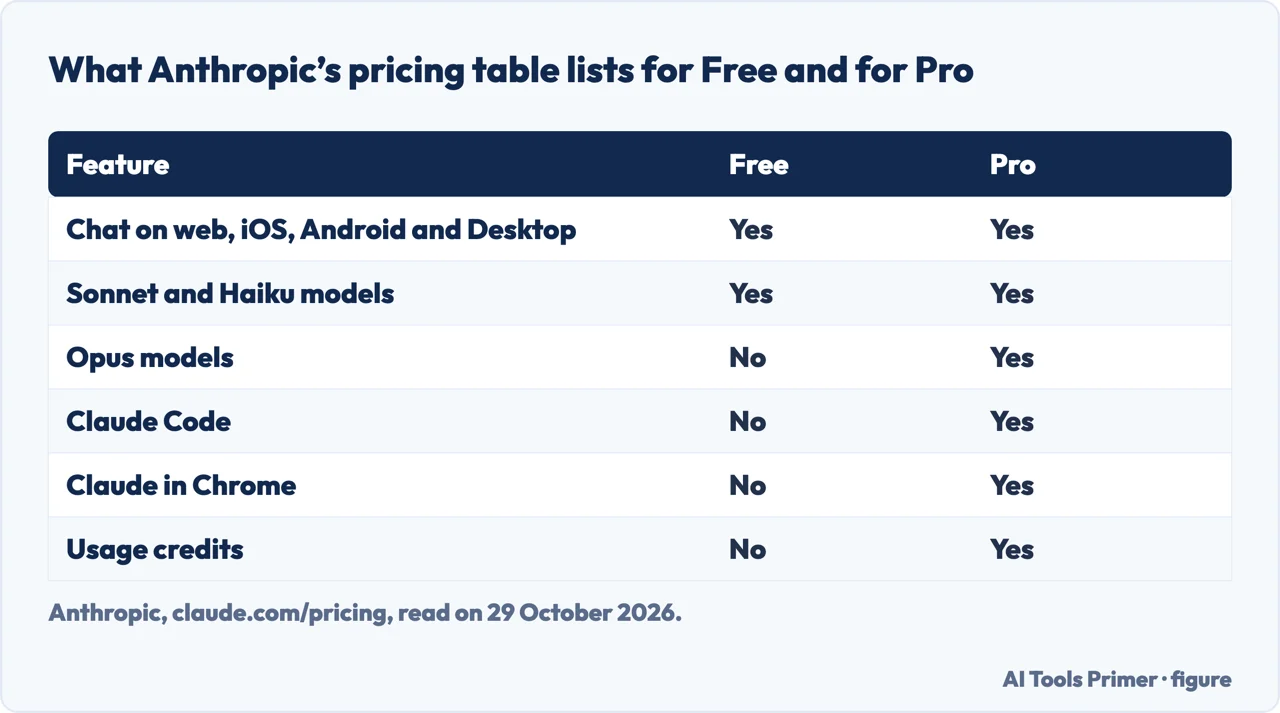
| What does Free leave out? | Opus models, Claude Code, Claude in Chrome and usage credits | Pricing page |
| Are Free chats used for training? | When you allow it, when a chat is flagged for safety review, or when you opt in some other way | Privacy Center |
What the Free plan is, and how to get it
Anthropic’s pricing page lists Free at $0, with the words “Free for everyone” under the price. In the box it puts chat on the web, on the desktop and on mobile; searching the web, creating files and running code; memory across conversations; connecting your apps and tools; Artifacts; and Claude Design, Slides and Docs. The Pro column on the same page starts with “Everything in Free, plus” and a list, so the Free box is the base the paid plans are described against.
The way in is short. The Pro plan page, in the section on free or discounted plans, says anyone in a supported location can access the free version by going to claude.ai and signing up with an email address. The Get started with Claude page, dated 16 September 2026, adds two conditions: you must be in one of the supported locations, and you must be at least 18 years old. It names three ways to reach Claude: the web at claude.ai, Claude Desktop for Mac or Windows, and the Claude apps for iOS and Android. The text we read does not list the supported locations, so whether your country is on the list is something to check on Anthropic’s side.
One detail on moving over from another assistant. The Get started page says conversation history cannot be imported from another AI provider into Claude. It adds that Free, Pro and Max users can use a memory import feature to transfer memory from other providers. If you are coming from ChatGPT, our page on ChatGPT Go and Plus covers the OpenAI side of the same question.
The limit is a five-hour session, and the pages give no number
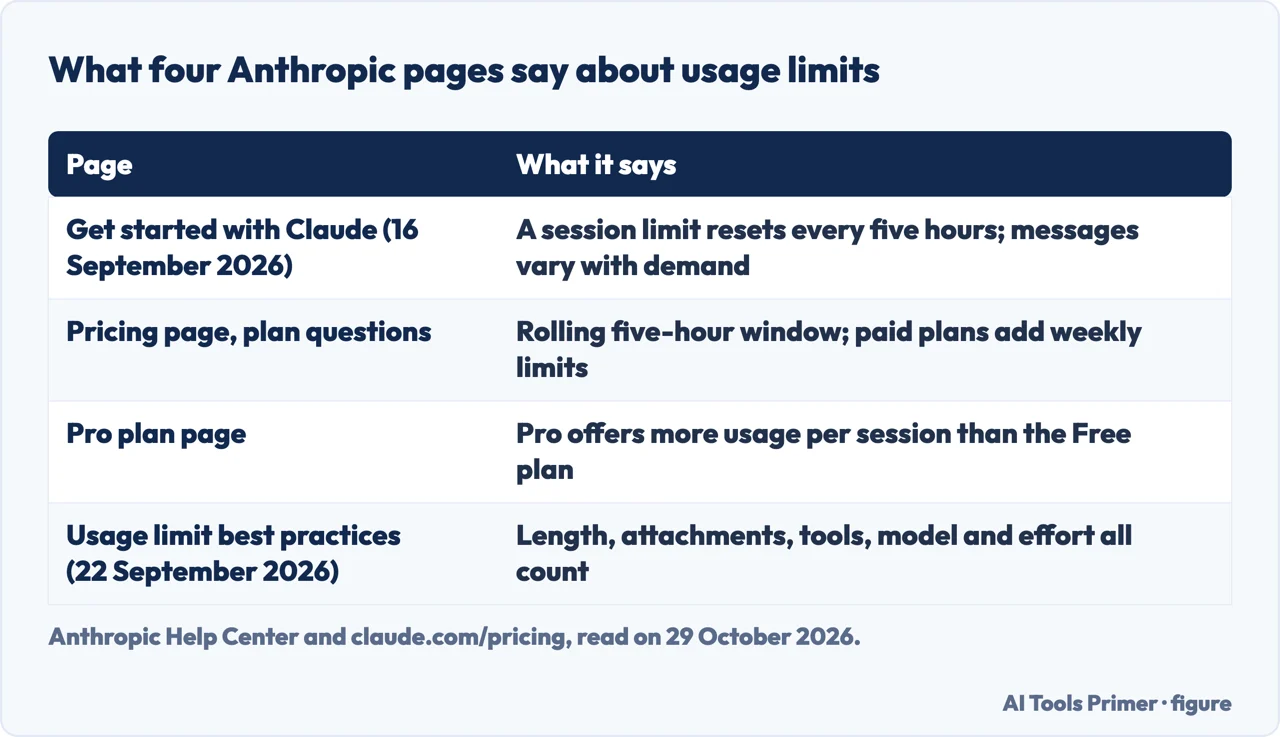
The Get started with Claude page answers the question for Free directly: the free plan has a session-based usage limit that resets every five hours. The number of messages you can send, it says, varies with demand, and Anthropic may impose other types of limits to give all users fair access. Claude tells you when you have reached your limit, or when a prompt is larger than the available context window.
The pricing page says the same thing about every plan: usage limits reset on a rolling five-hour session window, and paid plans add weekly limits on top. It also says your activity across web, desktop, mobile and Claude Code draws from one pool, and that there is “no fixed message count”, because what you can do depends on how long and complex your conversations are, the model you choose and the features you use. The page on usage and length limits describes the two kinds of limit for paid plans: a session limit that resets every five hours and weekly limits that reset once a week. The pages we read describe a weekly limit for paid plans and do not mention one for Free. The pricing FAQ adds a general reservation: to manage capacity and keep access fair, Anthropic may limit usage in other ways, such as weekly and monthly caps or limits on a model or feature, at its discretion; it does not say whether any of this applies to Free.
The Anthropic pages we read give no daily message count. They say the count varies with demand, so this page states no figure.
What spends the allowance is listed twice. The usage limit best-practices page, dated 22 September 2026, names message length, file attachment size, the length of the current conversation, tool use such as Research and web search, the model, the effort level, creating and using artifacts, and multi-step tasks such as running code, creating files or browsing websites.
Long conversations have a cost of their own. The limits page says that when a conversation approaches the context window and code execution is enabled, Claude summarizes earlier messages so the chat can go on, and that conversations which trigger this consume more of the usage limit. Its advice is to start a new conversation when you are approaching the usage limit in a longer chat. The best-practices page adds habits: plan the conversation first and combine related questions into one message.
Length limits are a separate thing. The limits page says they relate to the context window, the amount of information Claude can work with in a single chat, and that a portion is always reserved for the response. It gives sizes for paid plans: the newest models up to a 1M-token window, others 500K or 200K tokens. The pricing table shows “Up to 1M varies by model” in the Free column as well. The limits page itself speaks of paid plans in that passage, so the Free figure is the pricing table’s, with its caveat that the size varies by model.
When you reach a limit, the limits page names two ways on: wait for it to reset or upgrade, in which case the new plan’s limits apply right away. Usage credits keep work going on paid plans, and the pricing table shows “No” for usage credits on Free. To see where you stand, the pricing page points to Settings > Usage. The best-practices page describes the progress bars there for Pro, Max, Team and seat-based Enterprise plans and does not mention Free.
What Free leaves to Pro and Max
The pricing table is the clearest list. Opus models show No in the Free column and Yes for Pro and Max; Sonnet and Haiku show Yes on every plan. A row for Fable models shows No for Free, usage credits for Pro and 50% of weekly limits for Max. Claude Code, Claude Science, Claude in Chrome, Claude for Microsoft 365 and Claude Dashboards (beta) show No for Free. The pricing page adds that Claude Code is included in all paid plans and shares the usage limits of the rest of the plan. Priority access at high-traffic times shows No for Free and for Pro, and Yes for both Max plans. Projects is a partial case: Pro’s list on the pricing page names Projects, but the comparison table shows “Up to 5” projects for Free and Yes for Pro and Max, so Free has them with a cap rather than not at all. The same Pro list also names handing off and scheduling tasks, which the Free box does not.
Two Anthropic pages differ on priority access, and may differ on memory, so both are worth holding side by side. The Pro plan page lists priority access to Claude during high-traffic periods among Pro’s benefits, while the pricing table shows No for Pro on that row. And the pricing page lists memory across conversations in the Free box, while the best-practices page, in its passage on memory, names users with paid plans (Pro, Max, Team and Enterprise) and does not mention Free. That page does not say Free lacks memory, and the pages we read do not say whether the two descriptions differ.
What Pro adds to usage is stated two ways. The pricing page says Pro gives at least 5x more usage per 5-hour session than Free, and that Max gives 5x or 20x more than Pro. The Pro plan page says only that Pro offers more usage per session than the Free plan, and adds that Pro has a weekly limit across all models, which resets at a fixed time assigned to the account. Pro subscribers can turn on usage credits to keep working past the included usage.
Prices are given on two pages and do not read the same. The pricing page shows Pro at $17 per month with an annual subscription, $200 billed up front, or $20 if billed monthly, and Max from $100 per month. The Pro plan page says $20 per month in the US, with pricing in local currency where supported, and that an annual plan is billed once yearly at a discounted rate. It also says the Pro plan does not include API usage through the Claude Console, which is paid separately, and that there is no standard discount for individual plans, only occasional promotions. Both pages say prices and plans can change at Anthropic’s discretion.
The same pricing page sums up the Free plan in one sentence: Free covers everyday questions. The pages we read do not rate how good the answers are, and do not say how many everyday questions fit in a session.
If you try Pro and go back, the pricing FAQ says downgrades take effect at the end of the current billing period and that your chats, projects and files stay with your account whichever plan you are on. Cancelling does not delete your data either: for Pro and Max the account moves to the Free plan when the period ends, though some features are not available on Free. You can cancel at any time and the plan stays active until the period ends; to avoid the next charge, cancel at least 24 hours before renewal.
When Free chats can be used for training
The Privacy Center article “Is my data used for model training?”, dated 16 March 2026, covers the consumer products: Claude Free, Pro and Max, and Claude Code when it is used from those accounts. It lists three cases in which Anthropic will use chats and coding sessions, including to improve its models:
- you choose to allow Anthropic to use your chats and coding sessions to improve Claude;
- your conversations are flagged for safety review, in which case they may be used or analyzed to improve detection and enforcement of the Usage Policy, including training models for the Safeguards team;
- you otherwise explicitly opt in to training, for example by joining the Trusted Tester Program.
The data it describes includes the entire related conversation, with any content, custom styles or conversation preferences, and data collected when using Claude for Chrome. It does not include raw content from connectors such as Google Drive, remote and local MCP servers included, though the article says data may be included if it is directly copied into the conversation. The pricing table shows “Opt-out” in its Model training row for all four columns, Free among them.
Incognito chats are not used to improve Claude, the article says, even if Model Improvement is enabled in Privacy Settings. Feedback works differently. When you use the thumbs up or down button, Anthropic stores the entire related conversation in its secured back-end for up to 5 years, de-links it from your user ID, such as your email address, and may use it to analyze its services, conduct research, study user behavior and train its models as permitted by law. It says it does not combine that feedback with your other conversations.
Where this does not apply: Anthropic’s announcement of 28 August 2025 says the updates do not reach services under its Commercial Terms, including Claude for Work with its Team and Enterprise plans, Claude Gov, Claude for Education, and API use through Amazon Bedrock or Google Cloud’s Vertex AI. A Free account is a consumer account, so it falls on the side the article describes.
How long chats are kept, and how to change the setting
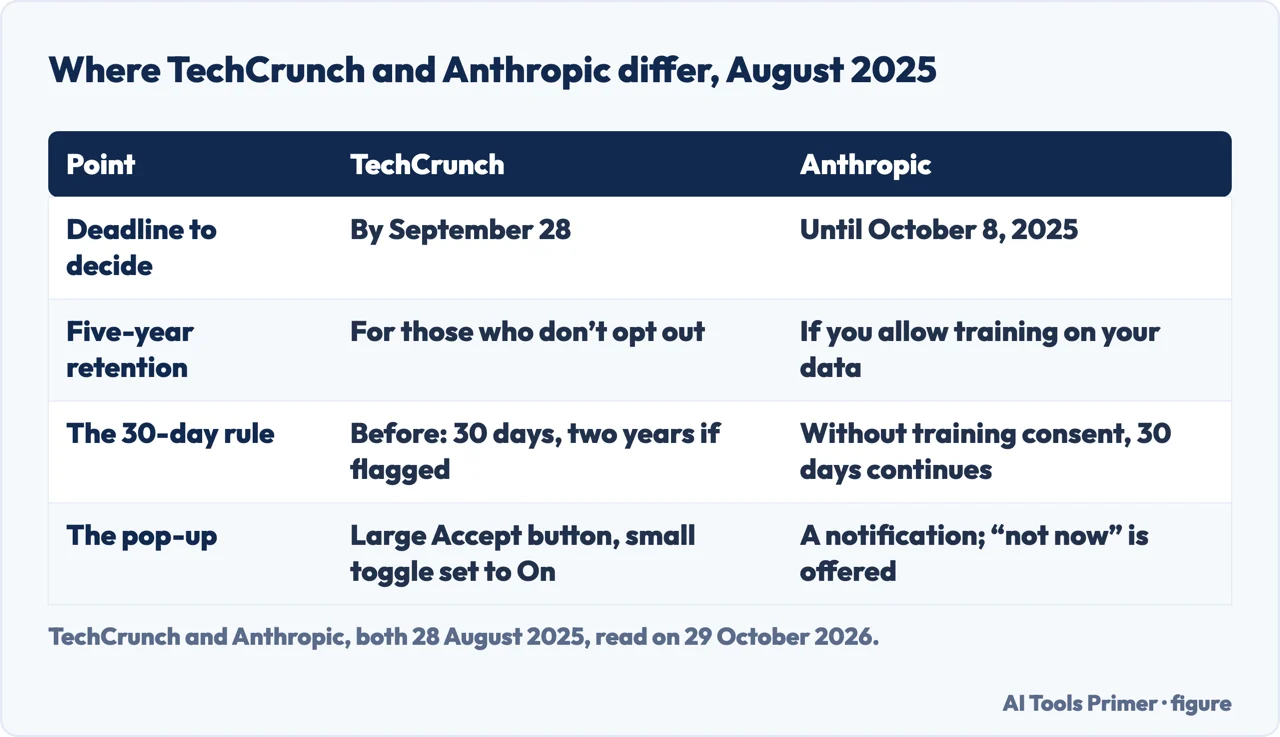
The same announcement says retention is extended to five years if you allow Anthropic to use your data for model training, and that this applies only to new or resumed chats and coding sessions. Without that choice, the existing 30-day retention period continues. The five years also apply to feedback you submit about Claude’s responses. If you change the setting or delete your account, the announcement says, your data is excluded from future model training, and deleting individual chats has the same effect for those chats.
The announcement also sets the timeline. New users pick their preference during sign-up. Existing users saw a notification and had until 8 October 2025 to accept the updated Consumer Terms and decide; the announcement says that after that date a selection is needed to keep using Claude, and that choosing “not now” and deciding later was possible before then. The full text of the Consumer Terms and Privacy Policy is not among the pages we read, only the explanatory articles and the announcement, so what follows describes those.
To change the choice, a Privacy Center article dated 3 August 2026 gives the steps. On a computer, select your name in the settings menu and open the drop-down, choose Settings, then Privacy, and under “Help Improve our AI models” click the button to toggle it off or on. On mobile, select your name, then Settings, then Privacy, and use the same toggle. The article says turning the setting off means new chats and coding sessions will not be used for future model training. Data is still included in training that has already started and in models already trained, but previously stored chats stop being used in future training runs. It adds that conversations flagged by safety classifiers may still be used to improve trust and safety models, detect harmful content, enforce policies or advance safety research.
TechCrunch covered the change on 28 August 2025, and it is the one source outside Anthropic among the pages we read. It differs from Anthropic on three points. It gives the deadline for all Claude users as September 28, where Anthropic’s announcement says October 8, 2025. It says the five-year retention applies to those who don’t opt out, where Anthropic writes that it applies if you allow the use of your data. And it describes the pop-up for existing users as a large “Accept” button above a smaller toggle for training permissions, set to On, citing The Verge on the risk of accepting without noticing. Anthropic’s announcement describes a notification with a choice to decide later. We use the dates and the rule from Anthropic’s pages, which are the primary source for Anthropic's own terms, and TechCrunch for what the change looked like on the day it was announced. TechCrunch also reports that before the change, Anthropic told consumer users prompts and outputs would be deleted within 30 days, with up to two years for inputs flagged as violating its policies.
What the pages do not say
We opened no account and tested no limit. The pages we read do not give a number of messages, tokens or hours for Free. They do not give a weekly limit for Free, though the pricing FAQ says Anthropic may apply weekly and monthly caps at its discretion. The pricing table lists model families, Sonnet and Haiku, for Free, and the pages we read do not name the exact version. The supported locations are not listed in the text we read. We did not read the full Consumer Terms or Privacy Policy, only the articles that explain them.
Besides the TechCrunch article, the pages we read are Anthropic’s own, so the rules above are Anthropic’s description of its service, as of the dates on each page. Pages from Anthropic change; the Help Center pages carry dates of 16 and 22 September 2026, the Privacy Center articles 16 March and 3 August 2026, and the limits and Pro plan pages show only a relative date.
Where to start
Four ways in.
- Can we use Claude for free?
- What the Free plan is, and how to get it — plan
- How long can you use it for free?
- The limit is a five-hour session — limit
- Is free Claude good enough?
- What Free leaves to Pro and Max — missing
- “Are my chats used for training?”
- When Free chats can be used for training — chats
What happens to your chats
The same privacy questions answered for ChatGPT, OpenAI’s assistant.
Plans and who stands behind them
ChatGPT’s paid tiers, how to cancel one, and who owns the service.
Questions people also ask
Can we use Claude for free?
Yes. The pricing page lists a Free plan at $0, and the Pro plan page says anyone in a supported location can sign up at claude.ai with an email address. The Get started page adds that you must be at least 18 years old.
How long can you use Claude.ai for free?
The Get started page says the free plan has a session-based usage limit that resets every five hours, and that the number of messages varies with demand. The pages we read do not set an end date for the Free plan.
Is Claude.ai free like ChatGPT?
The pages we read are Anthropic’s and do not compare Claude with ChatGPT. On the Claude side, Free is $0 with a five-hour session limit; our page on ChatGPT Go and Plus covers the OpenAI plans.
Is free Claude good enough?
The pricing page says Free covers everyday questions. Among the rows its table marks No for Free are Opus models, Claude Code, Claude in Chrome and usage credits. The pages we read do not rate the quality of the answers.
Not covered here. We opened no account and tested no limit. The statements come from eight pages of Anthropic and an article of TechCrunch, all read on 29 October 2026. The sources are Anthropic’s own description of its service, with TechCrunch the only outside voice, from 2025.
The search volume and difficulty behind this page come from a Semrush reading of 29 August 2026, older than the 60 days the site normally allows.
Sources
- Anthropic — How do usage and length limits work? (Claude Help Center) — support.claude.com, read 29 October 2026.
- Anthropic — Pricing (claude.com) — claude.com, read 29 October 2026.
- Anthropic — What is the Pro plan? (Claude Help Center) — support.claude.com, read 29 October 2026.
- Anthropic — Is my data used for model training? (Privacy Center) — privacy.claude.com, read 29 October 2026.
- Anthropic — Get started with Claude (Claude Help Center) — support.claude.com, read 29 October 2026.
- Anthropic — Updates to Consumer Terms and Privacy Policy — www.anthropic.com, read 29 October 2026.
- Anthropic — Usage limit best practices (Claude Help Center) — support.claude.com, read 29 October 2026.
- Anthropic — How do I change my model improvement privacy settings? (Privacy Center) — privacy.claude.com, read 29 October 2026.
- TechCrunch — Anthropic users face a new choice: opt out or share your chats for AI training — techcrunch.com, read 29 October 2026.
Written by Alberto Gulotta
Founder and editor of AI Tools Primer, writing from Palermo, Italy. Thirty-five years of taking computers apart, starting with a Commodore 64 — the long version is on the about page.
Something wrong on this page? Write to aitoolsprimer@gmail.com and it gets fixed.
Written on 29 October 2026.
Independence and limits
No affiliate links and no paid placements anywhere on this site. Nobody pays to appear here, and no company has seen this page before you did.
This is general information, not professional advice. Where a page touches money, health, safety or the law, it names its source and the date it was read — and your situation may still differ. See the privacy page and the cookie policy.