Most of the difference between these two plans is a matter of degree — more of the same things. One difference is not, and it appears on only one of the two pages.
ChatGPT Go
“a low-cost subscription plan”
Everything in Free, plus higher usage limits for eligible features.
More image generation, more file uploads, more advanced data analysis.
“Longer memory for more personalized responses: keep conversations flowing with a larger context window.”
Access to projects, tasks, custom GPTs and Library — “subject to current feature
availability and storage limits”.
Available “in all countries ChatGPT is supported in”.
ChatGPT Plus
$20/month, billed monthly
Priority access during high-traffic periods.
“Higher model limits: use more messages and broader model options than on the Free plan.”
Advanced reasoning access “for coding, planning, and multi-step analysis”.
Faster response speeds.
Voice, image generation, file uploads and analysis, and Deep Research tools “where
available”.
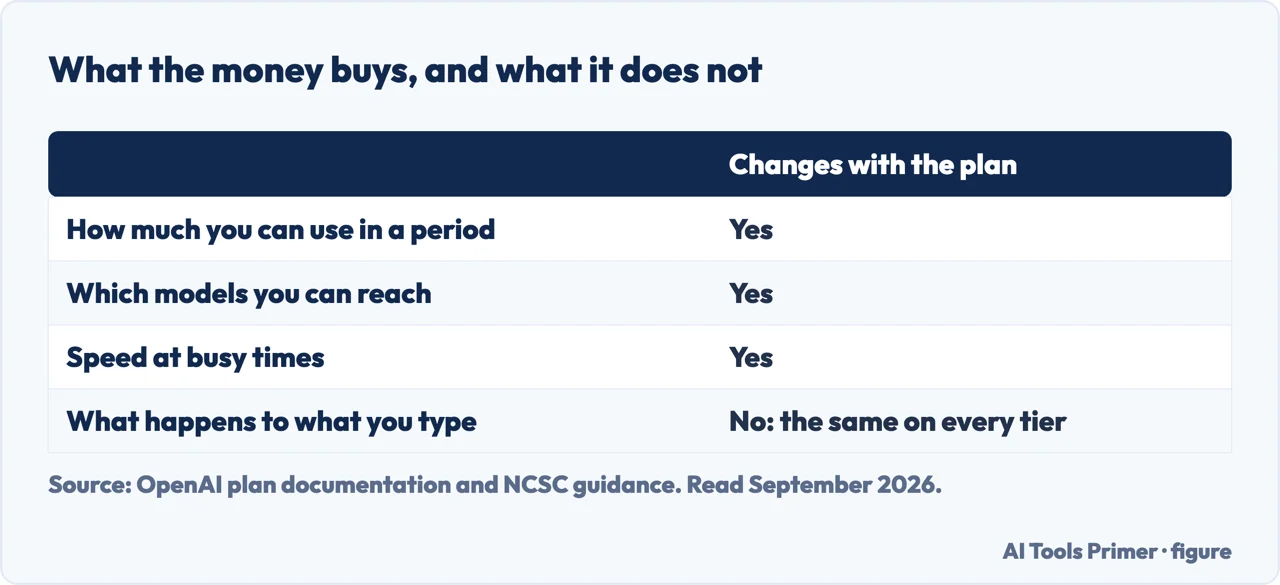
Three things change. The fourth never does. Figure drawn by AI Tools Primer.
Read the two lists side by side and the shape of the choice comes out. Go is described almost entirely in terms of “more”: more images, more uploads, more analysis, longer memory. Every item is a limit being raised on something the free plan already does.
Plus is described differently. Alongside its own “more”, it names things that are about access rather than quantity — priority during busy periods, broader model options, advanced reasoning, Deep Research where available. Those are doors rather than allowances.
That is a reading of the two descriptions rather than a rule OpenAI states, but it maps onto a question you can answer about yourself: are you running out of something, or unable to reach it? The Go list is written for the first. The Plus list adds the second.
“We may start testing ads in ChatGPT Go in the future.”
That sentence is on OpenAI’s page for Go. It is not on its page for Plus. Nothing has
happened yet — “may” and “in the future” are the company’s own words, and this page is not going
to read them as a promise in either direction. But it is the one difference between the two
plans that is about kind rather than about quantity, and it is the sort of
thing worth knowing before rather than after.
Now the price, which is where this comparison gets awkward — and the awkwardness is itself part of the answer.
“All purchases are in USD — we offer a local currency billing in a limited set
of countries… Note that we may adjust pricing over time as we learn from early use and
gather feedback.”
Two things follow from that, and they explain something confusing. First, a figure shown in your
own currency is a billing convenience rather than a separate price list. Second, and more
practically: OpenAI publishes $20/month for Plus in its help centre, but for Go it sends
you to the pricing page instead of naming a figure — and warns on the same line that the number
can move. So check the current price at the source before deciding, and treat any figure
quoted second-hand, including on this page, as needing confirmation.
True of both, and worth knowing before you pay
Four statements OpenAI makes about the paid plans generally.
The API is not included. On both pages: “API usage is not included and billed
independently.” Paying for a subscription does not give you developer access.
Limits are conditional. Plus “may include usage limits such as message caps,
especially during high demand. These limits may vary based on system conditions.” Go’s usage
is “subject to plan limits, abuse guardrails, and temporary restrictions during high
demand”.
The model list is not fixed. OpenAI declines to publish one: “Because model
availability and limits change over time, check the model picker for the options on
your account.”
Monthly, cancel anytime. “Subscriptions are billed automatically monthly, and can be
canceled anytime.”
The third of those deserves a moment. OpenAI is declining to publish a list of which models each plan gets, and gives its reason on the same line: the list moves. Whatever else follows from that, one thing does immediately — no page can give you a durable answer to “which models do I get”, including this one. The model picker inside your own account is the only current source, and OpenAI says so itself.
Where the boundary sits. OpenAI draws it in one sentence on the Go
page: “Some advanced products and higher-tier features may require Plus or another eligible
plan.” It does not enumerate which — so the honest form of the comparison is that Go raises
the ceiling on what Free already does, while Plus is the plan the company names when something is
gated. If a specific feature is your reason for paying, check on its own page whether it names
a plan, because the tier pages do not list the exceptions.
It is worth being explicit about what none of this settles. These are the plans as the company describes them, and a description of a plan is not a measurement of it. Whether the higher limits feel higher, whether priority access is noticeable when demand spikes, whether the longer memory holds up over a real week of work — those are questions about experience, and they need testing rather than reading. This site does not publish verdicts on tools it has not run for long enough to have one.
What can be said without testing anything is where the two plans differ in kind rather than in amount, and there is exactly one such difference on the record: the sentence about ads sits on the Go page and not on the Plus page. Everything else in the comparison is a dial.
One practical note about stopping, since both plans renew monthly. OpenAI documents cancelling from inside the account: profile icon, then Settings. It does not say anything on these pages about subscriptions bought through a phone’s app store, so if that is how you pay, where the cancellation lives is a question for whoever took the money — worth establishing at the moment of paying rather than at the moment of stopping.
What is true of both plans, and of every plan. The NCSC’s note on large language models is about the query rather than the subscription: a provider “(or its partners/contractors) are able to read queries, and may incorporate them in some way into future versions”, and questions asked under one login can be aggregated. No tier changes that, which is the right way to read the whole comparison — what you pay for is capacity and speed, not a different relationship with what you typed.
The guides below take it three ways: the two plans themselves, what is true of both, and the wider questions about the company and the service that this comparison sits inside.
Where to start
Three ways in. The first question is whether you are running out or locked out.
The API excluded, limits that vary with demand, a model list the company will not publish, and a monthly subscription you can stop. Plus the practical business of cancelling one.
Choosing a plan sits inside larger questions about what these tools are for and what they get wrong. These guides are the ones worth reading before paying for either.
Not covered here. It will not tell you which plan is better. That would need running both for long enough to have an opinion worth the word, and this site does not publish verdicts it has not earned.
It will not quote a price for Go. OpenAI does not publish one in its help centre and says the figure may change, so a number here would be a hostage to the date you read it.
And it will not tell you ads are coming to Go. The company says it may test them in future, which is neither a plan nor a denial, and reporting it as either would be putting words in somebody’s mouth. What holds instead is simple: every price and limit above is OpenAI’s own wording, and this page marks where OpenAI stops publishing rather than filling the gap.
Living with ChatGPT: the plan, the history and the data
What you are paying for, what it keeps, and how to stop both.
OpenAI, What is ChatGPT Go? (that Go is a low-cost subscription plan providing expanded access to ChatGPT’s most popular features; that it is now available in all ChatGPT supported countries; that it includes everything in the Free plan plus higher usage limits for eligible features, extended access to image generation, file uploads and advanced data analysis, longer memory with a larger context window, and access to projects, tasks, custom GPTs and Library subject to current feature availability and storage limits; that some advanced products and higher-tier features may require Plus or another eligible plan; that usage is subject to plan limits, abuse guardrails and temporary restrictions during high demand; that OpenAI may start testing ads in ChatGPT Go in the future; that API usage is not included and is billed independently; that all purchases are in USD with local currency billing offered in a limited set of countries, that subscription prices are found on the ChatGPT pricing page, and that pricing may be adjusted over time; and that subscriptions are billed automatically monthly and can be cancelled at any time) — help.openai.com, read 22 August 2026.
OpenAI, What is ChatGPT Plus? (that Plus is a subscription plan providing enhanced access to the ChatGPT web app for $20 per month, billed monthly; that because model availability and limits change over time the model picker should be checked for the options on an account; the listed benefits of priority access during high-traffic periods, higher model limits and broader model options, advanced reasoning access for coding, planning and multi-step analysis, faster response speeds, and expanded features including voice conversations, image generation, file uploads and analysis, and Deep Research tools where available; that Plus is available on the ChatGPT website and supported apps; that API usage is separate and billed independently; and that Plus subscriptions may include usage limits such as message caps especially during high demand, which may vary based on system conditions) — help.openai.com, read 22 August 2026.
National Cyber Security Centre — ChatGPT and large language models, what’s the risk: the exposure that is the same on every tier — www.ncsc.gov.uk, read 4 September 2026.
AG
Written by Alberto Gulotta
Founder and editor of AI Tools Primer, writing from Palermo, Italy. Thirty-five years of
taking computers apart, starting with a Commodore 64 — the long version is on the
about page.
Written on 22 August 2026 · last checked 23 September 2026.
§
Independence and limits
No affiliate links and no paid placements anywhere on this site. Nobody pays to appear here,
and no company has seen this page before you did.
This is general information, not professional advice. Where a page touches money, health,
safety or the law, it names its source and the date it was read — and your situation may
still differ. See the privacy page and the
cookie policy.