
Chat · guide
Is Gemini free, and what the free account gets
By Alberto Gulotta · Updated · 16 min read
Is Gemini free? There is a free level, and it has a ceiling. Google's help page says the usage limits are compute-based and refresh every 5 hours until a weekly limit. Android Police reports that the free account has had only Flash-Lite since 9 October, and that video and Gemini inside Gmail, Docs and Sheets need a paid plan.
| Question | Answer | Where it comes from |
|---|---|---|
| Is there a ceiling? | Yes: usage limits that refresh every 5 hours until a weekly limit | Google, Gemini Apps Help |
| How much do the plans raise it? | AI Plus 2x and AI Pro 4x the standard limits | Google, Gemini Apps Help |
| How much can it read? | 32k tokens without a plan, 128k with AI Plus, 1 million with AI Pro | Google, Gemini Apps Help |
| Which model is free? | Flash-Lite only since 9 October, says Android Police; the Google pages we read do not say | Android Police |
| What do the plans cost? | Google’s announcement gives $19.99 a month for Pro and $4.99 for Plus once a student year ends | Google blog |
Yes, with a ceiling that refreshes
Google’s Gemini Apps Help page opens with the idea that decides everything else: the usage limits are calculated from compute, not from a count of messages, and they set how far you can use Gemini’s tools and features. The page says the limits depend on how complex the prompt is, which models and features you use, and how long the chat has run. It also says the allowance renews every 5 hours until the weekly limit is reached. So the first answer is about the shape of the ceiling, not about a number: a short allowance that fills up again, sitting under a longer one.
The page gives its limits as multipliers. Without an AI plan the limits are the “Standard limits”; AI Plus is 2x higher than that, AI Pro 4x higher, and AI Ultra 5x or 20x higher than AI Pro depending on the subscription. The pages we read do not turn any of this into a count of prompts. Android Police, in an article published on 27 October 2026, says the same from the outside: Google does not provide exact usage limits, so there is no set number of prompts, and that each plan draws on a compute allowance renewed every five hours under a weekly cap, with Pro at four times the free tier’s limits. The two accounts agree on the shape and on the factor of four.
Google’s page is written for a personal Google Account. It says Gemini Apps upgrades are part of select Google One paid plans for personal accounts, and it sends work and school accounts to a separate page. For using Gemini Apps with a Google AI plan, it states an age rule: 13, or the age that applies in your country, and 18 in the European Economic Area, Switzerland and the United Kingdom. The page also warns that some features may not be available to users under 18 or 13. The pages we read do not state a separate age rule for an account without a plan.
What the ceiling is made of
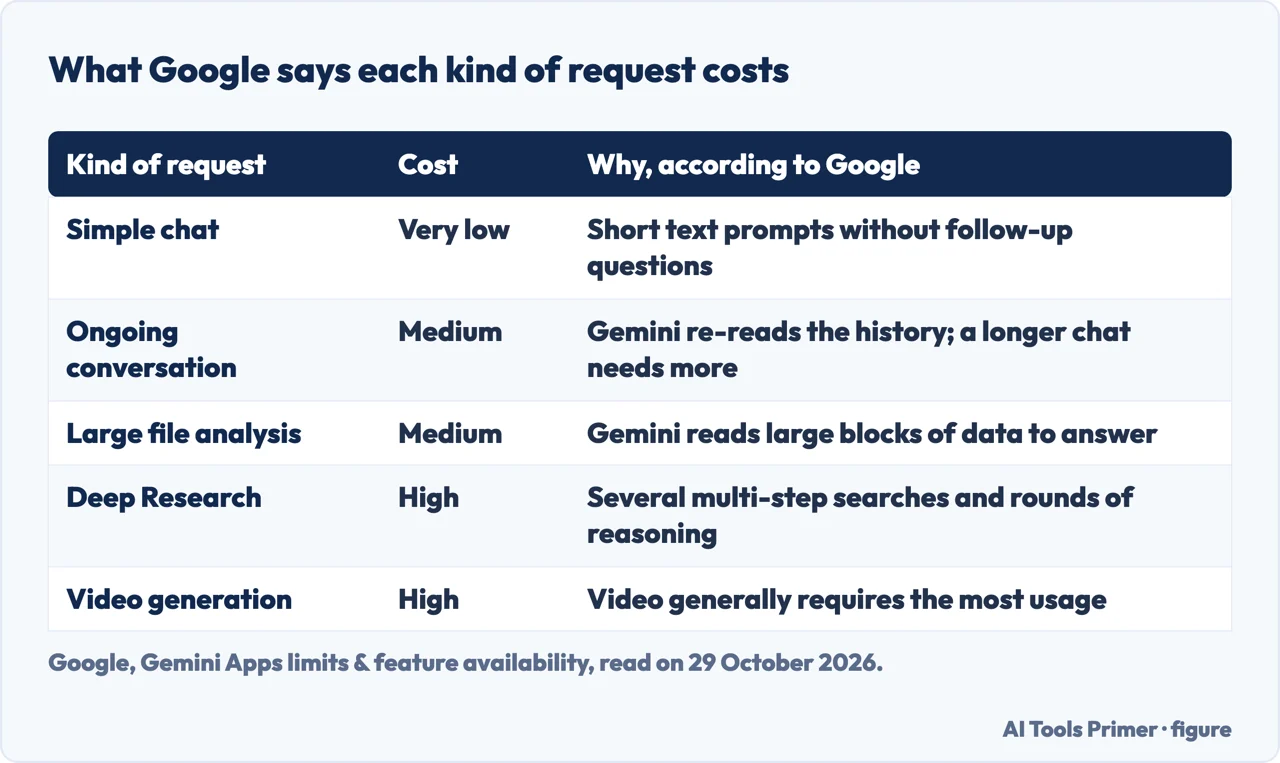
Because the limit is compute-based, two people on the same plan can reach it at different speeds. Google’s page includes a table of relative usage cost, and the figure below reproduces it. A simple chat is rated very low: a short text prompt without follow-up questions does not need much thinking power. An ongoing conversation is rated medium, because Gemini has to re-read the earlier history to keep the context, and a longer chat needs more. Analysing a large file is also medium, since long documents, codebases or spreadsheets mean reading large blocks of data. Deep Research is rated high, because it uses several multi-step searches and rounds of reasoning to build a report. Video generation is rated high too, and the page says video generally requires the most usage; it groups images, music and video as multimedia requests that need a lot of thinking power.
The page offers one piece of advice that follows from the table: start a new chat when you move to a new topic. Gemini then does not have to re-read a long conversation history before it answers, which saves usage. Android Police makes a related point, saying that heavier features such as Deep Research, image generation, video creation on Pro and higher thinking levels use up the allowance faster.
Reaching the limit is described differently for people with and without a plan. Google says that someone with a Google AI subscription who reaches the limit can continue the conversation with Flash-Lite. Someone who reaches the five-hour or weekly limit can upgrade to a subscription with higher limits or wait until the limit refreshes. The page adds that limits may change without notice, including because of capacity constraints, and that when activity in Gemini Apps rises sharply it may change limits to keep quality high. For people without a plan, it says some features that need more compute, like Deep Research, may be unavailable during periods of high demand, and that their limits may be reduced before those of people with a plan.
You can see where you stand. The page says to visit gemini.google.com, select Settings at the bottom left and then Usage Limits. It says Gemini Apps notifies you when you are close to the limit for your plan, and when you reach it, gives another notification that says when the limit will refresh.
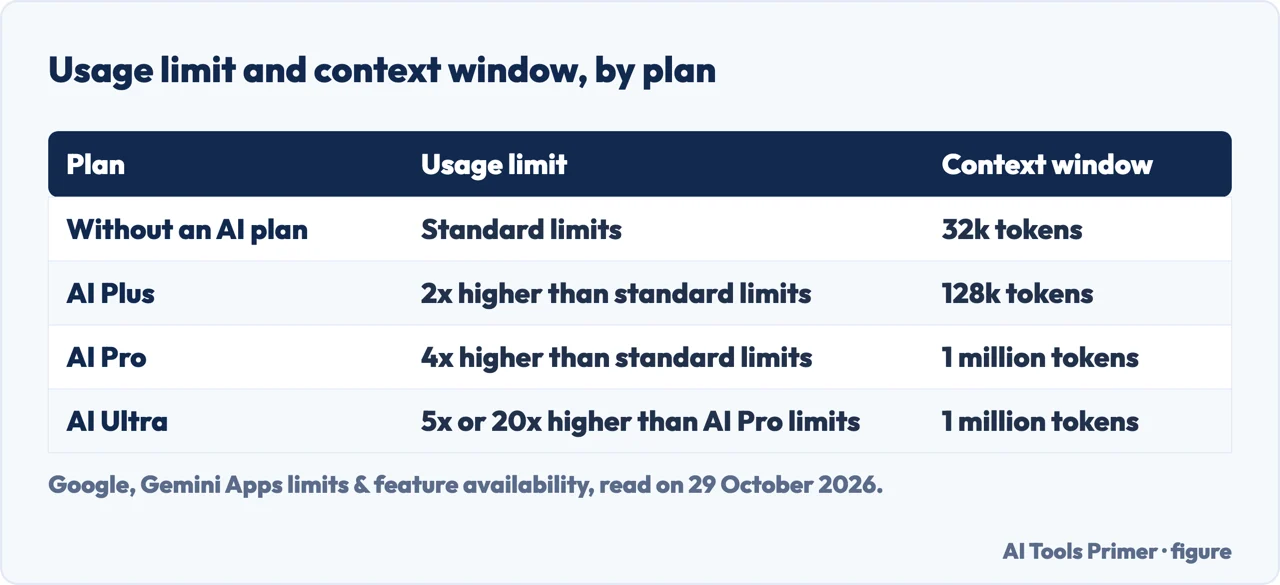
How much it can read, in two different units
Google measures how much Gemini can take in at once with the context window. Its page describes it as a reading capacity: how much content can be understood together at one time, so that a larger window lets Gemini work with longer prompts and chats. By plan, the page lists 32k tokens without an AI plan, 128k tokens for AI Plus, and 1 million tokens for AI Pro and AI Ultra. With a 1 million token window, the page says, Gemini can understand up to 1,500 pages of text or 30 thousand lines of code. If you go past the window, it warns, responses might not take into account all the content you provided, or might miss connections and details scattered through large files.
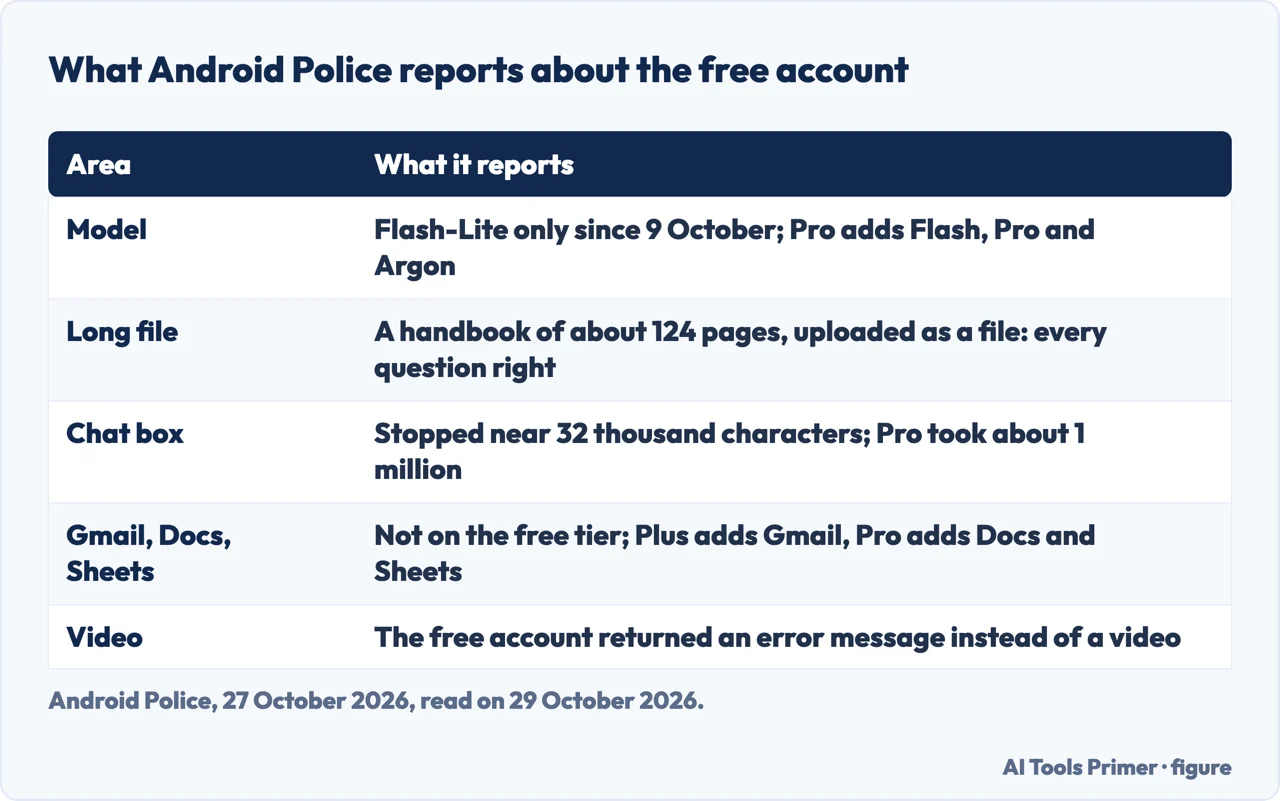
Android Police measured something else, and the two should not be read as one number. Its author pasted a handbook of about 124 pages into the free chat box, and the box accepted about 32 thousand characters, roughly 5,000 words, before cutting off in the middle of a sentence. That is about 8% of the handbook, or roughly 10 pages. On Pro, the same handbook went in twice and about half of a third copy, which the article puts at roughly 1 million characters, about 315 pages. Google counts in tokens and describes the window; Android Police counts characters and describes what the chat box accepted. We have not converted between them.
The article then adds a workaround for the free tier: upload the long text as a file. It says that is how the free account read the full handbook in an earlier test, and that Gemini answered every question about fees, rules and dates hidden across sections correctly. A second test, a spreadsheet with months of purchases, also got every question right. Google’s table does not separate the chat box from an uploaded file, so the difference between the two comes from Android Police alone.
What the free account does, according to Android Police
The sharpest difference between the sources is the model. Android Police says that from 9 October Google took the Flash and Pro models away from free accounts and left them only Gemini 3.5 Flash-Lite. Before that, the article says, you could switch between models on the free tier; now you only get Flash-Lite, with a choice of low, medium and high thinking levels, and the allowance runs out faster at the higher levels. On Pro, the article says, you choose between the Flash models, Pro and Argon, which it calls Gemini’s most advanced model. Google’s page on Pro benefits does list the Gemini app with Gemini 4 Argon among the things Google AI Pro includes.
The Google pages we read do not say which model an account without a plan uses. Google’s limits page names Flash-Lite only as the model you continue with if you have a plan and reach the limit. Android Police is therefore the only source we read for the free model, and the model names, like Argon and Flash-Lite, are quoted here with the page and date rather than confirmed by Google.
On what still works, the article says free accounts keep Deep Research, image generation, Gemini Live and Canvas. From its tests, scheduled actions still work on free accounts, and so do Skills, which it says are replacing Gems in Google’s latest renaming. Google’s own feature table lists Canvas, Skills, Deep Research, scheduled actions, image generation, video generation and others for four columns, from no plan to Ultra, but the check marks did not come through in the text we read. We therefore cannot say from Google’s table which of them the free column includes.
On what does not work, the article reports two things. The first is video: asked to create a video, the free account returned an error message, which the article criticises for not saying that the feature needs a subscription. The second is Gemini inside Google’s own applications. It says the free tier does not work in Gmail, Docs and Sheets, and that the Gemini button opens a box with a “Try it out” button that links to Google’s pricing plans. Google’s Pro benefits page is less specific: it says that some Gemini features in Gmail, Docs, Vids and other apps come with Google AI plans, and that availability varies with the plan.
Its verdict is its own opinion, not Google’s: the free tier is more than enough for most everyday tasks, since it will answer questions, read and analyse long files and generate images. The pages we read do not rate the quality of the answers. For a comparison with other assistants, the article only notes, as context for Google’s change, that Claude gives free users its mid-tier Sonnet model while ChatGPT offers GPT-6 Luna, and it suggests seeing how Gemini stacks up against both before paying. We ask the same question about each of them: is Claude free and is ChatGPT free.
What the plans add, and the free year for students
The plan table is on Google’s limits page: AI Plus raises the usage limits 2x and the context window to 128k tokens; AI Pro raises them 4x and the window to 1 million tokens; AI Ultra goes to 5x or 20x the Pro limits. Beyond the numbers, Google’s page on Pro benefits says that AI Pro makes the Gemini app far more capable on demanding work, and it names coding, logical reasoning, nuanced instructions and creative collaboration. It says Pro members have more access to Gemini features, including Deep Research, for users aged 18 or over, and that the plan includes 5 TB or 10 TB of storage depending on the Pro membership plan. The same page says each product has its own AI usage limits, and that Pro and Ultra members who reach a plan’s limit can buy AI credits to extend their use in Google Flow and Google Antigravity.
Android Police lists what it sees as the practical differences. Pro lets you create videos in chat and gives 1,000 monthly credits in Flow, Google’s AI video tool; it adds 5 TB of cloud storage, up from 15 GB free, YouTube Premium Lite and Google Home Premium Standard. For someone who already pays for those services, the article says, Pro would cost under $20 in practice. The cheaper AI Plus plan, which it prices at $5 a month, adds Gemini in Gmail, but Docs and Sheets need Pro. Its closing advice is to consider Pro for Gemini in Docs and Sheets, for video, for hitting limits often, or for paying for the related services, and Plus as a middle ground for someone who wants Gemini in Gmail and a better model than Flash-Lite.
The exact prices come from Google. In its announcement of 19 August 2026, Google says eligible college students in the United States can have one year of Google AI Pro free, a plan it values at $19.99 a month. The offer lists 4x the usage limits in Gemini, access to Gemini Spark, Gemini inside apps such as Gmail and Docs, 5 TB of storage and Google Health Premium, among other things. Outside the United States, eligible students can have one year of Google AI Plus free, which Google says provides Gemini Omni, 2x higher usage limits, 400 GB of storage and more. Android Police’s $20 and $5 sit close to the $19.99 and $4.99 in Google’s announcement.
The announcement’s footnotes carry the conditions. Both offers can be redeemed until 31 December 2026 and need a valid form of payment at sign-up. Unless cancelled earlier, Pro charges $19.99 a month after the trial ends, and Plus charges $4.99 a month or the local equivalent; Google adds “Cancel anytime”. The Plus offer excludes the United States, Bolivia, Albania, Canada, Macau, Hong Kong and Tunisia. A separate bundle of Google AI Pro with a YouTube Premium subscription is offered at up to 70% off and needs verification through SheerID; the terms say the student offers are valid for up to 4 years and may renew automatically at the standard monthly price once student status ends. The announcement also says that the student hub, study notebooks, interactive visualizations and Deep Research in Gemini Live roll out to all Gemini app users; its footnotes add that usage limits apply and that school-issued accounts get them in the coming weeks.
What the pages do not say
The pages we read give the plan multipliers but do not give a number of prompts or messages for any plan. They do not say how long the free level will stay as it is; Google’s limits page says limits may change without notice. A feature-by-feature answer for the free column therefore rests on Android Police alone. We did not read what Google does with the conversations of people without a plan, and we did not read the pages on the developer tools, AI Studio or the API.
We read the four pages listed under Sources and no others. We opened no account and tested no limit, so every statement above is what a page says, with its date.
Where to start
Four ways in.
- “Is Gemini AI free or paid?”
- Yes, with a ceiling that refreshes — yes
- “How long can I use it for free?”
- What the ceiling is made of — ceiling
- “Is the free version any good?”
- What the free account does, according to Android Police — free
- “What does a plan add?”
- What the plans add, and the free year for students — paid
The same question for other assistants
Free plans and paid tiers of Claude and ChatGPT, read the same way.
Around Gemini
Gemini in the terminal.
Questions people also ask
Is Gemini AI free or paid?
Both. Google’s limits page describes usage limits for people without an AI plan and for AI Plus, AI Pro and AI Ultra, which are paid plans. Android Police describes the free tier as limited to Flash-Lite since 9 October 2026 and says Pro adds video, Gemini in Docs and Sheets, and four times the free limits.
Is free Gemini better than free ChatGPT?
The Google pages we read do not compare the two. Android Police mentions that ChatGPT offers GPT-6 Luna and Claude gives free users Sonnet, as context for Google’s change, without ranking them. Our pages on ChatGPT and Claude cover what each says about its own free plan.
How long can I use Gemini for free?
The pages we read do not set an end date for the free level. Google says usage limits refresh every 5 hours until a weekly limit, and that limits may change without notice.
Is the free version of Gemini good?
Android Police judges the free tier more than enough for most everyday tasks, and reports that it read a long file uploaded to it and answered every question correctly. It also reports that the free account has no video and no Gemini in Gmail, Docs or Sheets. Google’s pages do not rate quality.
Not covered here. We opened no account and tested no limit. The statements come from two Google help pages, a Google announcement and an Android Police article, all read on 29 October 2026. Android Police is the outside voice, the free account’s model comes from its report, and what the free account can and cannot do comes from its own tests.
The search volume and difficulty behind this page come from a Semrush reading of 29 August 2026, older than the 60 days the site normally allows.
Sources
- Google — Gemini Apps limits & feature availability (Gemini Apps Help) — support.google.com, read 29 October 2026.
- Google — Use Google AI Pro benefits (Google One Help) — support.google.com, read 29 October 2026.
- Google — Start the semester with one year of Gemini, on us (Google blog, 19 August 2026) — blog.google, read 29 October 2026.
- Android Police — Gemini’s free plan just got cut down; is the $20 Pro tier worth it now? (27 October 2026) — www.androidpolice.com, read 29 October 2026.
Written by Alberto Gulotta
Founder and editor of AI Tools Primer, writing from Palermo, Italy. Thirty-five years of taking computers apart, starting with a Commodore 64 — the long version is on the about page.
Something wrong on this page? Write to aitoolsprimer@gmail.com and it gets fixed.
Written on 29 October 2026.
Independence and limits
No affiliate links and no paid placements anywhere on this site. Nobody pays to appear here, and no company has seen this page before you did.
This is general information, not professional advice. Where a page touches money, health, safety or the law, it names its source and the date it was read — and your situation may still differ. See the privacy page and the cookie policy.