
Chat · guide
Is Perplexity better than ChatGPT? Sources, side by side
By Alberto Gulotta · Updated · 17 min read
Is Perplexity better than ChatGPT? The company pages we read do not settle it. Perplexity's help pages say each answer carries numbered citations to verify. OpenAI's say a ChatGPT citation can be incomplete, outdated or incorrect, and tell you to open it. A third-party test covers one question.
| Question | Answer | Where it comes from |
|---|---|---|
| Does it search the web each time? | Perplexity’s page says it searches when you ask; OpenAI’s says ChatGPT may, and you can start a search yourself | Perplexity Help Center, OpenAI Help Center |
| What is a citation for? | Perplexity says to verify the information; OpenAI says to check that the source supports the answer | Perplexity Help Center, OpenAI Help Center |
| Can a citation be wrong? | OpenAI says citations can be incomplete, outdated or incorrect; the Perplexity help pages we read do not say | OpenAI Help Center |
| Can the links be made up? | Perplexity’s developer docs say addresses written by a model can be hallucinated; OpenAI lists fabricated references among its errors | Perplexity Docs, OpenAI Help Center |
| Who says which is better? | Zapier says Perplexity, on one test question; the company pages do not compare the two | Zapier |
What each one says it does when you ask
Perplexity’s Help Center page “How does Perplexity work?” says that when you ask a question it uses AI to search the internet in real time, and it lists three steps: it interprets the question, searches the web and summarises what it finds. The page “What is Perplexity?” calls it an AI-powered search engine and says it integrates OpenAI’s GPT models and Anthropic’s Claude, so the company that makes ChatGPT appears on Perplexity’s own page as a model provider. In both pages, searching is the thing that happens when you ask.
OpenAI describes ChatGPT differently. Its page “Searching the web with ChatGPT” says ChatGPT can search the web to answer questions with current information and links to relevant sources, and that it “may search the web automatically” when a question would benefit. To start a search by hand you select View all tools, then Search, or type a slash in the message box. The page lists the Free, Go, Plus, Pro, Business, Enterprise and Edu plans and says people who are not signed in can search too, within each plan’s usage limits. A second OpenAI page, “Does ChatGPT tell the truth?”, adds that without search the answers rest on what the model learned in training, that the search tools are on by default for all models, and that you can tell whether search is active from the icons in the input bar or from web sources cited in the reply.
Zapier, a third party we come back to below, describes the same difference from the user’s side: with ChatGPT you may need to press Search or ask it to search, to be sure of getting real-time results. That is Zapier’s comparison table, written in March 2026. OpenAI’s page says the search may start on its own.
On Perplexity’s side, the plan decides how deep a search goes. The page says Pro Search is not a separate toggle: when you use Search, Perplexity applies it by itself if your plan includes it, and free users get a limited number of Pro Searches per day. The pages we read give no number for that limit. A table on the “What is Pro Search?” page sets standard search at one or two sources against dozens for Pro Search. The model page adds that on the Free plan you can use the automatic Best option but cannot pick an advanced model by hand. The Perplexity pages disagree with each other on which models exist, so we name none: the page on models, a snapshot of 27 October 2026, says the model selector is always the source of truth for your account.
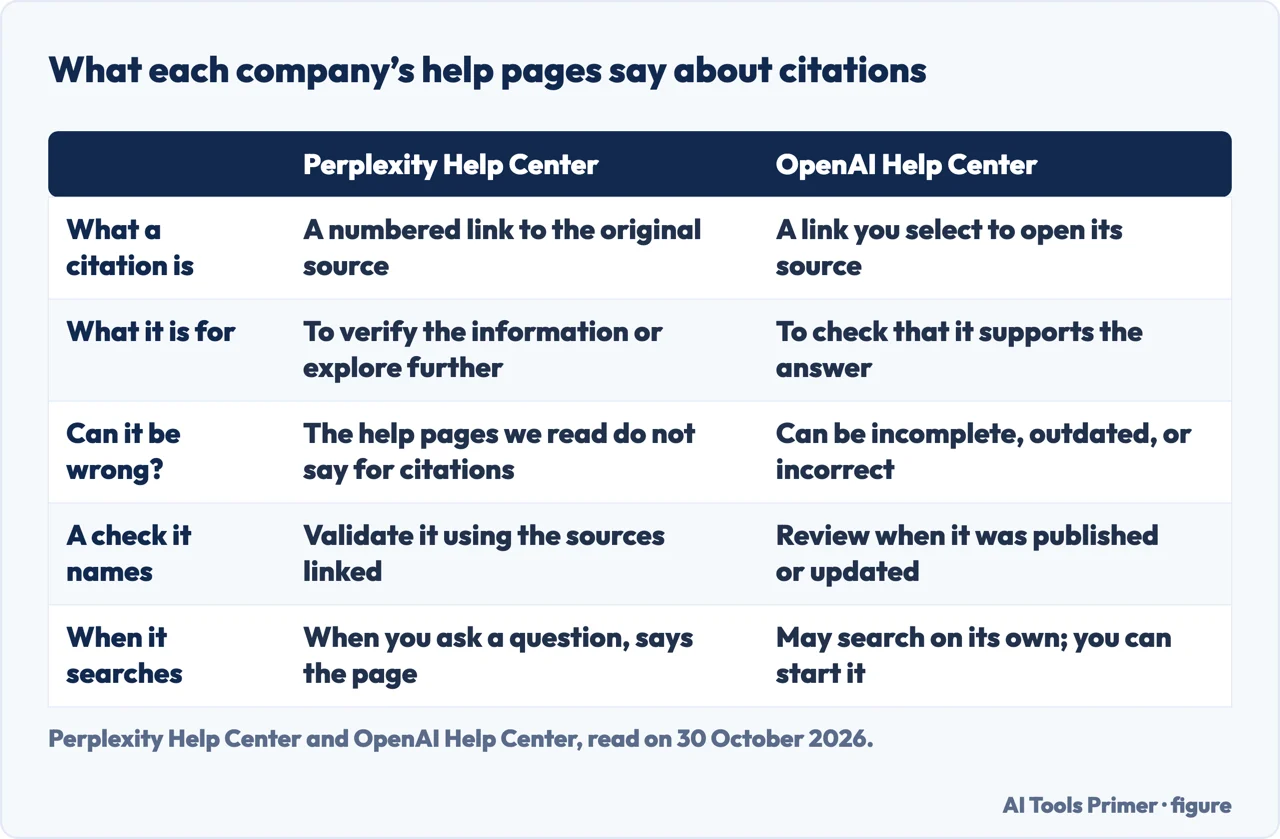
What a citation promises, in each company’s words
The two companies use the same device, a numbered or clickable source beside the answer, and promise slightly different things with it. Perplexity’s help pages say each answer includes numbered citations that link to the original sources, so that you can verify the information or explore further. The Pro Search page says that with full source citations you can check the origin of any information, and in a section headed “Validating information” it says it is crucial to validate what you read by using the sources linked in the answer. The page “What is Perplexity?” adds the company’s description of itself: answers backed by verifiable sources and supported by citations from reputable news organisations, academic publications and established content sources. The Perplexity Pro page lists “10x as many citations” per answer as a benefit; it does not say compared with what, and we do not compare it with ChatGPT.
OpenAI says responses that use web search may include citations, and that selecting one opens its source. A Sources button lists the cited sources and other relevant links. Then comes the sentence that sets the two companies apart in wording: search results and citations can be “incomplete, outdated, or incorrect”. OpenAI’s instruction follows from it. Open a cited source to check that it supports the answer, look at when it was published or updated, and use an authoritative source when accuracy matters. If a result looks wrong, the page says to ask ChatGPT to search again with a specific source, date or location.
Both ask you to check. What differs is how much each page says about what you would find. OpenAI says a citation can be incomplete, outdated or incorrect, and says what to look at. The Perplexity help pages we read do not use those words about citations, and they do not say that a cited source might fail to support the sentence it sits beside. The help center does carry a notice on its assistant box that responses are generated using AI and may contain mistakes, but that is a line about the assistant, not about citations. We take no side from this: it is a difference in what two sets of pages tell a reader, and neither page measures how often a citation is right.
The warning about invented links
The clearest warning on the Perplexity side is not in the help center. It sits in Perplexity’s developer documentation, in a guide called “Streaming Citation Parsing”, which is written for people who build software on Perplexity’s API. The guide explains that the model puts numbered references such as [1] and [2] in its text, while the web addresses arrive separately in a list called search_results. It then tells developers never to generate their own addresses and to use only the ones in that list, because addresses written by a model can be hallucinated. It suggests checking each address with a quick request and a time limit before showing it, and, if a numbered reference has no matching entry, showing the number without a link.
The same guide notes that a long, multi-step run produces one batch of search results per search, all sharing one set of numbers, and that a developer who keeps only the first batch leaves references in the text with nothing to match. That is advice to developers, not to someone typing a question, and the help pages we read do not repeat it.
OpenAI puts the same risk on its ordinary help page. “Does ChatGPT tell the truth?” lists, among the errors it calls hallucinations, fabricated quotes, studies, citations or references to non-existent sources. It says confidence is not reliability, that ChatGPT should be used as a first draft and not a final source, and that you should check sources when accuracy matters by visiting the links directly. So the two companies name the same hazard, an answer that points to a source that is not what it seems, but in different places and for different readers.
Here is a short routine of our own, built from those pages. It is our suggestion, not either company’s, and each step borrows from a page named above:
- Open the link. Visit it directly, as OpenAI says, and see that it arrives where the answer says it does.
- Find the sentence. OpenAI’s test is whether the source supports the answer, which is more than whether the page exists.
- Look at the date. OpenAI says to review when the source was published or updated.
- If it fails, ask again. For ChatGPT, OpenAI says to ask for a new search with a specific source, date or location. The Perplexity pages we read give no equivalent step.
Deep research on both sides
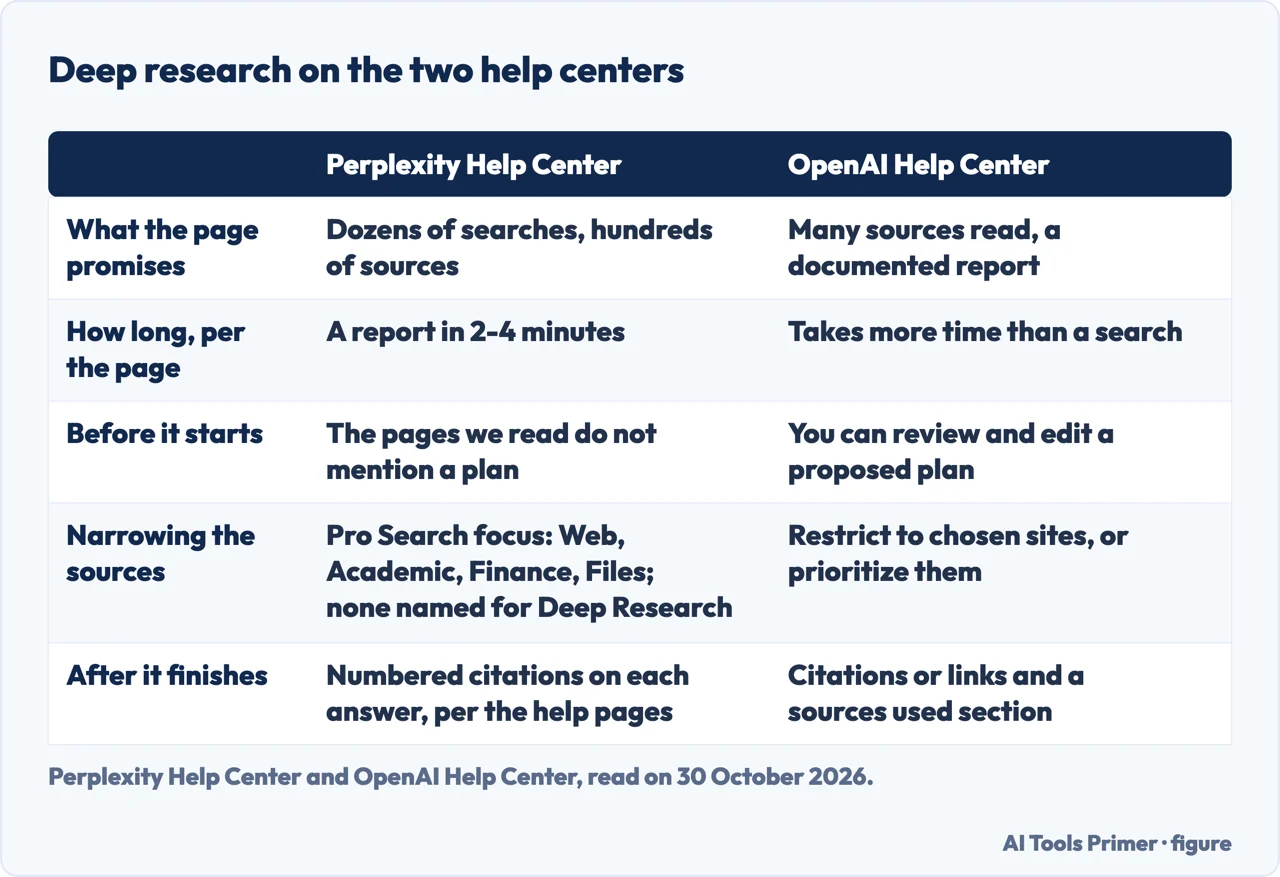
Both companies offer a slower mode for bigger questions. Perplexity describes it by scale, and OpenAI by what you can steer. Perplexity’s page says Deep Research performs dozens of searches automatically, reads hundreds of sources and delivers a report in 2-4 minutes. Those are the company’s figures and we timed nothing. The Pro Search page makes a related comparison, between standard search and Pro Search: one or two sources against dozens, and basic citations against extensive, direct source links. Free users get a limited number of Pro Searches per day, and Pro subscribers have extended access.
OpenAI’s page “Deep research in ChatGPT” describes a process with more steps you can see. ChatGPT may ask clarifying questions, then proposes a research plan that you can review and edit before the research begins. You can follow progress and interrupt to refine the focus. You can limit the research to chosen websites, or ask it to prioritise them while still searching the wider web. Every output carries citations or source links, and the finished report opens with a table of contents, a sources-used section and an activity history. The page tells you to use search for quick facts and deep research for depth and thoroughness.
Zapier’s comparison covers the same ground from outside, and its statements are opinions. It calls ChatGPT’s deep research industry-leading but limited to publicly available web sources. For Perplexity it lists an Academic option for scholarly sources, a Premium Sources feature that draws on paywalled data from Statista, CB Insights and PitchBook, and Model Council for Max subscribers, which runs a query across several models. It also writes that ChatGPT does not always make clear which facts come from which sources. OpenAI’s page, for its part, says every deep research output has citations. Those two statements are about different things, citations being present against each fact being tied to one, so they do not contradict.
What the two companies’ pages share is the job they leave with you. A report built from dozens of sources carries a long list of citations, and each company says the citations are there so that you can verify the information.
What a third-party test says, and what it cannot
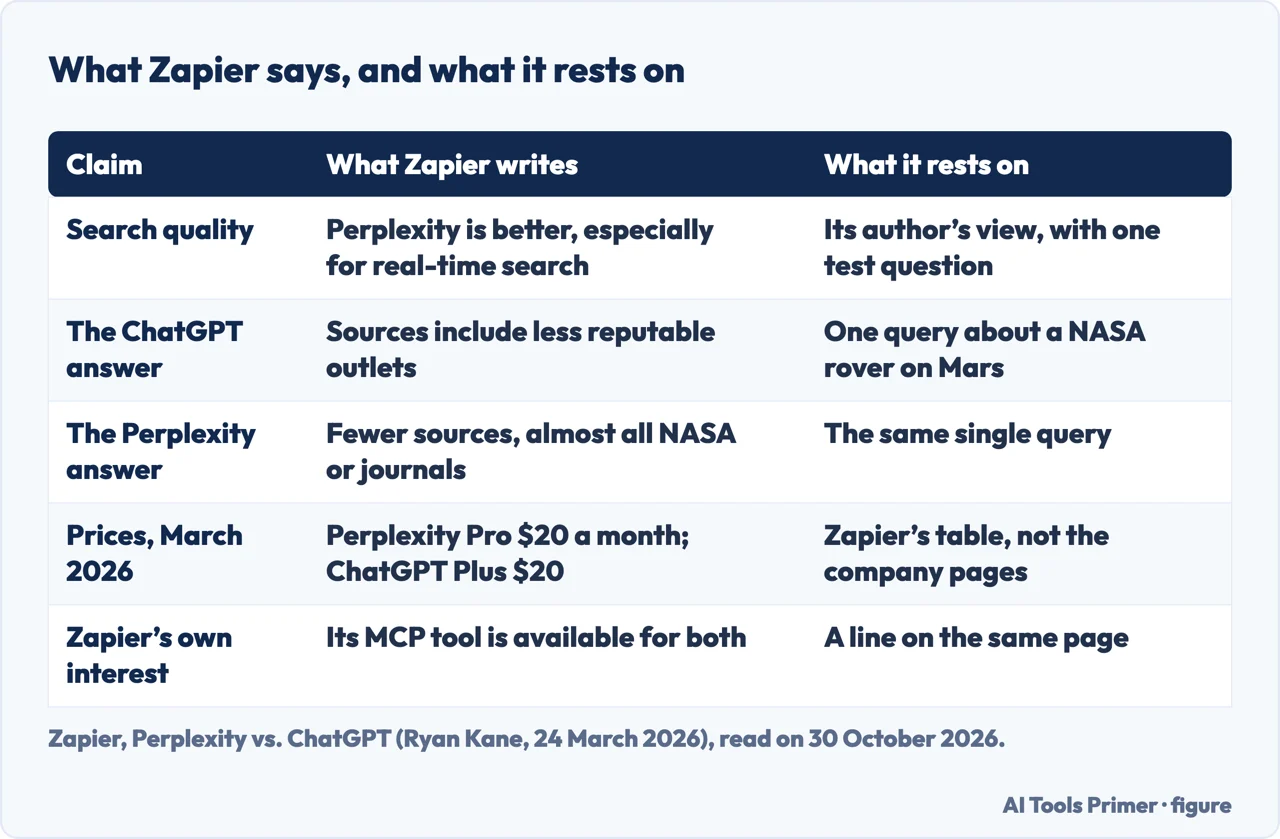
The one comparison we read in full is Zapier’s “Perplexity vs. ChatGPT”, bylined Ryan Kane and dated 24 March 2026; the page also says it was first published in June 2024 by Harry Guinness and last updated in March 2026. Zapier is an automation company, and the page says its Zapier MCP tool is available for both Perplexity and ChatGPT, so the company has a commercial interest in both. On search, the article favours Perplexity: its table calls Perplexity’s results consistently better, especially for real-time search, and ChatGPT’s search solid but not quite as accurate.
The author also says they have used both apps side by side for a few months, which the article does not document. The one test it shows is a single question typed into both apps: what is the latest with the NASA rover on Mars. Zapier writes that ChatGPT searched the web and pulled content from around two dozen searches, and that its sources included less reputable publications, naming the New York Post and SlashGear. It writes that Perplexity used fewer sources, almost all from NASA or reputable scientific journals, and presented them in a way it found more polished, which it calls a bit subjective. The author adds that this is just one example and says the results are the same for other factual or newsworthy prompts, without showing those other prompts.
Two things limit what this proves. The first is size: one question, judged by one author. The second is what was judged. The article rates which publications were cited, not whether each sentence matched the source beside it, which is the check OpenAI’s page asks of you. There is also a tension inside the page. The comparison table says ChatGPT’s search relies on “fewer sources”, while the test paragraph says Perplexity used fewer in that example. Zapier does not reconcile the two, and neither do we.
The article also gives prices as of March 2026: Perplexity Pro at $20 a month and Max at $200; ChatGPT Go at $8 with ads, Plus at $20 and Pro at $200. We did not read the pricing pages of either company, so these are Zapier’s figures with that date. Our page on ChatGPT Go and Plus covers what OpenAI’s pages say about those two plans. Zapier also writes about browsers and agents, Perplexity’s Comet and Computer and ChatGPT’s Atlas; we say no more about them here.
So which one?
We will not name a winner. We opened no account and ran no test, the company pages describe their own products, and the one outside test used a single question. The company pages we read do not compare the two companies, and the pages we read do not measure how often a citation supports the sentence beside it, for either one. What the pages do show is where the two differ:
- Search. Perplexity presents it as what happens when you ask; OpenAI says ChatGPT may search and that you can start a search yourself.
- Citations. Perplexity says to verify and validate with the linked sources; OpenAI says a citation can be incomplete, outdated or incorrect and tells you to check that it supports the answer.
- Invented links. Perplexity says it in its developer documentation; OpenAI says it on its user help page.
- Deep research. Perplexity states the scale, dozens of searches and hundreds of sources; OpenAI describes an editable plan and a sources-used section.
- The verdict. It comes from Zapier alone, in March 2026, and its test rests on one question.
Matching the tool to the task is where the pages do help. Zapier’s own rule of thumb, which is opinion, is Perplexity for research with real-time results and citations, and ChatGPT as a general-purpose assistant for creative work, data analysis and coding. Perplexity’s model page lists Search for fast answers to everyday questions and Deep Research for in-depth reports; OpenAI’s page points to search for quick facts and deep research for depth. Both companies tell you to check sources, and OpenAI adds that an authoritative source is the one to use when accuracy matters. For a question where a wrong answer would cost you something, that is where either company’s page says to spend your time. Our pages on the free plans of ChatGPT, Gemini, Copilot and Claude, and on whether ChatGPT is safe, each describe what a company says about its own product.
Where to start
Four ways in.
- “Does it search every time?”
- What each one says it does when you ask — asks
- “Can I trust the citations?”
- What a citation promises, in each company’s words — cite
- “Can the links be made up?”
- The warning about invented links — links
- “Who says Perplexity is better?”
- What a third-party test says, and what it cannot — test
The same question for other assistants
Free plans and limits, read from each company’s own pages.
Checking what an assistant tells you
Safety, plans and the questions around them.
Questions people also ask
Is Perplexity more trustworthy than ChatGPT?
The pages we read do not say. Perplexity’s help pages ask you to validate answers with the linked sources. OpenAI’s page says citations can be incomplete, outdated or incorrect and asks you to check them. Zapier prefers Perplexity, on a few months of use and one test question. We measured nothing ourselves.
Which is better for me, Perplexity or ChatGPT?
The company pages we read do not decide it for you. Perplexity’s model page lists Search for fast answers and Deep Research for in-depth reports; OpenAI says to use search for quick facts and deep research for depth. For either, check the sources when the answer matters.
What are the cons of Perplexity?
The company pages we read do not list any. They show a daily limit on free Pro Searches and model names that differ between pages. Zapier adds that Perplexity has nothing like ChatGPT Go, and that its subreddit is full of users frustrated by shifting quotas and models changing without warning; that is a forum report.
Which AI is better than Perplexity?
The pages we read compare Perplexity only with ChatGPT, and we do not rank assistants. Our pages on Gemini, Copilot and Claude read what each company says about its own plans.
Not covered here. We opened no account and ran no test. The statements come from six Perplexity pages (five Help Center articles and one developer guide), three OpenAI Help Center pages and one Zapier article, all read on 30 October 2026. We did not read the pricing pages or the privacy page of either company, the four other Google results for this question, or the Google AI box.
The search volume and difficulty behind this page come from a Semrush reading of 29 August 2026, older than the 60 days the site normally allows.
Sources
- Perplexity Help Center — How does Perplexity work? — www.perplexity.ai, read 30 October 2026.
- Perplexity Help Center — What is Perplexity? — www.perplexity.ai, read 30 October 2026.
- Perplexity Help Center — What is Pro Search? — www.perplexity.ai, read 30 October 2026.
- Perplexity Help Center — What is Perplexity Pro? — www.perplexity.ai, read 30 October 2026.
- Perplexity Help Center — What advanced AI models are included in my subscription? — www.perplexity.ai, read 30 October 2026.
- Perplexity Docs — Streaming Citation Parsing — docs.perplexity.ai, read 30 October 2026.
- OpenAI Help Center — Searching the web with ChatGPT — help.openai.com, read 30 October 2026.
- OpenAI Help Center — Does ChatGPT tell the truth? — help.openai.com, read 30 October 2026.
- OpenAI Help Center — Deep research in ChatGPT — help.openai.com, read 30 October 2026.
- Zapier — Perplexity vs. ChatGPT: Which AI tool is better? (Ryan Kane, 24 March 2026) — zapier.com, read 30 October 2026.
Written by Alberto Gulotta
Founder and editor of AI Tools Primer, writing from Palermo, Italy. Thirty-five years of taking computers apart, starting with a Commodore 64 — the long version is on the about page.
Something wrong on this page? Write to aitoolsprimer@gmail.com and it gets fixed.
Written on 30 October 2026.
Independence and limits
No affiliate links and no paid placements anywhere on this site. Nobody pays to appear here, and no company has seen this page before you did.
This is general information, not professional advice. Where a page touches money, health, safety or the law, it names its source and the date it was read — and your situation may still differ. See the privacy page and the cookie policy.