
Code · guide
How much does Claude Code cost on a plan, on tokens and per session?
By Alberto Gulotta · Updated · 19 min read
How much does Claude Code cost? Anthropic’s pricing page includes it in paid plans, from $17 a month on Pro with annual billing, and its docs say it charges by API token. Anthropic gives an average of about $13 per developer per active day for enterprises, while OpenRouter reports medians per session.
| Question | Answer | Where it comes from |
|---|---|---|
| Is it free? | The Free plan does not include Claude Code; every paid plan does | Anthropic pricing page |
| What does a plan cost? | Pro is $17 a month billed annually or $20 billed monthly; Max starts at $100 | Anthropic pricing page |
| What does a token bill look like? | Sonnet 5.5 is $2 per million input tokens and $10 per million output tokens | Anthropic API pricing |
| What does one session cost? | Medians of $0.155 on Sonnet 5.5 and $0.305 on Opus 5.5 for a session of 2 to 9 turns on an API key | OpenRouter |
| What do companies average? | About $13 per developer per active day, and below $30 per active day for 90% of users | Anthropic Claude Code docs |
| Why does it climb? | Long sessions, a cache that went cold during a pause, subagents and agent teams | Anthropic Claude Code docs, Finout |
Paid plans include Claude Code, and the Free plan does not
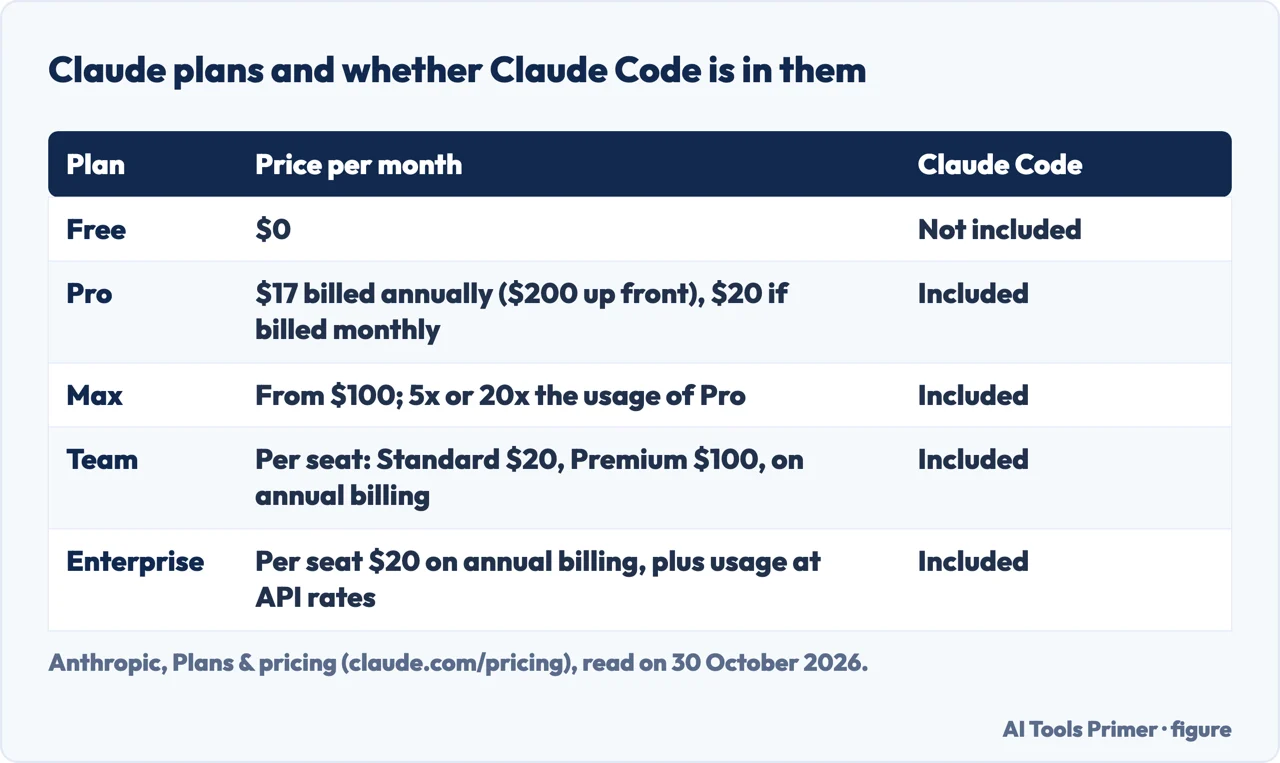
Anthropic’s pricing page lists Claude Code in its feature table with a No under Free and a Yes under Pro, Max 5x and Max 20x. Its questions and answers say Claude Code is included in all paid plans and shares the same usage limits as the rest of the plan, so work in the terminal and in chats draws from one pool. For heavy coding sessions, the page says you can switch to pay-as-you-go API credits through a Console account. OpenRouter, a company that sells access to models, puts the split another way: the program is free to install, and what you pay for is the model it calls. Our page on what the Free plan of Claude includes covers the chat side of the same plans.
The prices on the page are these. Pro is $17 a month with the annual discount, which is $200 billed up front, or $20 if billed monthly. Max is listed as “From $100” a month, with a choice of 5x or 20x more usage than Pro, and it comes with $100 to $200 a month in API credits for building on the Claude Platform; the comparison table gives $100 a month on Max 5x and $200 a month on Max 20x. Finout, a company that sells cloud-cost software, writes the same $100 and $200 as the prices of Max 5x and Max 20x in an article dated 18 April 2026. The pricing page text we read gives the starting price and the credits.
For teams, a Standard seat is $20 per seat per month on annual billing and $25 billed monthly, and a Premium seat is $100 annual or $125 monthly, described as 5x more usage than a Standard seat. The Team plan lists up to $500 a month in pooled API credits. Enterprise is listed as seat price plus usage at API rates: $20 per seat per month billed annually, with a minimum of 20 seats, and the page adds that usage cost scales with model and task.
What a plan’s usage limit tells you, and what it leaves open
The pricing page says every plan has usage limits that reset on a rolling five-hour session window, and that paid plans add weekly limits on top. Activity on the web, desktop, mobile and in Claude Code draws from the same pool. How much you can do depends on the length and complexity of your conversations, the model and the features, so the page says there is no fixed message count. It gives ratios instead: Pro at least 5x more usage per five-hour session than Free, and Max 5x or 20x more than Pro. It also says Anthropic may limit usage in other ways, such as weekly and monthly caps or limits by model and feature. When you reach a limit you can wait for the reset, move to a higher plan or, on paid plans, turn on usage credits to keep working at standard API rates.
Anthropic’s Claude Code docs say what the two kinds of limit message mean. “You’ve hit your session limit” or the weekly version is a seat-based window on a subscription plan, shared across all models, so switching models with /model does not restore access. After a message that names Opus or Sonnet, switching to a model outside that family does keep you working. A message about an individual spend limit means the request would be billed to usage credits and those credits have reached a limit. On Pro and Max the usage-credit settings are on claude.ai under Settings and Usage, with an optional monthly limit; with no limit set, the row in /usage reads Unlimited.
On Team and Enterprise plans the docs say each member’s usage draws from a per-seat allowance that resets on a rolling five-hour window and a weekly window. It is shared with Claude chat and Cowork, and its size depends on the seat tier, Standard or Premium. Usage inside the allowance is not metered in dollars. Past it, usage credits apply, with limits that an admin can set for the organization, a group or one member.
Here the sources differ. Finout’s table gives Team Standard as 1.25x Pro per session and Team Premium as 6.25x Pro. The Anthropic pricing page we read says only that Standard seats give more usage than Pro and that Premium seats give 5x more than Standard, and the 1.25x multiplier does not appear on it. Finout also offers a rule of thumb of its own, not Anthropic’s: with Claude Code three or more days a week on regular Opus use, Max 20x wins; with one or two days a week or mostly Sonnet, the API wins; between the two, run /usage for two weeks before committing. The pages we read do not say how many dollars of tokens a Pro or Max allowance is worth, so a monthly fee cannot be set against a per-token price from these pages alone.
What the token bill looks like
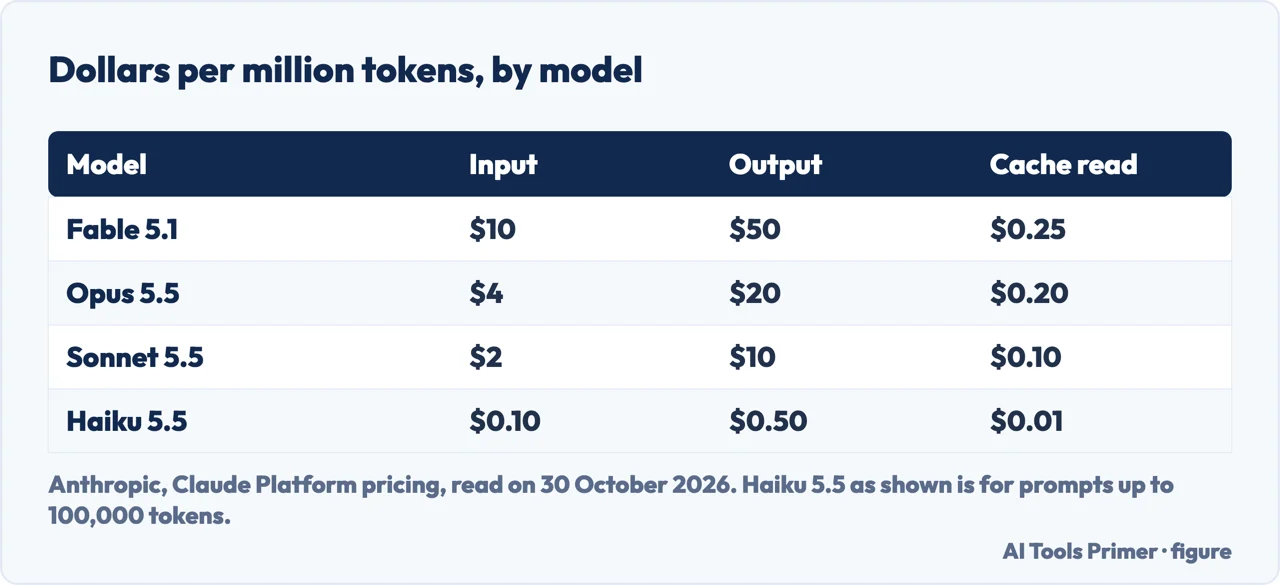
The Claude Code docs open with one sentence on cost: Claude Code charges by API token consumption, and for subscription prices they point to the pricing page. Anthropic’s API pricing page lists the rates per million tokens in the table above. Cache reads, which are most of a Claude Code session’s tokens according to OpenRouter, are charged at 5% of the input price on Opus 5.5 and Sonnet 5.5. Writing to the cache costs more than plain input: for Sonnet 5.5, $2.50 per million tokens for a five-minute cache and $4 for a one-hour cache. Haiku 5.5 is priced by prompt length, with the higher rates of $0.50 input and $2.50 output once a prompt passes a hundred thousand tokens. The same page says models from 4.7 onward use a tokenizer that produces about 30% more tokens for the same text, and that US-only inference carries a 1.1x multiplier; the Claude Code docs say the session cost figure applies it.
The question people type is what a hundred thousand tokens cost. It depends on which kind they are, and this is our arithmetic on the rates above. On Sonnet 5.5, a hundred thousand input tokens are $0.20, a hundred thousand output tokens are $1.00 and a hundred thousand tokens read from the cache are $0.01. On Opus 5.5 the same input and output are $0.40 and $2.00. On Haiku 5.5, for a prompt under the threshold, they are $0.01 and $0.05, and on Fable 5.1 they are $1.00 and $5.00.
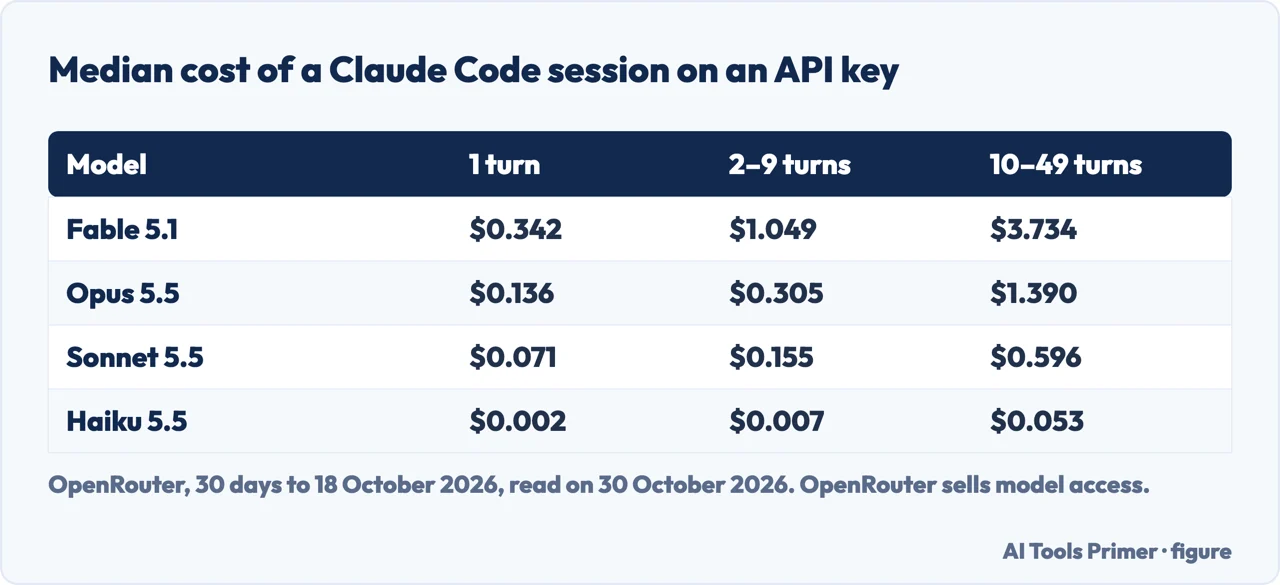
The Anthropic pages we read give no median or typical cost per session. OpenRouter does, from its own traffic. It reports median costs of Claude Code sessions run through an OpenRouter API key in the 30 days to 18 October 2026, by model and by number of turns, in the table above. Two of its statements frame the table. Once a model is chosen, session length matters most: a session of 10 to 49 turns costs, in its words, about four to five times one of 2 to 9 turns. Dividing the numbers in its own table gives 3.6 times on Fable 5.1, 4.6 on Opus 5.5, 3.8 on Sonnet 5.5 and 7.6 on Haiku 5.5, so the range it states fits Opus and sits close to Sonnet. And Sonnet 5.5 costs about half as much as Opus 5.5 or less at every length. OpenRouter adds that a one-turn Fable 5.1 session costs more than a long Haiku 5.5 session.
Most of a short session’s cost, OpenRouter says, is Claude Code’s own context and not the prompt. In a test on Opus 5.5 in an empty folder, a reply of four tokens came with roughly seventeen thousand tokens written to the prompt cache, which it identifies as Claude Code’s system prompt and tool definitions. At $5 per million tokens that write cost $0.085, and reading the same context back later is $0.20 per million, 25 times cheaper. OpenRouter also ran its own task three times on each model, a small library with three bugs and five failing tests, and every run fixed all three. The medians were $0.098 on Opus 5.5, $0.062 on Sonnet 5.5 and $0.0052 on Haiku 5.5. It says these come in under its two-to-nine-turn medians because the task was small and the runs shared a warm cache.
For a month, OpenRouter multiplies sessions by those medians over 22 workdays and calls the results estimates. Five short sessions a workday come to $34 on Opus 5.5 and $17 on Sonnet 5.5; twenty short sessions, $134 and $68; ten long sessions, $306 and $131. The sums can be checked from its table: 5 x 22 x $0.305 is $33.55 and 10 x 22 x $0.596 is $131.12. Two cautions apply. OpenRouter sells model access and these are sessions on its own keys, not a subscription. And it warns that Claude Code’s own total_cost_usd field reported wrong figures for model names it did not recognize in its runs, $0.16 to $0.31 for Haiku sessions that cost about half a cent; we take that as a statement about its setup and not about Claude Code in general.
The averages Anthropic gives, and what /usage shows
The Claude Code docs say per-developer costs vary widely with the model, the size of the codebase and usage patterns such as running several instances or automation. Across enterprise deployments, they give the average as around $13 per developer per active day and $150 to $250 per developer per month, with costs below $30 per active day for 90% of users. To estimate spend for your own team, they suggest starting with a small pilot group and using the tracking tools to set a baseline before a wider rollout.
That average and OpenRouter’s estimates are not the same kind of number. Anthropic’s comes from enterprise deployments; OpenRouter’s monthly figures, from $17 to $306, multiply its session medians by usage patterns it chose. The two ranges overlap, but they start from different data, and the pages we read do not say what a typical single developer outside an enterprise spends in a day.
Inside Claude Code, the /usage command shows a Session block with token counts. The docs say it is intended for API users: Pro and Max subscribers have usage included in the subscription, so the session cost figure is not relevant to their billing, and they see plan usage bars and a breakdown instead. The dollar figure is computed locally from token counts at list price, which makes it an estimate; for authoritative billing the docs point to the Usage page in the Claude Console. Their example block, a sample in the documentation and not a measurement, shows a total of $0.55 for 1.2k input, 5.3k output, 940.0k cache read and 50.0k cache write tokens on a Sonnet model, so cache reads are most of the tokens in it.
Newer versions add more to /usage. A Prompt cache line, in recent versions, reports the number of requests, the share of input served from cache, the misses and whether the cache is warm or cold. On Pro, Max, Team and Enterprise plans an attribution list shows the share of recent usage by skills, subagents, plugins and MCP servers, with a recommendation for any behavior behind 10% or more of recent usage.
Where the bill goes depends on how you sign in. On the Claude Console, spend is metered per token by organization, a workspace called Claude Code is created automatically, and workspace spend limits can be set. On Amazon Bedrock, Google Cloud and Microsoft Foundry, Claude Code is billed per token to the cloud account, and the docs say no metrics come back to Anthropic. For unexpectedly high spend on an API or cloud plan, the docs name long sessions that were never cleared and Opus left as the default model.
Where the bill climbs, and what the docs say to do
The Claude Code docs list why a session open for hours can use far more than the activity suggests. Claude Code sends the full conversation with every request, re-read from the cache at the cached rate, so a one-line question late in a long session still draws on the whole history. The first message after a break longer than the cache lifetime misses the cache and reprocesses the full context. A scheduled task fires on its interval even while the session is idle, and a message from another session arrives as a new turn. Idle goal check-ins are capped at three per goal between prompts. Every subagent and every active agent teammate sends its own requests, and compaction is itself a large request, while /clear costs nothing.
Two single items stand out in the docs. Agent teams use approximately 7x more tokens than standard sessions when the teammates run in plan mode, because each keeps its own context window; they are off by default and switched on with the CLAUDE_CODE_EXPERIMENTAL_AGENT_TEAMS variable. And extended thinking is on by default, with thinking tokens billed as output tokens and a default budget that, the docs say, can be tens of thousands of tokens per request depending on the model. The pages do not measure how much thinking adds in practice. It can be lowered with /effort, and it cannot be turned off on Opus 5.5, Sonnet 5.5, Haiku 5.5 or the Fable models. Session recaps and idle compaction can also use tokens while you are away; the docs give no figure.
Finout’s article, which predates the current rate table and so is used here only for its causes, lists eight reasons for a spike. Besides the ones above, it says the cache lasts one hour on a subscription within included usage and five minutes with usage credits, an API key or a cloud provider, citing Anthropic’s prompt caching docs. It says a setup of five MCP servers with 58 tools took about 55K tokens before the conversation started, citing an Anthropic post, and that on supported models Claude Code now defers those definitions by default, unless a server is marked alwaysLoad. It says an ANTHROPIC_API_KEY set in the shell is used ahead of a subscription login, so a subscriber can end up billed per token; /status shows which credential is active. And it points to a report on Anthropic’s issue tracker of a Max 20x subscriber whose five-hour limit ran out in about 70 minutes after version 2.1.89, which it describes as one user’s report and not a confirmed cause.
For lowering the bill, the docs list /clear between unrelated tasks, custom compaction instructions, Sonnet for most coding and Opus for complex architectural decisions, and model: haiku for simple subagents. They add turning off MCP servers you do not use, hooks that filter long output before the model sees it, a CLAUDE.md under 200 lines with workflow instructions moved to skills, specific prompts instead of “improve this codebase”, plan mode with Shift+Tab, and Escape to stop early. OpenRouter’s advice for API keys is Sonnet as the default, which it says roughly halves the bill against Opus, Haiku for background work and subagents, short sessions and a credit limit on the key. Our page on what an AI agent is sets out the word that agent teams and subagents rest on, and our page on what Claude Code, Cursor and GitHub Copilot keep when a chat is compacted covers what compaction does to the project in view.
What the pages we read do not say
The pages we read do not say how many dollars a Pro or Max allowance is worth, or how many hours or messages it covers. They give no dollar figure for the background token use the docs describe. They do not give a typical day for one developer outside an enterprise, since the $13 average is for enterprise deployments. They do not compare the cost of a task billed per token with the same task on a subscription.
We tested nothing in Claude Code. We did not open the Reddit thread whose title says the average Claude Code cost per developer is $4 a day, so we cannot say whether it is accurate, and we did not open the guides to Claude Code pricing published by Superblocks, SiteGround and MindStudio, so nothing on this page rests on them. Finout’s model prices, from April, differ from the current table, so only the Anthropic pages are used for rates.
Where to start
Four ways in.
- “Is Claude Code free?”
- Paid plans include it, and the Free plan does not — plans
- “What does a session cost?”
- What the token bill looks like — tokens
- “What do companies spend?”
- The averages Anthropic gives — averages
- “Why did my bill jump?”
- Where the bill climbs — climbs
Claude Code and its neighbours
What a coding tool sees, what an agent is and a rival command line.
Checking, automating and plan limits
Reviewing code, automation between apps and what a plan raises.
Questions people also ask
Is Claude Code free or paid?
Anthropic’s pricing page marks Claude Code as not included in the Free plan and included in Pro, Max, Team and Enterprise. OpenRouter says the program is free to install and that the cost is the model it calls, through a subscription or per API token.
Is the $20 Claude code worth it?
The pages we read do not judge worth. They say Pro is $20 a month, or $17 billed annually, and that Claude Code shares the plan’s limits with chats. They put no dollar value on the allowance. For a solo developer under 10 hours a week, Finout suggests moving to Max only after hitting limits for two straight weeks.
Is the Claude code worth paying for?
The pages we read do not answer that. Anthropic’s docs suggest a small pilot group to estimate your own spend, and Finout suggests running /usage for two weeks before committing to a plan.
How much do 100,000 Claude code tokens cost?
It depends on the kind of token. At Anthropic’s rates, our arithmetic gives $0.20 of input, $1.00 of output or $0.01 read from the cache on Sonnet 5.5, and $0.40 and $2.00 on Opus 5.5 for input and output.
Not covered here. We tested nothing in Claude Code. The statements come from three Anthropic pages (the Claude Code docs on costs, the plans and pricing page and the API pricing page), an OpenRouter post of 30 October 2026 and a Finout article of 18 April 2026, all read on 30 October 2026.
The search volume and difficulty behind this page come from a Semrush reading of 29 August 2026, older than the 60 days the site normally allows.
Sources
- Anthropic — Manage costs effectively (Claude Code Docs) — code.claude.com, read 30 October 2026.
- Anthropic — Plans & pricing — claude.com, read 30 October 2026.
- Anthropic — Pricing (Claude Platform Docs) — platform.claude.com, read 30 October 2026.
- OpenRouter — How Much Does Claude Code Cost? Real Session Costs by Model — openrouter.ai, read 30 October 2026.
- Finout — Claude Code Pricing 2026: Complete Plans & Cost Guide — www.finout.io, read 30 October 2026.
Written by Alberto Gulotta
Founder and editor of AI Tools Primer, writing from Palermo, Italy. Thirty-five years of taking computers apart, starting with a Commodore 64 — the long version is on the about page.
Something wrong on this page? Write to aitoolsprimer@gmail.com and it gets fixed.
Written on 30 October 2026.
Independence and limits
No affiliate links and no paid placements anywhere on this site. Nobody pays to appear here, and no company has seen this page before you did.
This is general information, not professional advice. Where a page touches money, health, safety or the law, it names its source and the date it was read — and your situation may still differ. See the privacy page and the cookie policy.