Code · guide
How much does it cost to build an app? The ranges sellers give
By Alberto Gulotta · Updated · 17 min read
How much does it cost to build an app? The six cost pages we read put a simple one anywhere from free to $100,000 or more, and each was written by a company that sells something. Here are their ranges side by side, what the budget is made of, the upkeep and the signs that point to a developer.
| Question | Answer | Where it comes from |
|---|---|---|
| What does a simple app cost? | GoDaddy says free to $20,000, Bubble $5,000 to $50,000, Couchbase $10,000 to $100,000 or more | GoDaddy, Bubble, Couchbase |
| What does a mobile app on one platform cost? | Couchbase says $40,000 to $150,000 for a production-ready iOS or Android app; GoDaddy says $50,000 to $250,000 per platform for native | Couchbase, GoDaddy |
| What does it cost to keep running? | Yearly upkeep of 15-25% of the original cost (GoDaddy) or 15-20% (Couchbase, Base44); Bubble gives a percentage but no number | GoDaddy, Couchbase, Base44, Bubble |
| What do the stores charge? | Apple 99 USD per membership year; Google Play a US$25 one-time registration fee | Apple, Google |
| What does a developer cost an hour? | GoDaddy puts a freelancer at $25-$100 and a large agency at $150-$300 or more; Couchbase cites Upwork for $13 to $60 | GoDaddy, Couchbase |
| Who wrote these figures? | Companies that sell a builder, a database, hosting or custom development, so each figure is that company’s statement | All six cost pages |
The ranges each page gives, and who wrote them
Each of the six cost pages we read was written by a company with something to sell near the answer. GoDaddy’s page promotes its Airo AI Builder, which it offers with 50 AI credits a month for free. Bubble’s sells plans for building and hosting an app, and Base44’s promotes the Base44 app builder. Quickbase’s sits on the blog for Pave, its AI app builder. Couchbase’s names its Capella database service. SOLTECH writes that its figure comes from its own experience of custom mobile app projects. The figures below are those companies’ statements, not measured prices.
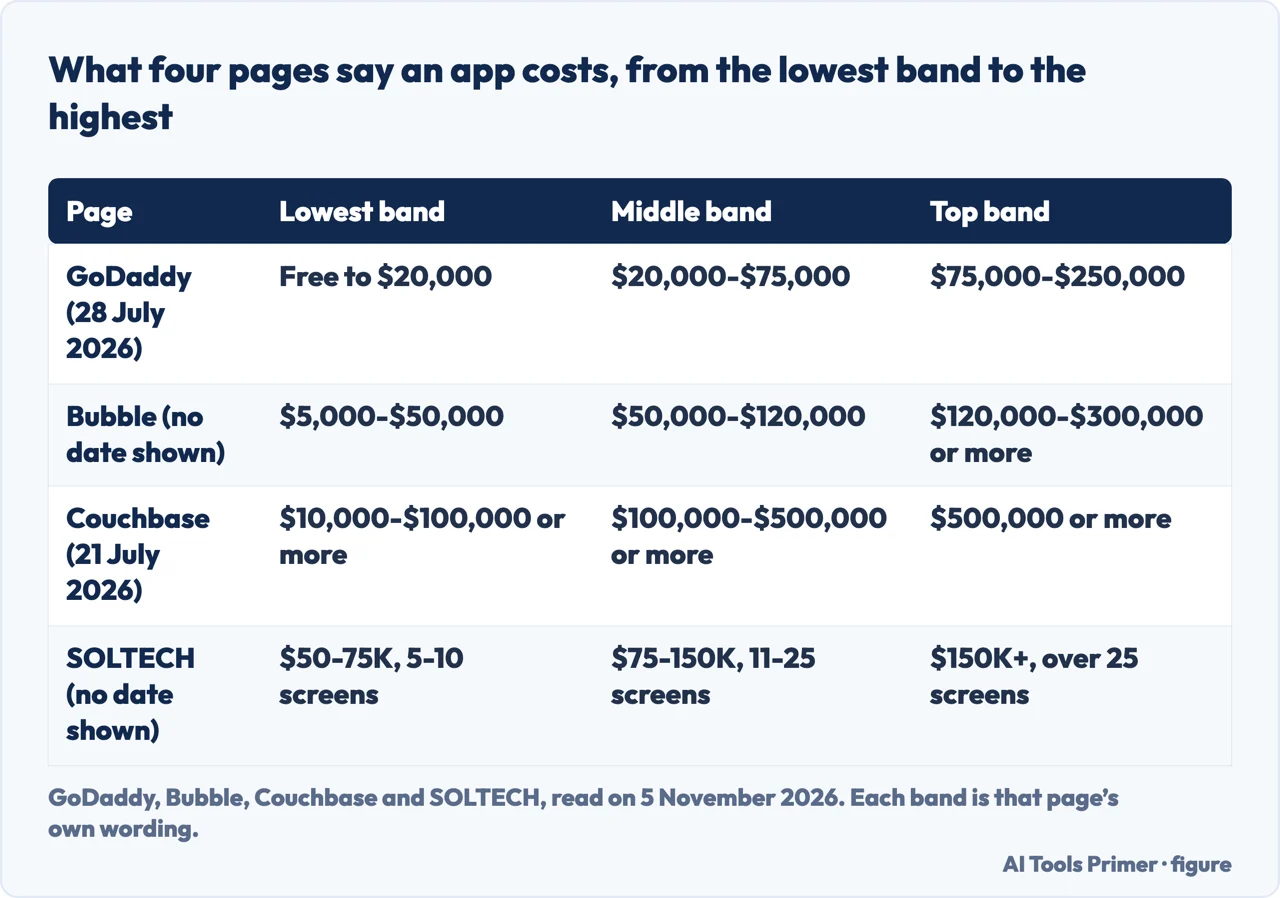
For a simple app, GoDaddy’s table says free to $20,000, taking 2 to 8 weeks. Bubble says $5,000 to $50,000 and adds that very small freelance projects in lower-cost regions can come in under its ranges. Couchbase says simple apps cost from $10,000 to $100,000 or more. Base44 puts a freelancer at $5,000 to $50,000 or more for simple projects with a clear scope. SOLTECH says small apps of 5 to 10 screens run $50-75K. Quickbase passes on a Clutch benchmark, from a guide updated in September 2026, of $10,000 to $49,999 for typical custom software projects its clients reviewed, and calls it a broad project-cost benchmark, not a measured price for internal business apps.
Past the simple tier the pages cut the scale in different places. GoDaddy gives a mid-level app $20,000 to $75,000 over 2 to 4 months, a complex app $75,000 to $250,000 over 4 to 9 months, and an enterprise app $250,000 to $500,000 or more over 9 to 18 months or more, and calls these estimates broad starting points. Bubble gives $50,000 to $120,000 for medium complexity and $120,000 to $300,000 or more for a complex app. Couchbase sorts by kind of app: social media or e-commerce at $100,000 to $500,000 or more, and high-end apps such as banking or healthcare at $500,000 or more. Base44 puts an agency at $50,000 to $500,000 or more, and for traditional development gives iOS apps $55,000 to $300,000 and Android apps $50,000 to $300,000. Couchbase gives a web app with user accounts, a database and APIs $50,000 to $250,000, and a cross-platform mobile app $60,000 to $250,000. SOLTECH puts medium apps of 11 to 25 screens at $75-150K and large ones at $150K and up.
Read across, the lowest start for a simple app is GoDaddy’s free, and the highest for a small one is SOLTECH’s $50-75K; SOLTECH is the agency, and GoDaddy is the page that sells a builder. Couchbase’s summary puts the whole spread in one sentence: it says some apps cost as little as $5,000 to build and others over $1 million. The pages we read do not say why their starting figures differ.
What the number is made of
Two pages offer a formula. GoDaddy’s is development hours times hourly rate equals total cost, and it adds that this leaves out planning, interface design, testing, deployment and ongoing maintenance. Quickbase’s is first-year app cost equals one-time build costs plus ongoing operating and change costs. Quickbase counts scoping the workflow, building or configuring the app, preparing existing data, testing permissions and workflows, and onboarding users as one-time; platform or infrastructure fees, administration, integration maintenance and later workflow changes as ongoing.
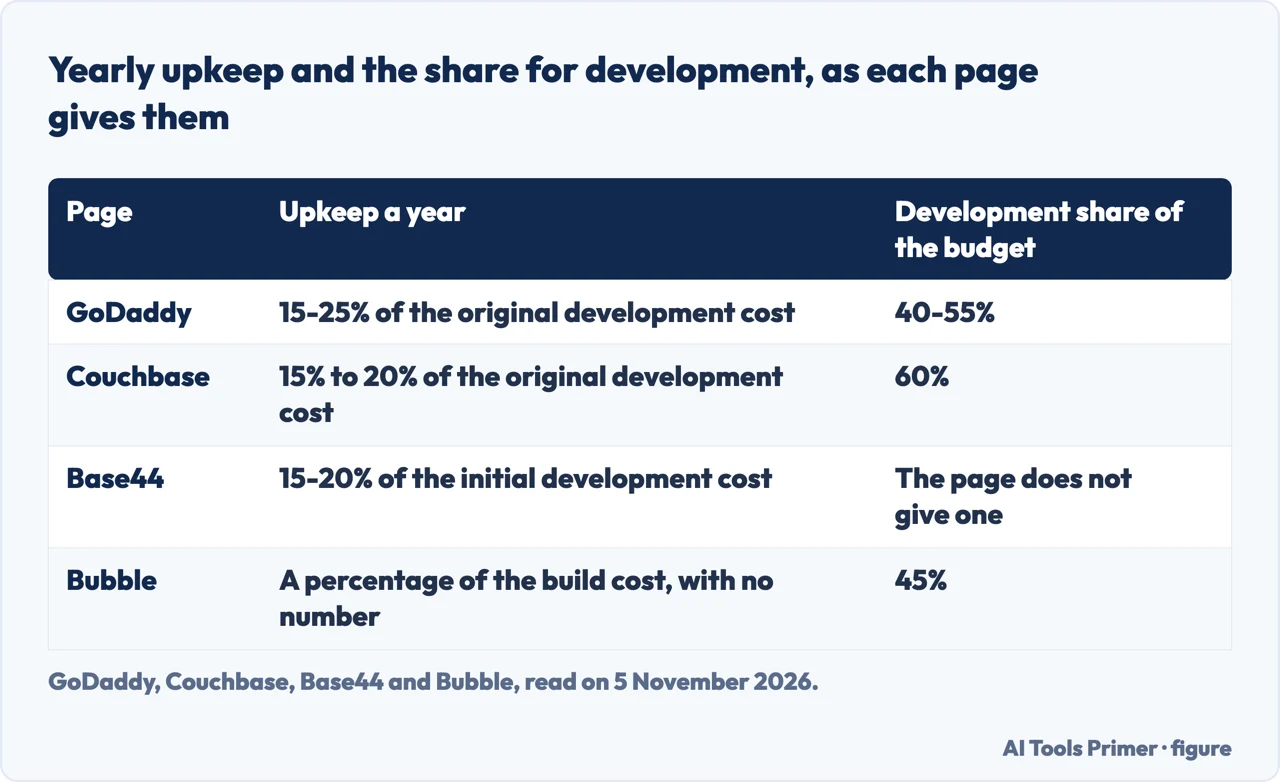
Three pages split the budget by phase, and the splits do not match. GoDaddy gives discovery 10-15%, design 20-25%, development 40-55%, and testing and deployment 15-20%. Bubble gives discovery 10%, design 20%, development 45%, quality assurance 15%, deployment 5% and project management 5%, and calls its percentages a rough guide. Couchbase gives planning 10%, design 15%, development 60%, testing 10% and deployment 5%, and works one example: for a $100,000 project, development would take about $60,000.
The hourly rate is the other half of the formula, and the pages disagree on it too. GoDaddy gives a solo freelancer $25-$100 an hour, a boutique agency $75-$200 and a large agency $150-$300 or more; by region it gives $100-$250 or more in the US and Canada, $75-$200 in Western Europe, $40-$100 in Eastern Europe, $30-$80 in South America and $20-$75 in Asia. Couchbase cites Upwork for a freelance app developer at around $13 to $60 an hour, says an agency costs $150 to $300 an hour, and gives an average US developer salary of around $121,983 a year. Quickbase cites Upwork for a median of $18-$39 an hour for mobile app developers.
The US Bureau of Labor Statistics is not a seller, and its page reports pay, not project prices. It gives a median annual wage of $135,980 for software developers in May 2025. For the wider group that includes quality assurance analysts and testers it gives $134,040 a year, or $64.44 an hour. Quickbase writes a median hourly wage of $65.38 for software developers in May 2025; the BLS page we read gives $64.44 for the wider group, and the pages do not say why the figures differ. We use only the BLS figures we read on its page.
Time is part of the price, and the figures come from the sellers. GoDaddy gives 2 to 8 weeks for a simple app. Quickbase says its own team of four built a change-request app with Pave in about four hours as a minimum viable product, and made smaller changes later through conversation. Bubble lists a customer, SuiteOp, that built its native app in two months against an estimated 6 to 8 months. Bubble chose that example, and the pages we read do not say how typical it is.
What comes after launch
Three pages give a yearly upkeep figure as a share of the original build. GoDaddy says 15-25% of the original development cost per year. Couchbase says between 15% and 20%, and adds that the amount varies with complexity, platform, features, integrations, user base and team size. Base44 says 15-20% of the initial cost annually. Bubble says to budget a percentage of the original build cost each year, depending on hosting, support, updates and compliance, and gives no number. Base44 also says that with an app builder, maintenance and updates are typically included in the subscription.
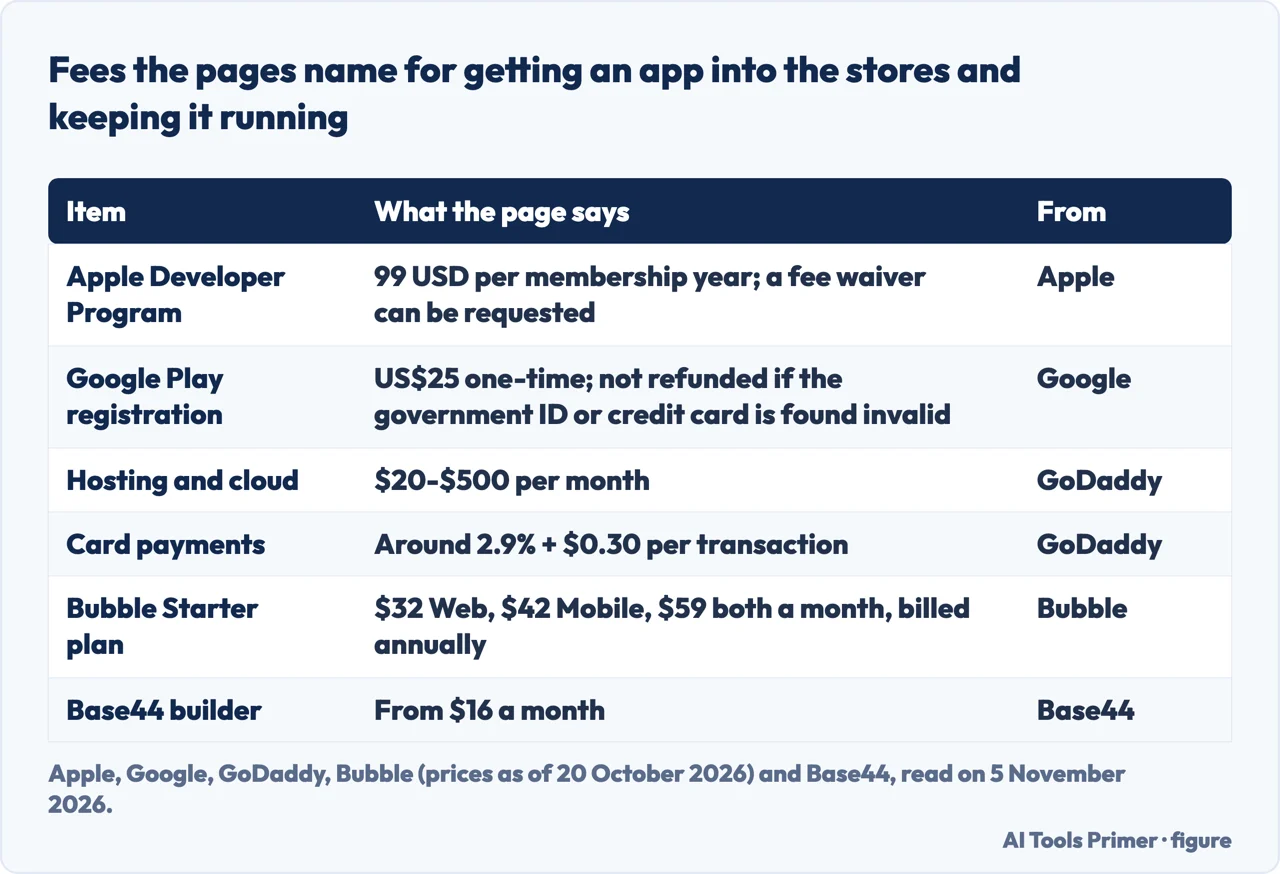
The stores charge their own fees. Apple’s enrolment page says the Apple Developer Program is 99 USD per membership year, with prices that may vary by region, and that a nonprofit organization, accredited educational institution or government entity can request a fee waiver. Google’s Play Console help says there is a US$25 one-time registration fee, and that a request may be asked for a government ID and a credit card under the legal name; if that information is found invalid, the fee is not refunded. GoDaddy repeats both fees. Quickbase says an app hosted internally and not distributed through a public store does not need either.
GoDaddy lists hosting and cloud infrastructure at $20-$500 a month, payment processing at around 2.9% plus $0.30 per transaction, and security updates as varying widely by platform. Bubble names costs a quote can leave out: yearly maintenance, a new build and another round of store approval for bigger changes, payment-gateway fees on each transaction, AI models that charge per request, vendor subscriptions, and SOC 2 and GDPR work after launch. On Bubble’s own plans it names extra workload, storage, paid plugins and store fees as costs beyond the plan.
Bubble’s prices, billed annually and given as of 20 October 2026, are Starter at $32 a month for Web, $42 for Mobile and $59 for Web and Mobile; Growth at $119 for Web and $209 for Web and Mobile; Team at $349 for Web and $549 for Web and Mobile. It says Starter Web is $39 a month if billed monthly, and that apps on the Free plan cannot go live. Base44 says its builder starts at $16 a month. Prices change, so check them on the page before you rely on them.
What a builder does to the bill
The pages that sell builders put the build far below an agency’s figure. GoDaddy’s table gives native development $50,000 to $250,000 per platform, cross-platform development $30,000 to $150,000, a no-code platform $500 to $15,000, and AI-powered development free to $5,000 per year. Base44 gives a builder $0 to $500 a month against $5,000 to $50,000 or more for a freelancer and $50,000 to $500,000 or more for an agency. Couchbase and Base44 also give a figure for a cross-platform mobile app built the traditional way, $60,000 to $250,000 and $40,000 to $150,000 respectively. These are the sellers’ own comparisons.
On whether you can build for free, the pages differ. GoDaddy and Quickbase say yes, with a free plan that includes AI credits; Quickbase adds that building or updating an app uses credits. Base44 says free plans from app builders are “usually very limited” and may carry ads or branding you cannot remove, and that a fully functional app for the stores typically takes some investment. Bubble says apps on its Free plan cannot go live.
Bubble is the page that says where costs return after a first build. It says AI lowers the cost of a first build, but the logic and data remain code, so a change in behavior needs a fresh prompt or a developer able to read it. It lists drift, where each prompt can change more than you asked for; apps that look alike; changes that get harder as features stack up; and pricing by credits or request, which puts a price on every change. Quickbase says natural-language changes still require review and verification, and that more complex requirements in a no-code platform may call for more sophisticated engineering help.
Bubble also covers moving an app to its own platform. It says that moving an app built with another AI coding tool to Bubble is a rebuild rather than an import, because code from another tool does not carry over, and that the existing app works as a spec for the screens, data and flows. The pages we read do not give a measured cost of building with a builder and then handing the app to a developer.
The signs that you need a developer
Three pages say when custom work is the better fit, in different words. Bubble says traditional code makes more sense for specialized hardware access, such as Bluetooth peripherals or custom native SDKs, and for background processes that keep running when the app is closed. It adds that code is the better fit when compliance needs go beyond what a platform’s built-in controls support, and that a team that already has a stack everyone knows may find staying with it cheaper than switching platforms mid-project. Bubble’s table lists a camera, a photo library, push notifications and location as features that suit an AI builder.
Quickbase says custom work makes sense when an app needs specialist engineering, tight control, or specific requirements that existing platform controls cannot meet. It says its own builder fits when the people building the app can describe the process, requirements are likely to change, and the app’s access and governance needs fit current permissions and security controls and the integrations are supported. GoDaddy says a custom-built app can make sense for highly specialized requirements, complex workflows, or strict security and compliance needs, especially with access to a development team. Bubble also says apps that handle sensitive health or financial data need extra security work, which adds to the upfront cost.
If you do hire, Quickbase lists what to ask of a quote: what the scope covers, how handover works, who owns the code, and what later changes will cost. It names four shapes a quote can take: fixed price, hourly, time and materials, or a dedicated team. A fixed price covers a set list of requirements, so it says to ask what happens when you add custom work or a new integration. For a freelancer it says to ask which parts of the work fall to you, and for an agency which roles the quote includes and who supports the app once it is live.
What the pages we read do not say
The pages we read do not explain why their starting figures for a simple app sit so far apart, from free to $50-75K. They do not say how many of a seller’s finished apps stayed at the stated price. Bubble’s customer examples, among them Artizen, SuiteOp, CLEBER and EZRA, are chosen by Bubble. The pages do not give a measured cost for an app built with a builder and later passed to a developer, and the sources that are not sellers are Apple, Google and the Bureau of Labor Statistics, which give fees and pay, not project costs.
Two dates are missing as well: the SOLTECH page shows none, and Bubble’s shows prices as of 20 October 2026 but no date for the article. We built no app and tested nothing. A page from businessofapps.com sat behind an anti-robot check and was not read, a Reddit thread was not opened, and the Google AI box was read only in part, so we use nothing from them.
Where to start
Five ways in.
- “What does a simple app cost?”
- The ranges each page gives, and who wrote them — ranges
- “What is the number made of?”
- What the number is made of — made
- “What do I pay after launch?”
- What comes after launch — after
- “Does a builder make it cheaper?”
- What a builder does to the bill — builders
- “Do I need a developer?”
- The signs that you need a developer — developer
Building without a developer
Builders for apps and websites, and what they cost.
What coding tools cost
Plans, credits and what a coding assistant keeps.
Questions people also ask
Is it expensive to build your own app?
It depends on the route, as each seller tells it. GoDaddy gives native development $50,000 to $250,000 per platform and a no-code platform $500 to $15,000. Base44 gives a builder $0 to $500 a month and a freelancer $5,000 to $50,000 or more. Bubble says changes after a first build can add cost.
Can I build an app for free?
GoDaddy and Quickbase say yes, with a free plan and AI credits. Base44 says free plans are “usually very limited” and may carry ads or branding. Bubble says apps on its Free plan cannot go live. Apple charges 99 USD per membership year and Google Play US$25 once to put an app in the stores.
What is the average cost of making an app?
The pages we read give bands, not one average. For a simple app: GoDaddy free to $20,000, Bubble $5,000 to $50,000, Couchbase $10,000 to $100,000 or more. Quickbase passes on a Clutch benchmark of $10,000 to $49,999 for typical custom software projects, not a measured price for internal apps.
How much can it cost to create an app?
Couchbase says some apps cost as little as $5,000 to develop and others over $1 million. GoDaddy gives an enterprise app $250,000 to $500,000 or more, and Couchbase gives high-end apps such as banking or healthcare $500,000 or more.
Not covered here. We built no app and tested nothing. The statements come from six cost pages (Quickbase, GoDaddy, Couchbase, Bubble, Base44 and SOLTECH) and from pages of Apple, Google Play and the US Bureau of Labor Statistics, all read on 5 November 2026.
The search volume and difficulty behind this page come from an Ubersuggest reading of 5 November 2026 (United States), which gives search volume and its own SEO difficulty score, not Semrush’s; a Semrush check is still to be made.
Sources
- Quickbase — Guide: How Much Does It Cost to Build an App? (Pave) — www.quickbase.com, read 5 November 2026.
- GoDaddy — How much does it cost to make an app in 2026? — www.godaddy.com, read 5 November 2026.
- Couchbase — App Development Costs (A Breakdown) — www.couchbase.com, read 5 November 2026.
- Bubble — How Much Does It Cost to Create an App in 2026? — bubble.io, read 5 November 2026.
- Base44 — How much does it cost to make an app — base44.com, read 5 November 2026.
- SOLTECH — What’s the Average Cost to Build a Mobile App? — soltech.net, read 5 November 2026.
- Apple Developer — Become a member — developer.apple.com, read 5 November 2026.
- Google Play Console Help — Get started with Play Console — support.google.com, read 5 November 2026.
- US Bureau of Labor Statistics — Software Developers, Quality Assurance Analysts, and Testers — www.bls.gov, read 5 November 2026.
Written by Alberto Gulotta
Founder and editor of AI Tools Primer, writing from Palermo, Italy. Thirty-five years of taking computers apart, starting with a Commodore 64 — the long version is on the about page.
Something wrong on this page? Write to aitoolsprimer@gmail.com and it gets fixed.
Written on 6 November 2026.
Independence and limits
No affiliate links and no paid placements anywhere on this site. Nobody pays to appear here, and no company has seen this page before you did.
This is general information, not professional advice. Where a page touches money, health, safety or the law, it names its source and the date it was read — and your situation may still differ. See the privacy page and the cookie policy.