Code · guide
Free AI coding assistants: limits, students and data use
By Alberto Gulotta · Updated · 16 min read
A free AI coding assistant is not one thing: the pages we read state the free plan in completions, requests, credits or a weekly quota, or only as limited, and they say different things about what happens to your code. This page sets GitHub, Google, AWS, Cursor and OpenCode side by side, read on 6 November 2026.
| Question | Answer | Where it comes from |
|---|---|---|
| What does Copilot Free include? | 2,000 completions a month and an allowance of AI credits, with auto model selection only | GitHub Docs |
| Is Gemini Code Assist still free for individuals? | Its IDE extensions stopped serving the individuals, Google AI Pro and Google AI Ultra tiers on 18 June 2026; Google points to Antigravity | Google for Developers |
| How much do the AWS free plans give? | Amazon Q Developer Free: 50 agentic requests a month. Kiro Free: 50 credits a month | AWS, Kiro |
| How much does Cursor Free give? | Limited usage; the page gives no figure | Cursor Docs |
| Is there a free open source option? | OpenCode describes itself as free to use and open source, with a set of free models | OpenCode |
| What about my code? | It differs by page: opt-out settings at GitHub, Kiro and Antigravity, a Privacy Mode at Cursor | Each tool’s pages |
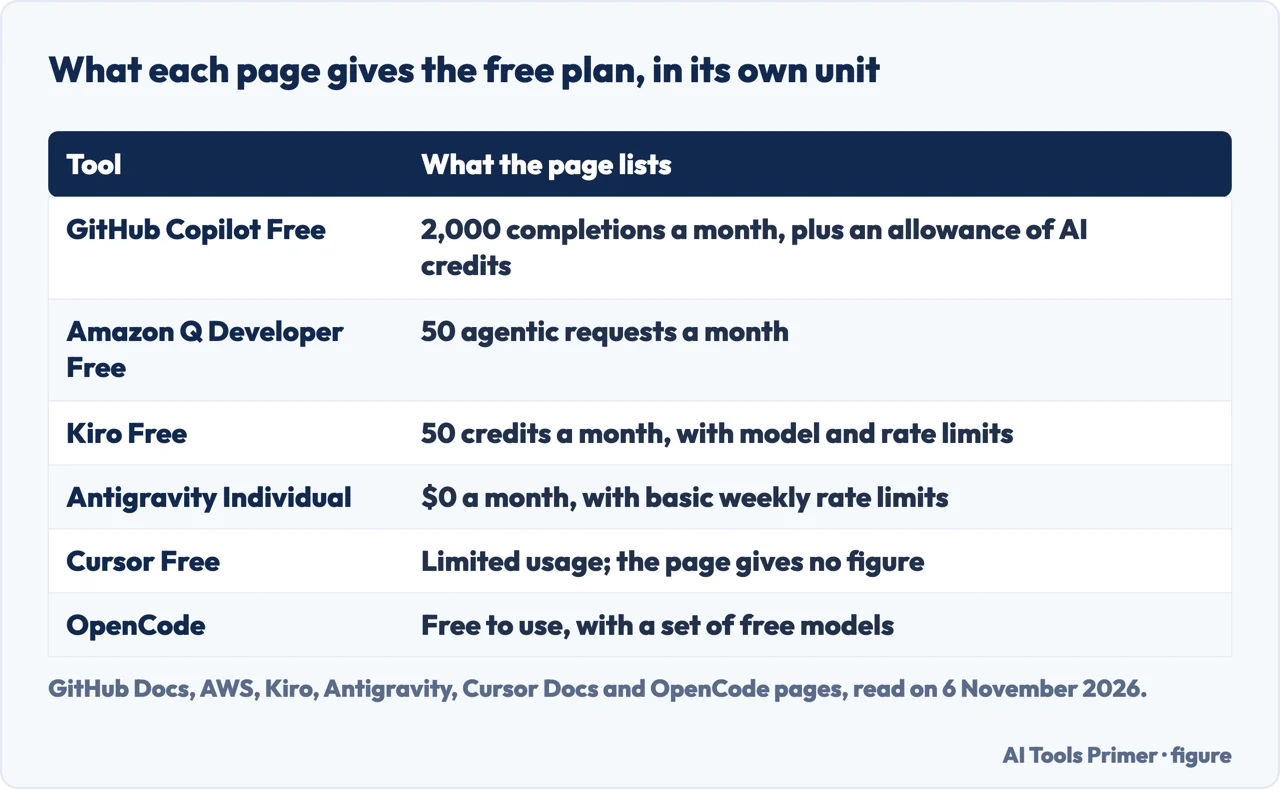
Read side by side, the pages do not count the free plan the same way. GitHub counts completions and an allowance of credits, Amazon Q Developer counts agentic requests, Kiro counts credits, Antigravity gives a weekly quota with no figure, and Cursor says only that usage is limited. Those units cannot be added up or set against each other, so this page reports each limit in the words of the page that states it. It also sets out what each page says happens to the code and prompts you send on the free plan, because a free plan is a limit and a data policy at the same time. Gemini Code Assist shows how fast a free plan can change: the Google page we read, last updated on 9 October 2026, says its individual tiers stopped being served on 18 June 2026, and the section on Google gives the details.
GitHub Copilot Free and Copilot Student
GitHub’s Plans page lists Copilot Free at no charge, with an allowance of GitHub AI Credits, limited agents and model access through auto model selection only. A separate line on inline suggestions limits Copilot Free to 2,000 completions a month. The page adds that Copilot Free plans are only available to individual developers who do not have access to Copilot through an organization or enterprise.
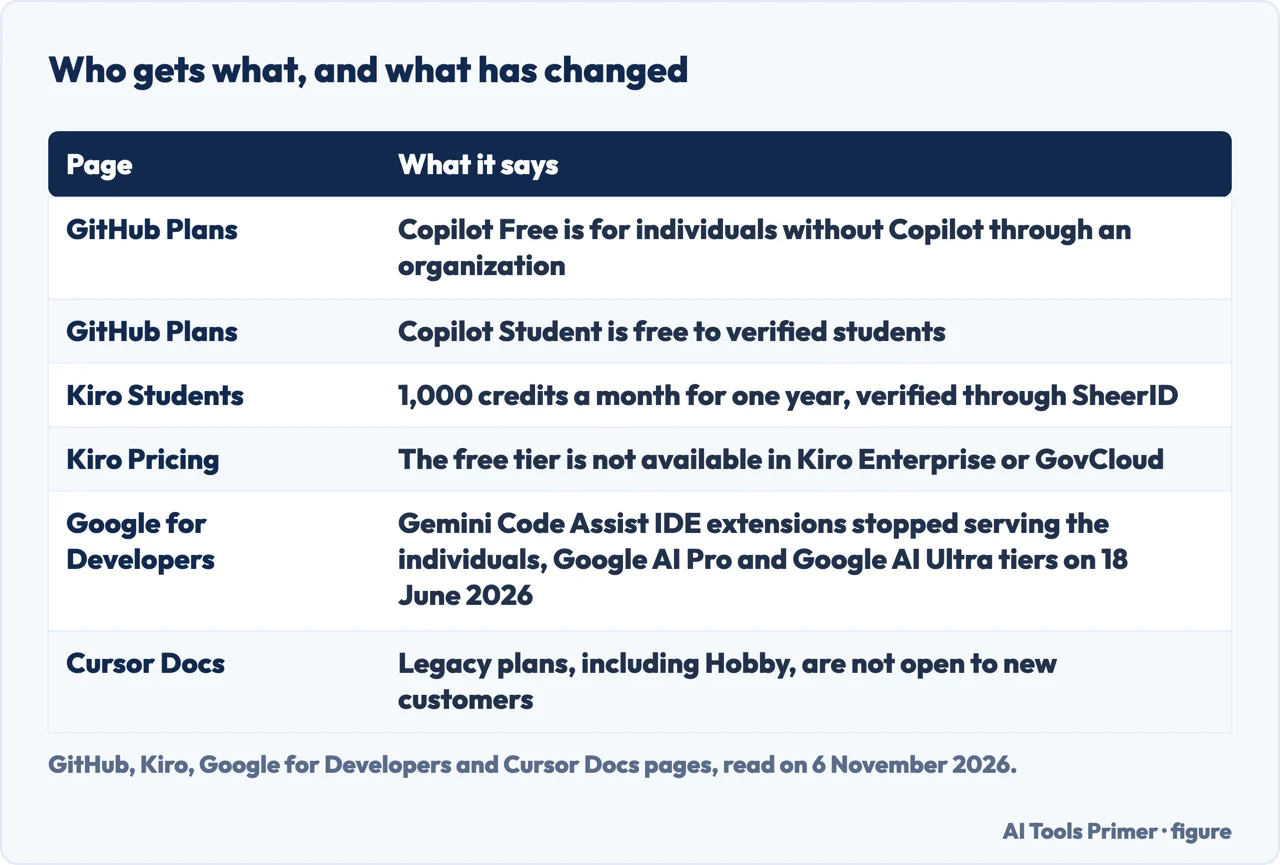
Copilot Student is also listed as free and as available to verified students. Its row shows the same allowance of credits and auto model selection only, and notes that third-party agents are excluded. The page says verified teachers and maintainers of popular open source projects may be eligible for free access to Copilot Pro; the “may” is GitHub’s. A student plan is not part of every tool’s page: Antigravity’s Plans and Pricing pages, Cursor’s pricing page and Amazon Q Developer’s pricing page do not mention one, while Kiro has its own students page, covered below.
Our page on GitHub Copilot sets out the paid plans, who owns the generated code and what GitHub says about indemnity. Here Copilot is one row among several.
Google: one door closed, Antigravity open
Google’s deprecation page says that from 18 June 2026 the Gemini Code Assist IDE extensions stopped serving requests for the individuals, Google AI Pro and Google AI Ultra tiers, and that this also applies to Gemini CLI. As part of that, it says, Login with Google can no longer be used to reach the extensions or the CLI. It tells people with those consumer accounts that they can migrate to the Antigravity family of products. Standard and Enterprise subscriptions, it says, follow a separate deprecation schedule. Our page on Gemini CLI covers the command-line side.
Antigravity’s pricing page lists an Individual plan at $0 a month, described as a way to experience Antigravity without a subscription plan. It lists access to a variety of agent models, unlimited Tab completions, unlimited Command requests and basic weekly rate limits. The Plans page says people who are not on Google AI Pro or Ultra receive a meaningful quota, refreshed weekly, and a weekly rate limit, while Google AI Pro users receive a quota refreshed every five hours until the weekly limit is reached.
The same page says the baseline rate limits are primarily determined by available capacity and correlate with the amount of work the agent does, so more prompts fit when tasks are straightforward and fewer when they are complex. It also says usage limits are subject to modification. The pages we read give no number for the weekly quota, so the $0 plan cannot be compared with a plan that states a count.
AWS: Amazon Q Developer Free and Kiro Free
The Amazon Q Developer pricing page lists a Free tier with 50 agentic requests a month for the IDE plugins and CLI, and a Java upgrade transformation capability of 1,000 lines of code a month. Its notes say the free tier is perpetual, available to users logged in as an IAM user or an AWS Builder ID user, and that free tier limits in the IDE are available only to Builder ID users.
Kiro’s pricing page says new users can start with a perpetual Free tier of 50 credits a month, including access to open weight models and Claude Sonnet 4.5, with limits. It describes a credit as a unit of work: simple prompts can use less than one credit, complex ones typically more than one, and different models use credits at different rates. The page says the free tier is not available in Kiro Enterprise or in AWS GovCloud (US) Regions. An AWS comparison page repeats the figure for people signing in with a social login or an AWS Builder ID, subject to model and rate limits.
Kiro also has a students page. It says eligible university students get 1,000 credits a month free for one year, with no credit card, after choosing a university in Settings and completing verification through SheerID. If the university is not listed, the page says it is not currently supported. When the year ends, the account is downgraded to the Kiro free tier and the code, specs and projects remain on the machine and in the repositories.
Cursor and OpenCode
Cursor’s pricing page says Cursor is part of The X Subscription and that new customers choose a plan there. Its plan list shows Free at $0 with included usage marked Limited. The page says Free gives access to Cursor’s core features with limited usage: Agent, Chat and Tab completions with Cursor models, named as Grok and Composer. It gives no figure for that usage. Legacy Cursor plans, it says, are not available to new customers; the legacy Hobby plan is listed as free and the page says it works the same way for Cursor.
OpenCode’s home page says it is an open source agent for the terminal, an IDE or the desktop, free to use and with a set of free models. It adds that there might be additional costs if you connect any other provider. Its FAQ says the free models can be used without creating an account, and that the source code is public on GitHub under the MIT License. The Zen page marks its free models as free or available for a limited time, and the list of those models changes, so we name none of them here.
What the free plans do with your code
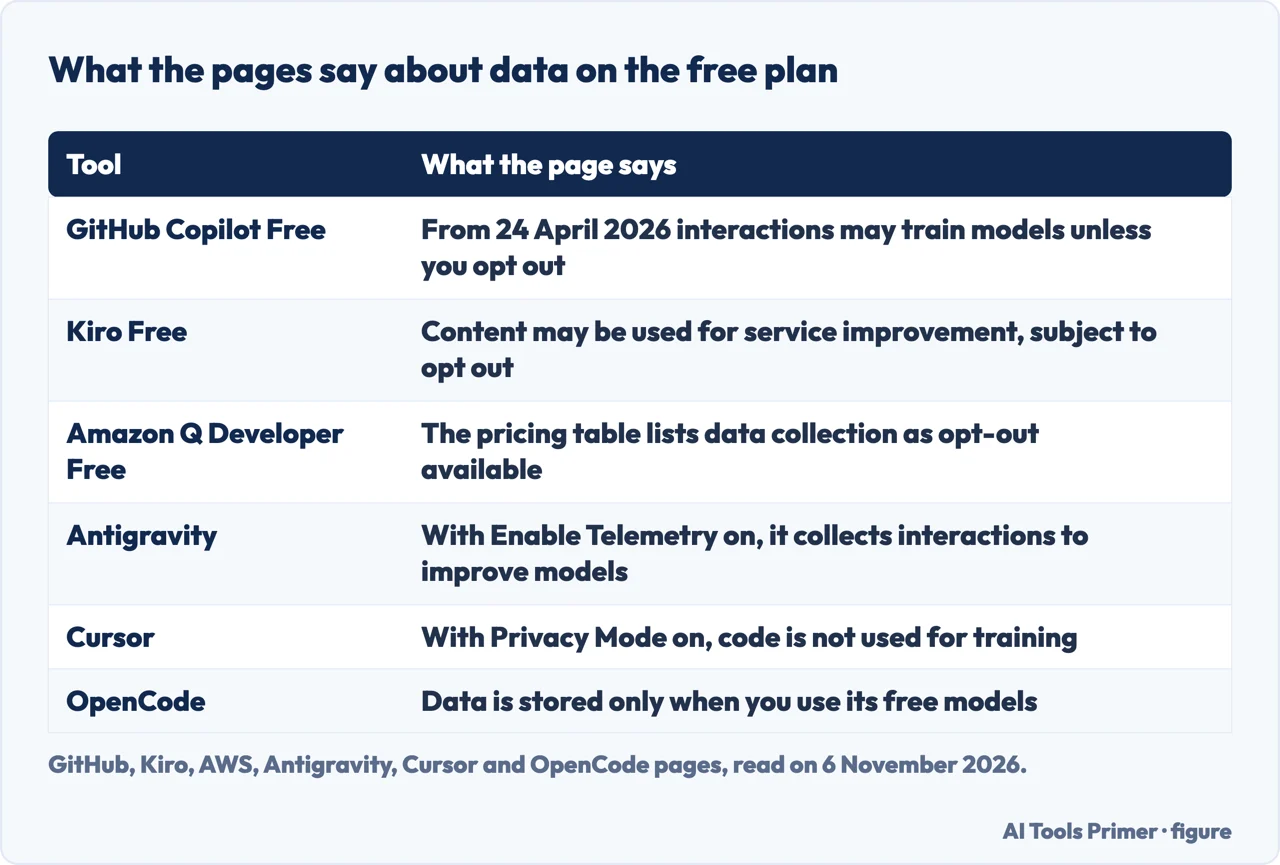
GitHub. The Plans-linked policy page says that from 24 April 2026, if you have Copilot Free, Pro, Pro+ or Max, GitHub may use your interactions, including inputs, outputs, code snippets and associated context, to train and improve AI models, and that you can opt out in your personal Copilot settings. GitHub’s blog post says Business and Enterprise users are not affected, and that a choice made earlier against product-improvement collection has been retained. The data it lists includes outputs you accepted or modified, inputs with code snippets, context around the cursor, file names and repository structure, and thumbs up or down ratings. It excludes the content of issues, discussions and private repositories at rest, and warns that Copilot does process code from private repositories while you are using it.
AWS. Kiro’s data protection page says that for a Free Tier user, content may be used for service improvement subject to the user’s opt out, and that the use can include model training. It adds that even after an opt out, Free Tier inputs may be stored for up to 60 days to detect abuse, and that these are not used to improve Kiro’s models but may be used to develop classifier tools. Content from Free Tier users is stored in the US East (N. Virginia) Region. Amazon Q Developer’s pricing table lists data collection as opt-out available for Free and automatically opted out for Pro. Its FAQ page says the Free Tier might use certain content for service improvement, including model training, unless you opt out, that in the IDE you opt out in the IDE settings, that Pro content is not used to train the underlying models, and that Free Tier data is stored in a Region in the US.
Google. Antigravity’s settings page describes an Enable Telemetry setting under Account: when it is on, Antigravity collects interactions to evaluate, develop and improve itself and the models behind it. The FAQ says you can opt out of data collection at any point from the Settings panel. The pages we read do not say whether the setting is on by default.
Cursor. The privacy page says Privacy Mode ensures the code is never used for training by Cursor or other AI model providers, and that Cursor sends prompts and code context to providers such as OpenAI, Anthropic and Google. It says Privacy Mode is on by default for team members. The pages we read do not say whether it is on by default for someone on the Free plan.
OpenCode. The home page says data and information are only stored when you use its free models. The Zen page says some free models have providers with a zero-retention policy and no use of your data for training, that for others the team is collecting feedback to improve the model, and that NVIDIA’s free endpoints are for trial use only, with a warning not to submit personal or confidential data.
What the pages do not say, and how to read a limit
The pages we read do not give a figure for Antigravity’s weekly quota or for what Cursor Free includes, and they do not say which tool is the best one. Each states its own limit in its own unit, so a larger number on one page is not a larger allowance than a smaller number on another. A count of completions measures suggestions as you type; a count of agentic requests or credits measures interactions with chat or an agent (the Amazon Q Developer pricing page counts any Q&A chat or agentic coding interaction as an agentic request, and Kiro defines a credit as a unit of work in response to prompts), and the Kiro and Antigravity pages both say that more demanding tasks use more of the allowance.
Where a plan says it may be changed, as Antigravity’s does, or where a model is free for a limited time, as OpenCode’s Zen page says, the date of reading matters. Ours is 6 November 2026, and the Google deprecation page shows how much can change in a few months. The data rules differ in kind: GitHub, Kiro and Antigravity describe use of interactions with an opt-out, Amazon Q Developer lists opt-out available for Free, Cursor describes a mode that keeps code out of training, and OpenCode ties storage to its free models. Which of these matters depends on the code you are working on, and the pages do not say.
For the cost of a paid agent over a month, our page on what Claude Code costs sets out the plan prices and token rates it read. We did not read the blog lists or the Reddit thread that Google showed for this query,
Where to start
Four ways in.
- “What does the free plan actually include?”
- GitHub Copilot Free and Copilot Student — github
- “Is Gemini still free?”
- Google: one door closed, Antigravity open — google
- “Is there a free student plan?”
- AWS: Amazon Q Developer Free and Kiro Free — aws
- “Will it train on my code?”
- What the free plans do with your code — data
The tools and their plans
Copilot, Cursor and the Gemini command line.
Agents, cost and what they keep
Prices, what an agent is and what it remembers.
Questions people also ask
What IDE or editor do you use (VS Code, JetBrains, Terminal, Browser)?
The pages we read name different surfaces. OpenCode says it is available as a terminal interface, a desktop app and an IDE extension. Antigravity’s pricing page lists an app, extensions, a CLI and an IDE. GitHub’s Plans page says all plans include Copilot CLI and the Copilot app.
Do you prefer light autocompletion as you type or an autonomous agent that edits multiple files?
The free plans we read include both kinds. GitHub gives Copilot Free 2,000 completions a month and limited agents; Antigravity lists unlimited Tab completions and Command requests; Amazon Q Developer counts agentic requests; Kiro counts credits; Cursor Free lists Agent, Chat and Tab completions. The pages do not say which to prefer.
Best AI coding Agent Opensource/Free for coding?
The pages we read do not rank agents. OpenCode’s home page says it is open source under the MIT License, free to use and comes with a set of free models, with possible extra costs if you connect another provider. Its data note says storage applies when you use the free models.
What’s the best free AI tool for coding right now?
The pages we read do not name a best one. Each states its free plan in its own unit and with its own data rule, so we set them side by side rather than rank them. Read on 6 November 2026; limits and free models can change.
Not covered here. Every statement comes from pages of GitHub (the Plans page, the policy page for individual subscribers and a blog post), Google (the deprecation page and four Antigravity pages), AWS (the Amazon Q Developer pricing page, its FAQ page and a comparison page), Kiro (pricing, data protection and students), Cursor (pricing and privacy) and OpenCode (the home page and Zen), all read on 6 November 2026.
The search volume and difficulty behind this page are an Ubersuggest reading of 5 November 2026, and the difficulty is Ubersuggest’s own measure, not the Semrush figure, which is still to be checked. The Semrush reading of 29 August 2026 is older than the 60 days the site normally allows and was not used.
Sources
- GitHub Docs — Plans for GitHub Copilot — docs.github.com, read 6 November 2026.
- GitHub Docs — Managing Copilot policies as an individual subscriber — docs.github.com, read 6 November 2026.
- GitHub Blog — Updates to GitHub Copilot interaction data usage policy — github.blog, read 6 November 2026.
- Google for Developers — Gemini Code Assist consumer accounts — developers.google.com, read 6 November 2026.
- Google Antigravity — Pricing — antigravity.google, read 6 November 2026.
- Google Antigravity — Plans — antigravity.google, read 6 November 2026.
- Google Antigravity — Settings — antigravity.google, read 6 November 2026.
- Google Antigravity — FAQ — antigravity.google, read 6 November 2026.
- AWS — Amazon Q Developer pricing — aws.amazon.com, read 6 November 2026.
- AWS — Amazon Q Developer FAQs — aws.amazon.com, read 6 November 2026.
- AWS — Kiro and Amazon Q Developer compared — aws.amazon.com, read 6 November 2026.
- Kiro — Pricing — kiro.dev, read 6 November 2026.
- Kiro — Data protection — kiro.dev, read 6 November 2026.
- Kiro — Students — kiro.dev, read 6 November 2026.
- Cursor Docs — Pricing and plans — cursor.com, read 6 November 2026.
- Cursor Docs — Privacy — cursor.com, read 6 November 2026.
- OpenCode — Home — opencode.ai, read 6 November 2026.
- OpenCode — Zen — opencode.ai, read 6 November 2026.
Written by Alberto Gulotta
Founder and editor of AI Tools Primer, writing from Palermo, Italy. Thirty-five years of taking computers apart, starting with a Commodore 64 — the long version is on the about page.
Something wrong on this page? Write to aitoolsprimer@gmail.com and it gets fixed.
Written on 6 November 2026.
Independence and limits
No affiliate links and no paid placements anywhere on this site. Nobody pays to appear here, and no company has seen this page before you did.
This is general information, not professional advice. Where a page touches money, health, safety or the law, it names its source and the date it was read — and your situation may still differ. See the privacy page and the cookie policy.